| 0 comments ]

Blackstone's LivCor Settles DOJ's Alleged Rental Price-Fixing Claims

Authored by Naveen Athrappully via The Epoch Times,

LivCor, one of the largest landlords in the United States, has entered into a proposed consent decree with the Department of Justice (DOJ) to resolve price manipulation claims made by the department, the DOJ said in a Dec. 23 statement.

On Jan. 7, the DOJ announced it was suing tech company RealPage and six landlords, including LivCor, which operates under asset management company Blackstone. The department accused the landlords of using RealPage’s software to participate in algorithmic pricing schemes that harmed renters.

In its latest statement, the DOJ said LivCor and other landlords “shared competitively sensitive data to generate pricing recommendations using RealPage’s algorithms, which also included anticompetitive rules that aligned their pricing.”

“In addition, LivCor and other landlords discussed competitively sensitive topics—including pricing strategies, rents, and selected parameters for RealPage’s software—directly with each other,” it said.

The tactics aimed to decrease competition among landlords with regard to apartment pricing, thereby harming millions of renters in the United States, the DOJ said in January.

RealPage’s actions ended up enriching itself and the landlords “at the expense of renters who pay inflated prices and honest businesses that would otherwise compete,” the department said in its lawsuit.

The proposed consent decree between the DOJ and LivCor prohibits algorithmic coordination and the exchange of sensitive data with competitors.

LivCor is required to refrain from taking part in or attending meetings involving competing landlords that are hosted by RealPage. The company must also cooperate with the United States’ claims against other defendants in the case.

In the case that LivCor uses a third-party pricing algorithm not certified in line with the terms of the consent decree, it must allow a court-appointed monitor, the department said.

The decree must now be approved by the court.

“The Trump-Vance Administration is committed to an economy that works for all Americans,” said Assistant Attorney General Abigail Slater from the DOJ’s Antitrust Division.

“Landlords across America are on notice that the competition laws protect renters from the harms caused by competitors sharing competitively sensitive information or aligning prices, whether through an algorithm or otherwise.”

The Epoch Times reached out to LivCor for comment but did not receive a response by publication time.

The agreement with LivCor follows the DOJ’s obtaining consent decrees from RealPage and two of the landlords from the January complaint—Cortland Management LLC and Greystar Management Services LLC.

RealPage Agreement

RealPage had settled the claims brought by the DOJ last month. According to the proposed content judgment filed on Nov. 24 in a federal court, the company is barred from using competitors’ real-time, nonpublic data to generate rent recommendations.

The decree requires RealPage to remove features from its software that discourage landlords from cutting prices.

Texas-based RealPage denied any wrongdoing and said the agreement provides clarity while avoiding costly litigation. According to the company, the deal includes no admission of liability and carries no financial penalties.

“This resolution marks an important milestone for RealPage, our customers, and the multifamily industry,” said Dirk Wakeham, RealPage president. The company is “part of the solution to addressing the cost of housing,” he said. Moreover, RealPage’s tools help operators make “informed, independent decisions in a complex housing market,” he added.

The company said the agreement formalizes changes that it had been implementing over the past year.

The DOJ said the settlement restores free-market competition for millions of American renters.

Slater criticized RealPage’s system for having replaced independent pricing decisions, and said the deal was a big step in ensuring that rental housing markets remained “fair and competitive.”

“It means more real competition in local housing markets. It means rents set by the market, not by a secret algorithm,” she said. “It is a win for renters, and it means more affordable options for Americans trying to make ends meet.”

Meanwhile, the DOJ recently filed a statement of interest in another case related to protecting the interests of homebuyers in the real estate market, according to a Dec. 19 DOJ statement.

The lawsuit, brought by multiple buyers, accused real estate brokerages and the National Association of Realtors, a trade association of brokerages, of entering into anticompetitive agreements. These deals ended up inflating broker commissions, raising home prices for Americans.

In its statement of interest, the DOJ argued that competition among brokerages is critical to protect American homebuyers.

“Purchasing a home is the single biggest purchase most Americans make in a lifetime,” said Assistant Attorney General Abigail Slater, from the DOJ’s Antitrust Division.

“Today’s soaring housing prices make competition in real estate brokerage more important than ever. Antitrust laws are key to safeguarding competition, which reduces prices and improves services for homebuyers.”

Tyler Durden Fri, 12/26/2025 - 15:45
https://ift.tt/WpnUrEj
from ZeroHedge News https://ift.tt/WpnUrEj
via IFTTT

Blackstone's LivCor Settles DOJ's Alleged Rental Price-Fixing Claims SocialTwist Tell-a-Friend
| 0 comments ]

What Is Wall Street's Favorite Christmas Song

Every year-end, there are heated debates about what is the "best .... of Christmas", especially among those who work in finance. 

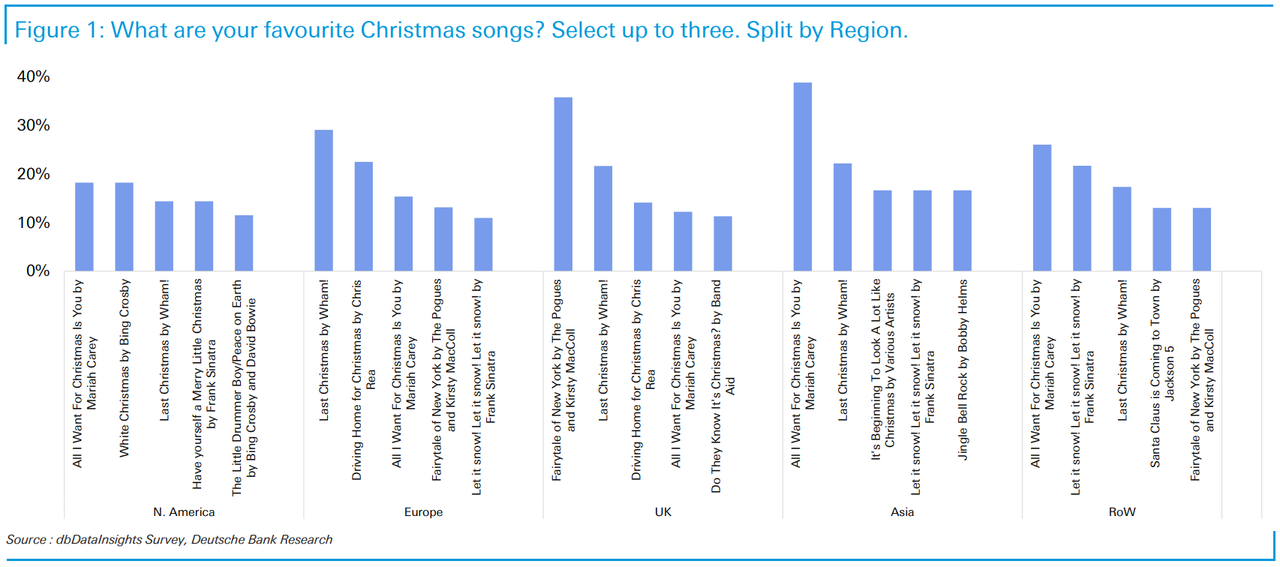
Last year, Home Alone, Die Hard, and Love Actually topped the Christmas movie rankings as polled by the 2025 Deutsche Bank Global Markets Survey. This year, the bank returned to the even more contentious topic of favorite Christmas songs.

At a global level, the bank's 2026 Year Ahead Global Markets Survey found that Wham! won again, while regionally, Mariah Carey took the crown in the US, Asia, and the Rest of the World with All I Want For Christmas is You. The full list is in the report.

For the record, Jim Reid - who compiled and published the survey - writes that his top three would have been Wham!, The Pogues, and Joni Mitchell’s River, a smooth progression from the tacky to the tasteful.

In his last note of the year, Reid also listed his favorite TV series, film, and album of 2025: we except it below (full report here)

  • 1. Slow Horses – The best TV series in the world at the moment. Well, until Rivals comes back! I try to model my management technique on Jackson Lamb, if not my personal hygiene.
  • 2. Dept Q – A bit like Slow Horses in that it involves a grumpy, rude police boss with a complicated past. He is of course a tortured genius and the show is gripping.
  • 3. Blue Lights – A brilliant Northern Ireland police drama on its third series with no drop off in quality and heart.
  • 4. Mobland - Helen Mirren and Piers Brosnan do terrible Irish accents in this trashy but fun mob drama. It proved a little light relief when we watched it as Liberation Day rolled through!
  • 5. SAS Rogue Heroes – Dramatised true story about an incredible bunch of elite soldiers who seemingly played a big part in the outcome of WW
  • 6. The White Lotus – I disliked series 1. Series 2 and now series 3 were great. Not at all like my holidays! Apart from the arguments.
  • 7. Karen Pirie – A Scottish police heroine who doesn’t play by the rules but gets results.
  • 8. The Newsreader – A homage to the 1980s. Clever Australian program that follows actual global news stories from the period with a fictitious news studio narrative in a period where TV hosts were the anchors of our lives.
  • 9. The Studio – Comedies tend not to be very good but this is an exception. Self-deprecating look at the life of a Hollywood studio boss. Seth Rogan plays the character you’d expect him to play. Cringeworthily funny.
  • 10. The Beast in Me – Clare Danes gives her usual tour de force and provides all the usual facial expressions to go along with it. A very tense psychological drama. I was a bit scared.
  • 11. All Her Fault – Sarah Snook is the magnetic force in this drama about a missing 6 year old boy.
  • 12. Black Doves - my wife is not a huge fan of Keira Knightley! So I watched while travelling. Enjoyable nonsense.
  • 13. The Diplomat - more enjoyable nonsense I watched while travelling as my wife believed the first series was too absurd to continue with.

Reid's favorite film of the year was "The Ballad of Wallis Island" which was "a life affirming, quirky movie, about a washed up folk pop star who gets booked to do a private gig on a small island at a house of a recluse who won the lottery and bought a place there. It's very good."

His favorite album was Florence and the Machine - Everybody Scream. A dramatic, orchestral, melodic, and confessional mini masterpiece

Finally, for those looking for some light Christmas reading (while escaping from kids or maybe in-laws), DB published its Ultimate Guide to Long-Term Investing (Available to pro subswhich is designed to help everyone put their long-term finances on the firmest footing, which should be a good New Year’s resolution.

More in the full  2026 Year Ahead Global Markets Survey

Tyler Durden Thu, 12/25/2025 - 17:15
https://ift.tt/soz4l0H
from ZeroHedge News https://ift.tt/soz4l0H
via IFTTT

What Is Wall Street's Favorite Christmas Song SocialTwist Tell-a-Friend
| 0 comments ]

Waste Of The Day: Superintendent Resigns, Nets Over $900K

Authored by Jeremy Portnoy via RealClearInvestigations,

Topline: A Long Island school district must pay its superintendent over $907,500 after he resigned without a public explanation this September, according to records obtained by Newsday through a Freedom of Information Law request.

Key facts: The Plainedge Union Free School District paid Edward Salina a $662,352 lump sum for 184 unused sick and personal days and 286.5 unused vacation days.

The district will also pay the remaining $245,185 of Salina’s salary for the 2025-26 school year. The salary is paid in bi-weekly installments, which will end if Salina takes a job at another school, Newsday reported.

Salina’s contract gave him 35 vacation days, 14 sick days and three personal days per year. Unused days were carried over to the next year with no limit.

Waste of the Day 12.23.25 Open the Books

He resigned abruptly on Sept. 12, two weeks into the current school year. The reason remains unknown. He had been superintendent since 2011, and his contract was set to expire in 2029.

What is paid is basically contractual,” school board president Joseph Beyrouty told Newsday. “There's nothing more to it than that.”

The school district is paying District Wise Search Consultants to lead the search for a new superintendent, according to Newsday. The dollar cost is unknown, but District Wise received $261,000 from several Long Island districts since 2020, including $23,000 each from four other Long Island school districts in 2023 for their superintendent searches, according to Open the Books’ data.

Interim Superintendent Carol Muscarella is earning $1,200 per day but will not hold the job permanently, according to Newsday.

It's just to basically keep the lights on and the employees paid. And I think she's done a phenomenal job with that,” Beyrouty said. “As a matter of fact, I think she's even gone above and beyond that and really helped tackle some issues that have come up along the way.”

Search all federal, state and local salaries and vendor spending with the world’s largest government spending database at OpenTheBooks.com

Background: The Plainedge school district had a $50.6 million payroll in 2024, according to Open the Books’ database. Seven employees, including Salina, made more than $200,000. An additional 292 people made $100,000 or more. 

Summary: It’s questionable whether any public employee should receive nearly $1 million in a single year, but paying one who is no longer working and gave no explanation for their departure is especially alarming.

The #WasteOfTheDay is brought to you by the forensic auditors at OpenTheBooks.com

Tyler Durden Thu, 12/25/2025 - 16:30
https://ift.tt/mCxlLPI
from ZeroHedge News https://ift.tt/mCxlLPI
via IFTTT

Waste Of The Day: Superintendent Resigns, Nets Over $900K SocialTwist Tell-a-Friend
| 0 comments ]

Work, Welfare, & The Illusion Of A New Eden

Authored by Richard Porter via RealClearPolitics.com,

The scandal among the Somali community in Minnesota highlights a question to consider as we plunge deeper into the AI Age, an age in which some futurists, such as Elon Musk, suggest work will be optional: What’s the point of working?

In the beginning, there was no work: God’s punishment for Adam’s disobedience was tossing him from the Garden of Eden and condemning mankind to suffer through labor. 

And for millennia, man suffered and labored merely to exist and reproduce, as all other living things did on earth. But whether from eating from the Tree of Knowledge, intelligent design, or the vagaries of evolution, man has the capacity to reason and imagine, create and innovate that other animals do not have. 

As a result, humans no longer labor merely to exist, but to aspire, acquire, and achieve. We trade our labor for things we cannot or do not wish to make ourselves; to provide for future needs; to enjoy plenty, luxury, and convenience. Humans are social animals too, so we work with others to build what a single person could not, and to gain status or admiration from other humans. 

And we work to help those who cannot help themselves, mindful of the Biblical exhortation “I have shewed you all things, how that so labouring ye ought to support the weak, and to remember the words of the Lord Jesus, how he said, It is more blessed to give than to receive.”

Working to achieve the blessing of giving is integral to Americanism; Americans are the most generous people on earth

Now, in this golden age of plenty and peace, we consider again: What’s the point of working? And its corollary as well: What’s the point of giving? 

Eden – or heaven on earth – a place of contentment, ease, and mindless happiness, a place where work no longer exists, shimmers like a mirage on the horizon: thirsted for but never really in reach. 

Well now, in the AI Age, perhaps a return to Eden is in reach, but is this version of Eden – abundant slothfulness – really the pinnacle of human existence? 

To Somali refugees escaping civil war, death, destruction, and a bare subsistence economy, the U.S. offered a new life in which work was no longer required to subsist. At the cost of merely filling out and filing a form – and no doubt, even that “work” was done for them as well by a well-meaning social worker – the U.S. provided for all needs and even some wants. 

Each and every Somali refugee found a better life in the U.S. without working. So, no one should be surprised that 89% of Somali families with children receive public aid

Indeed, some clever refugees figured out that the generous, inattentive welfare state the U.S. had created with good intentions over the last 60 years offered a return to Eden. 

Just by breaking a few rules that no one was enforcing, filling out and filing some more forms, vast unimaginable wealth was available – and would actually be given to you. Enough, it turns out, to live in opulence and to provide most of the needs for sprawling clans back home as well. 

If we create an environment in which wealth can be achieved so easily just by breaking a few rules that no one enforces, was it wrong for a rational person to pursue wealth just by taking it? 

We placed refugees into a new Eden and merely said: Take fruit from these trees but not from that tree. 

Somalian refugees are not the only people who have discovered this glitch – this feature – in how we give. DOGE started a process, which is ongoing, uncovering the startling extent to which government giving is gamed. 

For example, the Department of Agriculture has asked each state to provide the name, address, and Social Security number of each person receiving SNAP (Supplemental Nutrition Assistance) benefits. More than 20 states have refused to comply, but in studying the data on those that did, the government discovered over 150,000 dead people receiving benefits, hundreds of thousands more taking benefits from more than one state, and of course fake Social Security numbers. 

It turns out it’s easy to cheat the government, and most state governments are actually actively trying not to find the fraud. And it’s not just in the welfare state; it appears to be systemic in the social service grant-making world as well. 

The Somali experience is turning out to be an inadvertent social policy experiment complete with lessons, about both work and generosity. 

  • First, giving with lax, unenforced rules is akin to giving without rules, which is an invitation to live in Eden – an invitation many will accept. 

  • Second, Eden is good for animals, but it’s actually not the pinnacle of human existence so long as humans have the capacity to think, create, imagine, and aspire. 

  • Third, work may be a curse for humans focused on subsistence, but it’s a blessing for humans thinking, creating, imagining, aspiring, trading, acquiring, achieving – and giving. 

  • Fourth, giving as an output of human labor is better than receiving, because receiving discourages work and work is how one is blessed with the ability to give – so we need to beware of thoughtless, unstructured giving that discourages work. 

In our golden age, as our means to give grows, and as “work” itself becomes “optional,” we need to anticipate the paradox of working, giving, and getting. We still live in a world of scarcity, but we continue to create abundance through freely trading or selling work, and giving is a beneficial consequence of working. But getting undermines the will to work, which diminishes future giving. 

Giving and getting can never be a replacement for working and giving. If we ignore this, offering a new Eden to all without work, human will experience a painful fall from grace once again. 

Tyler Durden Wed, 12/24/2025 - 17:15
https://ift.tt/YgAeVM1
from ZeroHedge News https://ift.tt/YgAeVM1
via IFTTT

Work, Welfare, & The Illusion Of A New Eden SocialTwist Tell-a-Friend
| 0 comments ]

Canada Is Building The Wrong Army For The War That Is Coming

Authored by Andrew Latham via RealClearDefense,

The next major land war will not reward elegance, boutique modernization, or the comforting belief that advanced technology can replace mass and endurance. It will expose armies built on fragile assumptions. Concealment has largely disappeared. Attrition has returned as a central fact of combat. Sustainment shapes outcomes as decisively as firepower. Yet the Canadian Army remains organized, equipped, and intellectually anchored to a vision of warfare that belonged to yesterday’s world. The problem is not a simple modernization lag or a lack of new kit. It is a deeper conceptual failure—a refusal to absorb how radically and irreversibly the character of land warfare has changed.

That is the larger point. The key change is not this or that technology. The battlespace itself has changed. Artificial intelligence, proliferated drones, commercial satellites, autonomous strike systems, and persistent ISR have combined into a transparent, data-rich battlespace where everyone is on the move, movement is tracked instantly, concentrations are targeted rapidly, and supply lines are targeted as soon as they begin to form—an environment already documented in assessments of modern conflict. An army that cannot scatter, regenerate while under fire, and sustain itself while under persistent observation is not going to muddle through. It is going to break.

Transparency and the End of Concealment

Western armies have operated on the assumptions of concealment and intermittent detection for a generation. Those assumptions are no longer valid. The contemporary battlespace is full of aerial surveillance, open-source commercial satellite imagery, digital emissions that reveal every vehicle and headquarters location, and loitering munitions that make ground above those locations perpetually contested—patterns captured in recent operational analyses.

The issue is time: the time between being discovered and being targeted. The time between when a headquarters can command and when it becomes a targeting point. The time between declaring a movement and becoming a target.

Survival requires dispersion, deception, mobility, and an entire operating paradigm built on the idea that you are observed all the time. The Canadian Army knows about the emergence of drones, ISR, and digital exposure, but it has not yet internalized the ways that they change land warfare’s fundamentals.

Attrition Has Returned—and Canada Is Not Ready

Precision fires promised surgical, inexpensive war. In reality, they have intensified attrition: the ability to strike targets more often, more reliably, and more predictably. Ukraine has demonstrated the scale of this shift: modern war is industrial, not surgical. It consumes people, equipment, ammunition, drones, and spare parts at rates far beyond what most Western forces planned for in peacetime, as shown by studies of wartime industrial demand.

The Canadian Army is not designed for this reality. It is small and brittle. It is optimized for controlled, expeditionary contributions, not for open-ended, high-intensity conflict. Ammunition stocks are low. Maintenance capacity is thin. Replacement cycles are slow. Mobilization—across industry, reserve forces, and training pipelines—is largely theoretical, even as official modernization documents highlight the fragility of the current model.

You can have a small and lethal army if it is small and lethal through design and deliberate choice. You cannot have a small, hollow, and unprepared army if it has to fight for extended periods. In an attritional war, those features are decisive.

Sustainment as a Front-Line Fight

The rise of long-range strike, drones, and cyber means that the old rear area is no more. Supply lines are now a front-line fight from start to finish. Supply depots, railheads, ports, repair facilities, and fuel infrastructure are all high-priority targets. If an enemy cannot stop forward brigades, it will attempt to starve them. Analyses of modern logistics under fire emphasize that industrial capacity and resilient supply networks—not efficiency—determine strategic endurance.

An army for the future must be able to fight under conditions of intermittent resupply, contested and damaged infrastructure, disrupted and overloaded communications, and near-constant threats to supply lines. Planning and organization must prioritize resilience, redundancy, and regeneration rather than peacetime efficiency and timeliness.

The Canadian Army still plans as if reliable resupply were a given and rear areas could stay intact. The moment a capable adversary enters the fight, those assumptions are shattered.

Dispersion, Autonomy, and Command Under Fire

Land warfare favors armies that can fight dispersed but connected, decentralized but coordinated. Small units must be able to operate at will even when isolated or cut off. Junior leaders must be able to act without micromanagement. Commanders must know their communications will be lost and they must be able to exercise control while that loss is happening. Contemporary doctrinal analysis underscores exactly this requirement for decentralized command in contested environments.

This is a question of more than new radios or drones. It is also a cultural issue. The instinct for centralization, risk aversion, and procedural control stems from the experience of peacekeeping and counterinsurgency missions, not from the needs of a high-tech, fully contested battlespace.

The institutional habits and instincts of the Canadian Army are still oriented to a previous world. It is those habits that will be unprepared when the next world comes.

The Arctic and Continental Reality

Canada’s geography adds to the problem. The Arctic is no longer a distant, largely theoretical frontier. It is now a theatre of competition defined by opposing surveillance architectures, long-range strike systems, and critical infrastructure vulnerabilities—conditions mapped in recent assessments of Arctic security. Continental defense is no longer just about aerospace warning. It is also about protecting energy networks, ports, radar sites, satellite uplinks, and the digital infrastructure that underpins modern life, as reflected in NATO’s forward defense posture.

A land force built for small contributions overseas cannot do all that. Canada needs an army that is also oriented toward persistent continental defense, NATO high-intensity operations, and hybrid resiliency. Canada does not have that. Instead, it has something far smaller and far less capable—an assessment echoed in recent readiness evaluations.

Radical Redesign, Not Cautious Incrementalism

Add drones, experiment with AI tools, rewrite doctrine. It is the typical Ottawa response to a problem of this nature. It is also not remotely enough. This is a structural problem, not a superficial one. Canada faces a conceptual failure, not a cosmetic one. A conceptual failure cannot be solved by bolt-on solutions.

What is needed is redesign. Force structure, reserves, sustainment, mobilization, training, and even strategic purpose must be rethought. This means jettisoning some assumptions that have been bedrock in Canadian defence since the Kosovo and Afghanistan era. It also means facing political realities about cost, scale, and what it is to be a responsible nation in this new moment. Emerging analysis of “hiding vs. finding,” sensor-shooter compression, and mass-versus-quality dynamics illustrates how unforgiving the next battlespace will be.

Optimism that everything is fine is a costly illusion. The faster you are wrong, the greater the cost.

The Cost of Illusion

The transformation of land warfare is happening before our eyes, under real fire. Armies that adapt late lose deterrence, relevancy, and influence. Canada does not need the biggest army in NATO. It needs an army designed for the realities of transparent, attritional, technologically saturated land warfare where endurance—not elegance—is the definition of combat power, themes reinforced in the latest assessments of the future competitive security environment.

Steel will matter. Silicon will matter. But none of it will matter until Canada has rethought how it prepares for land war – and makes the necessary changes. Waiting until events force that remaking is asking for a much harder reckoning in far worse circumstances down the road.

Andrew Latham, Ph.D., a tenured professor at Macalester College in Saint Paul, Minnesota. He is also a Senior Washington Fellow with the Institute for Peace and Diplomacy in Ottawa and a non-resident fellow with Defense Priorities, a think tank in Washington, D.C.

Tyler Durden Wed, 12/24/2025 - 16:05
https://ift.tt/fIA2MpY
from ZeroHedge News https://ift.tt/fIA2MpY
via IFTTT

Canada Is Building The Wrong Army For The War That Is Coming SocialTwist Tell-a-Friend
| 0 comments ]

A Christmas Gift To The War Machine

Authored by Ron Paul

Late last week, Congress passed and President Trump signed the 2026 National Defense Authorization Act (NDAA). The bill marks the first time the US military budget officially passed the one trillion dollar mark. Of course, when you add in other military-related spending such as interest on the debt, veterans’ affairs, and military components of other government agencies, the true number is at least one and a half times that amount.

To paraphrase the famous 1953 President Eisenhower speech, "The Chance for Peace," each of these dollars spent on military offense and the maintenance of the US global empire rather than on defense of our own nation is taken from the mouths of the hungry and off the backs of hardworking American families.

Congress is so addicted to military spending that they appropriated even more money than President Trump requested, including an unconscionable $800 million for thoroughly corrupt Ukraine. Will Washington ever be called to answer for why Americans, who are seeing their standard of living eaten away by inflation and a declining economy, should continue to subsidize a criminal regime overseas whose ruling class enjoys the comfort of golden toilets?

The Ukraine money also undermines President Trump’s claim to be a neutral mediator in the conflict. How can you be a peacemaker when you are sending nearly a billion dollars in weapons to one side to help kill the other side? It makes no sense.

Congress even included measures in the bill that would prevent President Trump from bringing any US troops home from real “forever wars” in Korea and Europe. For how many more decades must the American worker continue to subsidize a US military presence in countries completely unrelated to our own security? World War II ended 80 years ago and the Korean war some ten years later. Yet the American military empire remains, at an incalculable cost to Americans.

Some fellow critics will say this is all about welfare for rich countries overseas, and that’s partly right. But more than that, it is welfare for the politically-connected US military-industrial complex at home. Imagine how many retired US military officers and former US officials-turned-lobbyists might be financially inconvenienced if we finally "just marched home"?

This week Western Christians will celebrate the coming of the Prince of Peace, with the Orthodox celebrating a few days later. It is disheartening that so many Americans who call themselves Christians also hold fast to a view that we must bankrupt our country and impoverish our people by playing policeman to the world and arbiter of whose regime must be changed by Washington.

Christians are among the biggest victims in these overseas operations, including in Syria, Lebanon, and Gaza. Yet many American Christians turn a blind eye to the suffering and misery produced by neocon-led militarism overseas. They don't care that unquestioning support for Israel, for example, has nearly erased Christianity from where it was born.

Imagine if Jesus were born in the Holy Land today.

"Blessed are the peacemakers: for they shall be called the children of God." That is the message of the Savior whose birth we Christians celebrate this week. Continuing to bankrupt our country and export misery overseas in the futile pursuit of a global military empire places us in opposition to this worthwhile advice. Let us all join together and work for a real peace in the New Year!

Tyler Durden Tue, 12/23/2025 - 17:00
https://ift.tt/PtTpx5h
from ZeroHedge News https://ift.tt/PtTpx5h
via IFTTT

A Christmas Gift To The War Machine SocialTwist Tell-a-Friend
| 0 comments ]

"Winter Isn't Over": NatGas Soars As Another Cold Blast Targets US East

U.S. natural gas futures surged the most since late October as one energy trader warned that "winter isn't over," with another wave of cold air set to spill into the eastern half of the Lower 48 early next week. The upcoming cold blast arrives even as much of the U.S. enjoys a brief warm-up following an early-month polar vortex that plunged large parts of the U.S. East into Arctic-like conditions.

"Winter isn't over yet. Here are forecast anomalies for this time next week showing a large area of unseasonably chilly temperatures across the major population centers of the Eastern US," energy trader Celsius Energy wrote on X.

Celsius Energy noted, "Near-term #natgas demand will be quite volatile with very bearish daily storage withdrawals under +5 BCF/d through this weekend surging to nearly -30 BCF/d by this time next week, more than double the 5-yr avg. In general, these projections have improved considerably."

By late afternoon Tuesday, NatGas futures are up nearly 10%, the largest intraday jump since October 30's 17% price spike. Prices are trading around $4.365 per MMBtu.

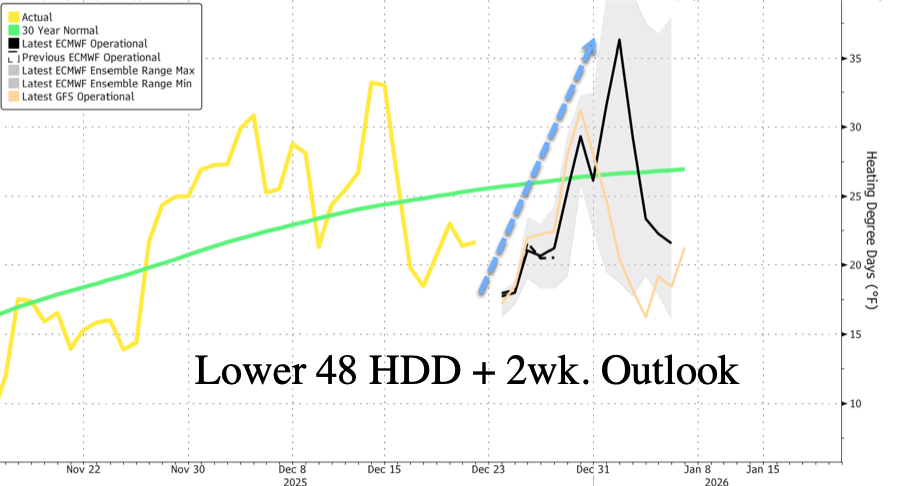
Looking at Heating Degree Days for the Lower 48 - the weather-based measure of US heating demand -the index is projected to surge well above the 30-year average early next week and remain elevated through year-end.

Cold is returning to the eastern half of the Lower 48. Time to stack the firewood and get the gas-powered snowblower ready.

Tyler Durden Tue, 12/23/2025 - 15:45
https://ift.tt/8hHjVXT
from ZeroHedge News https://ift.tt/8hHjVXT
via IFTTT

"Winter Isn't Over": NatGas Soars As Another Cold Blast Targets US East SocialTwist Tell-a-Friend
| 0 comments ]

Mapping The Chances Of A White Christmas

A white Christmas is one of those holiday experiences that feels universal—until you look at the weather history and actual odds of snowfall on Christmas Day across the United States.

This map, via Visual Capitalist's Niccolo Conte, shows the historic probability across the U.S. of seeing at least one inch of snow on the ground on December 25, using data from the NOAA National Centers for Environmental Information (NCEI) is based on the latest U.S. Climate Normals (1991–2020).

These “normals” are three-decade averages built from observations at nearly 15,000 stations, offering a consistent baseline for what’s typical in different parts of the country.

Latitude Matters Most For a Snow on Christmas Day

If you want the simplest rule of thumb for a white Christmas, head north. The northern Plains, Upper Midwest, and large stretches of the interior Northeast generally sit in higher probability bands than the rest of the country.

The data table below features state averages of NOAA’s full 5,000+ row dataset of specific station probabilities of at least one inch of snow:

State Average probability of at least one inch of snow on Christmas day
Alabama 0.1%
Alaska 84.3%
Arizona 4.1%
Arkansas 1.3%
California 4.4%
Colorado 48.7%
Connecticut 35.2%
Delaware 6.5%
Florida 0.0%
Georgia 0.4%
Hawaii 0.0%
Idaho 62.1%
Illinois 27.2%
Indiana 26.0%
Iowa 46.9%
Kansas 15.0%
Kentucky 6.6%
Louisiana 0.1%
Maine 74.4%
Maryland 11.2%
Massachusetts 35.8%
Michigan 64.8%
Minnesota 75.2%
Mississippi 0.2%
Missouri 13.7%
Montana 56.7%
Nebraska 35.1%
Nevada 17.8%
New Hampshire 70.1%
New Jersey 13.7%
New Mexico 11.3%
New York 55.9%
North Carolina 3.1%
North Dakota 77.3%
Ohio 26.8%
Oklahoma 3.1%
Oregon 14.4%
Pennsylvania 34.2%
Rhode Island 26.9%
South Carolina 0.6%
South Dakota 55.5%
Tennessee 2.8%
Texas 0.8%
Utah 46.2%
Vermont 76.9%
Virginia 8.6%
Washington 26.9%
West Virginia 26.8%
Wisconsin 66.3%
Wyoming 56.0%

Areas around the Great Lakes can also improve their odds thanks to lake-effect snow, which can build persistent snowpack when cold air is in place.

Meanwhile, the further south you go, the more quickly the map shifts into darker shades—signaling that a white Christmas is historically uncommon.

Mountains Upgrade White Christmas Probabilities

Elevation can change the forecast more than any state line. The Rockies and the Sierra Nevada stand out as some of the most reliable places for holiday snow cover, with many high-altitude areas reaching the upper probabilities of Christmas Day snowfall.

The Cascades and ranges across Idaho also show strong odds, reinforcing how quickly temperatures drop with height.

Even in the East, the Appalachians make a visible difference—higher terrain can hold onto snow that the surrounding lowlands doesn’t.

Why the South and Coasts Often Miss White Christmas

Across the Gulf Coast, Deep South, and much of the Sun Belt, the map largely sits in the 0–10% range. Warmer winter temperatures mean snow is rarer to begin with—and even when it does fall, it’s less likely to stick around long enough to still be on the ground by Christmas morning.

Coastal climates often tilt milder as well, especially where ocean air moderates winter cold.

And for non-contiguous states, the story is mixed: Alaska’s station network is too sparse to confidently fill in the entire map, while Hawaii’s odds remain firmly at zero.

In other words, the classic “white Christmas” is real—but it’s also highly regional. If snow is the goal, history suggests two reliable strategies: chase colder latitudes, or climb into the mountains.

For more Christmas-related visualizations, check out this graphic which ranks Spotify’s most streamed Christmas songs on Voronoi.

Tyler Durden Mon, 12/22/2025 - 16:40
https://ift.tt/xAdoFQ1
from ZeroHedge News https://ift.tt/xAdoFQ1
via IFTTT

Mapping The Chances Of A White Christmas SocialTwist Tell-a-Friend
| 0 comments ]

Maduro Must Go, DHS Secretary Noem Says, Vows More Tanker Intercepts

Washington is making clear - in case there was still lingering confusion in anyone's mind - that we have entered the "Maduro must go" phase of looming regime change operations targeting Venezuela.

A fresh Monday statement from Homeland Security Secretary Kristi Noem makes clear that "We're not just interdicting these ships, but we’re also sending a message around the world that the illegal activity that Maduro is participating in cannot stand, he needs to be gone, and that we will stand up for our people."

Source: @Sec_Noem

"This is an enemy of the United States that we're taking strong action against, and our Coast Guard is doing a rock-star job going out there and interdicting these ships safely, but also sending a strong message that we will stop this flow and we will continue to stand up for our country," Noem said.

The Coast Guard falls directly under Noem’s jurisdiction, and while it has been the Pentagon doing the drug boat strikes with drones, the Coast Guard has been seeking to intercept and take control of a third 'illicit' tanker in waters off Venezuela.

Sources have told Bloomberg that US forces are still in pursuit of the Bella 1 tanker, which was en route to Venezuela to be loaded with oil. Amid conflicting reports that it had been boarded by American troops, US officials later told The New York Times that the Bella 1 refused to be boarded and fled to the northeast, into the Atlantic Ocean.

It remains unclear whether the Bella 1 will ultimately "get away" or not:

U.S. forces approached the Bella 1 late on Saturday. But it refused to be boarded, instead turning and creating what one U.S. official described as “an active pursuit.”

By Sunday, the Bella 1 was still fleeing the Caribbean and was broadcasting distress signals to nearby ships, according to radio messages reviewed by The New York Times and first posted online by a maritime blogger. The vessel was traveling northeast into the Atlantic Ocean, more than 300 miles away from Antigua and Barbuda, the messages showed. By Sunday evening, Bella 1 had sent over 75 alerts.

It is not clear what steps the United States is taking to pursue the ship. The White House said Mr. Trump would make an announcement on Monday afternoon with his defense secretary and his navy secretary but provided no indication of the subject.

These tanker interdict actions have clearly been stepped up, and more will likely follow, raising the stakes also as China and Russia could react with strong condemnations:

The Coast Guard on Saturday stopped and boarded the Centuries, a tanker that had recently loaded Venezuelan oil, reportedly for a Chinese trader. The U.S. authorities did not have a seizure warrant for the Panamanian-flagged vessel and said they were verifying the validity of its registration. It was unclear how long the ship would be detained.

On Dec. 10, the United States had seized another tanker, the Skipper, which was transporting Venezuelan crude but had earlier carried Iranian oil. The Skipper has been escorted to Galveston, Texas.

This month the US strikes on alleged trafficking boats have have killed about 100 people total since early September. While these actions have remained deeply controversial, denounced in many quarters as 'extra-judicial killings' - Congress has essential neutered itself.

Recent bills before the House have sought war powers for Congress, which would have required President Trump to seek Congressional approval for further military action; however, these efforts have been voted down, and the strike down was largely bipartisan.

* * *

Enter the "days are numbered" rhetoric on Venezuelan strongman Maduro. There's been speculation he could flee to places like Qatar or even Russia, like someone else did a year ago...

via Enab Baladi
Tyler Durden Mon, 12/22/2025 - 15:45
https://ift.tt/1AnGIca
from ZeroHedge News https://ift.tt/1AnGIca
via IFTTT

Maduro Must Go, DHS Secretary Noem Says, Vows More Tanker Intercepts SocialTwist Tell-a-Friend
| 0 comments ]

California Faces Fuel Disaster As Refineries And Gas Stations Shut Down

The Democrat crusade to divert blame for the stagflation crisis triggered during the Biden Administration led them down a path of economic lies.  The central theme of their narrative was that corporations were "price gouging" consumers and inflation was actually a product of "corporate greed."  In reality, helicopter money and dollar devaluation during the pandemic triggered a massive consumer demand rush as well as shortages in a variety of goods and raw materials.

The profit margins in many of these industries were paper thin as their manufacturing and labor costs skyrocketed, yet Democrats tried to scapegoat them anyway.  The word "accountability" is not in the leftist vocabulary.

We are only now starting to witness the aftermath of the legislation and policies put in place by blue states as a means to control prices.  California under Governor Gavin Newsom may have staged its own economic demise (the final nail in the coffin) after laws were passed requiring even greater state interference into oil refineries and gas stations.

Gavin Newsom 's major refinery law, ABX2-1 (signed Oct 2024), gives the state power to mandate minimum fuel storage levels and control refinery maintenance to prevent price spikes, empowering the California Energy Commission (CEC) to stabilize supply. This builds on earlier efforts (like SB X1-2) creating an oil market watchdog (DPMO) to increase oversight, aiming to stop refiners from manipulating supply for profit, while also adding data reporting requirements for companies.

In response, companies are shutting down refinery operations in the state.

Lawmakers in California at both the state and federal levels are warning that refinery closures could push prices higher while leaving the state more dependent on foreign oil.  At the center of the warning is the planned shutdown of two major refineries: Valero’s Benicia facility and Phillips 66’s Los Angeles plant. Together, the closures would eliminate nearly 20% of California’s in-state refining capacity.

Experts suggest prices could go as high as $10-$12 per gallon as a result of the supply squeeze, spreading outside of CA to Arizona and Nevada. Republican lawmakers say that the loss of in-state production threatens not only consumer prices at the pump but also the state’s military readiness; a matter of national security. 

The refineries make jet fuel and diesel and gasoline for military bases across California.  California is home to more than 30 military bases, many of which rely on fuel refined in-state.  Gavin Newsom has mostly dismissed concerns as exaggeration, asserting that foreign shipments of fuel will fill the supply gap.  He argued in a recent statement:

“The claim that California policies pose a national security risk isn’t grounded in fact. The state has proactively engaged defense fuel customers throughout this energy transition, and no credible concerns have been raised about future fuel supply for the military. California is leading this transition responsibly while ensuring families have access to a safe, reliable, and affordable supply of transportation fuels..." 

California law, primarily through Senate Bill 445, also mandates that all single-walled Underground Storage Tanks (USTs) and piping must be permanently closed or replaced with compliant double-walled systems by December 31st, 2025.  The claims is that this will prevent leaks and environmental contamination, with significant fines for non-compliance.

The state created a program called "RUST" to supposedly help small businesses meet the deadline by providing subsidies to pay for new tanks.  However, many mom-and-pop gas stations are reporting that they never received any aid from the RUST program, even though they applied far in advance.  Hundreds of small business CA gas stations are set to shut down in 2026.  A large number of them are rural and operate as the only gas stations for long stretches of highway.  

In October, the newly created Division of Petroleum Market Oversight released its first annual report meant to discover why CA gas prices are so high.  The report merely confirmed what was already known - CA prices are much higher than other states because of the differential in taxes and regulatory costs.  No concrete evidence of price gouging on the part of energy companies was found.

Blue states like CA have been increasingly subjecting their citizens to an experiment in artificial energy scarcity; reducing access to "fossil fuels" while raising taxes to force consumers into the electric car market.  All of this is being down in the name of stopping "man-made global warming", a problem which does not exist.  Newsom claims that he is trying to help CA citizens by lowering gas prices, but all of his actions are leading to a price explosion.

Tyler Durden Sun, 12/21/2025 - 18:05
https://ift.tt/5vZlBw4
from ZeroHedge News https://ift.tt/5vZlBw4
via IFTTT

California Faces Fuel Disaster As Refineries And Gas Stations Shut Down SocialTwist Tell-a-Friend
| 0 comments ]

Minnesota AG Faults Carmakers For Thefts Instead Of Criminals

Authored by Luis Cornelio via Headline USA,

Minnesota Attorney General Keith Ellison came under fire for blaming two car manufacturers for a surge in vehicle thefts across the state, with critics arguing the problem stemmed from lenient, soft-on-crime policies instead. 

The backlash followed Ellison’s framing of a multi-state settlement, in which he claimed Minnesota faced a “crisis,” describing it as a “public safety epidemic of vehicle thefts, financial harm to consumers, injury and tragically, even deaths.” 

On X, critics mocked Ellison’s remarks, particularly given his reputation as a soft-on-crime prosecutor and his alleged failure to crack down on one of the largest COVID-19 relief fraud schemes to date. 

“Minnesota AG Ellison blames car theft in his state on Kia and Hyundai being too easy to steal…” the X account End Wokeness wrote while sharing a clip of Ellison’s comments, which garnered nearly half a million views. 

National Review senior writer Dan McLaughlin responded, “My favorite anti-theft device is jail.” 

Rep. Mike Collins, R-Ga., added bluntly, “I’d blame the criminals.” 

National syndicated radio host Anthony Cumia echoed these sentiments, writing, “They will never take responsibility for their shit behavior.” 

Ellison’s comments followed a settlement between Hyundai and Kia and a coalition of 35 states plus the District of Columbia, after Minnesota launched an investigation into the automakers’ weak anti-theft technology. 

The settlement includes up to $4.5 million in restitution for eligible consumers and an additional $4.5 million for states that investigated the thefts. 

The car theft trend went viral on social media after the so-called “Kia Boys” began posting videos purportedly showing how easily they stole certain Kia and Hyundai models. 

According to the Minnesota Attorney General’s Office, thefts involving Kia and Hyundai were linked to at least five homicides, 13 shootings and 36 robberies. 

“These are not just numbers; they represent a public safety crisis that has caused substantial and serious harm to the people of Minnesota,” the office said in a statement. 

Ellison claimed the thefts were the product of automakers failing to implement anti-theft technology that was made available in vehicles sold in Mexico and Canada. 

Several Republican attorneys general joined the lawsuit, including those of New Hampshire, Florida, Georgia, Iowa, Kansas, Kentucky, Louisiana, Mississippi, North Dakota, Ohio, Oklahoma and South Dakota. 

Tyler Durden Sun, 12/21/2025 - 16:20
https://ift.tt/9aiXMUQ
from ZeroHedge News https://ift.tt/9aiXMUQ
via IFTTT

Minnesota AG Faults Carmakers For Thefts Instead Of Criminals SocialTwist Tell-a-Friend
| 0 comments ]

Gunboat Diplomacy Accelerated: US Seizes Another Oil Tanker Off Venezuela's Coast

Update: 

Secretary of Homeland Security Kristi Noem confirmed that the U.S. Coast Guard, with support from the Department of War, has seized another oil tanker that was last docked in Venezuela.

"The United States will continue to pursue the illicit movement of sanctioned oil used to fund narco-terrorism in the region. We will find you, and we will stop you," Noem wrote in a post on X.

Reuters reported earlier about the operation. 

*  *  * 

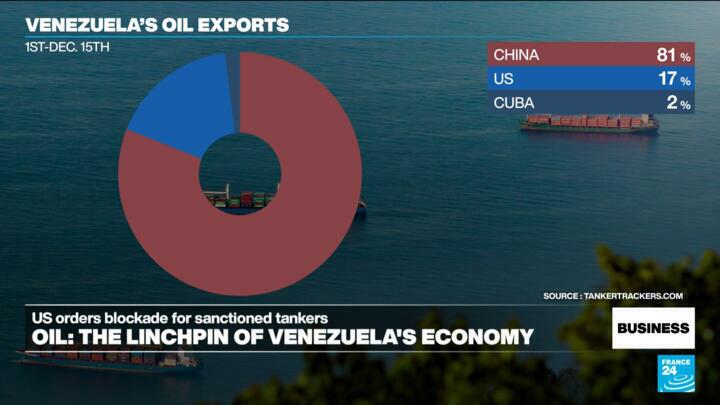
President Trump's gunboat diplomacy is aimed at disrupting crude oil flows moving from Venezuela to Cuba and onward to China. The foreign-policy campaign began earlier this year with U.S. warships stationed off Venezuela's coast in international waters, but it accelerated sharply weeks ago with the U.S. seizure of a sanctioned tanker in the Caribbean and has now escalated further with reports that another tanker was intercepted and seized.

Reuters cites three U.S. officials on Saturday morning who said U.S. forces are interdicting and seizing another tanker off the coast of Venezuela in international waters. This could mark the second such seizure in weeks and comes days after Trump announced a "blockade" of all sanctioned oil tankers in the Venezuela region.

Apparently, U.S. Coast Guard teams are leading this operation amid a broader U.S. military buildup in the region, though officials have not disclosed the exact location of the latest tanker seizure.

Trump's gunboat diplomacy is aimed at the country's autocratic leader, Nicolás Maduro. This ploy could accelerate regime instability in Caracas and materially weaken Cuba.

"Their theory of change involves cutting off all support to Cuba," Juan S. Gonzalez, who was President Joe Biden's top White House aide for Western Hemisphere affairs, recently said. "Under this approach, once Venezuela goes, Cuba will follow."

On Tuesday, Trump ordered a "total and complete blockade" of all sanctioned oil tankers going into and out of Venezuela. He further boasted of the country having been "completely surrounded" with the "largest Armada ever assembled in the History of South America."

He then warned, "It [the blockade] will only get bigger, and the shock to them will be like nothing they have ever seen before — Until such time as they return to the United States of America all of the Oil, Land, and other Assets that they previously stole from us."

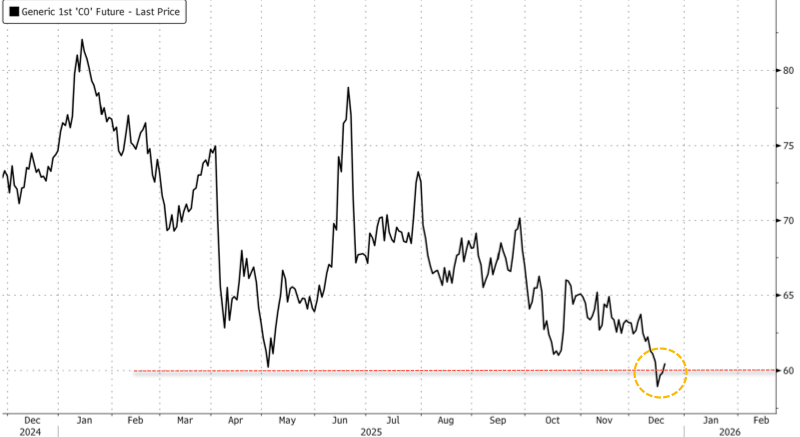
Brent crude markets slipped underneath $60/bbl last week, ending the week at $60.57, as traders appear numb to Trump's gunboat diplomacy in the Caribbean.

We're surprised Beijing hasn't lashed out at the U.S. for such actions in the Caribbean, given that this disrupts oil trade flows from West to East. Perhaps a deal was made at the Trump-Xi meeting in the fall.

Tyler Durden Sat, 12/20/2025 - 18:05
https://ift.tt/7hzksNc
from ZeroHedge News https://ift.tt/7hzksNc
via IFTTT

Gunboat Diplomacy Accelerated: US Seizes Another Oil Tanker Off Venezuela's Coast SocialTwist Tell-a-Friend
| 0 comments ]

Nebraska To Become First State To Launch Medicaid Work Requirements

Authored by Tom Ozimek via The Epoch Times,

Nebraska plans to become the first state in the nation to implement work requirements for certain Medicaid recipients, with Gov. Jim Pillen and federal health officials announcing an accelerated rollout under provisions of the One Big Beautiful Bill Act (OBBB).

At a news conference earlier this week, Pillen said the state has formally notified the Centers for Medicare & Medicaid Services (CMS) of its intent to require Medicaid expansion enrollees to meet work or community engagement standards beginning May 1, 2026—well ahead of the federal compliance deadline.

The event was also attended by Nebraska Department of Health and Human Services CEO Steve Corsi, and remotely by CMS Administrator Dr. Mehmet Oz.

Under the new rules, able-bodied adults aged 19 to 64 enrolled through Medicaid expansion will be required to complete at least 80 hours per month of employment, education, job training, community service, or other qualifying activities to maintain coverage, unless they qualify for an exemption.

“These requirements will help Nebraskans achieve greater self-sufficiency through employment and other meaningful activities,” Pillen said.

“Working not only provides purpose but helps people become active, productive members of their communities.”

Pillen added that Nebraska will be ready to move forward with the work requirements well before the federally mandated start date of Jan. 1, 2027.

His office said that work requirements are associated with greater success in finding better-paid work and more stable incomes over time, and that higher employment rates are linked to lower crime rates. Children in working households also tend to have improved educational outcomes and stronger routines.

Federal Law Mandates Medicaid Work Rules

The work requirements stem from the OBBB Act, which President Donald Trump signed into law on July 4. The bill mandates work or community engagement conditions for most adults covered through Medicaid expansion nationwide. While it directs states to implement the requirements by the end of 2026, states may move sooner, as Nebraska now plans to do.

Oz, who joined the conference by video, praised Nebraska for acting quickly.

“Nebraska is leading the way as the first state to launch its community engagement requirements, and we congratulate Governor Pillen and his team for their commitment to helping more Nebraskans move toward greater independence and opportunity,” he said.

“CMS will be working together with Nebraska and its 50 counterparts to ensure every program is implemented smoothly, responsibly, and in compliance with federal law.”

According to state officials, the policy will apply only to the Medicaid expansion population—low-income adults earning up to 138 percent of the federal poverty level—while leaving traditional Medicaid groups unaffected. Children, pregnant women, seniors, and people who are blind or disabled are excluded from the requirement.

The Nebraska Department of Health and Human Services estimates that around 350,000 residents are enrolled in Medicaid, with Pillen saying that some 30,000 Nebraskans will be subject to the new work requirement once it is implemented.

Critics contend that the accelerated timeline could strain Nebraska’s eligibility system and lead to coverage losses among people who qualify for exemptions but struggle with paperwork or verification.

“We have seen in other states that when Medicaid work requirements are implemented too quickly, like what Nebraska is proposing here, thousands of people who are eligible for the program unnecessarily lose coverage and millions of state dollars are wasted on ineffective administrative costs,” Nebraska Appleseed Health Care Access program director Sarah Maresh said in a statement.

“We know a vast majority of Nebraskans subject to these requirements work or meet an exemption to work requirements, but rushing to implement work requirements will cause them to lose coverage anyway.”

The Congressional Budget Office projected in June that 4.8 million able-bodied adults would lose Medicaid coverage by 2034 for failing to meet new work requirements under the OBBB.

Tyler Durden Sat, 12/20/2025 - 17:30
https://ift.tt/5Tnu2kN
from ZeroHedge News https://ift.tt/5Tnu2kN
via IFTTT

Nebraska To Become First State To Launch Medicaid Work Requirements SocialTwist Tell-a-Friend
| 0 comments ]

Project Sunrise: Inside The $112BN Plan To Rebuild Gaza As 'High Tech Metropolis'

Via The Cradle

US special envoy Steve Witkoff and Jared Kushner have presented a $112 billion reconstruction plan to Gulf officials to build a “high-tech metropolis” atop the remains of Gaza, the Wall Street Journal reported on Friday. The 32-page PowerPoint presentation labeled "sensitive" and titled "Project Sunrise" was developed over 45 days and reportedly presented to officials from Qatar, UAE, Egypt, and Turkiye

The plan envisions turning the Gaza Strip into a "high-tech metropolis" over the next two decades with four phases of reconstruction beginning in southern Gaza. It also calls for turning Rafah into Gaza's new "administrative center," housing over 500,000 residents.

However, the plan does not specify where two million Palestinians would be sheltered during the reconstruction period. Israel's blockade of shelter materials has left Palestinians sheltering in bombed-out buildings and tattered tents.

In early December, a severe winter storm caused over a dozen fatalities, including three infants who succumbed to exposure, and led to the collapse of several buildings. About 95 percent of Gaza's tent camps have flooded due to the heavy rain.

Witkoff and Kushner's reconstruction plan also proposes monetizing 70 percent of Gaza's coastline beginning in year ten of the project, a move officials hope would generate over "$55 billion in long-run investment returns for prospective investors."

Both Witkoff and Kushner come from prominent Jewish real estate families rooted in New York’s property sector, with careers built around large-scale, high-value developments and deep financial ties to Gulf sovereign wealth funds.

According to the proposal, the US would provide $60 billion in grants and loan guarantees to back new debt, with expectations that the project would become self-financing as local industry and the broader economy recover. The World Bank would also have a role in the project.

The proposal is contingent on Hamas demilitarizing and decommissioning all weapons and tunnels. This precondition is highlighted in bold red type on the second page of the slide deck.

Hamas officials recently offered to "bury" the group's weapons and hand over power to a Palestinian governing body.

However, Israel has blocked those efforts and refused the participation of nearly all Palestinian technocrats and bureaucrats who would be suited to govern Gaza.

Earlier this year, Trump proposed permanently relocating Gaza's Palestinian residents to transform the strip into a "Riviera of the Middle East," a plan rejected by several countries but welcomed by Israel's government.

Tyler Durden Sat, 12/20/2025 - 16:20
https://ift.tt/lBXPiV0
from ZeroHedge News https://ift.tt/lBXPiV0
via IFTTT

Project Sunrise: Inside The $112BN Plan To Rebuild Gaza As 'High Tech Metropolis' SocialTwist Tell-a-Friend