| 0 comments ]

'We Have Many Options': US Warships Pass Through Panama Canal Toward Southern Caribbean

U.S. warships were seen entering the Panama Canal while navigating east toward the Atlantic, according to photos taken on Aug. 30.

White House press secretary Karoline Leavitt said on Aug. 19 that President Donald Trump was “prepared to use every element of American power to stop drugs from flooding into [the United States] and to bring those responsible to justice.”

“Many Caribbean nations and many nations in the region have applauded the administration’s counterdrug operations and efforts,” Leavitt added.

As Jacob Burg reports below, the previous day, a White House official told The Epoch Times that U.S. naval and air assets would deploy to the southern Caribbean Sea amid a heightened counternarcotics effort.

That deployment puts U.S. warships a short distance off Venezuela’s northern coastline, following years of strained relations between the United States and Venezuela.

In 2017, Trump told reporters, “We have many options for Venezuela, including a possible military option, if necessary.”

Trump rejected the 2018 snap presidential election, in which Nicolás Maduro was declared the winner. He also backed then-Venezuelan National Assembly President Juan Guaidó’s efforts to declare himself the rightful head of state of Venezuela until new elections commenced.

In 2019, Guaidó led a short-lived attempted uprising against Maduro. A year later, the U.S. Department of Justice declared that Maduro was linked to both drug and weapons trafficking and offered $15 million for information leading to the regime leader’s arrest.

When Maduro claimed he had won Venezuela’s 2024 presidential election, the Biden administration rejected the results, and accusations mounted that the outcome was rigged for Maduro.

Now, the Justice Department is offering $50 million for information leading to Maduro’s arrest.

Maduro denounced the news that U.S. warships were traveling to the Southern Caribbean this week.

On Aug. 28, Venezuela criticized the U.S. naval buildup to United Nations Secretary-General António Guterres and accused Washington of breaking the founding U.N. Charter.

“It’s a massive propaganda operation to justify what the experts call kinetic action—meaning military intervention in a country which is a sovereign and independent country and is no threat to anyone,” Venezuelan U.N. Ambassador Samuel Moncada told reporters after meeting with Guterres.

In February, the Trump administration designated several transnational gangs, including Mexico’s Sinaloa Cartel and Venezuela’s Tren de Aragua, as global terrorist organizations.

In response to the U.S. actions, Maduro said, “Our diplomacy isn’t the diplomacy of cannons, of threats, because the world cannot be the world of 100 years ago.”

Maduro’s regime said last week that it would send 15,000 troops to states along its western border with Colombia to combat drug trafficking rings. He has also directed civil defense groups to train every Friday and Saturday.

The Venezuelan regime often accused both domestic opposition and foreigners of conspiring with U.S. entities, including the CIA, to hurt Venezuela, which the opposition and the United States have denied. The regime refers to U.S. sanctions as “economic war.”

On Aug. 24, Venezuela released a group of 13 political prisoners after the Trump administration ramped up pressure on the regime.

The move came after news first broke that the United States was sending military assets to the waters off the coast of Venezuela.

Henrique Capriles, a prominent member of Venezuela’s opposition and two-time presidential candidate, said eight prisoners were freed outright and five others were transferred to house arrest.

“Today, several families are reunited with their loved ones. We know that many remain, and we do not forget them; we continue fighting for all,” Capriles, who narrowly lost to Maduro in the highly disputed 2013 presidential election, said on X.

Tyler Durden Sun, 08/31/2025 - 18:05
https://ift.tt/kOG97iL
from ZeroHedge News https://ift.tt/kOG97iL
via IFTTT

'We Have Many Options': US Warships Pass Through Panama Canal Toward Southern Caribbean SocialTwist Tell-a-Friend
| 0 comments ]

How The US Will Force Yields Lower Across The Curve

By Peter Tchir of Academy Securities

Forcing Yields Lower Across the Curve

We were already set to get a lot of economic data, especially on the labor front, compressed into a short week, and now we have to digest a court ruling on tariffs.

A federal appeals court ruled against (many/some/all?) tariffs imposed using an emergency law.

  • The tariffs will remain in place while the case proceeds.

  • It may go back to the lower court for another round, while also being pursued up to the Supreme Court. Nothing is “final” yet.

  • We discussed a couple of weeks ago that tariff rebate claims were trading at 25 cents on the dollar. Presumably, those are trading moderately higher after this ruling, but to a large degree, this news, which hit after the close on a long weekend, should be at least partially priced in.

Given that, we won’t dwell on this issue, for now, and will try and have some fun with the almost universal view that U.S. yield curves will steepen and the long end is very vulnerable to a spike higher in yields.

It is worth highlighting that the equity narratives highlighted in last weekend’s No Lonesome Doves continued to work this week.

The Consensus on Rates and the Fed

There is a lot of debate over whether Fed independence will be compromised or not?

That goes hand in hand with whether or not we will have “unnecessary” or “politicized” rate cuts?

For anyone answering “yes” to both questions, the natural conclusion is that we get rate cuts, but yield curves steepen and long end yields likely rise, possibly by a lot (yes, we mentioned that once already, but it seemed worth mentioning again).

As discussed on Bloomberg TV this week, we think that might be too simplistic. That people aren’t thinking “out of the box” enough and may well be underestimating this admin on their plans for yields.

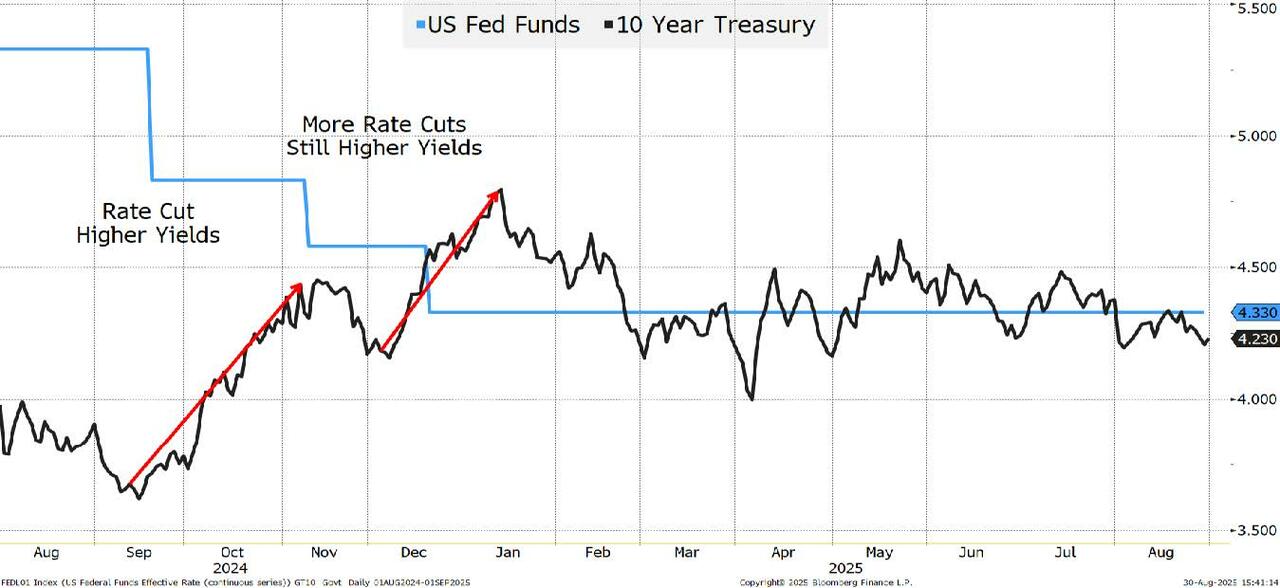
Everyone Knows What Happened Last September
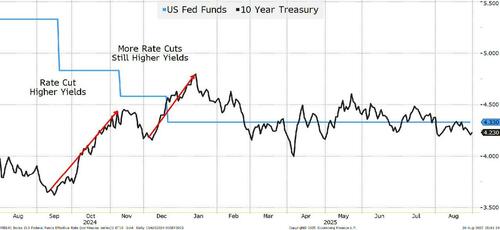
Since the risk that this pattern repeats itself is so obvious, it seems obvious (at least to the T-Report) that someone in D.C. is trying to figure out a strategy so that it doesn’t happen again.

Largely Playing Devil’s Advocate

For this report we can have some “fun.” We can think out of the box and suggest things that we would/might do if we were trying to implement policy that would help yields across the curve. Some of the things suggested are not things we would do or advocate for someone to do, but that isn’t the point. The point is to think about things that could be done, that would really hurt the consensus trade.

What could or will the administration do to Force Yields Lower Across the Curve (and hurt the consensus view)?

Guided By Bessent

There have been all sorts of statements (maybe even outrageous statements) on where monetary policy should be.

Bessent in a Bloomberg TV interview a couple of weeks ago said that Fed Funds were 100 bps too high. There was some wiggle room around his answer, but I think we can assume that Bessent sees 100 bps as the right range of cuts in the (very) near term.

Bessent has also spoken about 3, 3, 3. That was linked to 3% budget deficits, 3% GDP growth, and 3 million barrels of oil per day.

While I don’t think Bessent has given a specific target on 10s, he has been quite vocal about focusing on longer-term yields, not just the front end. Additionally, the administration has been very concerned about mortgage rates – a function of yields and spreads.

Maybe it is a stretch to assume something in the low 3% range would be a target for this admin on 10s, but that is the working thesis for this exercise.

Politicized Cut?

It is easy to turn this into a debate about whether a cut is politicized or not. But that might be missing the point.

  • The July meeting had 2 people dissent about the decision not to cut rates.

    • That was before the June jobs data was revised down sharply.

  • Powell came across very dovish at Jackson Hole, leading many (or at least us) to conclude that while “only” two dissented, the debate to cut or not may have been even more vigorous than he made it seem during the press conference or in the Fed minutes.

  • This is an “art” not a science. There have been plenty of people with a wealth of experience in economics and markets calling for rate cuts to have already started. Yes, there are people on both sides of the argument, but that is the point – there is no “right” answer. Having low quality data doesn’t make finding an answer any easier.

For purposes of this report (which is in line with our analysis and concerns on the labor front), 50 bps in September would be in the realm of justifiable.

Yes, many will disagree, and that is fair, but unless the jobs data across the board (ADP and the JOLTS Quit Rate are important to me) shows a robust improvement, I’d go with 50 bps and don’t consider that political.

Let’s just reflect on this for a moment.

If 50 bps is actually justified, why would the long end get hurt?

What many seem to consider a “politicized” cut, which sounds exciting to discuss, may not be, which means the alarm bells people expect to see in the market are less likely to materialize.

Independent versus Collaborative

Yeah, we are heading down a slippery slope here, but an “Independent” Fed doesn’t mean it has to (or should) “go it alone.”

Monetary policy, when implemented in conjunction with the Treasury Department (for example), may be the most powerful way to implement policy and get the desired results.

Whether it was during the GFC or COVID, we have seen the Fed work with other areas of the government to achieve their goals. That doesn’t mean the Fed isn’t independent, it just means that it is part of an overall strategy to achieve goals that it is in line with.

The Limitation of Fed Funds

Fed Funds as a policy tool seems weak at best. The “long and variable” time it takes for monetary policy to take effect when conducted through changes in the front end of the yield curve is almost comical.

  • In the months it takes for moves at the front end of the yield curve to work through the system, any number of other things can happen (trade wars, actual wars, technological improvements, etc.). It is difficult, even after the fact, to judge what some cuts or hikes actually did in the real world.

  • While ZIRP was a few years ago, many corporations, individuals, and municipal bond issuers locked in low rates, and are not that impacted by changes in front end yield. Whatever effectiveness conducting monetary policy via front end yields had has diminished since so many (other than the U.S. government itself) took advantage of lower for longer to protect themselves against changes in interest rates.

We’ve thought out of the box before, why not again?

Favorite Example
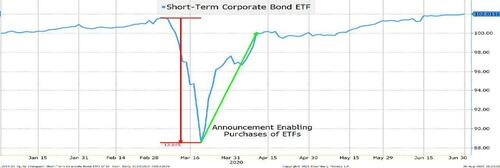
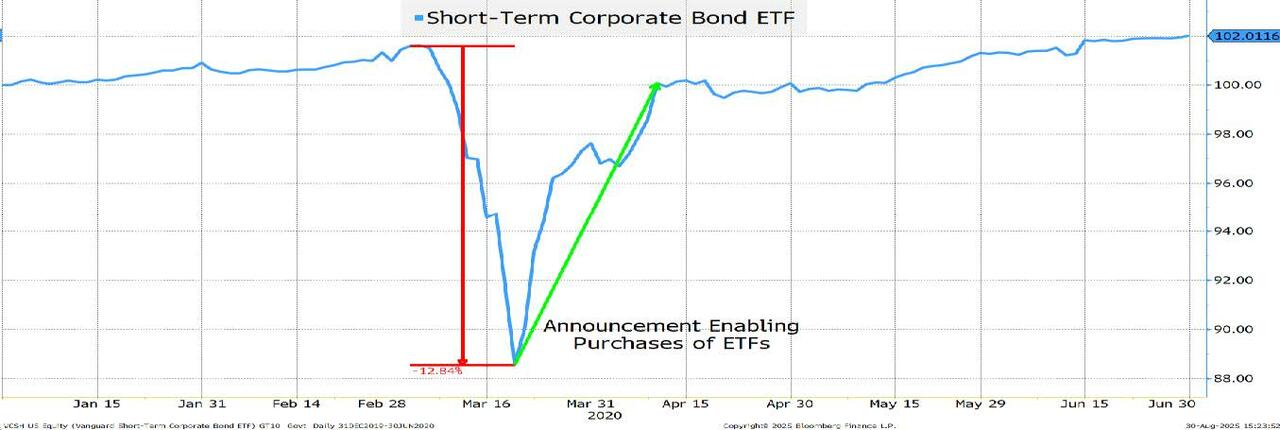
This was one of the “scariest” charts as COVID wreaked havoc on bond markets.

VCSH is an ETF that tracked 1 to 5 year corporate bonds. A 1% move in a short time is a relatively big deal. It fell around 12% in a matter of days. The discount to NAV was exploding. The ETF Spiral™ was in full effect (the arbitrage of selling bonds and buying the ETF, in times of stress, tends to accelerate and amplify the stress). Then the government announced a plan where the Fed (with money from the Treasury Department if I remember correctly) would buy ETFs.

The problem was literally fixed overnight.

Despite the fact that the mechanism to get the funding wasn’t set up. The ability to buy equities (which is what the ETFs are) had not been established. Again, I think it took weeks (if not longer) before any purchases of ETFs were made, but just the announcement fixed the problem.

Incredibly powerful and nothing that any amount of Fed Fund cuts was going to fix as effectively or quickly as this plan did.

One and Done?

We will start with this one, because timing wise, it might be easiest.

I’m not sure if this will work or not, but it deserves some consideration.

  • If the Fed goes 25 or even 50 in September, the market will immediately move to speculate on the timing and sizes of the next cuts. Especially those who characterize any cut as being politically pressured. There will be just as much uncertainty about the path and intentions of the Fed after the cut, as before the cut. Realistically, no one thinks we will get one cut of 25 bps and be done, so the speculation about Fed independence etc., will still attract a lot of attention and possibly push yields higher.

  • What about going 100 bps (which is where Bessent is and not far off from our 3 to 4 cuts this year), but committing to leave rates alone for several quarters unless the data changes dramatically one way or the other? Would people “trust the commitment”? That might be a stretch (even I’d be skeptical and I kind of like the concept).

    • 100 bps would take Fed Funds to 3.33% (I like the 3s).

    • The 1 month versus 10 year yield spread is currently -9 bps. It would have to steepen by almost 80 bps for 10s to stay above 4%. A 100 bp cut would require a LOT of steepening, maybe more than the vigilantes can deliver to keep 10s above 4%?

Not my favorite idea, but something to think about. I do like “ripping the band-aid off” on cuts and getting to the endpoint (or potential endpoint) quickly rather than dragging it out (which is the “normal” procedure).

Attack Rent Inflation

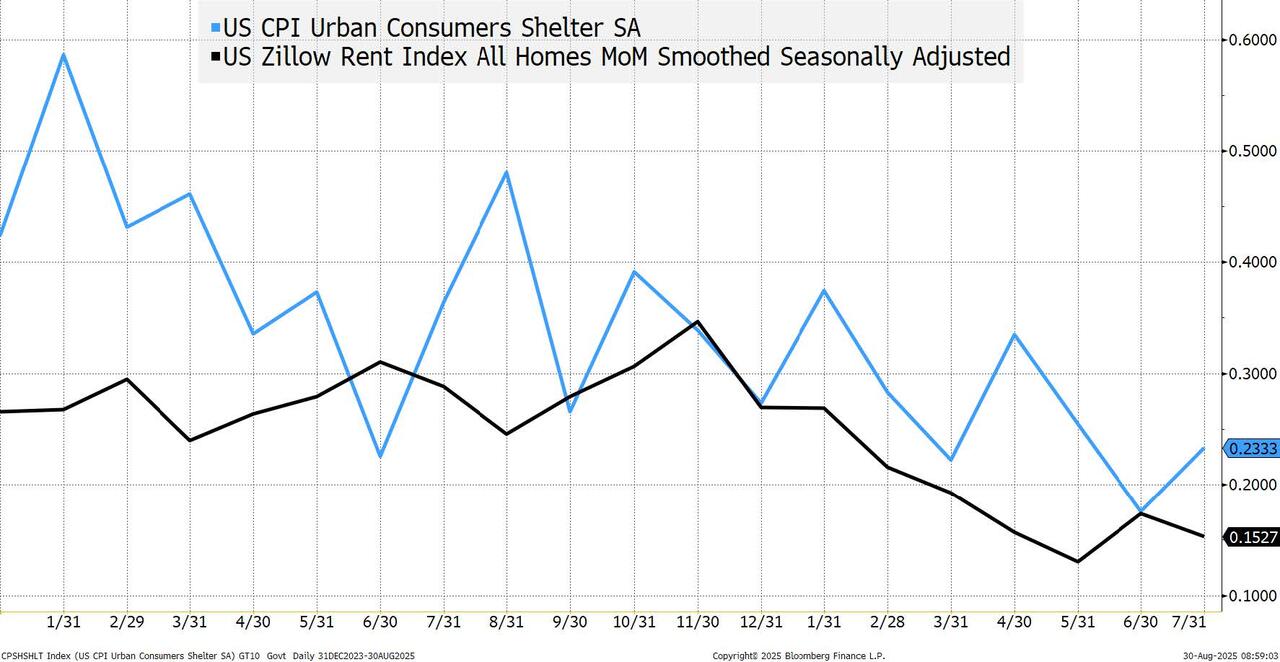
Shelter is one of the biggest components of CPI.

“We” (and I use that term loosely) continue to use Owners’ Equivalent Rent as part of the calculation. If anyone can tell you succinctly and simply why Owners’ Equivalent Rent is still the right metric, I’d be shocked. It is a “calculation,” maybe even an “awkward” calculation. It is designed to have lags built in. Those lags presumably were to slow inflation from hitting the benchmarks in real time (by and large shelter costs go up). We were screaming at the top of our lungs during “transitory” that the shelter inflation in CPI was understating the real world rent inflation. Now “shockingly” it is working in reverse. The shelter component is artificially raising inflation benchmarks.
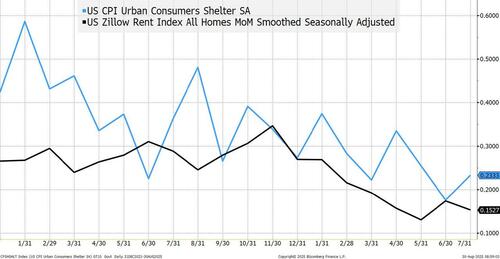
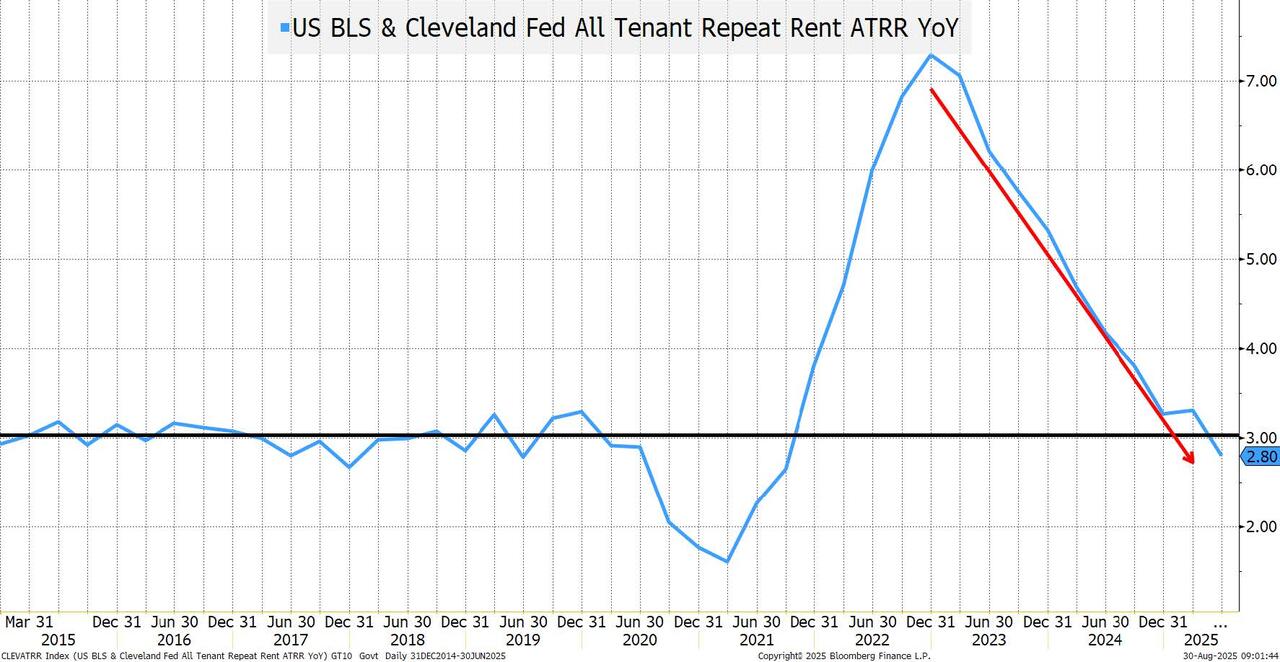
What I find interesting is that the Cleveland Fed has created their own metric, which seems to work well (I could only find a year-on-year version and it is a long weekend so didn’t spend too much time looking for a month-on-month version).
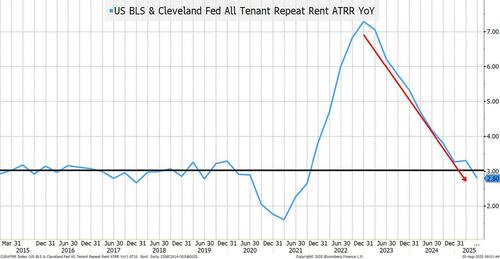
What little I know about charting this stuff is:

  • We are back to a pretty normal level of inflation for rents.

  • If the annual line is continuing to decline, the recent monthly numbers are lower still.

The Cleveland metric is below the almost 4% change in shelter inflation in CPI. Now, we wouldn’t normally quibble over a 1% or so difference in the course of a year, but since shelter is such a large component it is keeping inflation both stubbornly and inaccurately high.

If you want to attack inflation fears, start by attacking the data itself and highlighting this large component which virtually everyone agrees it is being overstated.

If you can combat some of the inflation fears, it should reduce the power of the bond vigilantes and the arguments of those who say it is a “political” decision to cut with inflation high.

Shift the Balance Sheets

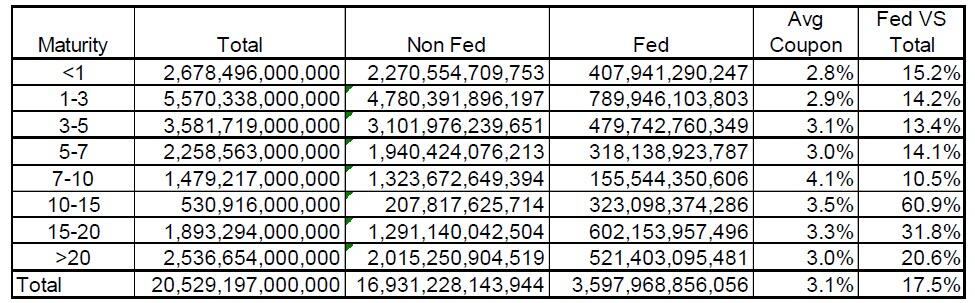
This gets to the heart of the problem. These are our current calculations of the Fed holdings of Treasuries by maturity (ignoring T-Bills, floaters, and TIPS).
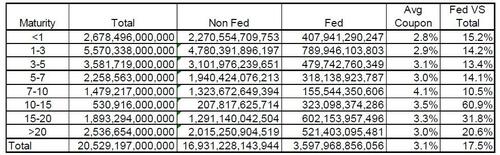
The Fed balance sheet is skewed to the shorter maturities.

The Fed owns $2 trillion of bonds maturing in less than 7 years versus “only” $1 trillion of bonds maturing 15 years or more.

Let’s “imagine” that the Fed starts an “aggressive” Operation Twist. Selling bonds that mature in 3 years or less (most anchored by Fed Funds) would create about $1.2 trillion of purchasing power.

If they only bought bonds 20 years or longer, that would almost triple their portfolio size. Interestingly, “only” $2 trillion of bonds maturing 20 years or longer are outside of Fed control, so that would be 50% of the float! When you start thinking about what percentage of that is locked up in not available for sale accounts, it would be IMMENSE buying power.

That is extreme, but we start to get a sense of what can be done.

T-bills will be “anchored” by Fed Funds. So, the Treasury Department, if it doesn’t like where yields are (even with Operation Twist), could scale back issuance of longer-dated bonds even further, creating favorable supply and demand dynamics.

Don’t Fight the Fed.

Why would the Fed do Operation Twist? 

Why wouldn’t they? They’ve done similar actions before. If they believe (and some do) that rates are too high, why would they be content to “only” set the front end of the yield curve? Why not, once again, interfere in the longer end of the bond market?

Heck, while I’m at it, why not shift out of some Treasuries and into mortgages? That might help the “spread” component of mortgages come down.

Also, there are $3.6 trillion of bonds maturing 10 years or longer, with prices below 90 cents on the dollar. That may create some interesting “accounting games” as selling bonds at par to buy bonds below par could be pitched as some sort of a gain? In the real world, it is far more complex than that, but possibly in an accrual accounting world, something can be done with these bonds to make it seem “even better” from either a deficit or overall debt standpoint. Bit of a stretch, but I’ve always been a fan of buying bonds at a discount.

YCC

That looks like the 3 letter code for a Canadian airport, but it is Yield Curve Control

The U.S. hasn’t gotten into yield curve control in my lifetime, but it seems like each crisis brings new “unconventional” tools, which take us a step closer.

Japan had it recently. 

This is an administration that is comfortable “setting the prices” on things like tariffs, so setting the price of yields seems well within the scope of what they might do.

If this was the 1990s and I said yield curve control, I’d expect people (including myself) to be aghast at the idea. But seriously, we have been on this slippery slope since at least the GFC, if not LTCM (Long Term Capital Management for those of you who didn’t have to deal with that mess).

Stablecoin Demand for Treasuries

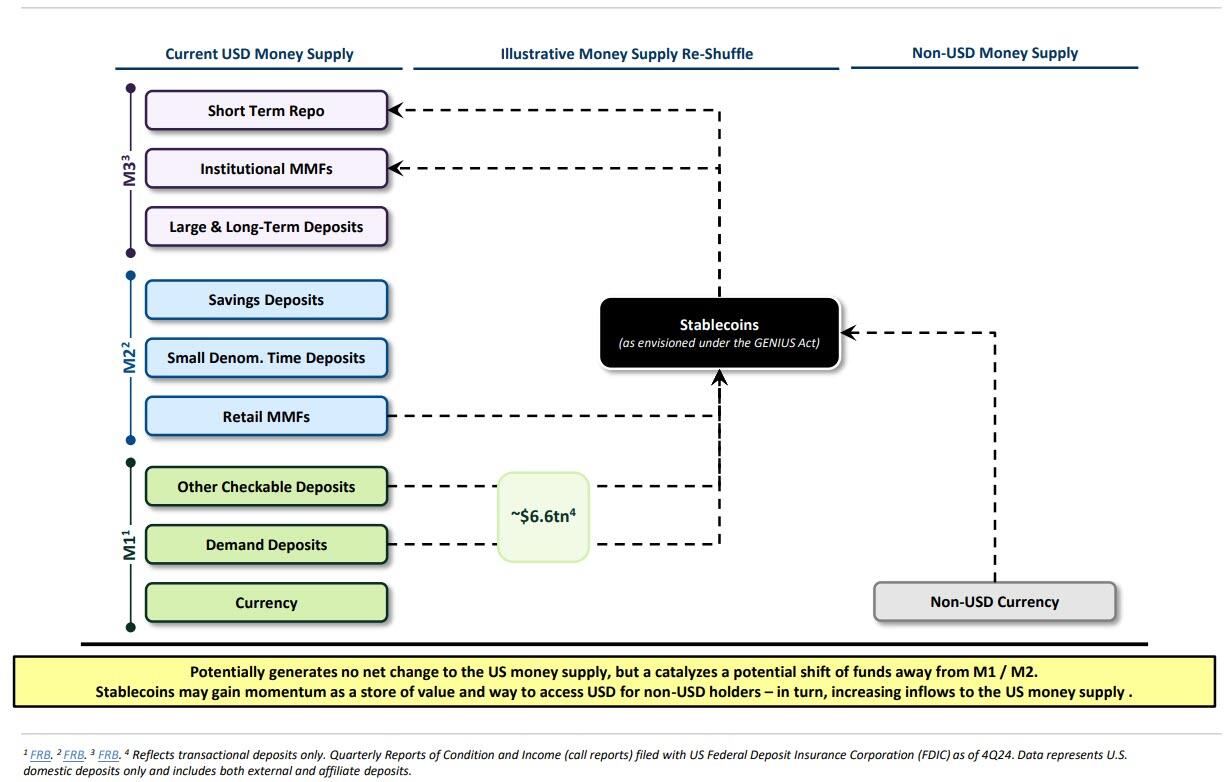
We’ve written in the past that Bessent expects $3 trillion to come into USD stablecoins (he really does seem to like the number 3).

That, if it materializes, would create demand for T-bills and short dated bonds.

Maybe we could issue more T-bills and fewer longer-dated bonds to satisfy that demand? Maybe we could sell bonds maturing in less than a year, to buy bonds maturing in 20+ years, to satisfy that demand?

I am excited for the opportunities in the stablecoin space given recent laws and regulations, but it might take more time to generate those sorts of inflows (new inflows into the USD forcing T-bill buying, rather than flows that cannibalize money from funds that also bought T-bills).
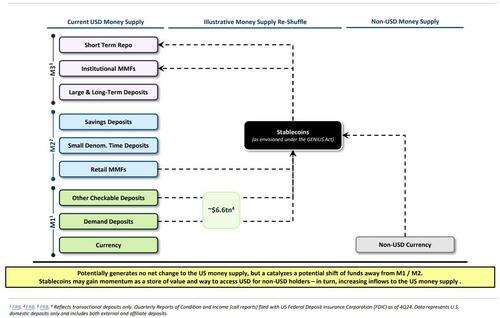
In any case, as this demand grows, it fits very well with things like Operation Twist, or a different maturity profile from the Treasury.

Any new net demand is good demand.

Gold Revaluation

According to AI, the U.S. has 8,133.46 metric tons of gold. I get confused between a tonne, a metric ton, and a ton, but it is a LOT of gold!

The book value is $6.2 billion (which is based on a price of gold of $42.222 per troy ounce that was established in 1973).
With spot gold almost $3,450 per ounce, the “market value” of the gold would be more than 80 times that amount – or about $506 billion.

Just “marking to market” gold would generate $500 billion of accounting revenue.

That is fraught with other issues. Annually, presumably, we’d have to adjust the value based on the price of gold. If the market thought the repricing was a sign that the U.S. would sell a lot of gold, the price would likely drop.

Since I presume the U.S. would sell some gold to fund some of its “Sovereign Wealth Fund” aspirations or make some deals, then the gains would be less, but still nothing to dismiss.

If you wanted to cause a distraction – announcing that you are revaluing gold and planning to sell it to invest in companies (or maybe even crypto currencies) might make everyone forget that the yield curve is meant to steepen!
Since I don’t understand why we hold so much gold as it is (I’m not in the barbaric relic camp, but am probably closer to that than the “sound/hard” money camp) I cannot see why we wouldn’t do some of this.

Would it lower the dollar? Probably, but for an administration trying to revert trade flow, a weaker dollar is a feature not a bug, even if they can’t say that out loud.

Tariffs

For now, despite the recent court ruling, it is worth resending our Tariff Revenue Charts which highlight the revenue that has come in so far (though subject to legal challenge) along with our rationale of why tariffs will take a long time to truly impact inflation.

Not the strongest argument right now after the court ruling, but some version of this argument remains relevant.

Bottom Line

It’s a long weekend and I could have written the umpteenth piece on the risks to the Fed and to the shape of the yield curve.

But, I thought it would be more fun to try to play devil’s advocate and create some discussion around tools and steps that could be taken to not just reduce the risk, but also potentially reverse the risk as the trade seems quite one-sided at this point and seems to not give the administration enough credit for trying to force things that we hadn’t thought could be forced.

It is too early to pound the table on flatteners, but that is the opportunity I’m looking for.

Nothing we’ve written or suggested today, if used, is helpful for the dollar, but, again, not sure that anyone involved in the U.S. efforts to import less and export more cares.

Enjoy your Labor Day weekend and get ready for all the labor data next week, all of which will be taken with a grain of salt given the recent adjustments.


Tyler Durden Sun, 08/31/2025 - 16:20
https://ift.tt/K1pVhHq
from ZeroHedge News https://ift.tt/K1pVhHq
via IFTTT

How The US Will Force Yields Lower Across The Curve SocialTwist Tell-a-Friend
| 0 comments ]

New Recall Of Potentially Radioactive Cocktail Shrimp In 27 US States

Authored by Naveen Athrappully via The Epoch Times (emphasis ours),

The Food and Drug Administration announced on Aug. 28 a new recall of cocktail shrimp sold in Walmart stores across 27 states for potential contamination due to being prepared, packed, or held under insanitary conditions where they may have become contaminated with cesium-137 (Cs-137).

A package of frozen shrimp potentially affected by radioactive contamination. U.S. Food and Drug Association via AP

Seattle-based AquaStar (USA) Corp is recalling approximately 26,460 6-ounce packages of cocktail shrimp, imported from Indonesia, and sold between July 31 and Aug. 16.

The states in which they have been sold are Alaska, Alabama, Arkansas, Colorado, Georgia, Iowa, Idaho, Illinois, Indiana, Kansas, Kentucky, Louisiana, Michigan, Minnesota, Missouri, Mississippi, Montana, North Dakota, Nebraska, Ohio, Oklahoma, Oregon, South Dakota, Tennessee, Texas, Washington, Wisconsin,

A day earlier, on Aug. 27, the FDA issued a similar recall warning for frozen cooked shrimp sold across 17 states. In that instance, the importer, Aquastar, had recalled approximately 18,000 bags (net weight 2 pounds) of Kroger Mercado Cooked Medium Peeled Tail-Off Shrimp.

Both recalls are an expansion of recent recalls by Walmart and other distributors.

Cs-137 is a man-made radioisotope of the extremely reactive metal cesium, the FDA said.

Traces of Cs-137 are widespread and can be present at higher levels in water or foods grown, raised, or produced in areas with environmental contamination.

Exposure to stable or radioactive Cs-137 happens when an individual ingests contaminated food or liquids, or even breathes in contaminated air, according to the Centers for Disease Control and Prevention.

High levels of radioactive cesium in or near the body can result in nausea, vomiting, diarrhea, bleeding, coma, and death.

The FDA warned that repeated low-dose exposure to Cs-137 through consuming contaminated food can increase the risk of cancer and result in damage to DNA.

The latest Walmart products recalled were sold in refrigerated conditions, have a 12-day shelf life, and have various “Best By” dates, the FDA said.

The 6-ounce batches of cocktail shrimp were packaged in a clear plastic tray and have a red and white label with UPC 19434612191 and lot codes 10662 5106, 10662 5107, 10662 5124, and 10662 5125 printed at the bottom of the tray.

Kroger Mercado Recall

The recalled Kroger Mercado shrimp products were sold at Baker’s, Gerbes, Jay C, Kroger, Mariano’s, Metro Market, Pay Less Supermarkets, and Pick ‘n Save between July 24 and Aug. 11.

The states in which they were sold are Alabama, Arkansas, Georgia, Illinois, Indiana, Kansas, Kentucky, Michigan, Missouri, Mississippi, Nebraska, Ohio, South Carolina, Tennessee, Virginia, Wisconsin, and West Virginia.

Mercado is Kroger’s exclusive private label grocery brand, mostly dealing in Latin American food products.

All shrimp involved in both recalls were processed by the Indonesian company PT. Bahari Makmur Sejati (doing business as BMS Foods).

Along with investigating the products, the FDA is actively investigating reports of Cs-137 contamination in shipping containers in which the products were transported.

The recalled Kroger products weighed 2 pounds, packaged in clear plastic bags with a white label on top of each bag, and have the following codes: UPC 011110626196, lot code 10662 5139, and a “Best By” date of Nov. 19, 2027; and UPC 011110626196, lot code 10662 5140, and a “Best By” date of Nov. 20, 2027.

No illnesses have been reported to date, the FDA said.

The Epoch Times reached out to Kroger and Walmart for comment, but did not receive a response by publication time.

Consumers who have purchased the affected shrimp are requested not to consume it, but instead dispose of the product or return it to the place of purchase for a full refund.

On Aug. 26, Health Secretary Robert F. Kennedy Jr. said that federal health authorities are taking a closer look at shrimp being imported into the United States after the FDA issued warnings about potentially radioactive shrimp that were recalled last week.

“We have now increased FDA inspections of shrimp to make sure that Americans are not eating ... contaminated shrimp,” Kennedy said at a Cabinet meeting.

Kennedy also said that South Asian countries “are now dumping shrimp on our country, and the shrimp is heavily contaminated” and that “we just stopped a shipment that was contaminated with [Cesium-137].”

“They’re farming these shrimps, and they’re using bactericides and antibiotics and all kinds of chemicals, and the shrimp are so contaminated. The European nations won’t take them, so they’re dumping them all here. We have the most sustainable and most highly regulated fishing industry in the world. What our fishermen do is a good thing. And all of the trawlers in the Gulf and in Alaska are being shut down,” Kennedy said.

Jack Philips contributed to this report.

Tyler Durden Sat, 08/30/2025 - 17:30
https://ift.tt/UPN9iGB
from ZeroHedge News https://ift.tt/UPN9iGB
via IFTTT

New Recall Of Potentially Radioactive Cocktail Shrimp In 27 US States SocialTwist Tell-a-Friend
| 0 comments ]

When Washington Gets Out Of The Way – Energy Workers Deliver Results

Authored by Larry Behrens via RealClearEnergy,

This Labor Day feels different.

After years of paying too much at the pump and hearing politicians in Washington tell us it was all Putin’s fault, American families are finally getting relief. The reason is simple: our energy workers have an administration that lets them do their jobs. The results are undeniable.

This weekend, gas prices are the lowest they’ve been since 2020. According to GasBuddy, the national average for Labor Day 2025 is $3.15 a gallon. Compare that to Labor Day 2022, when drivers were shelling out an average of $3.83. That’s a 68-cent difference, and for families packing up the minivan for one last summer road trip, it means real savings. When Washington gets out of the way, energy workers deliver.

And deliver they have. America is now producing nearly 13.5 million barrels of oil a day, the highest level in our nation’s history. That production doesn’t happen in some ivory tower or Washington think tank—it happens in oil fields, on rigs, and in refineries where American workers put in long hours to keep our nation fueled. Thanks to their work, the United States is the largest oil-producing country in the world, outpacing even Saudi Arabia and Russia.

But it’s not just oil. The U.S. is also the world’s largest producer of natural gas liquids, critical fuels that heat our homes, power our factories, and keep energy affordable. Together, oil and natural gas account for more than 10 million American jobs and contribute nearly $2 trillion to the U.S. economy. Those numbers aren’t just statistics—they represent livelihoods, small businesses, and communities that depend on a strong energy sector.

Contrast that with the policies from just a few short years ago. Labor Day 2022 came on the heels of massive inflation and record energy costs. Prices were high not because American workers weren’t willing to deliver, but because Washington was actively standing in the way. Permits delayed, pipelines blocked, and a green political agenda superseded paychecks and prices at the pump.

Today, the change is obvious. With President Trump’s America First Energy policy, Washington is finally working with—not against—the men and women who power our nation. The results speak louder than any speech: lower prices for families, record production for workers, and a stronger America on the global stage. Energy dominance is no longer a campaign slogan—it’s happening in real time.

This Labor Day, as we enjoy the barbecues and road trips that mark the unofficial end of summer, we should take a moment to celebrate the American energy worker. They are the reason gas is cheaper, the reason America leads the world in production, and the reason our economy is stronger today.

And here’s the best news: if we stay the course with President Trump’s America First Energy policy, there will be even more to celebrate in the years ahead. Lower prices, stronger jobs, and a nation that relies on its own workers—not foreign cartels—for energy security.

This Labor Day feels different, but with America First Energy it could simply become the new normal.

Larry Behrens is an energy expert and the Communications Director for Power The Future. He has appeared on Fox News, ZeroHedge, and NewsMax speaking in defense of American energy workers. You can follow him on X/Twitter @larrybehrens

Tyler Durden Sat, 08/30/2025 - 16:20
https://ift.tt/uW1o63t
from ZeroHedge News https://ift.tt/uW1o63t
via IFTTT

When Washington Gets Out Of The Way – Energy Workers Deliver Results SocialTwist Tell-a-Friend
| 0 comments ]

Puerto Rico Has The Highest Share Of US Households On Welfare; Utah, The Lowest

Between persistent inflation, trade wars, and AI-related job disruptions, the outlook on the U.S. economy is once again ticking to “uncertain.”

If things get worse and unemployment starts to tick up, then more Americans might be forced to rely on state support to make ends meet.

But what’s the current picture? How many families in the country are already in need of benefits?

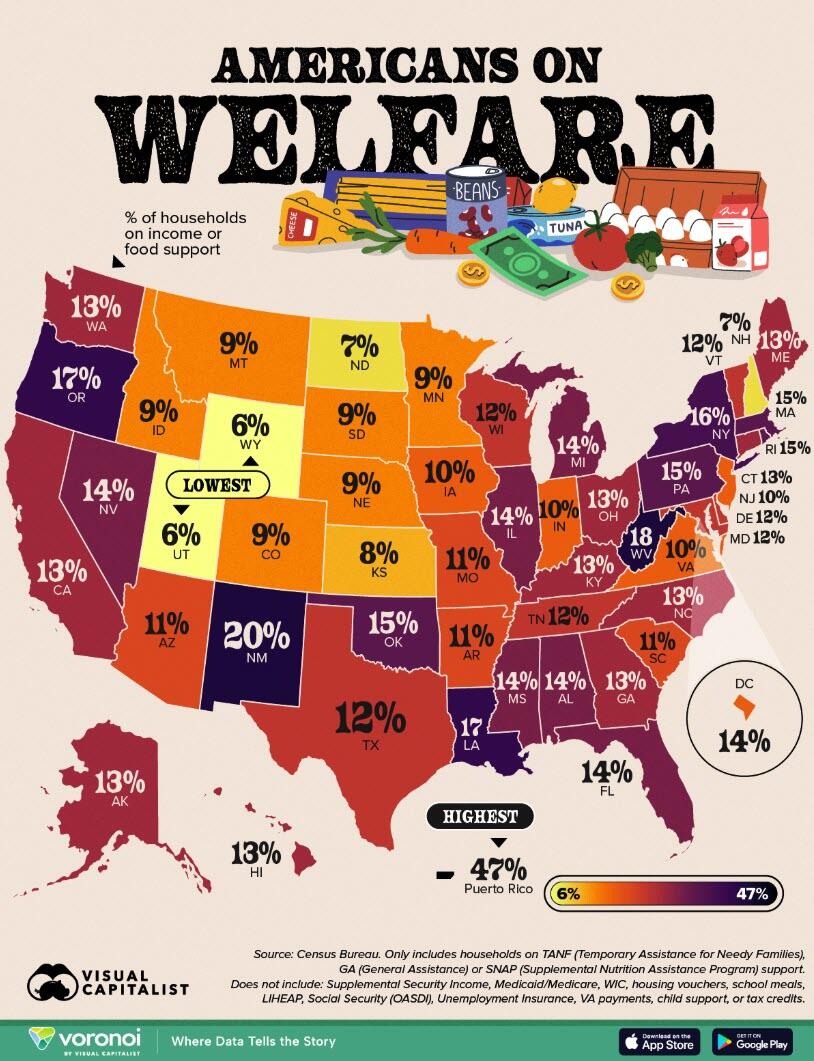
This map, via Visual Capitalist's Pallavi Rao, shows the share of households in each state that reported receiving cash public assistance (also known as TANF, Temporary Assistance for Needy Families) or food assistance (also known as SNAP, Supplemental Nutrition Assistance Program) in 2023.

The data for this visualization comes from the U.S. Census Bureau’s. Figures are rounded.

Ranked: U.S. Households on Welfare by State

Puerto Rico stands out with 47% of households receiving assistance.

This reflects sustained economic challenges and unique territorial program structures.

Rank State or Jurisdiction Code Share of Households
on Welfare
# of Households
on Welfare
1 Puerto Rico PR 47% 586K
2 New Mexico NM 20% 162K
3 West Virginia WV 18% 129K
4 Louisiana LA 17% 308K
5 Oregon OR 17% 284K
6 New York NY 16% 1253K
7 Massachusetts MA 15% 418K
8 Oklahoma OK 15% 224K
9 Pennsylvania PA 15% 787K
10 Rhode Island RI 15% 67K
11 Alabama AL 14% 277K
12 District of Columbia DC 14% 46K
13 Florida FL 14% 1157K
14 Illinois IL 14% 723K
15 Michigan MI 14% 571K
16 Mississippi MS 14% 162K
17 Nevada NV 14% 162K
18 Alaska AK 13% 35K
19 California CA 13% 1748K
20 Connecticut CT 13% 182K
21 Georgia GA 13% 524K
22 Hawaii HI 13% 63K
23 Kentucky KY 13% 240K
24 Maine ME 13% 76K
25 North Carolina NC 13% 553K
26 Ohio OH 13% 641K
27 Washington WA 13% 382K
28 Delaware DE 12% 46K
29 Maryland MD 12% 279K
30 Tennessee TN 12% 329K
31 Texas TX 12% 1322K
32 Vermont VT 12% 32K
33 Wisconsin WI 12% 282K
34 Arizona AZ 11% 311K
35 Arkansas AR 11% 132K
36 Missouri MO 11% 264K
37 South Carolina SC 11% 230K
38 Indiana IN 10% 262K
39 Iowa IA 10% 131K
40 New Jersey NJ 10% 342K
41 Virginia VA 10% 320K
42 Colorado CO 9% 215K
43 Idaho ID 9% 63K
44 Minnesota MN 9% 201K
45 Montana MT 9% 42K
46 Nebraska NE 9% 69K
47 South Dakota SD 9% 32K
48 Kansas KS 8% 90K
49 New Hampshire NH 7% 39K
50 North Dakota ND 7% 24K
51 Utah UT 6% 68K
52 Wyoming WY 6% 14K

Among the states, New Mexico has the highest share at 20%, followed by West Virginia (18%), Oregon (17%), Louisiana (17%), and New York (16%).

A large cluster of state jurisdictions have low‑to‑mid teens of U.S. households on welfare.

And at the other end, Utah and Wyoming are lowest at 6%, with New Hampshire and North Dakota at 7% and Kansas at 8%.

Regional Patterns and Notable Outliers

Appalachia and parts of the South post elevated welfare participation, mirroring higher poverty rates in the region.

However, even the richer Northeast has several higher‑than‑average states with households on benefits.

This includes Massachusetts, Pennsylvania, and Rhode Island (each 15%), alongside low New Hampshire (7%).

Meanwhile, on the West Coast, Oregon is an outlier at 17%, while California and Washington are closer to the national middle at 13%.

Overall, the median across the 50 states, D.C., and Puerto Rico is 13%, showing most places cluster in a narrow band.

Policy Design Matters for Welfare Access

Safety‑net participation reflects more than local poverty rates.

For example, SNAP is federally funded but state‑administered, and states differ in outreach, enrolment ease, and recertification cadence.

Cash assistance (often via TANF) is a capped block grant, and states set their own eligibility thresholds and work rules, which can meaningfully raise or lower participation.

States Will Have to Start Paying for Food Stamp Programs

Per reporting from Politico, Trump’s recent megabill has slashed federal funding for safety net programs and pushes food aid costs to the states.

Draft proposals would require states to cover between 5% and 25% of benefit costs starting in 2028 and pick up 75% of administrative expenses.

This marks a major change from today, where the federal government funds SNAP benefits entirely.

As a result states with higher participation and elevated error rates would face the greatest budget implications if these plans are implemented.

Tyler Durden Fri, 08/29/2025 - 17:20
https://ift.tt/KYAb4z7
from ZeroHedge News https://ift.tt/KYAb4z7
via IFTTT

Puerto Rico Has The Highest Share Of US Households On Welfare; Utah, The Lowest SocialTwist Tell-a-Friend
| 0 comments ]

The War On Reality Is Over

Authored by James Howard Kunstler,

“. . . this time the story has escaped the narrative guardrails and some real reckoning looms.”

- Jeff Childers

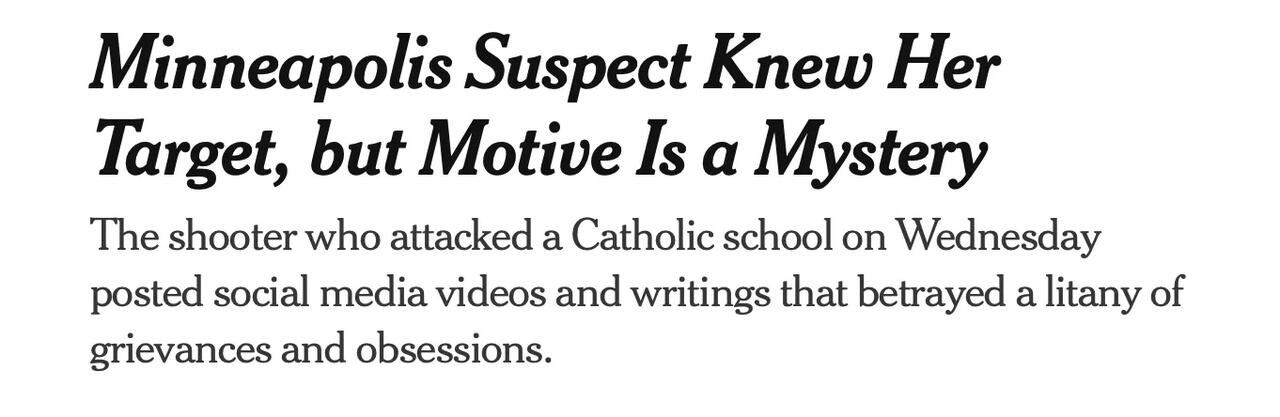
Unwittingly, that New York Times headline is a wondrous case of the self-solving mystery.

You come here to understand the many social and political mysteries of the day. I will attempt to unravel this hairball.

Most obviously, the suspect, now dead, in Wednesday’s Minneapolis school shooting was not a “her.”

He was a him, a 23-year-old male, Robert Westman, who had been pretending to be a female for some years since undergoing puberty, with the encouragement of his parents and the cultural leaders of his city, including Governor Tim Walz and Mayor Jacob Frey, backed by the expressed principles of the national Democratic Party.

The essence of all that was a gigantic game of pretend, a broad and deliberate dissociation from reality for the purpose of maintaining a political racketeering operation, which is what the Democratic Party had become.

Pretend that men can become women. Pretend that Covid vaccinations are safe and effective. Pretend that national borders don’t matter. Pretend that crime is not a social problem. Pretend that riots are mostly peaceful. Pretend that our elections are free and fair. Pretend that “Joe Biden” is president. Pretend that Ukraine is fighting for democracy. And so on. All pretend.

Since the Democratic Party has zero useful ideas for improving the lives of this country’s citizens, all it has is pretend theater, which is public performative psychopathology, otherwise known as acting-out.

Mass murders of school-children by so-called trans people are the most garish and horrific actings-out, the most offensive to society, a slaughter of innocents. Such an act grabs everybody’s attention. The New York Times pretends that all this is “a mystery” because to tell the truth would inculpate them in the ongoing criminal racketeering operation of their patron, the Democratic Party.

They all know what the truth is in this matter: that Robert Westman became insane, at least in his time of puberty, possibly earlier, and that his parents resorted to persuading their child that he was born in the wrong body — as the trendy theory goes — to remedy his psychological distress. He was thereafter influenced to play-act as a female. Possibly, he was induced to go through some stage of medical “treatment” to supposedly advance his transition to the opposite sex — for instance, a hormone regimen. This has not yet been reported. (Has it even been investigated by police or the news media?)

Of course, “gender-affirming medical care” is a vicious fraud, as is the preposterous idea of “sexual assignment at birth” (as if it is some kind of error-ridden clerical function).

Males cannot be changed into females no matter how much their hormones are altered or how much surgery they endure. It is all just costuming and makeup, to an extreme degree, to enhance the game of pretend.

It is also bound to be nightmarishly disappointing to the person undergoing such malign rigors.

As in the case of psycho-killer Robert Westman, he discovered his tragic mistake in exactly the period of life — emerging into adulthood — when emotions tend to be most labile. If he also happened to be on psychotropic drugs such as SSRIs (Prozac, Zoloft, Paxil, Celexa, etc.), known to produce suicidal and homicidal thinking, combined with his emotional instability, there you have an obvious recipe for disaster. None of that is mysterious.

Nor was the record he left behind in his “manifesto” or in the videos and social media postings he put up. Westman evinced stark rage and despair over the poor choice he was induced to make at a time in his life before the judgment region of his brain had fully developed. “I’m tired of being trans,” he wrote. “I wish I had never brainwashed myself.” It was hardly his own fault, though. He was pushed to do it by his own family and strongly supported by the culture that surrounded him in Tim Walz’s “trans refuge state” of Minnesota — the state that also gave us George Floyd, the fake martyr to black victimhood, whose death provoked a years’ long national race-hustle. And, of course, Tim Walz was a recent standard-bearer for the Democratic Party, a signature figure for all their insanity.

Wednesday’s shooting in Minneapolis looks like a hinge event in American politics. We’re done pretending. Trans is done as a political fashion-statement. Doctors will have to give up their pretenses about “gender-affirming care” if they don’t want to be bankrupted by lawsuits or prosecuted for criminal malpractice. Politicians like Walz and Frey will eventually shut-up about trans. But you can sense something else beyond that.

America is done being bullied and guilt-tripped into the matrix of untruth altogether, and the racketeering that thrives in it. And we are going after the racketeers. This week, President Trump suggested a RICO investigation and potential prosecution of George and Alex Soros, for using their vast philanthropic Open Society empire as a colossal money-laundering operation to fund Democratic Party activities, including all their efforts to disorder the legal system, sponsor riots, pay illegal migrants, promote trans activism, rig elections, and underwrite sedition. Without that money-flow — much of it used to winkle taxpayer dollars out of Congress — the party can’t keep paying its Antifa foot-soldiers in the streets, or the lavish salaries of its middle managers in a world of corrupt non-profit orgs.

Between that and the coming prosecution of its many stars from the Clintons to Adam Schiff to New York Attorney General Letitia James and many other names you are familiar with, the Democratic Party — and its war against reality — may be truly done.


Tyler Durden Fri, 08/29/2025 - 16:20
https://ift.tt/PwpJbSV
from ZeroHedge News https://ift.tt/PwpJbSV
via IFTTT

The War On Reality Is Over SocialTwist Tell-a-Friend
| 0 comments ]

Another Narrative Busted: Bolton Investigation Began Under Biden

Authored by Sundance via The Last Refuge,

For several days the media has been saying the Trump administration FBI targeted John Bolton, hence the FBI raid on his home and office.  However, the New York Times now outlines how the investigation into John Bolton began during the Biden administration and picked up speed after they received access to his email information from an “adversarial country’s spy service.”

Apparently, John Bolton used an unclassified email system to send information to his friends and allies.  The emails were intercepted.  Bolton was discussing information that appears to have been the outcome of his access to classified information as National Security Advisor.

CTH has previously outlined how John Bolton’s business model was essentially selling information and influence.  This common DC business model seems to have formed the baseline for him to share sensitive, possibly classified information, of greater value.  This does not come as a surprise.

Selling information is the currency of affluence in Washington DC.  That’s why the removal of security clearances is looked upon as devastating within the beltwayNew York Times story below:

NEW YORK TIMESThe investigation into President Trump’s former national security adviser, John R. Bolton, began to pick up momentum during the Biden administration, when U.S. intelligence officials collected information that appeared to show that he had mishandled classified information, according to people familiar with the inquiry.

The United States gathered data from an adversarial country’s spy service, including emails with sensitive information that Mr. Bolton, while still working in the first Trump administration, appeared to have sent to people close to him on an unclassified system, the people said, speaking on the condition of anonymity to discuss a sensitive case that remains open.

The emails in question, according to the people, were sent by Mr. Bolton and included information that appeared to derive from classified documents he had seen while he was national security adviser. Mr. Bolton apparently sent the messages to people close to him who were helping him gather material that he would ultimately use in his 2020 memoir, “The Room Where It Happened.”

In a sign of the stakes for Mr. Bolton, he is in talks to retain the high-profile criminal defense lawyer Abbe Lowell. Mr. Lowell, who has represented Mr. Trump’s son-in-law, Jared Kushner, and Mr. Biden’s son Hunter, is defending two other prominent perceived enemies of Mr. Trump who are now under scrutiny: the New York state attorney general, Letitia James, and Lisa Cook, a member of the Federal Reserve Board. (read more)

At the time of the raid, we noted the activity of Bolton mirrors that of former Senator John McCain (now dead). “An FBI investigation under the auspices of potential violations of the Espionage Act, where Bolton would have leveraged current or prior classified intelligence information as part of his influence business.

Almost identically to former Senator John McCain, John Bolton was well known to intersect with the nation of Qatar as part of his operation.  Qatar has deep pockets and a long-identified influence operation throughout the Middle East, sometimes playing both sides. Qatar is also the playground for the CIA.

While it is yet unknown which nation and which activity Bolton was likely engaged in, the highest probability centers around the deepest pockets, which would also put Bolton on the CIA radar.

Since initially writing that outline, someone noticed this video from John McCain’s funeral.  WATCH CLOSELY:

Something is being given to John Bolton in that video.  Something from Mouaz Moustafa, Syrian Emergency Task Force (SETF) and Senator John McCain’s intermediary to the Muslim Brotherhood. {Go Deep}

If I had to guess, from the position of Moustafa and those behind him (Muslim Brotherhood/Qatar), John Bolton became the replacement for John McCain after the senator’s death.  We wait to find out the details of the predicate for the FBI raid.

Tyler Durden Thu, 08/28/2025 - 16:20
https://ift.tt/I8sr3aq
from ZeroHedge News https://ift.tt/I8sr3aq
via IFTTT

Another Narrative Busted: Bolton Investigation Began Under Biden SocialTwist Tell-a-Friend
| 0 comments ]

Victor Davis Hanson: What Is The Democratic Alternative To Trump?

Authored by Victor Davis Hanson,

The Pavlovian Left goes berserk at the mere prospect of each new Trump initiative.

Its escalating reactive venom and hysteria are calibrated to the success of Trump’s latest policy.

Yet the new hard-left Democratic Party offers no counter-agenda to explain its furor.

Still less do Democrats attempt bipartisan efforts to craft shared legislation.

Take foreign policy.

Democratic senators trashed the recent Trump-Putin Alaskan summit as a failure. Then they became depressed when, just days later, an entourage of European leaders and Ukrainian President Volodymyr Zelenskyy suddenly flew to the White House.

The Euros praised Trump for offering some sort of negotiated pathway to peace after over three years of war and some 1.5 million dead, wounded, missing, and captured on both sides — on Europe’s doorstep.

So why did Democrats object to such negotiations by Trump?

Was the reason that no such thing occurred during the Biden administration, when Putin invaded Ukraine, after his earlier invasions during the Obama era?

What is the left’s alternate plan? The old Biden idea of supplying Ukraine with enough money and arms to keep fighting and dying, but with no path to either victory or a negotiated peace?

Would they prefer a fourth, fifth, or sixth year of war, or an additional one million casualties?

The more Trump pressed almost all NATO members to pay their promised two percent of GDP on defense, the more Democrats grew irate over Trump’s overseas influence.

NATO members now want to raise defense spending to 5% of GDP and gush that Trump is “Daddy.”

Democrats steamed at that, since Europeans are supposed to hate Trump, not admire him for rebooting NATO.

Would they prefer the old, disarmed NATO?

Under the Biden administration, over 10 million illegal aliens flooded the country, sometimes 10,000 a day at the southern border. More than half a million criminals swarmed in.

Yet now there is essentially zero illegal immigration and over 100,000 criminal aliens deported. A million who entered illegally have voluntarily gone home.

Yet the left has fought the enforcement of immigration law tooth and nail.

Do they believe that it is lawful and moral to break immigration law but immoral and illegal to enforce it?

What is their solution?

To allow in 20, 30, or 40 million more illegal aliens to distort the census and bring in new voters and constituencies?

Is their plan to protect 400,000 illegal-alien criminals to roam at will? Or to add another 600 sanctuary jurisdictions that will not hand over criminal illegal aliens to immigration authorities?

Democrats used to support reciprocal tariffs to save American jobs and businesses — while warning of Chinese mercantilism.

But now they blast Trump for negotiating tariffs with dozens of nations in efforts to reduce an unsustainable $1 trillion trade deficit.

So far, Washington projects $300 billion in new revenue.

Foreign businesses have promised to invest between $10 and $15 trillion within the United States. Trading partners have lowered tariffs on U.S. goods and services.

So why the left-wing frenzy?

Do they object to too much new federal income? Is there too much new foreign investment?

Are new foreign tariffs too low on U.S. exports? Are Democrats worried that China may lose money?

In 35 minutes of precision bombing, Trump disabled the Iranian nuclear program that was readying nuclear weapons. Few Iranians and no Americans died. No wider war followed.

And the Democrats still cursed the Trump action.

Did they prefer the Obama-era “Iran Deal” that had brought Iran to the threshold of nuclear acquisition? Did they want theocratic Iran to have nuclear weapons to threaten democratic Israel?

Do Democrats complain that Trump tweets too much and sometimes is crude in his postings?

Not really. California Gov. Gavin Newsom tries to out-Trump on social media.

Rep. Jasmine Crockett responds with scatological attacks.

Democrats in Congress let off f-bombs.

What explains the Democrat nihilism?

One, the prior Biden administration was among the most aimless, corrupt, and unpopular in modern history.

So the contrast with Trump’s successes is too hard to bear.

Two, Democrats so hate Trump the messenger that they seek to destroy his entire message, even when it benefits their own country and the world at large.

If Trump conducts peace, they prefer war. If he wages war on crime, they side with the criminal. If he stops illegal immigration, they want more illegal immigrants.

Three, they fear they have no alternatives to the Trump record, because his agenda is common sense and supported by a majority of Americans.

Fourth, the left cannot stop Trump’s success.

Nothing seems to destroy him — not the raid on his home, not 93 lawfare indictments, not efforts to strike him from state ballots, not two impeachments, not even two assassination attempts.

Instead, all that only made him stronger — and thus more hated.

*  *  *

You can support ZeroHedge by picking up a waxed canvas hat!

Click hat... add to cart... check out... receive awesome hat...
Tyler Durden Wed, 08/27/2025 - 16:20
https://ift.tt/VlyCnAh
from ZeroHedge News https://ift.tt/VlyCnAh
via IFTTT

Victor Davis Hanson: What Is The Democratic Alternative To Trump? SocialTwist Tell-a-Friend
| 0 comments ]

Commerce Secretary Says Pentagon Weighing Equity Stakes In Defense Contractors

Authored by Jack Phillips via The Epoch Times,

The Department of Defense (DOD) is weighing taking equity stakes in defense contractors such as Lockheed Martin and others, Commerce Secretary Howard Lutnick said in an interview on Tuesday.

Speaking on CNBC’s “Squawk Box,” Lutnick was asked about whether the Trump administration would attempt to acquire equity stakes in companies, days after the U.S. government acquired 10 percent of Intel stock for around $9.5 billion.

“Oh, there’s a monstrous discussion about defense,” Lutnick said in response, adding that Lockheed is now “basically an arm of the U.S. government” because it makes most of its revenue through federal contracts.

“But what’s the economics of that? I’m going to leave that to my secretary of defense and the deputy secretary of defense,“ he said, referring to Defense Secretary Pete Hegseth and his deputy, Steve Feinberg. “These guys are on it and they’re thinking about it.”

The current situation with defense contractors “has been a giveaway” by the federal government, Lutnick said, adding that the administration is also considering a significant overhaul in the DOD’s appropriations.

Lockheed Martin manufactures the F-35 Lightning II strike fighter plane, the F-16 Fighting Falcon, the F-22 Raptor, Patriot missiles, the C-130 transport plane, and numerous other assets used by the U.S. military.

Other major defense contractors include Northrop Grumman, Boeing, General Dynamics, and RTX, formerly called Raytheon.

On Monday, President Donald Trump signaled that he wants the U.S. government to hash out more deals like the one it made with Intel, telling reporters at the White House, “I hope I’m going to have many more cases like it.”

Trump said in a social media post on Monday that he would help companies that make similar deals with U.S. states, but he did not provide further details.

The move was not without criticism, including from Republicans. In a post on X, Sen. Rand Paul (R-Ky.) wrote that “if socialism is government owning the means of production, wouldn’t the government owning part of Intel be a step toward socialism?”

“I don’t care if it’s a dollar or a billion-dollar stake,” Sen. Thom Tillis (R-N.C.) said in a video interview this week with journalist Major Garrett.

“That starts feeling like a semi state-owned enterprise a la CCCP,” he said, referring to the acronym for the Union of Soviet Socialist Republics, or USSR in English.

Lutnick responded to Paul’s concerns on Monday, telling Fox News’ Laura Ingraham that the deal “is not socialism” and would “take care of the American taxpayer.”

In a filing with the Securities and Exchange Commission on Aug. 22, Intel warned it may receive negative sentiment from investors, employees, and others in response to the U.S. government taking a 10 percent stake in the company.

“There could be adverse reactions, immediately or over time, from investors, employees, customers, suppliers, other business or commercial partners, foreign governments or competitors,” it stated in the filing. “There may also be litigation related to the transaction or otherwise and increased public or political scrutiny with respect to the Company.”

Intel also warned that the deal could impact sales overseas.

“The Company’s non-US business may be adversely impacted by the US Government being a significant stockholder. Sales outside the US accounted for 76 percent of the Company’s revenue for the fiscal year ended December 28, 2024,” it said. “Having the US Government as a significant stockholder of the Company could subject the Company to additional regulations, obligations or restrictions, such as foreign subsidy laws or otherwise, in other countries.”

Tyler Durden Tue, 08/26/2025 - 15:05
https://ift.tt/MT8HcU6
from ZeroHedge News https://ift.tt/MT8HcU6
via IFTTT

Commerce Secretary Says Pentagon Weighing Equity Stakes In Defense Contractors SocialTwist Tell-a-Friend
| 0 comments ]

Peter Thiel's Secretive 'Tech Bilderberg' Group Eyes Global Expansion

Dialog, the exclusive forum co-founded by billionaire Peter Thiel and entrepreneur Auren Hoffman, is planning a permanent Washington headquarters as the PayPal co-founder's investment portfolio gains deeper federal government ties through companies like Palantir.

The invitation-only network is scouting real estate to build a "campus in the D.C. suburbs," according to reports, marking a strategic expansion into the nation's political center.

"Dialog, often compared to a tech-era Bilderberg, has quietly become one of the most elite, and mysterious, gatherings for CEOs, elected officials, and intellectual heavyweights," Axios reports.

The move comes as Thiel's influence in government circles has grown substantially, driven by lucrative federal contracts secured by his portfolio companies. Palantir, the data analytics firm he co-founded, has become a key supplier to U.S. intelligence and defense agencies.

A source with ties to Dialog told Axios that the permanent facility reflects "rising demand for quieter reflection in an always-on world. Dialog bills itself as offering global elites the chance to talk candidly across ideological lines, away from their phones and the pressures of social media, the news media, and their stakeholders."

The forum's secretive nature appears to be a selling point. "Given declining trust in institutions and anti-establishment fervor," the source added, "the group actively keeps its inner workings secretive and hidden from public scrutiny." The network's "secretive nature allows participants to share controversial and concerning ideas that they would not be comfortable sharing elsewhere."

Dialog has hosted events in the U.S. and Italy and is planning satellite gatherings in the Middle East and other locations, signaling global ambitions beyond its Washington expansion.

The forum attracts a bipartisan roster of power players, including Tesla CEO Elon Musk, Treasury Secretary Scott Bessent, former Treasury Secretary Larry Summers, venture capitalist Chamath Palihapitiya, KKR & Co. co-founder Henry Kravis, and Maryland Governor Wes Moore. Other participants include Senator Cory Booker, former White House senior adviser Jared Kushner, Director of National Intelligence Tulsi Gabbard, and Sen. Ted Cruz (R-TX).

As the late, great comedian George Carlin once famously said: It's a big club and you ain't in it.

*  *   *

10 of these just showed up... Grab yours now by clicking on the pic!
Tyler Durden Tue, 08/26/2025 - 14:40
https://ift.tt/8FmPng1
from ZeroHedge News https://ift.tt/8FmPng1
via IFTTT

Peter Thiel's Secretive 'Tech Bilderberg' Group Eyes Global Expansion SocialTwist Tell-a-Friend
| 0 comments ]

The Judicial Calvinball Of Justice Ketanji Brown Jackson

Authored by Jonathan Turley,

“I just feel that I have a wonderful opportunity.”

Those words of Justice Ketanji Brown Jackson came in a recent interview, wherein the justice explained how she felt liberated after becoming a member of the Supreme Court “to tell people in my opinions how I feel about the issues. And that’s what I try to do.”

Jackson’s sense of liberation has increasingly become the subject of consternation on the court itself, as she unloads on her colleagues in strikingly strident opinions.

Most recently, Jackson went ballistic after her colleagues reversed another district court judge who issued a sweeping injunction barring the Trump Administration from canceling roughly $783 million in grants in the National Institutes of Health.

Again writing alone, Jackson unleashed a tongue-lashing on her colleagues, who she suggested were unethical, unthinking cutouts for Trump. She denounced her fellow justices, stating, “This is Calvinball jurisprudence with a twist. Calvinball has only one rule: There are no fixed rules. We seem to have two: that one, and this administration always wins.”

For some of us who have followed Jackson’s interestingly controversial tenure on the court, it was crushingly ironic. Although Jackson accused her colleagues of following a new rule that they must always rule with Trump, she herself is widely viewed as the very embodiment of the actual rule of the made-up game based on the comic strip of Calvin and Hobbes. In Jacksonian jurisprudence, it often seems like there are no fixed rules, only fixed outcomes. She then attacks her colleagues for a lack of integrity or empathy.

To quote Calvin, Jackson proves that “there’s no problem so awful that you can’t add some guilt to it and make it even worse.”

Jackson has attacked her colleagues in opinions, shattering traditions of civility and restraint. Her colleagues have clearly had enough.

She now regularly writes diatribes that neither of her fellow liberals — Justices Sonia Sotomayor or Elena Kagan — are willing to sign on to.

Indeed, she has raged against opinions that her liberal colleagues have joined.

Take Stanley v. City of Sanford. Justices Jackson and Neil Gorsuch took some fierce swings at each other in a case concerning a retired firefighter who wants to sue her former employer. The majority, including Kagan, rejected a ridiculous claim from a Florida firefighter who sued for discrimination for a position that she had neither held nor sought. The court ruled that the language of the statute clearly required plaintiffs to be “qualified” for a given position before they could claim to have been denied it due to discrimination. (Stanley has Parkinson’s disease and had taken a disability retirement at age 47 due to the progress of the disease.)

Jackson, however, was irate that Stanley could not sue for the denial of a position that she never sought, held, or was qualified to perform. Jackson accused the majority of once again showing how “pure textualists can easily disguise their own preferences as ‘textual’ inevitabilities.” It was not only deeply insulting, but perfectly bizarre, given that Kagan had joined in the majority opinion. Kagan is about as pure a textualist judge as she is a pure taxidermist.

Gorsuch called Jackson out for once again ignoring the text of federal laws in order to secure the result she preferred in a given case. In other words, Jackson was playing Calvinball with the law.

Jackson, undeterred, has continued these diatribes, with escalating and insulting rhetoric. In Trump v. CASA, the court sought to rein in district courts issuing sweeping injunctions over the Executive Branch. Jackson went ballistic in her dissent, which neither Sotomayor nor Kagan would join.

Jackson accused her colleagues of blindly drifting toward “a rule-of-kings governing system.” She denounced the majority for “enabling our collective demise. At the very least, I lament that the majority is so caught up in minutiae of the government’s self-serving, finger-pointing arguments that it misses the plot.”

This is where Justice Amy Coney Barrett reached a breaking point, unleashing on Jackson in an opinion notably joined by her colleagues. Barrett noted that Jackson was describing “a vision of the judicial role that would make even the most ardent defender of judicial supremacy blush.” She added: “We will not dwell on Justice Jackson’s argument, which is at odds with more than two centuries’ worth of precedent, not to mention the Constitution itself. We observe only this: Justice Jackson decries an imperial executive while embracing an imperial judiciary.”

That is a slightly fancier way of describing Calvinball.

Jackson has also been criticized for making dubious or sensational claims, as in her opinion supporting affirmative action in higher education.

Jackson’s jurisprudence is the very model of a judiciary untethered from constitutional or institutional restraints. Not surprisingly, she is lionized in law schools for her rejection of judicial restraint and her pursuit of progressive outcomes. Yet, her approach is becoming increasingly lawless.

I truly believe that Jackson can leave a lasting legacy and bring an important voice to the court.

However, this is one “wonderful opportunity” that Justice Jackson may want to let pass more often.

Otherwise, she risks fulfilling that other lament from the cartoon Calvin: “I find my life is a lot easier the lower I keep everyone’s expectations.”

Jonathan Turley is the Shapiro Professor of Public Interest Law at George Washington University. He is the author of “The Indispensable Right: Free Speech in an Age of Rage.”

Tyler Durden Mon, 08/25/2025 - 17:00
https://ift.tt/YZgjJbV
from ZeroHedge News https://ift.tt/YZgjJbV
via IFTTT

The Judicial Calvinball Of Justice Ketanji Brown Jackson SocialTwist Tell-a-Friend