| 0 comments ]

After Prez Urges 'TRUMP CARD', Mike Johnson Warns Democrats Will Wreak Havoc If GOP Kills Filibuster

President Trump is pounding the table for Senate Republicans to “play their TRUMP CARD” - demanding they scrap the chamber’s 60-vote filibuster rule to push through a stopgap bill to end the government shutdown. But despite the former president’s fiery Truth Social post Thursday night, GOP senators - wary of detonating the so-called “nuclear option” - are crickets. 

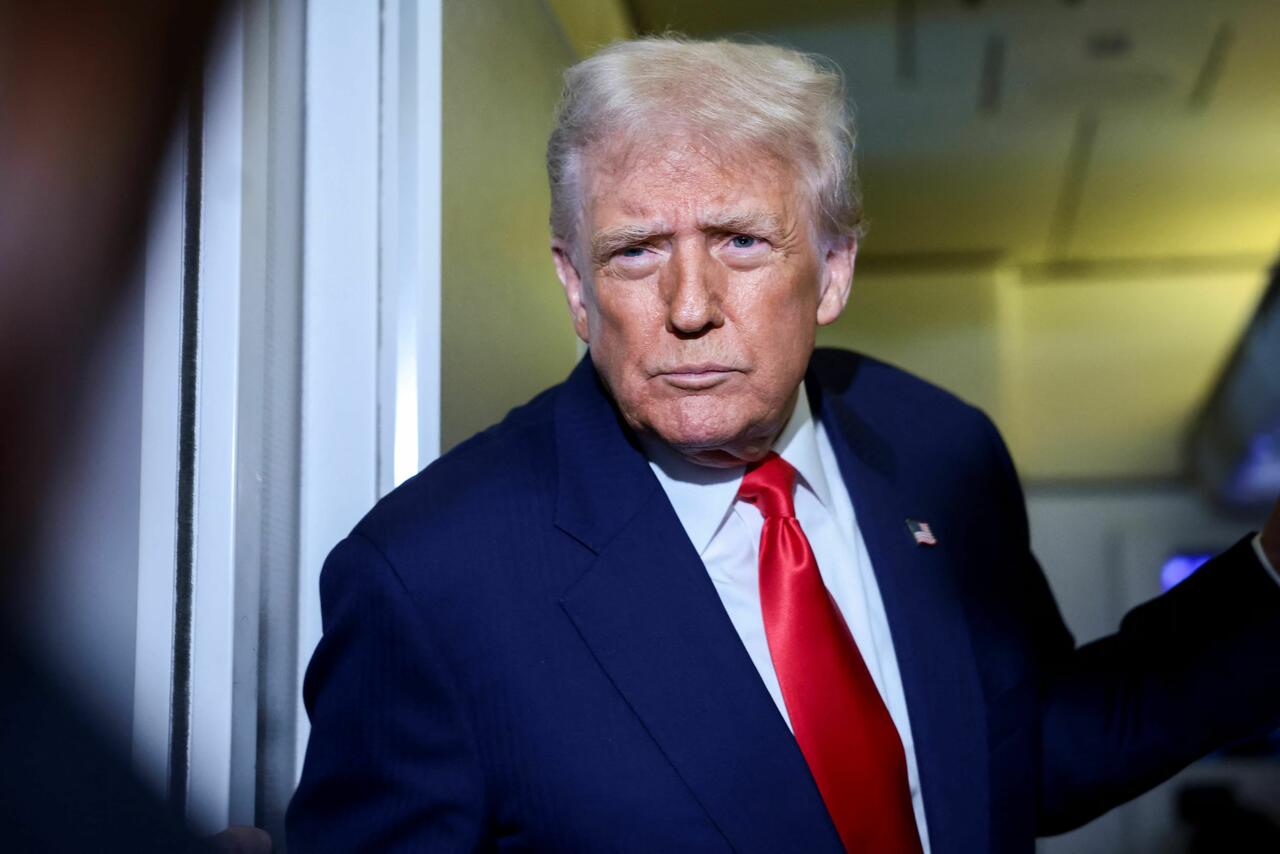
U.S. President Donald Trump speaks to members of the media on board Air Force One en route to the U.S., October 30, 2025. REUTERS/Evelyn Hockstein

Fresh off a trip to Asia, Trump said he faced questions overseas about why “powerful Republicans allowed” Democrats to shut down the government - and called on his party to act fast. “It is now time for the Republicans to play their ‘TRUMP CARD,’ and go for what is called the Nuclear Option - Get rid of the Filibuster, and get rid of it, NOW!” he wrote.

Under current Senate rules, most legislation, including funding measures, requires 60 votes to advance. Republicans hold just 53 seats, and while a few Democrats have occasionally sided with them on procedural votes, others, like Sen. Rand Paul (R-Ky.), have defected in the opposite direction. That math leaves Trump’s call a political long shot.

Johnson’s caution: "If the shoe was on the other foot…"

At a Friday press conference, House Speaker Mike Johnson (R-LA) didn’t directly break with Trump but made clear he’s wary of tampering with one of the Senate’s oldest guardrails.

The filibuster has traditionally been viewed as a very important safeguard,” Johnson said. “If the shoe was on the other foot, I don’t think our team would like it.

Johnson warned that eliminating the rule could pave the way for Democrats to grant statehood to Washington, D.C., and Puerto Rico - adding two likely Democratic senators - or ram through sweeping gun bans and other progressive priorities. He described Trump’s Truth Social broadside as “another expression of frustration, of the anger that has been felt, the anger by the President.”

Senate Republicans draw the line

Many Senate Republicans, especially veterans of the chamber, fear that once the filibuster is gone, there’s no going back. They say the rule forces both sides to seek compromise — and protects whichever party ends up in the minority.

The filibuster forces us to find common ground in the Senate. Power changes hands, but principles shouldn’t,” Sen. John Curtis (R-UT) wrote Friday, calling himself a “firm no” on eliminating it.

Senate Majority Leader John Thune (R-SD) - who has made preserving the legislative filibuster a central part of his leadership - also isn’t budging. “Leader Thune’s position on the importance of the legislative filibuster is unchanged,” a spokesman said Friday.

Thune has already faced pressure from the right, including Rep. Marjorie Taylor Greene (R-Ga.), to cave to Trump’s demands. But he and other Republicans insist that the short-term gain of reopening the government with a simple-majority vote isn’t worth the long-term fallout.

Even if Thune wanted to change course, he likely lacks the votes. Several Senate Republicans have said they won’t go along with any effort to end the 60-vote rule through the nuclear option — a parliamentary maneuver that lets the majority change Senate precedent with a simple majority.

Advocates of the move claim it could be narrowly written to apply only to spending bills. But critics warn that in practice, any change to the Senate’s precedents would effectively kill the filibuster for all legislation - opening the floodgates to one-party rule whenever control flips.

“It would be a drastic move for such a limited win as a stopgap spending bill,” one GOP aide told reporters.

Trump’s long-running feud with the filibuster

This isn’t the first time Trump has tried to “neuter” the filibuster. During his first term, he repeatedly urged then-Majority Leader Mitch McConnell (R-KY) to nuke it. McConnell, who made masterful use of the rule to stall Democratic priorities for years, refused.

Democrats, for their part, tried to kill the filibuster themselves in 2022 to pass election-law changes - but failed when Sens. Joe Manchin ( D-West VA) and Kyrsten Sinema (I-AZ) joined Republicans in opposition.

For now, Trump’s push appears to be more about political pressure than practical policy. Johnson and Senate GOP leaders are holding the line, warning that once the filibuster is gone, there’s no putting the genie back in the bottle.

Tyler Durden Fri, 10/31/2025 - 16:40
https://ift.tt/ptDzBCE
from ZeroHedge News https://ift.tt/ptDzBCE
via IFTTT

After Prez Urges 'TRUMP CARD', Mike Johnson Warns Democrats Will Wreak Havoc If GOP Kills Filibuster SocialTwist Tell-a-Friend
| 0 comments ]

Amazon Soars To Record High On Solid Guidance, Improving AWS Results

With mixed earnings from META and MSFT (both down) and GOOGL (up) yesterday, today attention turns to the other two Mag7 giants, AAPL and AMZN, with the latter reporting right after the close, and the former waiting the usual 30 minutes. With sentiment turning darker in the market throughout the day, these two companies may be critical to restore the upward momentum or else it could get ugly.

With that in mind, Amazon appears to be doing what it can to buck the downbeat mood by reporting results which the market clearly is impressed with - cloud growth exceeded estimates along with resilient North American sales.

Here is what the world's largest retailer just reported:

  • EPS $1.95 vs. $1.68 q/q, beating estimate $1.58

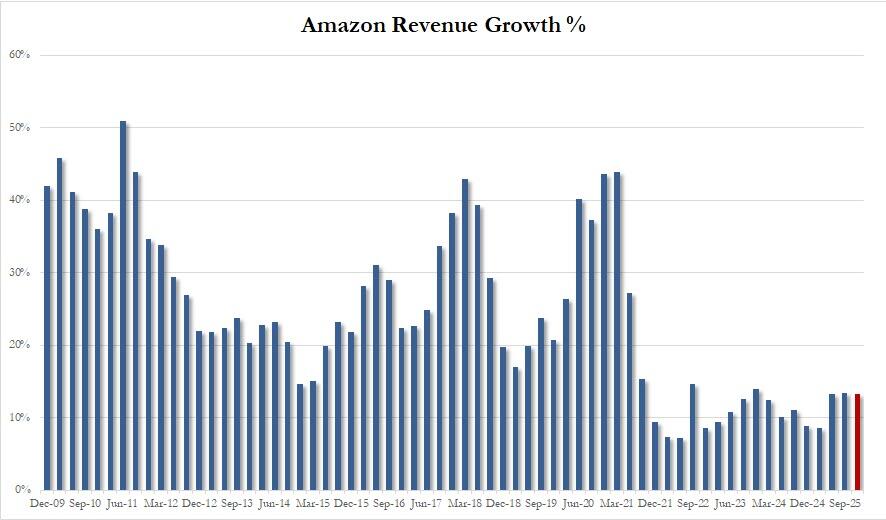
  • Net sales $180.17 billion, +13% y/y, beating estimate $177.82 billion 

    • Online stores net sales $67.41 billion, +9.8% y/y, beating estimate $66.93 billion

    • Physical Stores net sales $5.58 billion, +6.7% y/y, beating estimate $5.56 billion

    • Third-Party Seller Services net sales $42.49 billion, +12% y/y, beating estimate $42.05 billion

    • Subscription Services net sales $12.57 billion, +11% y/y, beating estimate $12.49 billion

  • Third-party seller services net sales excluding F/X +11% vs. +10% y/y, beating estimate +10.8%

  • Subscription services net sales excluding F/X +10% vs. +11% y/y, missing estimate +10.7%

Geographically the results were strong all around: 

  • North America net sales $106.27 billion, +11% y/y, beating estimate $104.96 billion

  • International net sales $40.90 billion, +14% y/y, beating estimate $40.77 billion

So far so good, with every line time beating. But what the market was especially focused on was the high margin AWS data, and here numbers also beat solidly: 

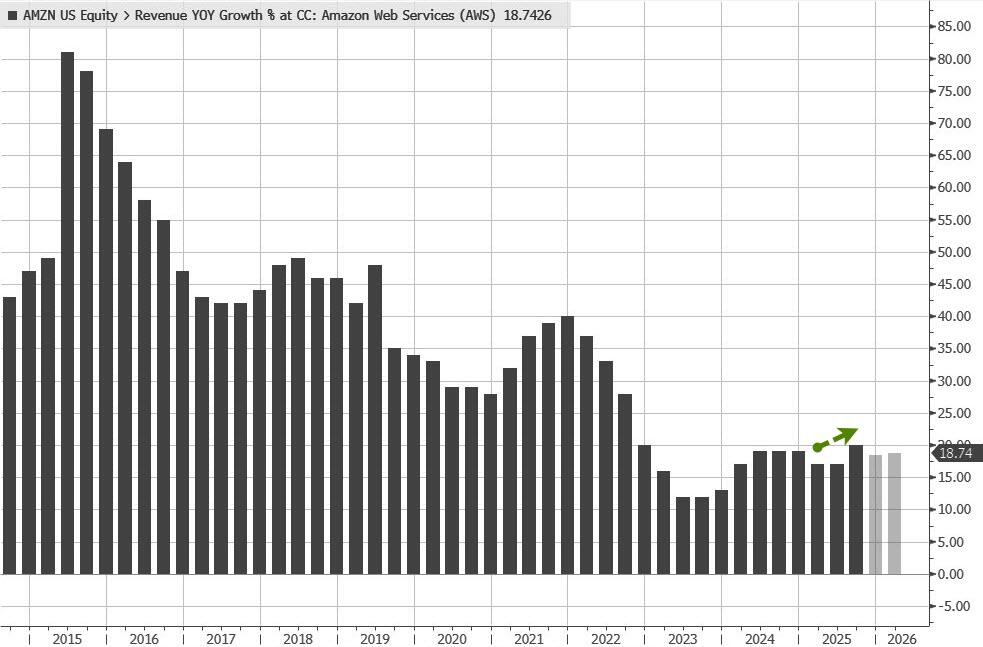
  • AWS net sales $33.01 billion, +20% y/y, beating estimate $32.39 billion

  • Amazon Web Services net sales excluding F/X +20% vs. +19% y/y, beating estimate +17.9%

That is the biggest year-over-year rise in AWS revenues since the end of 2022.

“We continue to see strong momentum and growth across Amazon as AI drives meaningful improvements in every corner of our business,” Jassy said in a statement.

Turning to operating profits, here the results were rather mixed: 

  • Operating income $17.42 billion vs. $17.41 billion y/y, missing estimate $19.72 billion

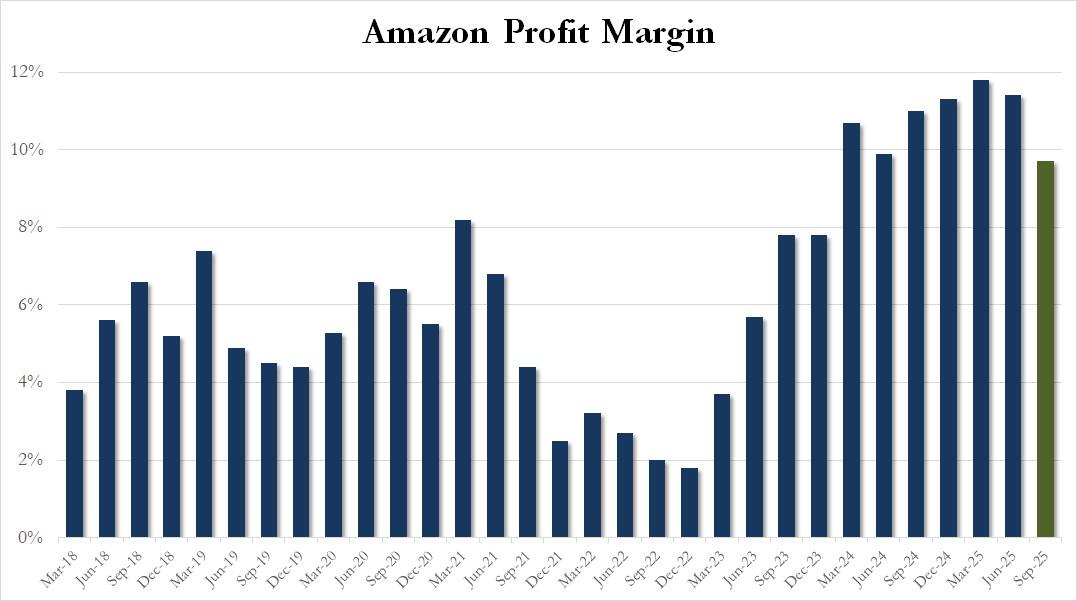
    • Operating margin 9.7% vs. 11% y/y, missing estimate 11.1%

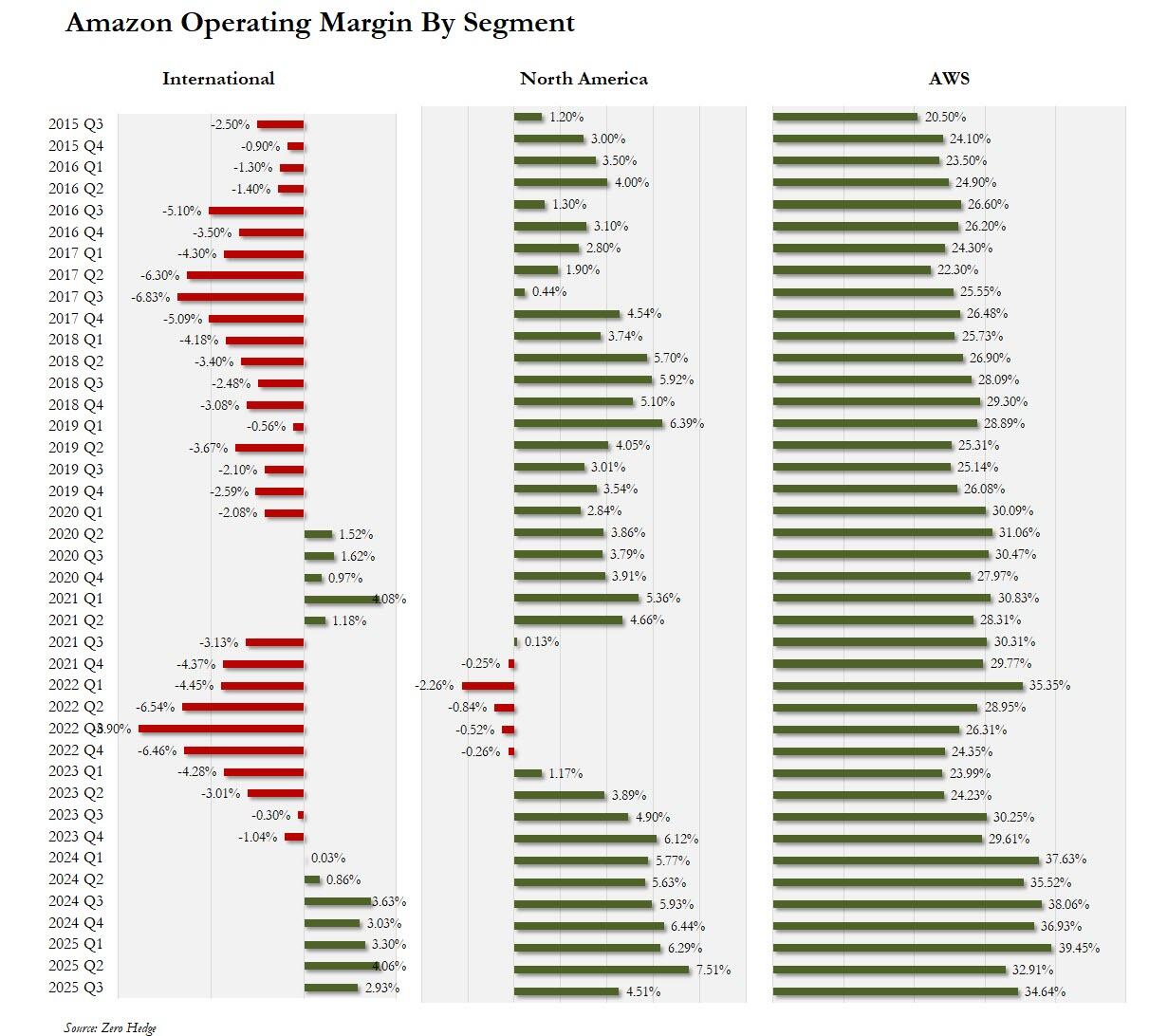
    • North America operating margin +4.5% vs. +5.9% y/y, missing estimate +6.98%

    • International operating margin 2.9% vs. 3.6% y/y, missing estimate 4.02%

As for fulfillment expenses, these came in slightly above estimates, as did the seller unit mix. These may deteriorate if  tariffs rise: 

  • Fulfillment expense $27.68 billion, +12% y/y, estimate $27.49 billion

  • Seller unit mix 62% vs. 60% y/y, estimate 60.7%

Of the above, the most notable highlight was AWS which grew revenue by 19.7% (stronger than the 19% year ago) to $33.0BN, above the sellside estimate of $32.39BN. That said, despite the latest quarterly beat, the growth rate is clearly slowing but not enough for the market to care right now:

Bloomberg reports that like its biggest rivals, Amazon has invested heavily in data centers and chips to build and operate AI models capable of generating text or images and automating processes.

  • Purchases of property and equipment during the most recent quarter jumped 55% to $35.1 billion, topping analysts’ projections.

Though Amazon has sought to position its cloud business as a marketplace for a broad range of AI tools, it has a lot riding on a single parter: Anthropic PBC, the maker of the Claude chatbot and software coding assistant.

Amazon is backing Anthropic with an investment of $8 billion, and built the startup a massive complex of data centers and custom AWS AI chips.

That system, called Project Rainier, is up and running, the company said this week. Google recently announced a deal to provide Anthropic with some of its own chips.

Amazon said its Trainium2 chip was “fully subscribed” and represented a multibillion-dollar business.

“We continue to see strong demand in AI and core infrastructure, and we’ve been focused on accelerating capacity – adding more than 3.8 gigawatts in the past 12 months," Amazon CEO Andy Jassy said in a letter to shareholders.

While AWS sales growth was solid, just as impressive was the the margin for the segment also increased from 32.9% in Q2 to 34.6%, beating the median Wall Street estimate of 33.95%, if below the recent average from the past two years. Elsewhere, North American profit dropped to $4.789 billion, resulting in a profit margin of 4.51%, missing estimates of 5.9%, while international margins dropped to to 2.93%, and also missing estimates of 3.6%

As a result of the drop in AWS profits, Amazon's consolidated operating margin posted a sequential drop and in Q3 declined from 11.4% to 9.7%, the lowest since 2023.

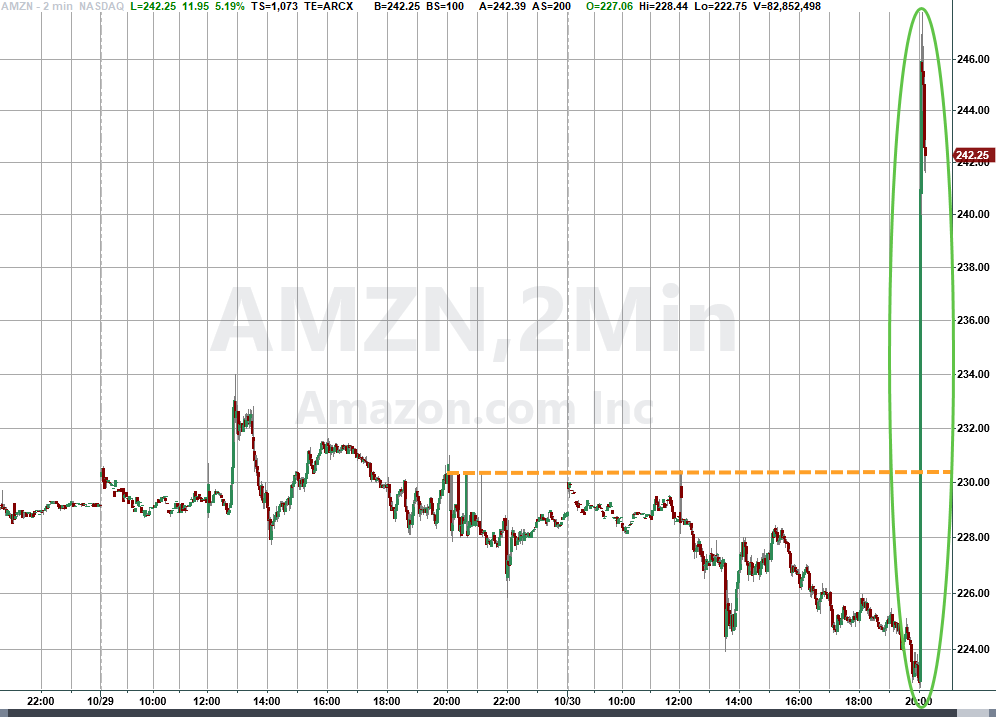
However, while the above data was solid, it was the company's guidance that cemented the stock's surge after hours; that's because the company projected revenue and profit in the current quarter which was seen as coming in above Wall Street expectations. 

  • Net sales are expected to be between $206.0 billion and $213.0 billion, or to grow between 10% and 13% compared with fourth quarter 2024, the mid point coming in above the estimate of 208.45BN

  • See operating income is expected to be between $21.0 billion and $26.0 billion, compared with $21.2 billion in fourth quarter 2024, the midpoint also beating the est. of $23.78BN

This means that revenue growth in Q3 is expected to print 13.2% YoY, just above the 13% in the current quarter and a continuation of the very solid recent growth.

In response to the solid guidance and the AWS results which came in above expectations, the spiked after hours, and surged just over $20, or nearly 9%, rising to a new all time high...

... as attention now turns to AAPL.

Tyler Durden Thu, 10/30/2025 - 16:32
https://ift.tt/sb57AZa
from ZeroHedge News https://ift.tt/sb57AZa
via IFTTT

Amazon Soars To Record High On Solid Guidance, Improving AWS Results SocialTwist Tell-a-Friend
| 0 comments ]

"Democrats Are Panicking"; Larry Klayman Warns They Realize "The Only Way To Take Control Of A Society Is To Destabilize It"

Via Greg Hunter’s USAWatchdog.com,

Just as predicted months ago by renowned attorney Larry Klayman, the Left continues to ramp up violence against ICE in the process of deporting millions of illegal aliens.  

Brace yourself for more savagery.  Klayman says, “It can only get worse..."

" President Trump has been incredibly successful in what he has done.  It’s not just shutting down the border or negotiating peace treaties.  It’s the record stock market, and the economy is generally doing very well. . . and inflation is coming down.  Because of that success . . . and even Bill Maher says Trump has been successful, the Democrats are panicking. 

They realize the only thing they can do is foment revolution. . .. They realize, as Karl Marx realized and Saul Alinsky realized, that the way you take control of a society is to destabilize it. 

You destabilize it by destroying Judeo-Christian values, and you destabilize it by creating civil unrest and revolution.”

InfoWars.com is reporting, “The Democrat Party is Officially Bragging that they are Going to Use the EBT/SNAP Benefit Shut Down to Trigger Mass Looting & Civil Unrest in the Hope of Igniting a Civil War.”  Klayman says:

“What was published by InfoWars was not way out.  It’s absolutely correct, and that is exactly what they are going to do.  It will be food riots and everything else...

We have seen two assassination attempts on President Trump.  We have seen a bounty on the head of Pam Bondi.  We have seen the assassination of Charlie Kirk. 

We have seen leaders from Chicago and the Governor (of Illinois) . . . the mayor of Boston, Massachusetts and all around the country, Portland and Seattle, are all calling for violence. 

We are in a situation where President Trump would be correct in using the Insurrection Act of 1807 and declaring martial law.  I believe he is about ready to do it.”

Klayman goes on to say, “You know what is interesting with regard to martial law?  There has never been a Supreme Court opinion that outlaws it..."

" We have used it 68 times in our nation’s history for riots.  It is perfectly legal, and it can be done by President Trump as a national declaration.  It is carried out by a military officer to quell unrest.  In the Insurrection Act, the President has to issue a proclamation, and then he can invoke that to quell unrest and civil disobedience that rises to the level of violence.  Those are two tools he can use here, and he ought to use them quickly.  He’s using the Insurrection Act now and in Chicago, and he’s going to the Supreme Court for clearance for that.”

In closing, Klayman points out, It is a full court press to destroy us physically, and in terms of us to be able to bring lawsuits and defend lawsuits on behalf of conservative libertarian and religious interests in this country.  These people are the disciples of the devil—period, as Joe Biden used to say."

There is more in the 63-minute interview.

Join Greg Hunter of USAWatchdog as he goes One-on-One with renowned lawyer and government corruption fighter, Larry Klayman, founder of FreedomWatchUSA.org for 10.29.25.

To Donate to USAWatchdog, click here.

Views expressed in this article are opinions of the author and do not necessarily reflect the views of ZeroHedge.

Tyler Durden Wed, 10/29/2025 - 16:20
https://ift.tt/CPQpmWB
from ZeroHedge News https://ift.tt/CPQpmWB
via IFTTT

"Democrats Are Panicking"; Larry Klayman Warns They Realize "The Only Way To Take Control Of A Society Is To Destabilize It" SocialTwist Tell-a-Friend
| 0 comments ]

Young Workers Will Pay The Price For Chicago Mayor's Employee Tax

Authored by Micky Horstman via AmGreatness.com,

This economy is one of the toughest job markets for entry-level positions, and now, Chicago Mayor Brandon Johnson is advancing new tax hikes in his budget that will make it even more difficult for Gen Z workers to build lives and careers in the city.

As he unveiled his third budget last week, Mayor Johnson took to a familiar tactic to fill a $1.15 billion budget shortfall: new taxes, higher fees.

The target of his worst tax hikes this time is the business community—and if history is any indicator, results are poised to be disastrous. Johnson announced he’d revive the city’s long-defunct business “head tax,” charging businesses with over 100 employees—such as McDonald’s, United, and other large firms—a $21 per employee per month fee.

Second-tier cities, including Raleigh, Baltimore, and our neighbor Milwaukee, have positioned themselves as technology hubs and are courting businesses and attracting young workers with affordable cost-of-living and well-paying positions.

Johnson, read the room. Chicago needs to do the same. Business giants such as Boeing, Caterpillar, TTX, Citadel, and Tyson have already left. This tactic will punish growth and make hiring even more expensive.

Even Gov. JB Pritzker has spoken out against the hike. Instead, the mayor is pushing for more taxes that risk driving out more businesses and young employees, right when Chicago most needs to grow and can least afford to lose them.

Chicago’s original head tax charged companies with 50 or more employees $4 per worker. It raised about $35 million annually before Mayor Rahm Emanuel phased it out, calling it a “job killer.”

The city estimates a new head tax could generate $100 million, yet the cost to Chicago’s competitiveness could be enormous. If you have 500 employees in Chicago, you would now owe $126,000 annually.

Chicago businesses already pay the third-highest state corporate income tax and the highest commercial property tax in the country. It’s no surprise that office vacancy continues to hit record highs, currently at 28%, and employers are fleeing to more competitive locales.

From 2015 to 2024, Chicago lost nearly one in five businesses—about 11,200 in total. The pandemic exacerbated a worrying trend. Chicago could lose hundreds more this year. Entrepreneurs and start-ups would be disincentivized from scaling or even opening their doors in Chicago in the first place. Why start a business in a city that will punish you for growing?

It would be especially hard for young Chicagoans trying to start their careers, as entry-level jobs are often the first ones cut when employers face new costs. Young workers who already struggle with Chicago’s rising cost of living may face fewer job openings, lower salaries, and slower hiring. New graduates across the Midwest could start choosing other cities instead.

Chicago’s unemployment rate already hovers around 4.6%—above the national average for large metro areas. Everyday Chicagoans are struggling to find work, while the city is pushing new taxes that will deter and punish large-scale employers, especially in blooming tech industries.

Johnson insists the city faces a “revenue challenge.”

But the problem stems from overspending and a city budget that’s grown faster than the city’s economy or population. Chicago’s budget has ballooned by $7 billion since 2019—a 62% increase. That’s more than double the growth rate of peer cities such as New York, Los Angeles, or Houston.

Federal relief masked overspending for years, but now that it’s gone, Johnson’s budget fails to address the increase in staffing and programming that was funded by temporary aid. As a result, City Hall keeps inventing new ways to nickel-and-dime Chicagoans. Johnson’s 2026 budget adds a first-in-the-nation social media tax on tech companies and increases taxes on rideshares, cloud-computing services, and sports betting.

Johnson would bankroll recent government spending by imposing a tax on private labor. Government institutions—Illinois’ fastest growing employer type—and nonprofits such as the Chicago Teachers Union will be exempt from the tax, despite being large employers themselves.

The city needs structural reform. Nearly 40% of Chicago’s local spending now goes to pensions and debt; the city desperately needs constitutional pension reform to address the growing, unsustainable burden. Chicago must right-size its government to at least 2019 levels, and should adopt a spending cap tied to 10-year inflation. Reducing the commercial property tax burden could also help attract large-scale firms that have been opting for low-tax states.

The best way to address the city’s revenue needs is to attract young residents and businesses and encourage existing employers to stay and expand—not by taxing them out of the city. Reviving a failed head tax will only make the city’s problems worse. It’s time to stop taxing work and start fixing government spending.

Tyler Durden Tue, 10/28/2025 - 17:00
https://ift.tt/n9iBw65
from ZeroHedge News https://ift.tt/n9iBw65
via IFTTT

Young Workers Will Pay The Price For Chicago Mayor's Employee Tax SocialTwist Tell-a-Friend
| 0 comments ]

Mid-Atlantic Lawmakers Unite In Push To Stop "Climate Cultists" As Power Bill Crisis Worsens 

The Maryland Freedom Caucus, a coalition of conservative Republican members of the Maryland House of Delegates, is preparing to go on the offensive alongside other state lawmakers across the Mid-Atlantic area in a new regional alliance to combat and break the stranglehold that far-left lawmakers have had on regional politics for decades, which they argue has torpedoed the regional power grid with failed climate change policies and triggered the worst power bill crisis in a generation. 

"Politicians and special interest groups have traded energy independence for a delusional climate cultist ideology, and every Maryland family is paying the price with skyrocketing bills and a rapidly dwindling energy supply," Maryland Delegate Brian Chisholm told local TV station Fox Baltimore.

Chisholm continued, "We stand firmly united with our colleagues in neighboring states to deliver real, adult solutions and finally put an end to the childish nonsense impacting our state."

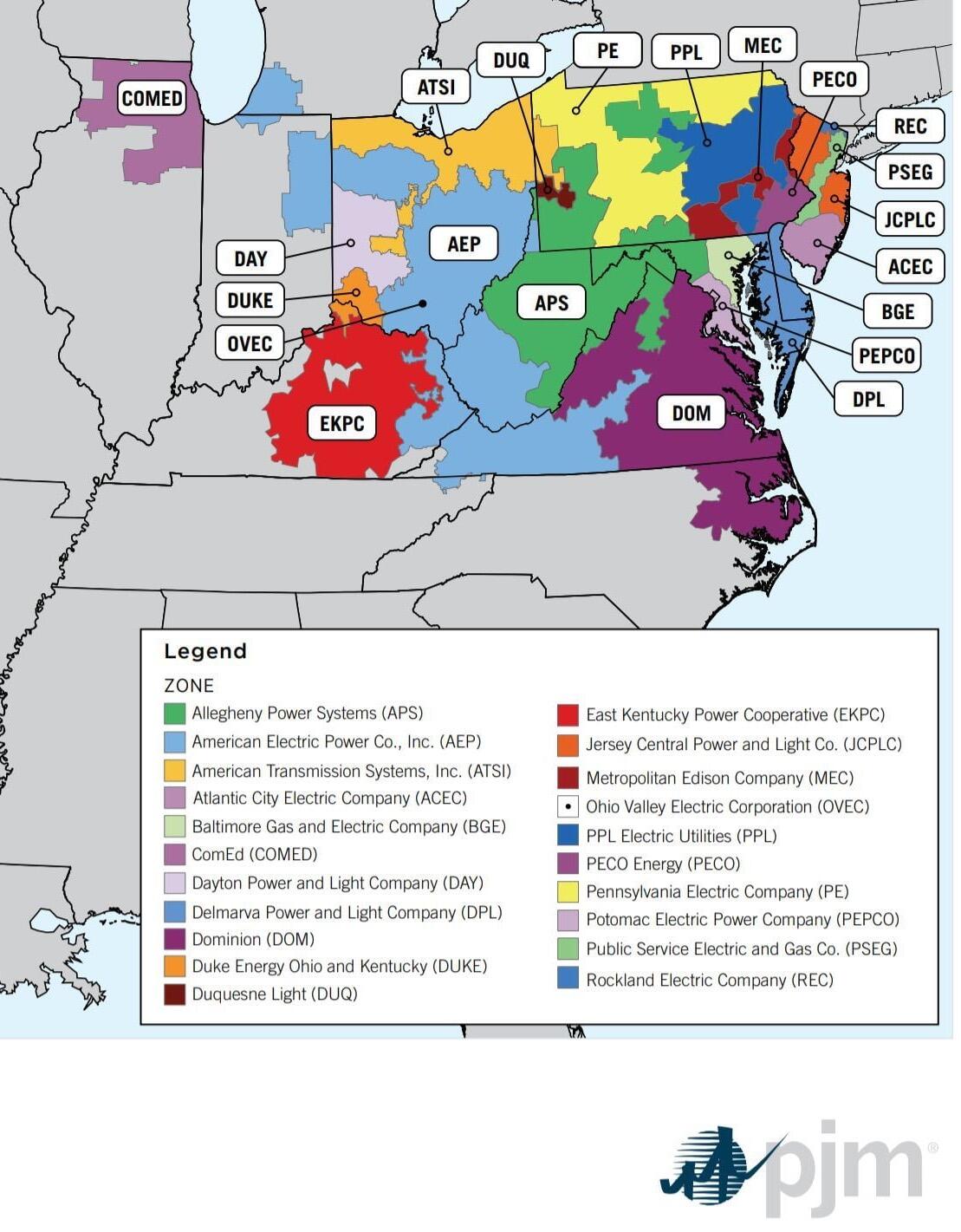
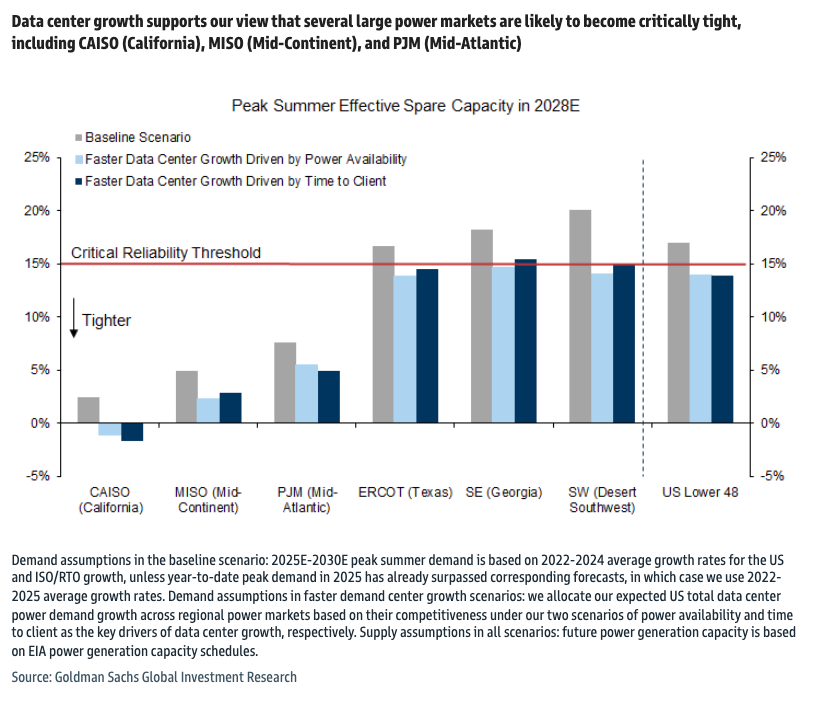
Powering the Mid-Atlantic plans to hold hearings in Pennsylvania, New Jersey, Maryland, and Virginia. The state delegates are joining forces because their states all share the same grid and transmission lines and have seen power bills skyrocket due to backfiring climate change initiatives, such as retiring reliable fossil fuel power plants for unreliable solar and wind. In return, PJM (Mid-Atlantic) remains critically tight, with limited spare capacity. We've outlined this alarming development last summer (read here). 

"Pennsylvania is poised to lead the energy revolution," said Representative David H. Rowe, chairman of the Pennsylvania House Republican Policy Committee. "Aligning energy policies with our neighboring states has been some of the most productive collaboration I've experienced this session. I commend my colleagues in the Maryland, New Jersey and Virginia delegations and look forward to working toward a balanced solution for a balanced grid."

The coalition of lawmakers comes as the power bill crisis spread across the Mid-Atlantic this year, from Maryland to New Jersey, putting Democrats who control these states at serious risk in future elections. 

With Election Day in New Jersey just days away, Republicans in the state launched an all-out blitz against Democrats, unveiling a new ad that pinpoints progressives for their epic mismanagement of the grid.

We've told readers...

Backfiring climate change initiatives have collided with the era of data center hookups across the Mid-Atlantic area. The Trump administration has rushed to bring retired fossil-fuel power plants back onto the grid to increase desperately needed spare capacity, while nuclear power won't be a major story until the 2030s.

Perhaps Republican lawmakers in the Mid-Atlantic have a breakthrough to communicate to voters just how terrible Democrats have become with their left-wing policies. Meanwhile, Democrats in these states have spent more time catering to illegal aliens, DEI, and other Marxist-aligned policies instead of finding proper solutions to fix this power mess. Sounds like people in these states are about to vote with their empty wallets.

Tyler Durden Mon, 10/27/2025 - 18:00
https://ift.tt/7cFERG5
from ZeroHedge News https://ift.tt/7cFERG5
via IFTTT

Mid-Atlantic Lawmakers Unite In Push To Stop "Climate Cultists" As Power Bill Crisis Worsens  SocialTwist Tell-a-Friend
| 0 comments ]

Task Forces Launched To Eliminate Violent Crime By Foreign Gangs, Cartels

Authored by Naveen Athrappully via The Epoch Times (emphasis ours),

The FBI and Homeland Security Investigations (HSI) have introduced new task forces cracking down on foreign gangs operating in the United States, the FBI said in a statement released on Oct. 24.

FBI agents patrol Beale Street in Memphis, Tenn., on Oct. 5, 2025. Travis Gillmore/The Epoch Times

These new teams, known as Homeland Security Task Forces, bring together FBI and HSI personnel—as well as task force officers from local, state, and federal partner agencies—to investigate transnational organized crime activity such as drug trafficking and human trafficking that occurs across all 50 states, the nation’s capital, and Puerto Rico,” the agency said.

According to the FBI, the task force is focused on “rooting out violent crime committed by foreign gangs, cartels, and other transnational criminal organizations impacting the United States.”

In an Aug. 8 statement, Immigration and Customs Enforcement (ICE) said it had arrested 356 gang members in the first six months of the Trump administration, who combined had been convicted of nearly 1,700 criminal offenses and had entered the United States illegally more than 1,400 times.

Arrested individuals included convicted murderers, thieves, child predators, and arsonists, the agency said. One individual was found to have illegally entered the country 40 times.

In total, members from 40 different gangs were arrested, including 39 individuals from the Salvadoran gang MS-13 and 25 from Venezuela’s Tren de Aragua gang.

On Oct. 16, ICE announced it had arrested more than 1,400 illegal immigrants in Massachusetts, including those related to transnational criminal gangs. Six of the arrested individuals were documented members of these gangs, and several more were associates.

In its recent statement, the FBI said the Homeland Security Task Forces will target criminal acts such as drug trafficking, homicide, extortion, money laundering, weapons trafficking, alien smuggling, kidnapping, and human trafficking.

Targeted groups will include those recently designated as foreign terrorist organizations by the federal government.

In February, the State Department designated multiple Mexican drug cartels and transnational criminal gangs as global terrorist organizations, including Tren de Aragua, MS-13, and the Sinaloa cartel.

The FBI said that although immigration investigations are not the focus of the task forces, investigators may examine immigration-related aspects as part of their probes.

In addition to the FBI and the HSI—an arm of the Department of Homeland Security (DHS)—task forces will include personnel from more than 15 federal agencies, such as Customs and Border Protection (CBP), the Department of War (officially the Department of Defense), Internal Revenue Service Criminal Investigation, and the Drug Enforcement Administration.

The task forces have been formed in response to a Jan. 20 presidential action signed by President Donald Trump, “Protecting the American People Against Invasion.” The order highlighted the dangers posed by the influx of millions of illegal immigrants into the country who present “significant threats to national security and public safety, committing vile and heinous acts against innocent Americans.”

It directed the attorney general and the secretary of Homeland Security to jointly set up Homeland Security Task Forces in all 50 states.

Threat of Transnational Gangs

According to ICE, transnational gangs take advantage of differences in law enforcement capabilities and legal jurisdictions to avoid detection and prosecution.

These groups focus on taking over the power and reach of other gangs, and competition between them leads to violence that affects the communities they operate in.

The violence and intimidation unleashed by the gangs create an environment of insecurity and fear in communities, and people refuse to cooperate with law enforcement because of concerns about their personal safety, ICE said.

On Sept. 2, Trump announced that U.S. forces in the Caribbean fired on what officials said was a drug boat from Venezuela, which ended up killing 11 Tren de Aragua members.

Talking about the incident during a Sept. 3 press conference, Secretary of State Marco Rubio said losing a small amount of drugs via seizures by U.S. forces was already factored into the economics of Mexican cartels and that stronger action is necessary to thwart such threats.

“Interdiction doesn’t work,” he said. “What will stop them is when you blow them up, when you get rid of them. So they were designated as what they are—they are narco-terrorist organizations.

“[Trump is] going to wage war on narco-terrorist organizations.

This one was operating in international waters, headed towards the United States to flood our country with poison, and under President Trump, those days are over.”

ICE deported several Tren de Aragua gang members, sexual predators, and other violent illegal immigrants from the United States back to Venezuela on Oct. 15, the DHS said in a statement.

“These public safety threats are out of the country and no longer pose a threat to Americans,” DHS Assistant Secretary for Public Affairs Tricia McLaughlin said.

Under the Trump administration, “more than 2 million illegal aliens have left the U.S.,” she said.

Meanwhile, CBP reported that illegal border crossings are now at historically low levels and that those who do cross are prosecuted swiftly.

According to the agency, there have been zero parole releases in September, “compared to 9,144 released by the Border Patrol under the Biden administration along the southwest border in September 2024.”

Tyler Durden Mon, 10/27/2025 - 17:00
https://ift.tt/dQ5Wmfr
from ZeroHedge News https://ift.tt/dQ5Wmfr
via IFTTT

Task Forces Launched To Eliminate Violent Crime By Foreign Gangs, Cartels SocialTwist Tell-a-Friend
| 0 comments ]

Investing In A Pre-War World

By Peter Tchir of Academy Securities

I’ve had the pleasure of having several in-person and video meetings with Academy’s Head of Geopolitical Strategy, General (ret.) Spider Marks. These discussions, such as this one at SIFMA’s Annual Meeting where Academy was given the privilege of speaking, have helped us solidify our framework around ProSec™.

Framing the conversation around a “Pre-War” world helps a lot in that respect as well.

When we use the word “investing” it is applicable to:

  • Asset managers who will drive the flow of capital.
  • Corporations who will invest to create opportunities for their companies and stakeholders.
  • Governments who will invest time and money into achieving their strategic goals.

We dug out this clip from July 2024, with Charles Payne on Fox Biz, where we talked about so many of the same issues – semiconductors, the processing and refining of rare earths and critical minerals, and of course, the need for energy.

Yes, we have “refined” our thoughts on the subject:

  • “Refine Baby Refine” was too narrow and never caught on anyways. It was too difficult to get people to think more broadly than just about oil and gas (with the reference to refine), and didn’t encapsulate our entire vision very well.
  • We pivoted to “National Production for National Security,” which is still our basic premise, but it is just a lot to say. I will admit, I spent some time with GROK and ChatGPT trying to figure out an acronym around this. We distilled it down to Production for Security (much easier to say 10 times fast, than “National Production for National Security,” which we are labelling as ProSec™).
    • No, ProSec is not a registered trademark, and yes, adding the “TM” makes typing these notes take longer.
    • Yes, we are working on an equity index that captures the ProSec™ concept, but if you think typing “TM” is out of my wheelhouse, then trying to build an equity index from scratch on a thesis that is evolving is in a league of its own.

Just over a week ago we published:

  • Is ProSec™ the New ESG? That is the moment when we really tried to home in on this concept as a longer-term investment, policy, and governance issue. Just like ESG dominated corporate culture, politics, and investments, we believe that ProSec™ is the evolution of that. It is starting in the U.S., but it will filter out to the rest of the world.
  • We delved into what we would focus on – anything from “lottery tickets” to National Champions. After this week, it is quite apparent that some of the “lottery tickets” are in the highly-speculative momentum bucket, as we had some wild swings. Which makes me wonder if “National Champions” may play an even bigger role than previously thought.
  • We would not want to own companies in the right “space” that are not heavily domestic- focused (though we are encouraged by the admin signing a deal with Australia where we will work with our allies to enhance how quickly we can achieve our goals). Our focus remains more on “processing and refining” and less on “extraction,” though both will be important

Now is a good time to “layer in” what we mean by a “Pre-War” World.

A Pre-War World

I am largely paraphrasing what Spider has been laying the groundwork on. Any deviations from Spider’s vision are either because of omission, misunderstanding, or I wanted to tweak things.

Since the end of World War II, we have been living in a Post-War World.

From the United Nations to NATO, we have been largely operating in a world outside of war.

The Soviet Union posed challenges, and that was the one sphere where “we” the “West” operated with a “Pre-War” mindset. Just think of the cooperation. The innovation. Even the sacrifices made to ensure that we would not go to war with the Soviet Union.

A Pre-War mindset does not automatically lead to war.

  • In fact, a properly executed Pre-War Strategy should lead to the AVOIDANCE of war.

Maybe that seems a bit convoluted, but it really fits with “Deterrence” and “Peace through Strength” (other long-running themes at Academy).

If you prepare well enough, conflict is less likely to arise as the attackers usually only attack when they see vulnerability (like Putin did with Ukraine – in which case he turned out to be wrong on his assessment of his forces and Ukraine’s, but that is another story).

We could argue that the Fall of the Soviet Union was a direct result of the Pre-War mentality being incredibly effective.

After the fall of the Soviet Union, we “basked” in the sunlight of the “Peace Dividend.”

There was no “war” footing anywhere, with the exception of in America. Even that “war” effort was primarily directed to the Middle East (oil was still a big deal) and against terrorism (which as we all know, is a difficult and complex battle).

Or so we thought.

While the West was busy enjoying the “Peace Dividend,” China was busy building up a significant military presence. Their equipment was improving, and the scope of their armed forces was growing. But it went far beyond just a military build-up. Expansion and militarization of the South China Sea Islands, constant “testing” around Taiwan and the Philippines, the Belt and Road Initiative, and the rapidly growing trade with countries (particularly the autocratic resource-rich nations) are all examples of this. Let’s not even talk about their rapidly growing industry, including their electricity production.

We used to “half joke” in meetings that the U.S had a “vision” of sustainability, but no plan to get there. And that China had no vision, but an excellent plan on how to get control of the things we might need. I say “half joke” because at the time you had to say it with only mock seriousness as you might have gotten tossed out of the room, depending on the audience.

The D.I.M.E. framework of levers of power was in full display with China.

  • Diplomacy.
  • Information.
  • Military.
  • Economic.

Let’s not go too far backward in time, but A D.I.M.E. Framework for China, Trade, and Strategic Competition from December 2019, crafted with a lot of guidance and input from General (ret.) Walsh, isn’t a bad read. General (ret.) Walsh was part of the group that first labelled China as a “Strategic” Competitor in National Defense Policy.

This is important for two main reasons:

  • We think it shows that China has had a “Pre-War” mentality and we need to shift to that to truly compete effectively with them.
  • The strategies outlined by the DoD really do impact markets via geopolitics. That is important as we will highlight some new potential shifts in policy.

ProSec™ Thrives in a Pre-War World

Again, as you know (and are probably sick of hearing) we have been pushing for Production for Security for some time. Re-inventing how we view “National Security” to encompass anything that we need to be secure (with chips and electricity generation as much at the forefront as a new weapons systems).
While that policy can work, it can be slow. If we are truly developing a Pre-War mindset, the difference is:

  • Urgency. From putting astronauts on the moon, to the Manhattan Project, you can see what a sense of urgency can achieve. If you are already “tired” of the headlines in and around ProSec™, then I suspect that you will be “really tired” soon, as the pace of developments along all fronts expands rapidly. Just this week, I think the government added quantum to their list of announced discussions, and drones also had some headlines.
    • The Russia/Ukraine war has taught us all a lot about the importance of drones in warfare going forward. While we knew it, it was unclear if Congress understood the urgency (Congress has a lot of influence on what the military spends money on). Expect rapid advancements on the drone front – both in the air and on the sea.
  • Sacrifice. Countries are often able to pull off amazing things when they move to “shared” sacrifice. It is difficult to argue that this theme didn’t help Ukraine with Russia or Israel with Iran. Is Deregulation a Sacrifice? For many it is. Probably for all of us, there are some regulations that we are wedded to. But will some deregulation (that we might not accept in a Post-War World) be acceptable in a Pre-War World?
    • We have often written and discussed that one of the great privileges of my job is that I get to talk to so many people in government and in so many different industries, from so many parts of the country (and increasingly, the world), and they all seem closer to agreement than if you lived in a world driven by social media (or more broadly, non-financial media). I think there is an immense amount of room “in the middle” to adopt policies that don’t make everyone happy, but are workable (it will probably go too far, but for today, I’m writing as the optimist).

The impetus to invoke ProSec™ is just beginning in the U.S. It will grow here and spread to our allies as well. This is THE investment theme – and it does incorporate AI and Data Centers as the U.S. being the leader there, and is necessary to “win” the Pre-War.

Where is the DoD Turning Their Attention?

China has been and will continue to be the “pacing” threat, but there are strong signals coming out of D.C. that we will see a “shift” in emphasis.

That we will put “defense of the U.S. homeland” as a higher priority.

Just like National Production for National Security requires us to think about producing more than tanks and weapons, this policy will make us think differently about “border” security and I think, more importantly, about national security.

The "war" on drugs has hardly been a war.

With what is occurring in and around Venezuela, drug smuggling is being elevated to the status of “war.” The U.S. is taking measures not seen before. As Spider has said, presumably the actions have been vetted by lawyers within the DoD and been given the go-ahead.

My view (and not everyone on the GIG agrees with me), is that the actions around Venezuela are going to set new levels of acceptable engagement that will be brought against the Mexican Cartels when the time is right. Presumably in conjunction with the government of Mexico, but maybe the U.S. will do things unilaterally to “protect our nation.”

Again, these national policy papers have real world repercussions.

Bottom Line

ProSec™ was always more than “just a trade” but I believe it is rapidly developing into a crucial way to invest (at the corporate, government, and asset manager level). At some point, if I can get my act together, we might even have some indices that capture this movement.

As I hit send on this report, I imagine some consternation amongst many of our readers, but I think we will also see an acknowledgement that while ProSec™ is rough around the edges, there is something substantial about it, and it will become a global theme.

To be perfectly honest, all we have to do is examine what China has been doing and is doing (look at their recent developments on chips and AI) and we have a pretty clear view of what ProSec™ looks like!

While Pre-War sounds scary (and it is), a successful Pre-War plan will keep us from getting to the War stage.

Tyler Durden Sun, 10/26/2025 - 18:40
https://ift.tt/QR6fgde
from ZeroHedge News https://ift.tt/QR6fgde
via IFTTT

Investing In A Pre-War World SocialTwist Tell-a-Friend
| 0 comments ]

Trump Says He Won't Meet With Putin Until There's A Deal On Ukraine

Authored by Jacki Thrapp via The Epoch Times,

President Donald Trump said on Oct 25 that he doesn’t plan to meet with Russian President Vladimir Putin until a peace deal with Ukraine is reached.

“I’m going to have to know that we’re going to make a deal,” Trump said while speaking to journalists on Air Force One at a pitstop on his way to Kuala Lumpur, Malaysia, for a week-long Asia tour.

“I’m not going to be wasting my time. I’ve always had a very great relationship with Vladimir Putin, but this has been very disappointing.”

On Oct. 21, Trump called off a potential summit with Putin in Budapest, Hungary, because he only wants to meet if it will push forward his administration’s efforts to end the war in Ukraine.

The cancellation announcement happened two months after their meeting in Alaska failed to produce a peace deal.

“I thought this would have gone long before peace in the Middle East,” Trump said.

“We have Azerbaijan and Armenia—that was very tough. In fact, Putin told me on the phone, he said, ‘Boy, that was amazing,’ because everybody tried to get that done and they couldn’t. I got it done. You had others. If you look at India and Pakistan. I could say almost any one of the deals that I’ve already done I thought would have been more difficult than Russia and Ukraine, but it didn’t work out that way. There’s a lot of hatred between the two, between [Ukrainian President Volodymyr] Zelenskyy and Putin.”

On Oct. 22, the Trump administration announced stricter sanctions on Russia, which impacted the country’s two largest oil companies, due to “Russia’s lack of serious commitment to a peace process to end the war in Ukraine,” according to a press release by the Treasury Department.

Trump suggested he might bring up China’s purchases of Russian oil when he meets with Chinese Communist Party (CCP) leader Xi Jinping for a wide-ranging meeting set for the last day of his Asia trip on Oct. 30, in Busan, South Korea.

“I may be discussing it,” Trump said.

“You probably saw today, China is cutting back very substantially on the purchase of Russian oil, and India is cutting back completely. And we’ve done sanctions.”

The commander in chief added that he hopes to get a “complete deal” that takes care of American farmers and stops fentanyl, originating in China, from arriving on U.S. soil.

Trump is expected to kick off the first full day of his Asia trip in Malaysia, where he’s set to have meetings with Prime Minister of Malaysia Anwar Ibrahim, Prime Minister of Cambodia Hun Manet, and Prime Minister of Thailand Anutin Charnvirakul on Oct. 26.

Tyler Durden Sun, 10/26/2025 - 17:30
https://ift.tt/a8YSFMf
from ZeroHedge News https://ift.tt/a8YSFMf
via IFTTT

Trump Says He Won't Meet With Putin Until There's A Deal On Ukraine SocialTwist Tell-a-Friend
| 0 comments ]

Japan Will Play A Much Greater Role In Advancing The American Agenda In Asia

Authored by Andrew Korybko via Substack,

Putin’s senior aide Nikolai Patrushev gave an interview to Arguments and Facts about Japan on the 80th anniversary of its unilateral surrender in World War II in early September that’s important to raise wider awareness of after the appointment of its new ultra-nationalist prime minister. He began by reminding everyone that “Tokyo zealously cultivated an open racism that surpassed German Nazism in its absurdity and inhumanity. And the sovereignty of other countries was considered an empty phrase there.”

Patrushev then touched upon Imperial Japan’s failed geopolitical plot to turn the Sea of Japan into an inland sea and even seize Kamchatka so as “to gain undivided possession of the Sea of Okhotsk” too. He assessed that Japan’s current campaign for “’justice’ on the issue of the so-called ‘northern territories’” is just a disguise for a similar plot to obtain control over new marine (seafood and mineral) resources. Patrushev accordingly warned that it’s planning to make new claims to Russian maritime territory.

The emerging trend of misportraying Imperial Japan as the “victim” of Soviet aggression in 1945, despite the Allies having agreed in advance that the USSR would open up the Manchurian Front three months after the Nazis’ defeat, is meant to lend false legitimacy to these claims. This threat shouldn’t be downplayed, Patrushev warned, since Japan’s “Self-Defense Forces” de facto function as national armed forces, are NATO-backed, and are “systematically building a powerful and ultra-modern submarine fleet”.

In his words, “Japan is one of the most powerful naval powers in the world today. Its fleet is capable of solving almost any task even in remote areas of the World Ocean. The Japanese Navy closely cooperates with the NATO fleet, and at any moment they can be integrated into Western coalition formats.” Even more concerning are Japan’s nuclear breakthrough capabilities: “it is capable of creating its own nuclear arsenal and means of delivery in a few years” if the decision is made, according to Patrushev.

Nevertheless, these threats shouldn’t be exaggerated either since Russia is “building up defensive potential in the Far East and strengthening our naval power in the Pacific Ocean”, thus meaning that it’s more than capable of defending itself from Japan. Rather, “The threat lies not so much in the destroyers and missiles, but in the fact that the national consciousness of the Japanese is shifting from pacifism to rabid revanchism”, which he attributed to a long-running “aggressive propaganda” campaign.

The purpose is to precondition the population to accept the risks associated with Japan more actively advancing US interests in the region via the “Squad” (those two, Australia, and the Philippines), which is envisaged as the core of AUKUS+, the US’ desired NATO-like regional analogue. Japan’s place in the US’ Chinese Containment Coalition just rose as a result of the unexpected Sino-Indo rapprochement, prior to which the US wanted India to play a complementary role, so Japan is now at the forefront of this effort.

The trend is that New Cold War’s focus is shifting from US-led NATO’s containment of Russia in Europe to US-led AUKUS+’s containment of China in Asia, all while the TRIPP Corridor injects Western influence into the Eurasian Heartland to stir trouble for both. India’s Pakistani rival is also poised to play a supportive role on the Central Asian front if tensions with the Taliban abate.

Altogether, Poland, Japan, Turkiye, and possibly Pakistan are now the US’ top containment allies, which isn’t lost on Russia, India, and China.

Tyler Durden Sat, 10/25/2025 - 17:30
https://ift.tt/yYa6XBp
from ZeroHedge News https://ift.tt/yYa6XBp
via IFTTT

Japan Will Play A Much Greater Role In Advancing The American Agenda In Asia SocialTwist Tell-a-Friend
| 0 comments ]

US Slaps Extensive Sanctions On Colombian President & Family Over Narco-Trade

Amid an ongoing verbal spat and back-and-forth between Washington and Bogotá, the United States on Friday announced extensive sanctions against Colombian President Gustavo Petro, along with his family and a senior cabinet minister.

The Trump White House has accused the Colombian administration of enabling drug cartels and facilitating narcotics trafficking to North America, at a moment of immense US military build-up near Venezuela and Latin America.

Via CBS News

Treasury Secretary Scott Bessent said in a statement that ever since Petro took office in 2022, "cocaine production in Colombia has exploded to the highest level in decades, flooding the United States and poisoning Americans."

He hailed Trump's "decisive action to protect our nation" which sends "a clear message that drug trafficking will not be tolerated."

The sanctions also target First Lady Verónica del Socorro Alcocer García, Petro’s son Nicolás, and Interior Minister Armando Benedetti - all alleged to be the Colombian leader's "accomplices."

American citizens and companies are now effectively barred from doing any business with these listed entities, and they will also see any assets held in the US frozen.

Petro has loudly denounced and rejected the accusations against his country, saying he's long aggressively fought the significant drug trade in his country.

The NY Times notes that a rise in illegal drugs out of the country has been a trend which began before Petro took office, though the cocaine trade has continued to worsen under his leadership.

"The cultivation of coca, the base product in cocaine, has soared since Mr. Petro took office in 2022. It also soared under his predecessor, Iván Duque, a conservative and close ally of Washington Republicans," the publication writes.

"In the CIA, we didn’t give a hoot about democracy. It was fine if a government was elected and would cooperate with us, but if it didn’t, then democracy wouldn’t mean a thing to us."

-Former CIA Agent Philip Agee

The NY Times reviews further:

Mr. Petro, a leftist, is one of few leaders in Latin America who have been vocal in their criticism of Mr. Trump’s decision to bomb boats carrying people his administration says are drug traffickers. The bombings have killed dozens of people, and Mr. Petro has said that Colombians have been among them and has accused the United States of committing murder.

Mr. Trump has responded by calling Mr. Petro “an illegal drug leader” and said that he would cut off aid to Colombia. About $377 million was designated to Colombia in the 2024 fiscal yearaccording to the Congressional Research Service. About a third of that money is meant for law enforcement and narcotics control.

But when it comes to the many decades-long so-called 'war on drugs' - there's plenty of blame to go around. The CIA has at times even participated in it at times, to raise funds for the Nicaragua Contras in the 1980s, for example.

Days ago the US for the first time attacked alleged drug smuggling boats on the Pacific side of South America for the first time, suggesting these operations could geographically expand at any time.

Tyler Durden Sat, 10/25/2025 - 15:45
https://ift.tt/8YGokDu
from ZeroHedge News https://ift.tt/8YGokDu
via IFTTT

US Slaps Extensive Sanctions On Colombian President & Family Over Narco-Trade SocialTwist Tell-a-Friend
| 0 comments ]

"Suitcases Filled With Dollars": Venezuela Reportedly Propped Up America's Radical Left To Sow Chaos

U.S. military developments in the Caribbean Sea, off the coast of Venezuela, are ramping up this week. Two additional narco-terror drug boats were destroyed with guided missiles, and there was news overnight that two Rockwell B-1 Lancer supersonic bombers entered Venezuela's ADIZ before switching off their transponders in what appears to have been a simulated strike mission - a posturing maneuver that President Trump denies

Venezuela's socialist regime is coming under intense pressure from the Trump administration for using cartel networks it controls to smuggle drugs into the U.S., contributing to the worst drug death crisis in American history, with more than 100,000 deaths per year. Some have described the drug death crisis as a "reverse Opium War." Last week, President Trump authorized covert CIA operations inside the country, an escalation that only suggests command and control structures of drug cartels will be targeted. He noted, "No to CIA-orchestrated coups d'état."

While the mainstream narrative is that these military efforts are aimed at dismantling cartel-linked drug trafficking networks, there may be another objective for the Trump administration, one that would certainly interest Secretary of State Marco Rubio.

As Washington Examiner reporter Mike Gonzalez reveals, Venezuela has been exporting left-wing political influence operations, some of which may be linked to dark-money-funded NGO networks. If accurate, the report suggests that stopping the radical left from destabilizing the U.S. and attempting to collapse capitalism to install a socialist or Marxist system may require scrutinizing foreign-linked networks. And perhaps that's why Venezuela is front and center with the Trump administration. 

But Caracas's transgressions extend to other areas. It has also long backed efforts to sow political division on U.S. streets. First, it supported Black Lives Matter and its founders. Now, it's antifa.

. . . 

Indeed, you can tell a lot about which domestic anti-U.S. groups are rising by the support they get from our enemies overseas, especially Venezuela, but also Iran, Cuba, and China. That Venezuela is diversifying into "anti-fascism" is yet another sign of how diminished BLM has become.

. . .

Venezuela played more than a supportive role in this attempt. Last week, I spoke with a former senior Venezuelan official who was very close to the dead dictator Hugo Chavez and who has now defected. He told me he was in the room in late 2012 when Chavez gave Opal Tometi — who the following year helped to found BLM — suitcases stuffed with dollars.

"Chavez ordered his people to hand the suitcases to them, suitcases filled with dollars, at least $20 million," the defector told me, adding that Tometi was accompanied by three other African American women and the actor Danny Glover, a huge supporter of the Marxist regimes in Venezuela and Cuba. "Chavez told them that the money was to project the Bolivarian revolutionary project on U.S. streets," he said, using Chavez's term for Venezuelan Marxism.

. . . 

All this networking, at Chavez's behest, happened years before BLM was founded in 2013 and helped create momentum for it. Garza pretty much revealed that the USSF was created at the request of America's enemies overseas at a speech she gave in Oakland in 2010.

So the mayhem we had on our streets, and all the stress it brought, was carried out by people who networked and carried out street organizing to help Marxist dictators in Caracas, at the very least, and may have received outright financial backing from them. Revolutionary Venezuela continued its relationship after BLM's founding by, for example, inviting representatives to gatherings of the Foro de Sao Paulo, the Hemispheric Marxist network Venezuela promoted.

. . .

Then, on January 9 to 11 this year, to coincide with Maduro's inauguration after actually losing elections last year, Caracas hosted an International Anti-Fascist Festival, which organizers said had over 2,000 attendees from 125 countries.

At the most recent one, last January, the Party for Socialism and Liberation was an attendee from the U.S. The U.K. Revolutionary Communist Group, another antifa group, also sent Sam McGill to four of the Venezuelan anti-fascist events.

And Code Pink, another antifa adjacent group, which has to boot connections to the Chinese Communist Party, has also sent members to visit Caracas and Havana.

What this all suggests, if the Washington Examiner report is correct, is that some of the nonprofits that helped sow chaos on America's streets in what can only be described as a color-revolution-style operation to undermine President Trump and conspired against the U.S. may have been influenced by foreign adversaries. These left-wing groups may also have direct links to broader NGO networks in the U.S. connected to the Democratic Party and their donor class of radical leftist billionaires.

The question, if this reporting is accurate, is whether the proper way, as the White House stated last month, to "dismantle" the radical left is through enforcement actions across the nonprofit world. This all aligns with Trump's recent claim that the Soros network "should be charged under RICO for supporting violent protests."

Civil terrorism expert Jason Curtis Anderson of One City Rising adds more color... 

If the Trump Administration wants to target South American influence operations, they should look no further than the People's Forum in NYC. While the People's Forum catches a lot of flak for its Shanghai-based benefactor, Neville Roy Singham, one could easily argue that they also help Venezuela and Cuba's agendas as well. 

In July of 2024, Manolo De Los Santos and fellow Singham operatives traveled to Caracas to do "election observing" and PR for Maduro. The Singham network also hosted Bruno Rodríguez, Foreign Minister of Cuba, and Yván Gil Pinto, Foreign Minister of Venezuela, at an event last year in Harlem. 

Match these with the constant pro-Venezuela protests held by the People's Forum in NYC, displaying clear signs of political pressure on behalf of a foreign government, and this should meet the qualifications for FARA, which does not require financial payments to meet the threshold of violation

. . . 

Tyler Durden Fri, 10/24/2025 - 16:40
https://ift.tt/3Mab0XJ
from ZeroHedge News https://ift.tt/3Mab0XJ
via IFTTT

"Suitcases Filled With Dollars": Venezuela Reportedly Propped Up America's Radical Left To Sow Chaos SocialTwist Tell-a-Friend
| 0 comments ]

Latest Harvard Enrollment Data Show Drop In Black Students, Uptick In Asians

Aaron Gifford via The Epoch Times,

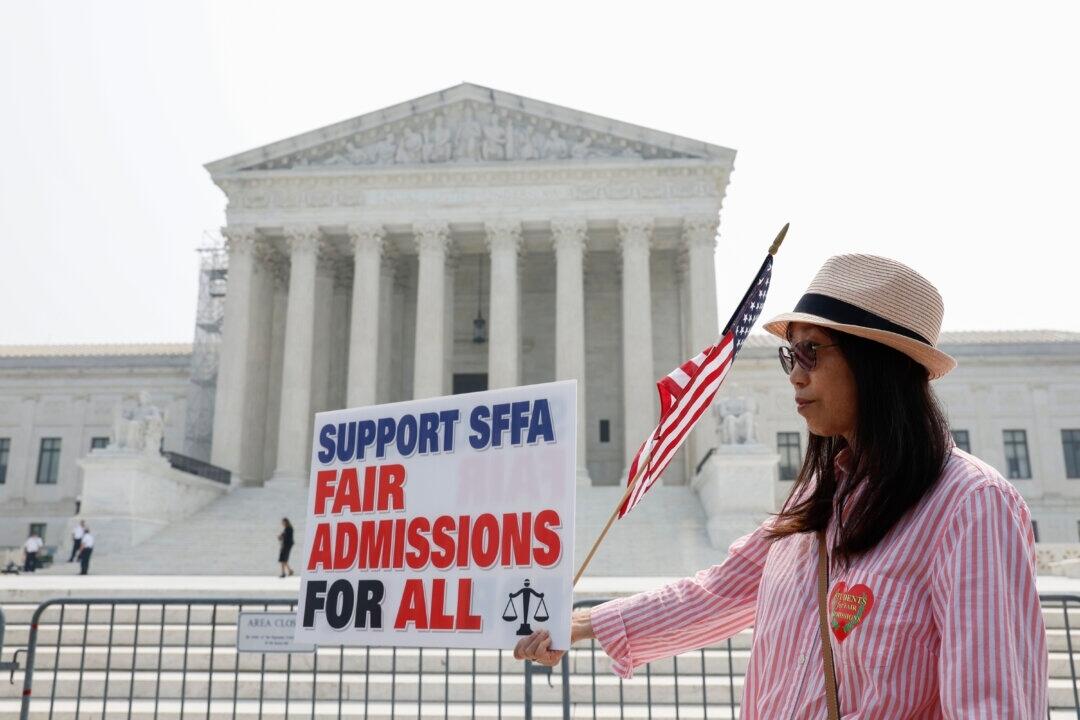
Two years after the U.S. Supreme Court decision prohibiting racial preference in higher education admissions, the nation’s oldest university is reporting a decline in undergraduate black student enrollment.

Harvard University, in a profile of the Class of 2029 released today, noted that black American students make up 11.5 percent of the freshman class. That’s a decrease of 2.5 percent from last year, 2.6 percent from 2023, and 5.1 percent from 2020, according to undergraduate data released by the school each year.

In 2023, the Supreme Court sided with plaintiffs, Students for Fair Admissions, which sued Harvard on the grounds that the university denied applicants of Asian descent because that group overrepresented the undergraduate student body, violating Civil Rights laws.

Asian students, meanwhile, make up 41 percent of Harvard’s undergraduate Class of 2029, up from 37 percent in last year’s freshman class and 29.8 percent in 2023.

“The class of 2029 was drawn from big cities and small towns, suburbs, and farms; and from nations around the world,” William Fitzsimmons, Harvard’s dean of admissions and financial aid, said in the Oct. 23 announcement on the university website.

“No matter where they’re from and what their personal circumstance might be, they were admitted to Harvard because they share the extraordinary potential to change the world.”

According to The Harvard Gazette, the class of 2029 also includes 11 percent self-identified Hispanic or Latino and nearly 2 percent Native American, Native Hawaiian, or Pacific Islander.

Students for Fair Admissions also recently took action against the U.S. service academies, reaching a settlement with the Department of Defense to end race-based admissions at West Point and the Air Force Academy, and filing a lawsuit against the Coast Guard Academy over racial preferences in its commissioning program, according to the organization’s website.

President Donald Trump issued executive orders affirming Civil Rights laws that prohibit racial preferences in university hiring and student admissions and, following investigations, sanctioned Harvard and several other elite institutions.

In August, he issued a directive requiring colleges and universities to publicize acceptance rates, enrollment figures, and average applicant grade point averages and SAT (Scholastic Aptitude Test) scores by race and gender.

In recent years, many competitive higher education institutions have eliminated SAT requirements and instead mandated personal statements or essays from student applicants, raising concerns that they are being used to ideologically screen applicants for entry.

Matthew Beienburg, education policy director at the Goldwater Institute, said those changes are an attempt to preserve racial preferences in admissions.

“The left believes standardized testing promotes racial inequality,” he previously told The Epoch Times. “They pushed [for substituting tests with personal essays] very hard.”

Harvard’s Class of 2029 also noted that 2,003 undergraduate applicants out of 47,893 applicants were accepted, and that nearly half of the 1,675 first-year students won’t be required to pay tuition.

International students make up 15 percent of the freshman class, which also represents 92 nations and all 50 states, the profile report stated.

Tyler Durden Fri, 10/24/2025 - 15:05
https://ift.tt/5jXTNSO
from ZeroHedge News https://ift.tt/5jXTNSO
via IFTTT

Latest Harvard Enrollment Data Show Drop In Black Students, Uptick In Asians SocialTwist Tell-a-Friend
| 0 comments ]

NATO Jets Scrambled Over Lithuania After Russian Aircraft Breach Airspace

NATO member Lithuania on Thursday alleged that a pair of Russian jets violated its sovereign airspace, in what the government quickly condemned as a breach the country's territorial integrity.

"This evening, Russian military planes violated Lithuanian air space. This is a blatant breach of international law and territorial integrity of Lithuania," the country's President Gitanas Nauseda said in a statement.

Illustrative file image via AP

Alluding to recent EU plans to create a joint aerial defense and drone shield to protect European airspace from Russian incursions, he added: "Once again, it confirms the importance of strengthening European air defense readiness."

Nauseda further announced that his foreign ministry will be summoning Russian diplomatic representatives, to lodge formal protest against the "reckless and dangerous behavior".

Lithuania's military said it scrambled jets in response to the brief incursion. It said:

Today, Russian military aircraft briefly entered Lithuanian airspace. Our forces acted quickly with NATO jets on patrol. Lithuania remains strong and ready. Every inch of our country is protected.

Initial reports say that two Russian military planes violated the airspace for a mere 18-seconds.

Baltic and Eastern European countries, including Poland, have for several weeks been complaining of Russian aerial incursions. This month Denmark hosted a summit where a 'drone wall' was the focus:

Fortified by intense security measures after a wave of drone incursions above airports and sensitive sites, two high-stakes summits in the Danish capital offered a mounting sense of collective clarity — and a possible solution that sounds like science fiction: a “drone wall.”

“There is only one country that are willing to threaten us, and it is Russia,” Danish President Mette Frederiksen told reporters on Wednesday, adding that Europe was in the middle of a “hybrid war.”

“I think we are in the most difficult and dangerous situation since the end of the Second World War,” she added. “I want us to rearm. I want us to buy more capabilities. I want us to innovate more.”

Likely Thursday's event happened off Lithuania's coast over the Baltic Sea, where Russian and NATO planes frequently patrol.

Via BBC

The biggest recent incidents involved many drones entering Poland, followed by a late September incident over Estonia which saw three Russian MiG-31 fighter jets allegedly entered Estonian skies "without permission and remained there for a total of 12 minutes," according to a government statement at the time.

Tyler Durden Thu, 10/23/2025 - 14:25
https://ift.tt/sXLGAhD
from ZeroHedge News https://ift.tt/sXLGAhD
via IFTTT

NATO Jets Scrambled Over Lithuania After Russian Aircraft Breach Airspace SocialTwist Tell-a-Friend