| 0 comments ]

Florida Cities Enforce Curfews And Mass Arrests After Spring Break Chaos

Do certain groups of people deliberately seek out chaos?  Do they revel in it so much that they choose to create it from thin air wherever they go?  Or, are they completely unaware of the destruction that follows them around?  One thing is certain - they obviously don't care about how it affects the people around them.  

Spring Break in Florida has always been a wild affair attracting masses of young vacationers from across the US to white sandy beaches, condos and the night life.  Decades ago, the locals were complaining just as they are now, but in recent years the demographics have changed dramatically and with this change comes the inevitable increase in random criminal violence.  It's not just loud parties and DUIs anymore.

Some residents are now referring to these incidents as "Ghetto Spring Break".  With the demographic being pushed out of traditional getaways like Miami Beach due to higher fees and restrictions, they have surged into alternatives like Fort Lauderdale and Daytona Beach.  This has led to skyrocketing crime and essentially unusable tourist spots. 

A large percentage of the crime is committed by minors and college age vacationers.  Underage teens roam in massive groups unaccompanied by parents is a common scene.  Authorities made more than 130 arrests last weekend, including 84 in Daytona Beach and 49 in New Smyrna Beach.  Officials say they specifically plan to bring the hammer down on "takeover events" which involve spontaneous parties announced on social media that takeover random streets, beaches or city blocks.  Such events usually end with violence. 

Daytona has been forced to declare a state of emergency and implement sweeping restrictions including a youth curfew from 8pm to 6am and zero-tolerance enforcement for violence, fighting, disorderly conduct, etc.  Authorities have responded with a heavy police presence.


Similar measures have been used to great effect in deterring the "usual suspects" from showing up to certain cities during the season.  The fatigue is very real, so much so that some traditional travel destinations are willing to sacrifice some tourist dollars in order to avoid gaining a reputation as a spring break cesspool.  

For example, violent crime reports and arrests for spring break used to make up 20% of Miami's yearly total, and this spike occurred in the span of just a couple of weeks.  Miami, dealing with dozens of shootings per season and thousands of arrests, decided to start cracking down on festivities in 2025. 

New measures included parking garage closures in South Beach, restricted beach access (e.g., certain entrances closing at 6 p.m.), sobriety checkpoints, potential curfews, high parking fees ($100 in some areas), no coolers/tents/tables/loud music on the beach, increased police presence and targeted road closures.  Incidents are down 21% so far this year, and there are no reported spring break related shootings. 

Florida cities are no longer embracing the concept of "grinning and bearing" this kind of tourist influx in exchange for quick cash.  The new regulations and fees also prove that cities are capable, to some extend, of filtering out the worst perpetrators of seasonal crime.  The first step to eliminating mindless mobs is to stop enabling mindless mobs. 

*  *  * ORDER BY MIDNIGHT PST / FREE SHIPPING OVER $500

Tyler Durden Sun, 03/22/2026 - 18:30
https://ift.tt/KPl46pU
from ZeroHedge News https://ift.tt/KPl46pU
via IFTTT

Florida Cities Enforce Curfews And Mass Arrests After Spring Break Chaos SocialTwist Tell-a-Friend
| 0 comments ]

Clinton-Appointed Federal Judge Blocks Trump's Pentagon Media Access Restrictions

Authored by Matthew Vadum via The Epoch Times (emphasis ours),

A federal judge on March 20 issued an order blocking the Trump administration’s media access policy at the Pentagon after The New York Times sued over the restrictions.

An aerial view of the Pentagon in Arlington, Va., on Dec. 15, 2025. Madalina Kilroy/The Epoch Times

The Department of War tightened its rules for the media in September 2025 after officials said reporters were roaming the halls of the Pentagon. The department took the position that the restrictions were reasonable and designed to safeguard national security.

The new rules provided that soliciting non-public information from department personnel or encouraging employees to break the law “falls outside the scope of protected newsgathering activities.” They also stated that reporters would be denied press passes if officials determined they posed a safety or security risk.

Most members of the Pentagon press corps declined to sign an acknowledgement of the new policy and lost their press passes.

In December 2025, The New York Times sued, arguing that the policy violated the U.S. Constitution’s First Amendment by restricting “journalists’ ability to do what journalists have always done—ask questions of government employees and gather information to report stories that take the public beyond official pronouncements.”

U.S. District Judge Paul L. Friedman wrote in his new ruling that the drafters of the First Amendment “believed that the nation’s security requires a free press and an informed people and that such security is endangered by governmental suppression of political speech.”

That principle has preserved the nation’s security for almost 250 years. It must not be abandoned now.”

Friedman held that the Pentagon press policy ran afoul of both the First and Fifth Amendments.

Friedman repeated a comment he made in open court in which he said the federal government has been dishonest in its communications with the public about military matters in the past.

We’ve been through, in my lifetime, you know, the Vietnam War, where the public, I think it’s fair to say, was lied to about a lot of things. We’ve been through 9/11. We’ve been through the Kuwait situation, Iraq, Guantanamo Bay.”

The judge also wrote that the department could not show that it would be harmed by the cancellation of the policy, which the judge said was vague and “fails to provide fair notice of what routine, lawful journalistic practices will result in the detail, suspension, or revocation” of a press pass.

The policy’s “true purpose and practical effect” was “to weed out disfavored journalists—those who were not, in the Department’s view, ‘on board and willing to serve,’—and replace them with news entities that are,” he wrote.

Washington-based Friedman issued a permanent injunction preventing the department from enforcing the challenged restrictions. The judge also ordered the department to reinstate the credentials of six reporters and to file a status report with the court by March 27 certifying compliance with its order.

The New York Times spokesperson Charlie Stadtlander said the media organization “welcomes today’s ruling, which enforces the constitutionally protected rights for the free press in this country.”

“Americans deserve visibility into how their government is being run, and the actions the military is taking in their name and with their tax dollars. Today’s ruling reaffirms the right of The Times and other independent media to continue to ask questions on the public’s behalf.”

The Epoch Times reached out for comment from the U.S. Department of Justice, which represents federal agencies in court. No reply was received by publication time.

Zachary Stieber contributed to this report.

Tyler Durden Sun, 03/22/2026 - 17:00
https://ift.tt/Yqkfztd
from ZeroHedge News https://ift.tt/Yqkfztd
via IFTTT

Clinton-Appointed Federal Judge Blocks Trump's Pentagon Media Access Restrictions SocialTwist Tell-a-Friend
| 0 comments ]

On The Hidden Fragility Of Our Energy-Dependent World & The Cascading Consequences Of A Supply-Shock That Money Alone Can't Fix

Authored by Milan Adams via Preppgroup blog,

For a long time, I accepted the same framework most people in finance operate within—that the global economy is, at its core, a system governed by monetary policy, shaped by interest rates, and stabilized by central banks. It’s an appealing idea because it suggests control. If growth slows, you lower rates. If inflation rises, you tighten conditions. If markets panic, you inject liquidity. There is a sense that someone, somewhere, is ultimately in charge of the system. But the longer I watch what is unfolding now, the more that framework feels incomplete, almost like a simplified map that works in normal conditions but fails the moment reality becomes more physical than financial. What we are seeing today forces a different perspective—one that is much less comfortable—because it suggests that the economy is not primarily a financial construct, but an energy-dependent system, and that everything we consider “economic activity” is simply a byproduct of energy being converted into work, goods, and services.

The disruption in the Strait of Hormuz, now stretching into multiple weeks, is not just another geopolitical event that can be neatly categorized and priced into markets. It is, in practical terms, a restriction on one of the most critical physical flows in the global system. A significant share of the world’s oil and natural gas moves through that corridor, and when that flow is constrained—even partially—the impact is not theoretical. It is immediate at the physical level, even if it is delayed in how it manifests economically. This is where the disconnect begins. Financial markets, by their nature, operate on expectations. They price what participants believe will happen—future resolutions, policy responses, geopolitical outcomes. But the physical world does not operate on expectations. It operates on what is available, here and now. If a portion of energy supply is removed from the system, that energy does not exist for consumption, regardless of how markets choose to price the future.

This distinction between financial perception and physical reality is critical, because it explains why, on the surface, everything can still appear relatively stable. Benchmark prices may not reflect the full severity of the situation, supply chains may continue to function with minor disruptions, and daily life may feel largely unchanged. But beneath that surface, constraints begin to build. Energy markets start to tighten in specific regions. Physical deliveries become more expensive or harder to secure. Refined products begin to diverge from crude benchmarks. None of these signals, on their own, create a sense of crisis. But together, they form a pattern that suggests the system is under strain. And unlike demand-driven shocks, where activity can be restarted once confidence returns, a supply-driven constraint introduces a different kind of pressure—one that cannot be resolved through financial means alone.

The reason this matters is because modern economic thinking is heavily biased toward demand-side explanations. When something goes wrong, the assumption is that consumption has weakened, that credit conditions have tightened, or that confidence has deteriorated. The solution, therefore, is to stimulate demand—lower rates, increase liquidity, encourage spending. This framework has worked repeatedly over the past decades, which reinforces the belief that it is universally applicable. However, it breaks down when the problem is not insufficient demand, but insufficient supply of critical inputs. In such cases, stimulating demand does not resolve the issue; it exacerbates it. If energy is scarce, increasing consumption only intensifies the competition for limited resources, pushing prices higher without increasing availability.

What makes the current situation particularly complex is that it places policymakers in a position where traditional tools become not just ineffective, but contradictory. Inflation driven by supply constraints would normally call for tighter monetary policy, yet slowing production and weakening economic activity would argue for easing conditions. This creates a structural dilemma often described as stagflation, but in practice it feels less like a defined economic state and more like a constraint with no clean exit. There is no policy lever that simultaneously restores growth and reduces inflation when the underlying issue is physical scarcity. This is the point where the limitations of a purely financial understanding of the economy become visible.

Beyond the immediate effects on energy markets, the implications extend into areas that are less visible in the short term but far more consequential over time. Modern industrial systems are deeply dependent on continuous energy input, and when that input becomes constrained, the effects propagate unevenly. High-energy industries are typically the first to adjust, either through reduced output or temporary shutdowns, as governments and operators prioritize essential consumption. This may appear manageable at first, but the system is interconnected in ways that amplify these adjustments. Reduced industrial output affects supply chains, which in turn impacts the availability of intermediate goods, and eventually filters down to consumer products. The process is gradual, which makes it easy to underestimate, but it is cumulative.

Perhaps the most underappreciated aspect of energy constraints is their relationship to food production. Modern agriculture is not simply a function of land and labor; it is an industrial process reliant on fertilizers, machinery, and transportation, all of which are energy-intensive. The production of nitrogen-based fertilizers, for instance, depends heavily on natural gas. When gas supply is disrupted, fertilizer production declines, and the effects are not immediate but delayed. Planting decisions are affected, yields are reduced, and the consequences emerge months later in the form of lower harvests and higher food prices. This lag creates a false sense of stability in the present, even as future constraints are effectively being locked in.

Another layer of complexity arises from the uneven distribution of both resources and vulnerabilities across different regions. Economies that are heavily dependent on imported energy are inherently more exposed to disruptions in global supply, while those with domestic production capacity and resource diversity have a relative advantage. However, this does not imply immunity. Even resource-rich economies operate within a global system, and disruptions elsewhere can feed back through trade, pricing, and financial channels. Moreover, access to resources is not determined solely by availability, but by policy decisions, infrastructure, and distribution mechanisms, all of which can introduce additional constraints.

As the duration of the disruption extends, time itself becomes a critical variable. Short-term interruptions can often be absorbed through inventories, strategic reserves, and temporary adjustments. But as those buffers are depleted, the system becomes increasingly sensitive to continued constraints. Restarting disrupted flows is not instantaneous. Maritime backlogs take time to clear, storage imbalances need to be resolved, and production that has been halted may require significant time and investment to restore. In some cases, the interruption itself causes lasting damage, reducing the efficiency or capacity of the system even after normal operations resume. This creates what could be described as a “lagging deficit,” where the effects of the disruption persist beyond its apparent resolution.

What makes this moment particularly difficult to interpret is that it does not present itself as a clear break from normality. There is no single indicator that signals a transition from stability to crisis. Instead, it unfolds as a gradual divergence between what appears stable and what is becoming constrained. Markets may continue to function, prices may not fully reflect underlying scarcity, and daily life may remain largely unchanged for a period of time. But beneath that surface, the system is adjusting in ways that are not immediately visible, and those adjustments tend to become apparent only after they reach a certain threshold.

The challenge, then, is not simply to predict specific outcomes, but to recognize the nature of the constraint itself. An economy that is limited by financial conditions behaves very differently from one that is limited by physical resources. In the former, policy intervention can often restore equilibrium. In the latter, equilibrium is redefined by what is physically possible. This distinction may seem subtle, but it has profound implications. It suggests that the range of potential outcomes is wider than what most models account for, and that the path back to stability—if it exists—is likely to be more complex and more prolonged than in previous cycles.

At a broader level, this situation forces a reconsideration of how we think about growth, stability, and resilience. For decades, the assumption has been that economic expansion can continue as long as financial conditions are managed effectively. But if growth is ultimately constrained by energy availability, then that assumption becomes conditional rather than absolute. The system can expand only within the limits imposed by its physical inputs, and when those inputs are disrupted, the adjustment is not just financial—it is structural.

None of this necessarily implies an immediate or inevitable collapse. There are still pathways through which the situation could stabilize, whether through geopolitical resolution, reallocation of supply, or demand adjustments. But it does suggest that the risks are asymmetrical. If the disruption is resolved quickly, the system may absorb the shock with manageable consequences. If it persists, the effects compound in ways that are difficult to reverse. And because those effects build gradually before becoming visible, there is a tendency to underestimate them in the early stages.

What stands out most, in the end, is not any single data point or scenario, but the shift in perspective that this moment demands. When the economy is viewed primarily as a financial system, stability appears to depend on policy and market behavior. When it is viewed as an energy-dependent system, stability depends on something more fundamental—the continuous availability of the physical inputs that sustain it. And when those inputs are constrained, even temporarily, the implications extend far beyond what traditional economic frameworks are designed to capture.

If we extend this line of thinking even slightly, it becomes clear that what matters most in the current situation is not just the existence of a disruption, but its duration and the way it interacts with the rigid structures of the global system. Modern supply chains, energy networks, and industrial processes are optimized for efficiency, not resilience. They are designed to function under the assumption of continuity, where inputs arrive on time, in predictable quantities, and at relatively stable prices. When that assumption holds, the system performs remarkably well. But when it breaks—even partially—the system does not adapt smoothly. Instead, it begins to reveal how little slack actually exists within it. Buffers that were assumed to be sufficient turn out to be temporary, and redundancies that were considered unnecessary suddenly become critical.

One of the most important aspects of this dynamic is that the system does not fail all at once. It degrades in layers. At first, the adjustments are subtle and often invisible outside of specific sectors. Energy-intensive industries begin to reduce output, not because demand has disappeared, but because input costs and availability make normal operations unsustainable. This reduction may even appear rational or contained at the macro level, as if the system is efficiently reallocating resources. However, these industries are not isolated. They form the foundation of broader supply chains, and when their output declines, the effects propagate outward. Intermediate goods become less available, production timelines extend, and costs begin to rise across multiple sectors simultaneously. The process is gradual, but it is cumulative, and once it reaches a certain threshold, it becomes self-reinforcing.

What complicates this further is the interaction between physical constraints and financial expectations. Markets tend to price in future normalization, especially in situations where past experience suggests that disruptions are temporary. This creates a scenario in which forward-looking indicators may imply stability even as current conditions deteriorate. The result is a divergence between what is expected and what is actually unfolding. This divergence can persist for some time, particularly if participants believe that policy intervention or geopolitical developments will resolve the issue. However, if those expectations prove overly optimistic, the adjustment in markets can be abrupt, as prices and valuations recalibrate to reflect a reality that has already been developing beneath the surface.

A useful way to understand this is to consider how dependent the global economy is on continuous energy throughput. In periods of steady growth, improvements in efficiency allow output to increase without a proportional rise in energy consumption. This creates the impression that the relationship between energy and growth is flexible. However, in periods of contraction driven by supply constraints, the relationship becomes far more rigid. Certain baseline functions—such as heating, transportation of essential goods, and basic food production—cannot be reduced beyond a certain point without causing systemic disruption. As a result, a relatively modest reduction in total energy supply can lead to disproportionately large effects in non-essential or marginal activities. These activities are not eliminated in a coordinated manner, but rather through a process of cascading adjustments that reflect both economic and physical limitations.

The implications of this become particularly significant when considering the role of time in amplifying these effects. In the early stages of a disruption, inventories and reserves provide a buffer that masks the severity of the underlying constraint. Strategic stockpiles, such as petroleum reserves, can temporarily offset reduced supply, and businesses may rely on existing inventories to maintain operations. However, these buffers are finite, and their depletion introduces a new phase of the adjustment process. As inventories decline, the system becomes increasingly sensitive to ongoing disruptions, and the margin for error narrows. At this point, even small additional constraints can have outsized effects, as there is less capacity to absorb them.

Another critical factor is the behavior of production systems under interruption. Unlike financial systems, which can often be restarted with relative speed once conditions stabilize, physical production systems are subject to more complex dynamics. In the energy sector, for example, shutting down production is not always reversible without cost. Wells that are taken offline may experience pressure changes, reduced flow rates, or mechanical issues that require time and investment to address. Similarly, industrial facilities that halt operations may face challenges in restarting processes, particularly if they depend on continuous input flows or specialized conditions. This means that even after a disruption is resolved, the recovery process may be slower and less complete than expected, creating a persistent gap between pre-disruption capacity and actual output.

When these dynamics are combined with geopolitical uncertainty, the range of potential outcomes expands significantly. The Strait of Hormuz is not merely a transit point; it is a chokepoint that concentrates a substantial portion of global energy flows within a narrow geographic corridor. This concentration introduces a form of systemic risk, as disruptions in that location have global implications. The longer the disruption persists, the more likely it is that secondary effects will emerge, including changes in trade patterns, shifts in pricing structures, and alterations in investment behavior. These effects may not be immediately visible, but they contribute to a gradual reconfiguration of the system.

At the same time, it is important to recognize that responses to scarcity are not purely economic. They are also political and strategic. In an environment where critical resources become constrained, the incentives for cooperation can weaken, particularly if domestic pressures intensify. Governments may prioritize internal stability over external commitments, leading to restrictions on exports, adjustments in allocation policies, or interventions in markets. These actions, while rational from a national perspective, can exacerbate global imbalances, as they reduce the overall availability of resources in international markets. This creates a feedback loop in which scarcity leads to protective measures, which in turn deepen scarcity.

The potential consequences of this dynamic become more pronounced when extended over longer timeframes. A disruption lasting a few weeks may be absorbed with limited structural impact, but one that extends into months begins to affect planning cycles across multiple sectors. In agriculture, for instance, decisions made during planting seasons are based on expectations of input availability and cost. If those expectations are disrupted, the effects are not confined to the present but extend into future harvests. Similarly, in industrial production, investment decisions may be delayed or altered in response to uncertainty, affecting capacity in subsequent periods. Over time, these adjustments accumulate, leading to a measurable impact on overall economic output.

Historical comparisons can provide some context, although they are not perfect analogues. The oil crisis of the 1970s, for example, demonstrated how supply constraints can lead to a combination of high inflation and low growth, fundamentally altering economic trajectories. However, the global system today is more complex, more interconnected, and in many ways more optimized for efficiency than it was at that time. This increased complexity amplifies both the benefits of normal operation and the risks associated with disruption. As a result, while past events can offer insight into potential dynamics, they may underestimate the speed and scale at which effects can propagate in the current environment.

From a financial perspective, this introduces a different kind of risk profile than what is typically encountered in demand-driven downturns. In those scenarios, asset prices often decline in response to reduced earnings and tighter financial conditions, but the underlying capacity of the system remains intact. In a supply-constrained environment, however, the challenge is not just reduced demand, but impaired production capacity. This affects margins, disrupts business models, and introduces uncertainty that is difficult to quantify. Assets that are valued based on long-term growth assumptions become particularly sensitive to changes in discount rates and input costs, while real assets linked to physical resources may perform differently.

At the individual level, the effects of these dynamics are likely to be experienced less through abstract indicators and more through changes in everyday conditions. Prices may rise, availability of certain goods may fluctuate, and services that were previously taken for granted may become less reliable. These changes are often gradual at first, which can make them easy to dismiss or rationalize. However, as they accumulate, they contribute to a broader shift in perception, as individuals adjust their expectations and behavior in response to a changing environment.

Ultimately, the defining characteristic of the current situation is not any single outcome, but the interaction between physical constraints, financial expectations, and human behavior over time. Each of these elements influences the others, creating a system that is dynamic but not necessarily stable. Understanding this interaction requires moving beyond a purely financial framework and recognizing the role of physical inputs in shaping economic possibilities. It also requires acknowledging that adjustments to constraints are rarely smooth or evenly distributed, and that the path from disruption to equilibrium—if such an equilibrium exists—may be more complex than anticipated.

What emerges from this perspective is not a definitive prediction, but a shift in how risk is understood. Instead of focusing solely on probabilities derived from past cycles, it becomes necessary to consider structural limits and the ways in which they can alter the range of possible outcomes. This does not mean that extreme scenarios are inevitable, but it does mean that they cannot be dismissed simply because they fall outside of familiar patterns. In a system that depends fundamentally on continuous energy flow, disruptions to that flow have the potential to reshape the environment in ways that extend beyond traditional economic analysis.

If we attempt to frame what lies ahead, the difficulty is not a lack of possible scenarios, but the fact that each of them depends on variables that are largely outside the scope of traditional economic analysis. Military timelines, geopolitical decisions, insurance constraints in maritime transport, and the simple physics of energy production all play a role in determining outcomes. This makes forecasting inherently uncertain, but it does not make it impossible to outline a range of plausible paths. What becomes clear, however, is that even the more optimistic scenarios involve a degree of disruption that is materially different from what has been experienced in recent economic cycles.

In the most favorable case, the disruption is resolved relatively quickly. A ceasefire is reached, transit through the Strait resumes, and confidence returns to markets. Even under these conditions, the recovery would not be immediate. Maritime traffic would need time to normalize, with vessels clearing backlogs and supply chains rebalancing. Storage imbalances, particularly in regions close to the disruption, would need to be resolved, and production that had been curtailed would require time to ramp back up. The key point here is that even a short interruption creates a lagging effect, where the consequences extend beyond the duration of the event itself. Economic activity might stabilize, but not without a temporary contraction in growth and a period of elevated prices as the system readjusts.

A more realistic scenario, however, involves a disruption lasting several months. In such a case, the effects begin to move beyond temporary dislocation and into structural adjustment. Strategic reserves, which initially provide a buffer, would start to decline meaningfully, reducing the system’s ability to absorb further shocks. Governments, particularly in energy-importing regions, would likely implement measures to manage consumption, ranging from incentives for reduced usage to more direct forms of rationing. Industrial output would be affected more visibly, as high-energy sectors become increasingly difficult to sustain under constrained supply conditions. At the same time, the delayed effects on agriculture would begin to take shape, setting the stage for tighter food markets in subsequent seasons.

From a macroeconomic perspective, this scenario aligns with a contraction in global growth, not driven by a collapse in demand, but by the inability of the system to sustain previous levels of production. This distinction is important, because it changes how the contraction unfolds. Instead of a sharp decline followed by a policy-driven recovery, the adjustment is more prolonged and uneven. Some sectors contract significantly, while others remain relatively stable, creating a fragmented economic landscape. Inflation remains elevated, not because of excess demand, but because of persistent supply constraints. This combination challenges both policymakers and market participants, as it does not fit neatly into the frameworks that have guided decision-making in recent decades.

Extending the timeframe further introduces a set of outcomes that are more difficult to model, but increasingly relevant if the disruption persists. A prolonged restriction on energy flows—measured in six months or more—would likely lead to a more pronounced contraction in global output, as the system adjusts to a lower level of available energy. This adjustment is not simply a matter of reducing consumption; it involves a reconfiguration of economic activity to align with physical limits. Activities that are less energy-efficient or less essential are gradually reduced, while critical functions are preserved as much as possible. However, this process is not centrally coordinated at a global level, and therefore it unfolds through a combination of market forces, policy decisions, and, in some cases, coercive measures.

In such an environment, financial markets would be forced to reprice risk in a more fundamental way. Equity valuations, particularly in sectors dependent on stable input costs and long-term growth assumptions, would come under pressure as margins compress and uncertainty increases. Fixed income markets would face a different challenge, as inflation erodes real returns while higher yields reflect both risk and policy responses. The traditional balance between asset classes, which has relied on predictable relationships between growth, inflation, and interest rates, may become less reliable. In contrast, assets tied more directly to physical resources or essential infrastructure could behave differently, as their value is linked to scarcity rather than purely financial metrics.

What makes this environment particularly challenging for investors and policymakers alike is the asymmetry of outcomes. The upside, in the case of rapid resolution, is a return to conditions that are already well understood and largely priced into expectations. The downside, however, involves a set of structural adjustments that are less familiar and potentially more disruptive. This imbalance creates a situation in which the perceived stability of the present may not fully reflect the range of possible future states. In other words, the system may appear stable not because risks are low, but because they have not yet been fully realized or acknowledged.

At a deeper level, this raises questions about the assumptions that underpin long-term economic thinking. For decades, the dominant narrative has been one of continuous growth, supported by technological progress and managed through financial policy. Energy, while recognized as important, has often been treated as a variable that can be adjusted through markets and innovation. However, when supply constraints become binding, this assumption is challenged. Growth is no longer simply a function of productivity and demand, but of available energy. This does not negate the role of innovation, but it places it within a framework defined by physical limits.

The implications of this shift extend beyond economics into broader considerations of stability and resilience. Systems that are optimized for efficiency tend to perform well under normal conditions, but they are less capable of absorbing shocks. Redundancy, which appears inefficient in stable environments, becomes valuable in times of disruption. The current situation highlights this trade-off in a very direct way. The global economy has been structured to maximize output and minimize cost, often at the expense of resilience. When a critical component of that system is disrupted, the lack of redundancy becomes evident.

At the individual level, these dynamics may not be immediately visible in their full complexity, but they manifest through changes in everyday experience. Prices fluctuate in ways that are not easily explained by familiar narratives, availability of certain goods becomes less predictable, and a general sense of uncertainty begins to influence decision-making. These changes are often gradual, but they contribute to a shift in perception, as individuals begin to question assumptions that previously seemed stable. Over time, this can lead to changes in behavior that reinforce broader economic trends, creating a feedback loop between perception and reality.

What ultimately defines this moment is not a single event or outcome, but the convergence of multiple layers of constraint. Physical limitations in energy supply interact with financial systems that are not designed to account for them, while human behavior responds to both in ways that are not always predictable. The result is a system that is still functioning, but under increasing pressure, with a range of possible trajectories that extend beyond what recent experience might suggest.

In this context, the most important shift may be conceptual rather than predictive. Understanding the economy as an energy-dependent system does not provide precise forecasts, but it changes the way risks are evaluated. It emphasizes the importance of physical flows, highlights the limitations of financial tools, and underscores the role of time in amplifying or mitigating disruptions. It also suggests that stability is not simply a function of policy or market behavior, but of the underlying conditions that make those behaviors possible.

Seen from this perspective, the current situation is less about a temporary disturbance and more about a test of how the system responds to constraint. Whether that test results in adaptation, disruption, or something in between will depend on factors that are still unfolding. But what is already clear is that the assumption of seamless continuity—the idea that the system can always adjust without fundamental change—is being challenged. And once that assumption is questioned, it becomes difficult to view the economy in the same way as before.

Tyler Durden Sat, 03/21/2026 - 19:50
https://ift.tt/lApkDKf
from ZeroHedge News https://ift.tt/lApkDKf
via IFTTT

On The Hidden Fragility Of Our Energy-Dependent World & The Cascading Consequences Of A Supply-Shock That Money Alone Can't Fix SocialTwist Tell-a-Friend
| 0 comments ]

Phantom Ayatollah? Iran's New Supreme Leader Has Never Been Seen Since Taking Office

Amid widespread reporting that Iran had long ago moved into a emergency wartime decentralized command among autonomously-acting units, serious questions persist as to the role of Supreme Leader Mojtaba Khamenei, who replaced his slain father, longtime leader Ali Khamenei.

What's clear is that the new, younger Khamenei - who may have been wounded in the early days of US-Israeli strikes, hasn't been seen in any public way, not even on TV, throughout the war. There have not so much as been official recent images of him circulated.

AFP/Getty Images

This has raised obvious questions on the degree to which the Ayatollah is actually running the country and the wartime response, also after national security official Ali Larijani was killed. Larijani had clearly been the interim public face of the Islamic Republic, before his death less than a mere week ago (reportedly on March 17).

In the meantime The Wall Street Journal on Saturday writes that Iran is filling the gap of the Ayatollah's public absence with AI and voice-overs:

In his first, fiery address to the Iranian nation on March 12, new Supreme Leader Mojtaba Khamenei vowed to “avenge the blood of our martyrs” and to keep the Strait of Hormuz closed. That message of defiance wasn’t delivered by Khamenei himself: It was read out on state television by a female news anchor.

Since then, the mystery surrounding Khamenei’s whereabouts and well-being has only deepened. Khanenei hasn’t appeared in public, nor has the Iranian government issued new images of him or even recordings of his voice.

His 86-year old father did not appear to have been in hiding at all when he was slain by airstrike on the very first day of Operation Epic Fury.

It could be that the younger Khamenei is directing the war from a much more secure and hidden setting, for example a deep underground bunker - or in a remote part of the country. Axios newly reports:

The CIA, Mossad and other intelligence agencies around the world were watching during Nowruz on Friday to see whether Iran's new supreme leader Mojtaba Khamenei would follow his father's tradition and give a new year's address.

The intrigue: When the holiday passed with only a written statement from Mojtaba, the mystery around his physical condition, whereabouts and role in Iran's war effort deepened.

As for who is really at the helm of the Iranian state, there's little doubt that the elite IRGC is now largely driving the response. 

To some degree, amid ongoing reports of assassinations by aerial bombing of a slew of top military leaders, it doesn't ultimately matter who precisely is in charge. Iranian institutions have deep benches, in the sense that especially high military officials are replaceable

At the same time, Tehran has signaled it is ready for a 'long war' - and will keep fighting while imposing a high cost on its attackers. This means it doesn't have to 'win' in a conventional sense, but just has to survive and exact pain. 

The WSJ writes, "Three weeks into the war, the Iranian regime is signaling that it believes it is winning and has the power to impose a settlement on Washington that entrenches Tehran’s dominance of Middle East energy resources for decades to come."

Tyler Durden Sat, 03/21/2026 - 19:15
https://ift.tt/klBofwp
from ZeroHedge News https://ift.tt/klBofwp
via IFTTT

Phantom Ayatollah? Iran's New Supreme Leader Has Never Been Seen Since Taking Office SocialTwist Tell-a-Friend
| 0 comments ]

Costco Gas Lines Surge As Drivers Hunt For Cheaper Fuel

Rising fuel costs tied to the conflict in Iran are forcing many Americans to rethink everyday spending, especially on gas, according to Bloomberg.

At a Costco near San Antonio, drivers are waiting up to half an hour to fill up, while others are checking apps like GasBuddy or driving farther to save a few cents per gallon. With prices close to $4 nationwide, households are cutting back on dining out, travel, and even groceries.

The broader economic impact will depend on how long prices remain high. Oil has jumped about 45% since the war began, and gasoline futures are up more than 50%, driven by supply disruptions and the shutdown of the Strait of Hormuz. That has pushed pump prices higher across the country, with some states already well above average.

Economists say this kind of spike quickly changes behavior. Gregory Daco pointed to $4 per gallon as a key threshold: “When you go from $3.99 to $4.01… there is a psychological effect.” As prices cross that line, consumers tend to rein in spending elsewhere.

Some are already doing so. A Texas driver quit DoorDash after realizing higher gas costs wiped out her earnings. Others are chasing discounts at warehouse clubs or using grocery reward programs, increasing traffic at retailers like Costco and Sam’s Club. GasBuddy says its monthly users have doubled since the conflict began.

Bloomberg writes that lower- and middle-income households are being hit hardest, since fuel makes up a larger share of their budgets. Families are also seeing costs rise beyond gas, from groceries to basic goods, and are adjusting by cutting extras and planning purchases more carefully.

Even though inflation had been easing, higher energy prices could reverse some of that progress. Federal Reserve Chair Jerome Powell said the ultimate effect is uncertain, noting, “We just don’t know.”

With prices climbing after a period of decline, the issue could also carry political weight ahead of upcoming elections. While officials hope tax refunds and other measures will support growth, economists warn that prolonged high energy costs could further strain consumers.

For many Americans, everyday choices now come down to trade-offs, from driving farther for cheaper fuel to skipping small indulgences at the store.

Tyler Durden Sat, 03/21/2026 - 18:05
https://ift.tt/y1xD0YQ
from ZeroHedge News https://ift.tt/y1xD0YQ
via IFTTT

Costco Gas Lines Surge As Drivers Hunt For Cheaper Fuel SocialTwist Tell-a-Friend
| 0 comments ]

Iran Ready To Let Japanese Ships Use Hormuz As Chinese, Indian Tankers Already Allowed Passage

While Iran's decision to close the Straits of Hormuz in response to the US-Israeli bombing campaign was understandable, after all it's the biggest point of leverage the IRGC-controlled nation has left (it is certainly more understandable than bombing all of its Gulf neighbors in the process pushing them from being on the fence to being staunchly anti-Iran), there was always a bit of a glitch in Tehran's calculus: as we showed the day the war broke out, the biggest clients of Gulf exporting nations by far are China, India, Korea and Japan, namely Asian countries which - with the exception of Japan - are hardly allies of the US. Therefore, the countries that would be hit the hardest were those Pacific rim nations that would buy millions of barrels of oil daily from Gulf countries before the war, and now find that oil indefinitely blocked behind the Strait.

Nowhere has this asymmetric impact been more evident than in the price of Asian-basin grades such as Dubai and Oman, which hit a record $170 on Thursday before retracing modestly to $160, while at the same time Europe-heavy Brent has been trading around $110, and WTI crude which primarily feeds the US is trading just below $100.

As a result, it's hardly a surprise that while ideologically they may support Iran, Asia's largest Gulf clients are suddenly finding themselves facing crashing stock markets and a brutal stagflation. 

It's also why while the world's attention has been focused on the escalating daily attacks in the Gulf, which last week crippled global LNG supplies for years - in the process once again hammering Asian supply chains far more than the US which for years has been swimming in natural gas - there has been a furious backchanneling operation to allow passage for tankers belong to said Asian countries.

To wit, late on Friday, Iranian Foreign Minister Abbas Araghchi said the nation was prepared to facilitate passage for Japanese vessels through the Strait of Hormuz after consultations between the countries’ officials, according to Kyodo News.

"We have not closed the strait. It is open," Araghchi said in a telephone interview with Kyodo News on Friday. He also stressed that Iran, which was attacked by the United States and Israel in late February, is seeking "not a cease-fire, but a complete, comprehensive and lasting end to the war."

Araghchi said Iran has not closed the strategic waterway but has imposed restrictions on vessels belonging to countries involved in attacks against Iran, while offering assistance to others amid heightened security concerns. He added that Iran is prepared to ensure safe passage for countries such as Japan if they coordinate with Tehran.

Japan relies on the Middle East for over 90 percent of its crude oil imports, most of which travel through the strait.

Araghchi made the comments in an interview with the Japanese news agency on Friday, Kyodo said. Japan relies heavily on the Middle East for its oil-import needs. The war in Iran prompted the Asian nation to release oil from its reserves this month. 

Araghchi, a former ambassador to Japan, has held phone talks with Motegi twice since the attacks on Iran were launched on Feb. 28. The top Iranian diplomat said he had discussed the passage of Japanese ships through the strait with Motegi.

In their most recent conversation earlier in the week, Motegi urged Iran to ensure the safety of all vessels in the strait.

In Tokyo, a Foreign Ministry official said Japan will carefully assess Araghchi's remarks, adding even if Japanese vessels are able to sail through, the surge in energy prices will remain.

A Japanese government official said that "directly negotiating with the Iranian side" is the "most effective way" to lift the blockade of the strait, while noting the need to avoid provoking the United States.

The potential de-escalation comes as Japan has also been under pressure from US President Donald Trump to help secure the strait. At an in-person meeting with the president earlier this week in Washington, Japanese Prime Minister Sanae Takaichi explained to him the legal limits to Japan’s involvement in such efforts. At the same time, she highlighted areas of agreement, including a pledge to import more oil from the US and to cooperate on missile development.

But it's not just Japan. In recent days, vessels from countries such as India, Pakistan and Turkey have also passed through the strait.As a reminder, all ships that fly Chinese national flags are free to pass the Strait of Hormuz as Beijing remains Tehran's only financial lifeline. 

In another indication that Iran's stance on the Hormuz blockade is softening, the Iranian Navy guided an Indian liquefied petroleum gas tanker through the Strait of Hormuz last week, allowing the ship to pass on a pre-approved route following diplomatic engagement by New Delhi, according to a senior officer onboard the vessel.

As Bloomberg reports, the officer asked for anonymity, as the crew of his vessel — one of two Indian ships that made the crossing — were not permitted to talk to the media. His account appears to confirm analysts’ views that Tehran is trying to impose a traffic control system through the strait, permitting safe passage for friendly vessels while leaving others fearful of attack.

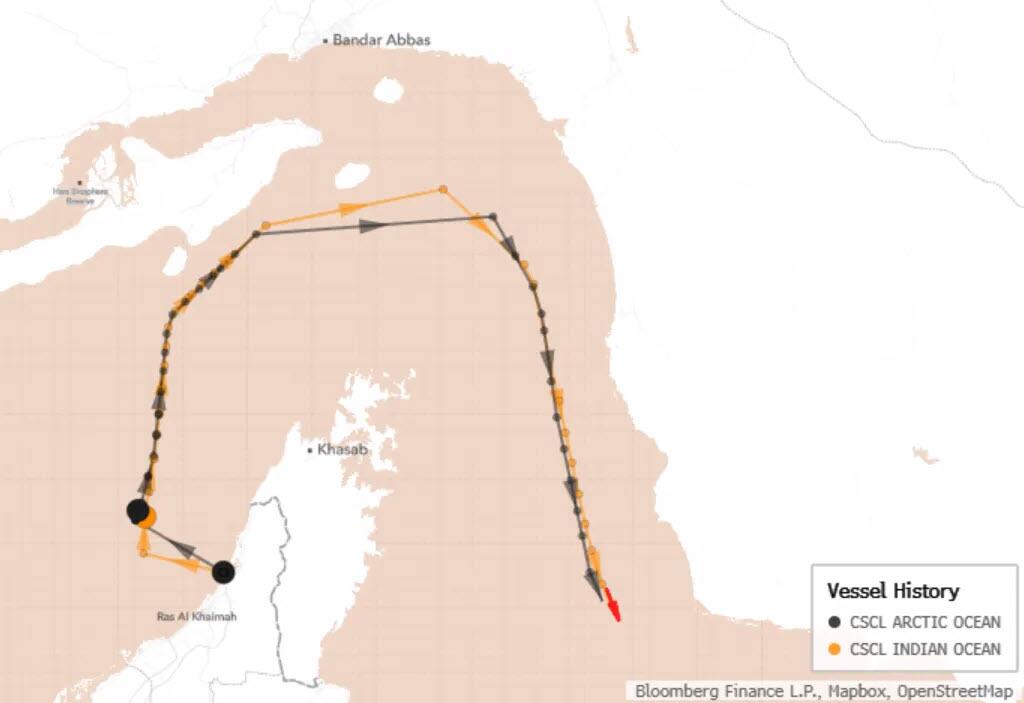
Over the past week, several ships have transited via a narrow gap between the Iranian islands of Larak and Qeshm, and tracked close to the Iranian coast.

They include two bulk carriers that had called at Iranian ports, and a Pakistani-flagged vessel, the Karachi.

The officer on the Indian LPG ship declined to give specific details of their route. They traveled with their automatic identification system, or AIS, system switched off, according to the officer and AIS data analyzed by Bloomberg, turning it back on after they were safely out into the Gulf of Oman. The officer said the ship was also unable to use GPS, which has been subject to widespread interference since the beginning of the conflict. That meant the crossing took hours longer than usual.

During the crossing, the officer’s ship was in contact with the Iranian navy by radio, he said. The Iranians took details of the ship’s flag, name, origin and destination ports, and the nationality of the crew members - all of whom were Indian - and guided them on an agreed course.

Before they entered the strait last week, sailors onboard the LPG tanker prepared their life rafts, the officer said. They had been anchored in the Persian Gulf for around 10 days when they were told on the morning of Friday March 13 that they had been granted permission to make the transit that night. On the far side of the strait, Indian Navy ships were waiting to escort them, with the national flag flying higher than usual, the officer said. The vessel has since sailed on to India.

Anil Trigunayat, a former Indian ambassador in Jordan and Libya, said that the fact India was able to secure safe passage shows that diplomacy is possible. “Iran also would not want to burn bridges with everyone at this juncture,” he said. “India, if needed, can also play the role of an interlocutor. These factors have collectively led to India getting this window.”

On Saturday, the WSJ reported that Indian Prime Minister Narendra Modi said he reiterated the importance of keeping international shipping lanes open during a call with Iranian President Masoud Pezeshkian. Modi said in a social-media post on Saturday that he condemned attacks on critical infrastructure in the region, which he said threaten stability and disrupt global supply chains. He also “reiterated the importance of safeguarding freedom of navigation and ensuring that shipping lanes remain open and secure,” said the post.

While two India-flagged tankers passed through the Strait about a week ago, India is now negotiating for more ships to be able to cross, Indian maritime government officials have told The Wall Street Journal.

Iran’s threats to ships passing through the strait give the government in Tehran leverage over global energy markets, pushing up prices and creating fears of shortages of oil, natural gas, cooking fuel and fertilizer. Around a fifth of the world’s oil normally passes through the channel. Since the beginning of the war in late February, several ships have been struck by missiles or drones in the strait, at least two seafarers have died, and insurance costs have soared. There have been reports that Iran has mined the waterway.

“It seems that Iran is allowing select vessels to transit Hormuz after verification which takes place during the ships’ transit inside Iranian waters,” said Martin Kelly, head of advisory at EOS Risk Group. “While ships are being allowed to transit, it is mostly only to the benefit of Iran.”

Which is to be expected until some sort of ceasefire deal is reach, or the Iran government capitulates. But even if passage remains limited, recall again that the primary shippers through the Strait are already nations that are viewed as either openly friendly to Iran, such as China, or quasi friendly, such as India and now, Japan. Which means that a significant percentage of the ships that would otherwise be blocked by Iran, can pass through, and the actual limitation to oil and LNG passage is much less than the mainstream media reports. 

Tyler Durden Sat, 03/21/2026 - 16:55
https://ift.tt/eLX4vlN
from ZeroHedge News https://ift.tt/eLX4vlN
via IFTTT

Iran Ready To Let Japanese Ships Use Hormuz As Chinese, Indian Tankers Already Allowed Passage SocialTwist Tell-a-Friend
| 0 comments ]

Putin Reportedly Offers To Cut Iran Intel-Sharing If US Does Same In Ukraine

Moscow has been accused by top officials in the White House and in Congress of expanding its intelligence-sharing with Iran amid the now three-week-long war involving the US and Israel. Russia has even been accused of handing over targeting information, allegedly assisting in Iranian ballistic missile attacks on US bases and radar sites as well as sensitive assets in the region.

Russia hasn't confirmed that it is doing this, and has issued a meager official denial - but it also hasn't taken serious steps to convince Washington otherwise. The Kremlin is perhaps relishing in the idea of doing to the US in Iran precisely what the US is doing to Russia in Ukraine - making the operation harder, more costly, and setting up for potential quagmire. 

On Friday Politico is reporting on a possible quid pro quo offer: "Moscow proposed a quid pro quo to the U.S. under which the Kremlin would stop sharing intelligence information with Iran, such as the precise coordinates of U.S. military assets in the Middle East, if Washington ceased supplying Ukraine with intel about Russia."

Getty Images/CNN

"Two people familiar with the U.S.-Russia negotiations said that such a proposal was made by Russian envoy Kirill Dmitriev to Trump administration envoys Steve Witkoff and Jared Kushner during their meeting last week in Miami," the report continues.

The sources indicated the US side rejected the offer. Of course, the US has long been very deep into the Ukraine crisis, and significant intel-sharing has stretched back for many years into the Biden administration and even before, in connection with the Donbass conflict of 2014.

Politico underscores, "Nevertheless, the sheer existence of such a proposal has sparked concern among European diplomats, who worry Moscow is trying to drive a wedge between Europe and the U.S. at a critical moment for transatlantic relations."

Assuming the fresh report is accurate, it raises some serious questions regarding US policy at this very sensitive moment of two major raging wars. 

For starters, much of Trump's base of support has already long been skeptical of Ukraine policy. There is a segment also not happy about the US launching another 'war of choice' in the Middle East, contrary to Trump's pledges on the campaign trail. There are also issues of 'overreach' and overextension in terms of American involvement in no less than two huge global hotspots - one of which Washington is the direct initiator (alongside Israel).

If Trump did actually cease intel-sharing with Kiev, there would be many Republicans which would be quite OK with this. Even J.D. Vance and Pete Hegseth have appeared cold on the idea of too much support for Ukraine.

Whether the alleged offer from Moscow will remain on the table or not is another question. But it seems clear Russia is ready to leverage events in Iran to its advantage related to Ukraine - even at a moment peace talks are clearly on indefinite pause.

* * * Top selling supplements (in stock)

Brain Rescue (on sale!)

Iodine Fortify (are you deficient?)

Resveratrol (potent antioxidant for healthy aging)

Tyler Durden Fri, 03/20/2026 - 15:45
https://ift.tt/W62NY78
from ZeroHedge News https://ift.tt/W62NY78
via IFTTT

Putin Reportedly Offers To Cut Iran Intel-Sharing If US Does Same In Ukraine SocialTwist Tell-a-Friend
| 0 comments ]

US Fast-Tracks Billions In 'Emergency' Arms Sales To Gulf, Bypassing Congress

On the one hand President Trump and Pentagon chief Pete Hegseth have declared that America is 'winning' against Iran, having destroyed its navy and air defenses, and having seriously degraded its missiles - but on the other the admin has put in for a more than $200 billion supplemental request to Congress to fund the war.

It seems Congress will likely eventually sign off on this gargantuan figure - for an 'excursion' which should end 'soon' we are told by Trump - given that even the effort to pass so much as a War Powers resolution gets repeatedly stymied. 

Still, the US administration is busy bypassing standard congressional review requirements, on Thursday approving a series of emergency arms sales across the Middle East, at a moment US regional allies are being pummeled by Iranian drones and ballistic missiles.

US military file image

The argument is that Washington's allies are in imminent danger, and given that indeed vital Gulf infrastructure is getting hit quite seriously - new arms have to be rushed over there on an emergency basis.

According to details in Saudi-owned Al Arabiya:

The largest package was approved for the United Arab Emirates, totaling more than $8 billion. It includes the $4.5 billion sale of a Terminal High Altitude Area Defense (THAAD), $2.10 billion for FS-LIDS counter-drone systems, $1.22 billion in Advanced Medium-Range Air-to-Air Missiles (AMRAAMs), and $644 million in F-16 munitions, including GBU-39 small diameter bombs and Joint Direct Attack Munitions (JDAMs).

In parallel, Washington approved an $8 billion deal for Kuwait to buy Lower Tier Air and Missile Defense Sensor Radars, significantly enhancing the country’s missile detection and tracking capabilities.

Jordan was also included in the emergency approvals, with a $70.5 million package covering aircraft support and munitions to sustain operational readiness.

Notably, a US base all the way over in Jordan, the Muwaffaq Salti Air Base, was struck by Iran in the opening days of the war, satellite imagery showed.

This development of all these newly approved 'emergency' arms and weapons shipments begs the question: is this more evidence that Washington is settling in for a 'long war'?

After all, Trump has given no timeline despite being repeatedly asked, and Israel too is saying the anti-Iran campaign is not even halfway complete. In the end it's certainly not the American people 'winning' here (and they are not going to think so especially at the gas pump either), but the major defense firms.

Tyler Durden Thu, 03/19/2026 - 18:00
https://ift.tt/xYctJfq
from ZeroHedge News https://ift.tt/xYctJfq
via IFTTT

US Fast-Tracks Billions In 'Emergency' Arms Sales To Gulf, Bypassing Congress SocialTwist Tell-a-Friend
| 0 comments ]

What Would A Bank Run Look Like Today?

Authored by Jeffrey Tucker via The Epoch Times,

The movie “It’s a Wonderful Life” (1946) features what is today the most famous bank run. It’s film and fiction, yes, but fits with a scenario that has been common for centuries. When the movie came out, the bank runs of 1930–1932 were very much in people’s memory. For older people, they remember the Panic of 1907. Before that, there was the Panic of 1893, the Panic of 1873, the Panic of 1837, and the Panic of 1819.

Panics and banking go together and have for 500 years.

It’s funny that we call them panics, as if people randomly start hurling themselves around in irrational fear. All that’s really going on is that people want their own money and ask for it. Customers grow concerned that the bank—which makes loans on deposits—has overextended and cannot make good on its redemption promises.

It’s a test that the bank passes or not. The bank run is nothing more than a rational check on the soundness of the bank. It’s not “panic” but merely a demand for one’s own property.

The bank run also serves a hugely important market function. The fear of one inspires banks toward prudence. Any attempt to suppress them invariably leads the banking system to become overextended, pushing out leverage beyond a sustainable point. When conditions change, unsound and overextended banks go belly up. This is nothing more than the market at work.

From 1913, with the establishment of the Federal Reserve, the driving ethos of banking and monetary policy has been to reduce bank runs and failures. It was to broadcast a message of confidence in the financial system so that people would no longer panic. It did not quite work, however, as evidenced by the vast bank failures of the early 1930s. President Franklin D. Roosevelt even declared a bank holiday to stop them, which didn’t work, so he turned to gold confiscation and devaluation.

All this is background to a note I just received from my own bank. It’s an update to the terms of service. Here is what it says:

“Added a new Section 8(e) (Digital Wires—Transaction Limits) to clarify that, to protect your account, online wire transaction limits may have daily or rolling 30-day restrictions and that we may establish or modify limits on the amount, frequency, or type of transactions you can initiate using our payment services, or your transaction limits may be temporarily reduced or subject to additional restrictions. Subsections following this one have been renumbered accordingly (Sections 8(f)–8(l)).”

Hardly anyone reads updates to terms of service. I’m probably in the 1 percent of customers who even clicked on the link. What it means should be obvious. My bank can restrict my access to money anytime it wants and by any amount. I might want to take it all in cash or move it to another institution. My bank has told me that this is entirely up to them. By continuing to bank with this famous institution, I have implicitly agreed to this.

To be sure, we should be grateful for banks that protect our accounts. That’s fine. What’s not fine is preventing access to money that is ours. It’s hard to know which is which, and while I would not suggest that banks would naturally lie to us, enterprises are not beyond some limited duplicity when financial survival is at stake.

Should I change banks? It’s probably pointless. Every bank, if it doesn’t have this as part of its terms of service, will adopt it anyway. You could say that this means nothing. Maybe that’s right. Or maybe the bank is just preparing for a rainy day that never comes, and so this update to the terms of service is practically meaningless. One hopes so.

But it did get me thinking: How would a bank run look today?

There will be no George Bailey rushing to the Building and Loan to calm the panicked depositors, explaining how the institution works (e.g., “Your money’s in Joe’s house”). These days, banks are not even very busy with customers. Every time I need to go to one, I walk right up to the window because no one is there. Nearly all money flows and banking services are done electronically.

I’m grateful for this change. My monthly bill-paying efforts take less than a minute. My childhood memories of my father on bill-paying day still stick with me. He had a small room off the kitchen that was his office. Once a month on Saturday, he would go inside. The kids knew not to disturb him. He had a stack of bills. He would write checks and put them in envelopes with stamps. With each bill paid, he went to his ledger and balanced the checkbook.

As he watched the family accounts drain more and more with each bill, he would grow ever more frustrated and upset. He made a salary of $14,500 and supported two kids, a wife, a home, and two cars, and we took plenty of vacations. In real terms, that’s about $114,000 today, a full household on one income. We made ends meet, but it was often a struggle, one from which he protected the family.

Our entire lives were being held by the bank.

There were never issues of trust.

I doubt that my father ever considered the possibility.

These days, money flows are throttled in every direction even without banking panics.

Venmo limits unverified weekly sending and spending to $300. Verified accounts allow up to $60,000 per week for payments to others. Outgoing bank transfers are limited to $5,000 per transfer and $20,000 per week as long as it is verified. Zelle’s limits vary by the bank: Bank of America permits $3,500 per day up to $20,000 per month. The others are the same or similar.

If you want to move real money, you have to go to ACH (automated clearinghouse) or FedWire (an improvement over old-style wiring) or get a crypto account and use a stablecoin (which moves $1.2 trillion per month, making it dominant). Regardless, it is not easy, and most depositors do not avail themselves of it.

Banks made ACH rather difficult, with pull-down menus of verified recipients. It can be extremely difficult to get serious blocks of money from here to there already. Mostly we don’t need to, so the system has not been really tested. Most people have no idea how much the system of electronic payments and withdrawals is already throttled.

As for cash, it is mostly out of the question. Your bank will give you the stare-down if you ask for $5,000 and make you fill out some law enforcement forms for $10,000. You dare not attempt to carry this kind of cash through an airport. You will be taken aside and asked to provide a full accounting for it. It’s even true for driving: If you are stopped and searched, you risk everything.

To the original question, what would a bank run look like?

It would involve millions of people simultaneously attempting to max out their withdrawals, perhaps to buy gold. It would be the raiding of ATMs until they are empty, which would take about 30 minutes. All the while, the institutions would assure you that they are fully sound and there’s nothing about which to worry.

The same would continue the next day as the banks doled out allotments as necessary and only for verified purposes. You might have a million dollars in the bank, but it would only be numbers flashing on a screen, interesting to look at but impossible to use. There is simply no way to get to it. And forget going to your branch. They would likely put up signs with the explanation that withdrawals are limited to $1,500 or so.

In other words, a serious bank run today would be a quiet and strangely uneventful financial apocalypse in which money movements would be effectively frozen. The Federal Reserve would get to work flooding the entire system with liquidity, unfreezing withdrawals even if they are still throttled. The new money flooding the system to bail out the banks would result in hyperinflation about nine to 12 months later, after which your money would have lost half its value anyway.

What could kick it off? Could be the default of a financial product. Could be the collapse in commercial real estate or a sudden plunge in artificial intelligence asset valuations. Or it could be nothing other than an online rumor that goes viral. This happened often in the 19th century: One person starts the fear, and it spreads like wildfire.

We will not likely ever see a bank run like we did in past times. That’s not a good thing. The system today provides the illusion of liquidity, but take a look beneath the surface. A genuine financial crisis—which we have somehow avoided even during these tumultuous times—would be a civilizational disaster.

This column is not intended to scare you. It might do that anyway.

Tyler Durden Thu, 03/19/2026 - 17:00
https://ift.tt/RfenOLW
from ZeroHedge News https://ift.tt/RfenOLW
via IFTTT

What Would A Bank Run Look Like Today? SocialTwist Tell-a-Friend
| 0 comments ]

Everything, Everywhere, All At Once

Authored by No1 at Gold & Geopolitics substack,

Let me start with a number.

In 1980, when the Iran-Iraq war disrupted global oil supply, the volume lost was around 4 million barrels per day.

Painful. The world went into recession. Volcker raised rates to 20% to kill inflation. It nearly killed the economy in the process. We called it a crisis and we meant it.

The current Hormuz blockade is running at roughly 20 million barrels per day.

The futures market, in its infinite wisdom, is pricing a quick resolution.

Trump says the war is “basically over”.

His Defence Secretary says it’s “only just the beginning”.

One of them presumably has read the intelligence reports.

The other has a golf course booked.

That’s the pin.

But that’s not the bubble.

My estimation where mines are likely placed (from “War is Peace”)

Even in the most optimistic scenario - ceasefire tomorrow, everybody shakes hands - the Maersk CEO noted it takes at least ten days after a ceasefire for tanker insurance to clear. Then mine-clearing: Iran has been laying mines in the Strait, and removing them will take weeks to months. Then tankers reposition, loads getting secured, and finally the flow resumes.

The oil futures curve is pricing step five as if it follows step one with a 48-hour lag.

It cannot physically happen on that timeline.

And Iran isn’t just shooting wildly at targets. Yesterday, Fujairah - the world-class bunkering hub sitting outside the Strait, the bypass everyone assumed would soften the blow - has been deliberately targeted. Tehran isn’t just closing Hormuz. It’s also closing the workarounds. One by one. Iran got fed up and decided to take down the imposed sanctions one way or another. And USrael just gave them the ultimate excuse.

If you’ve been reading my silver papers, you know there is a gap. A gap I call “PvP”… No not the gaming term. The Paper vs Physical.

And oh boy. Is it screaming!! Brent futures in New York closed Friday at $104. Elevated but ok-ish. Dubai crude - you know, the real physical oil, real barrels, real buyers - was trading around $127-140. Normally Brent commands a premium over Dubai. Now Dubai is $37 above the paper. And that’s just crude. Bunker fuel in Singapore hit $140 per barrel this week. In Fujairah, $160. High-grade marine fuel, $175. Ships burning fuel right now are paying those prices regardless of what the futures strip says in New York.

Silver at a $12 premium to Shanghai? pffff Silver… Amateur hour compared to oil!

If you’ve read Strait to Brrrrr, none of this is surprising. Paper price is massaged. The New York futures desk is clearly on something the physical buyers aren't.

However this started, this isn’t a military confrontation anymore. I’m even starting to doubt it ever was. The Strait stays closed, oil stays elevated. Oil stays elevated, inflation stays elevated. Inflation stays elevated, the Fed cannot cut. The Fed cannot cut, and $36 trillion in federal debt - already costing $880 billion a year in interest before the war added a billion dollars a day to the tab - gets rolled over at rates that make it progressively less serviceable. The dollar weakens under that strain. A weaker dollar makes the next barrel of imported oil more expensive in dollar terms. Which feeds back into inflation. Which keeps the Fed pinned.

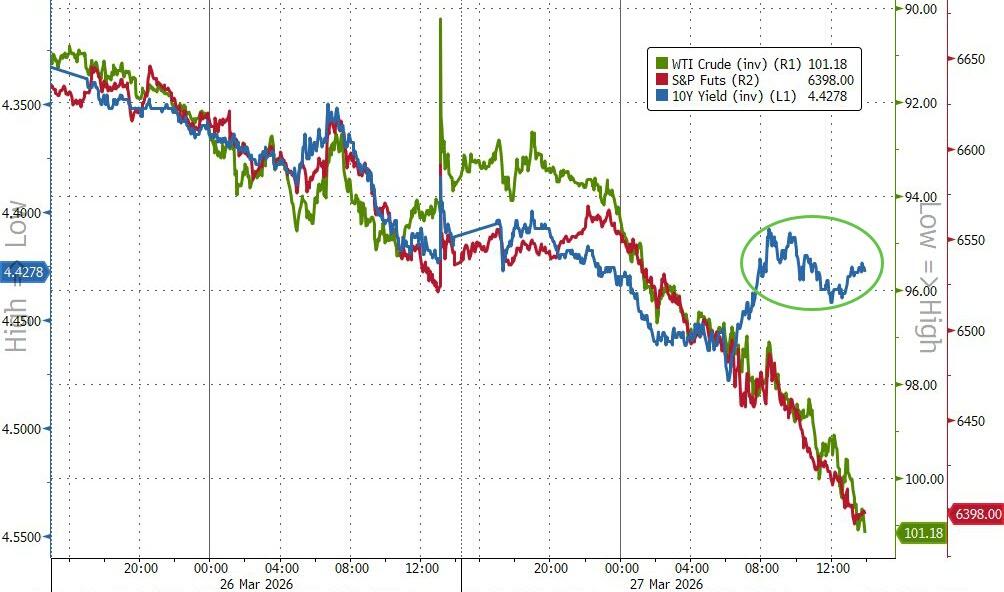
It’s a loop. Iran just needs to keep the strait closed long enough for it to complete a few rotations. The bond market has noticed. Treasury yields are rising in the middle of a geopolitical crisis - not falling. Capital isn’t fleeing to bonds. It’s fleeing to gold. That is a verdict on the US fiscal position.

Trump knows the physical reality, which is why last week he called Putin. The country America has been sanctioning for four years. The one it branded an aggressor, a pariah, an enemy of the liberal world order. He called to ask for help. Then he went further and lifted Russian oil sanctions outright. A Democratic Senator responded with perhaps the best summary of the year: “Looks like we fought Iran and Russia won”.

What else? The IEA approved a record 400 million barrel reserve release. Bessent telegraphed futures market intervention to cap prices. Russian sanctions lifted. Each one a gesture. On my feed someone quoted: “The oil market is massively short of supply. The other options the administration has, other than ending the war, are actually pretty limited”. Woops.

That’s the pin. But actually, the pin in itself doesn’t matter. Really truly doesn’t matter. What does matter greatly however, is WHAT it pricked…

In 1980, US federal debt stood at 26% of GDP. Today it’s 120%. That’s the difference between the same shock hitting a healthy patient and hitting someone already on oxygen. The Volcker treatment that worked then is structurally unavailable now. But don’t worry! These are the same people who called inflation transitory. I'm sure they've got it. This time.

The interest bill on existing debt is already $880 billion a year, more than defence, more than Medicare. Rates at 20% on $37 trillion would cost more than the entire federal budget in interest payments alone. That lever doesn’t exist anymore.

What exists instead is $846 trillion in notional OTC derivatives. Up from $108 trillion in 2000. An eightfold expansion in 25 years, and mid ‘24 → ’25 was the largest growth rate at 16% since 2008.

To put that number in some kind of human context: $846 trillion is roughly eight times the entire global GDP. With 1% of it you could buy every company in the S&P 500 twice over. With 0.01% you could buy Warren Buffett. With a rounding error - 0.0001% - a superyacht, a sports franchise, and a small Caribbean island, and you’d still have 99.9999% left. Nobody has this money, of course. Nobody owns $846 trillion. It’s the notional value of bets stacked on top of bets - leverage and hedges and derivatives daisy-chained to other derivatives. It nets out in normal conditions. In abnormal conditions, “nets out” becomes “finds out”.

Buffett called them ‘weapons of mass financial destruction’ in 2003. The book was $85 trillion then.

The bulk of the current book - around $548 trillion - is interest rate derivatives. All of it priced on a world where oil is $70 and rates are roughly stable. Guess what just happened? Oil exploding (quite literally at times) make counterparties not being able to meet margin calls (guess why gold and silver are trembling so much) and that failure cascades through the chain.

The private credit system was already the weakest link before the war. I covered the gating wave in my previous article so I’m not going to repeat it here, but the language from people who are in the know got pretty alarming. Mohamed El-Erian reached for Bear Stearns 2007 as his reference point. Dimon started talking about cockroaches. Dimon… Talking about cockroaches… The Treasury Secretary himself said he was ‘concerned’ about private credit. When the man responsible for placing a trillion dollars per quarter in new debt publicly expresses concern about the credit system he depends on to function, well… I’ll leave it at that.

Think the gating’s bad? Let me reassure you *evil grin*. One in five companies in the Russell 3000 cannot service their debt from current income. Over half of all investment grade paper is a single downgrade from junk. $5 trillion in corporate debt rolls over in the next four years at current rates, into a war-driven inflationary environment the Fed cannot cut its way out of. The losses are in there. Just not visible yet. When they surface, the institutions holding private credit will face redemption pressure at exactly the moment public markets are offering their best entry points since 2022 /s. Nah, just kidding. They dump whatever they can. Anything, just about anything unrelated with their illiquid portfolio will be hit. You've seen this movie before. Gold fell when Iran struck. Silver fell. Same mechanics, a tad larger. Think ‘08 or ‘00 on steroids.

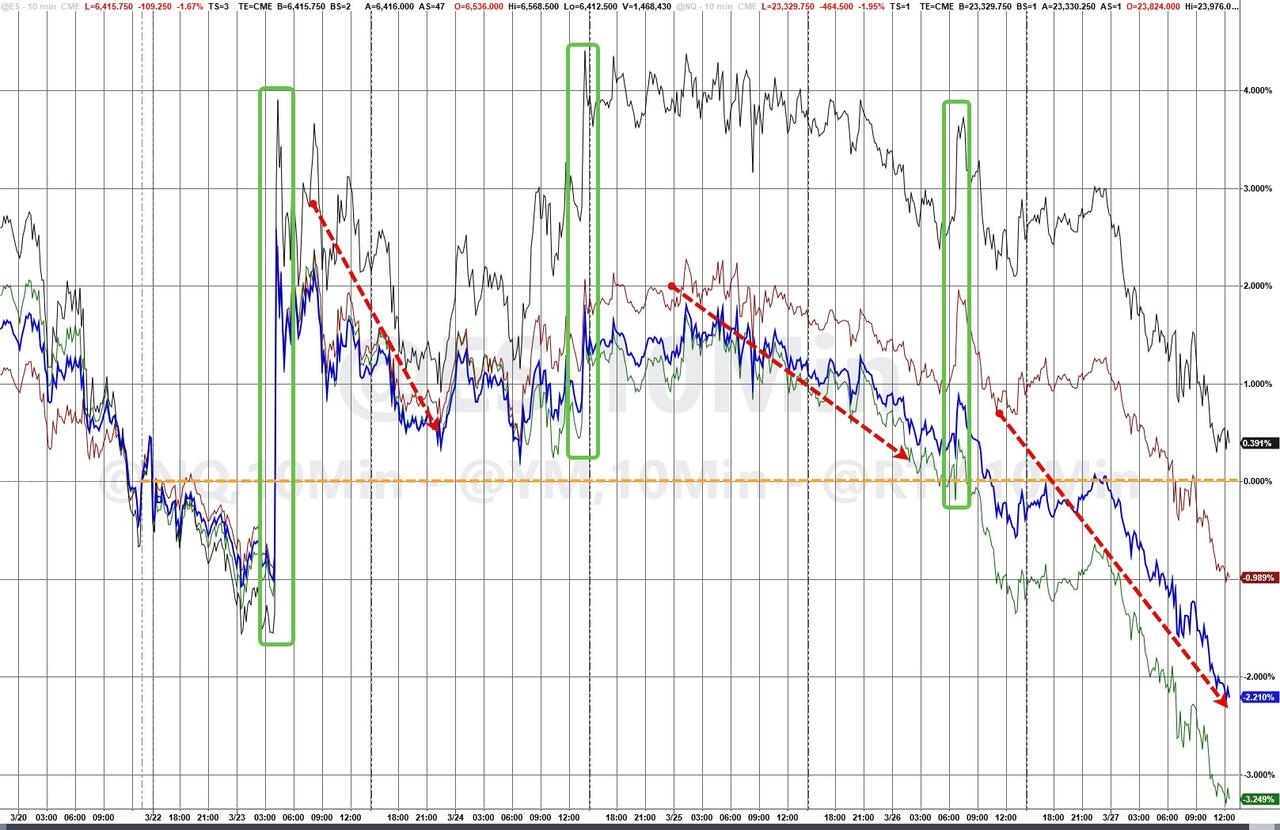
Now picture what happens when the equity markets start to move. The S&P 500 closed up 1% on Sunday night. The Dow gained 388 points. Meanwhile, fertiliser benchmarks are up 25-44% in seventeen days. Think food. Helium has doubled. Think chips - not the edible ones. Pharmaceutical feedstock pipelines are depleting. The wall between the financial “economy” and the real one is still holding. Walls do that, right until they don’t.

When people need cash fast, they sell what’s liquid. ETFs are the most liquid thing in the world. They sell indiscriminately - tech, gold miners, silver, and just about anything else. You don’t sell what you want to sell. You sell what has a bid. And passive investment? Volume wise, ETFs are like 60% of US equity markets (2024). In 1996 that was only 6%. Which means that when selling starts it’s mechanical. No analysis. No discrimination. Every ETF holder hitting the same exit through the same small door at the same time.

Think of “Liberation Day” as a test run. First-ever simultaneous crash in stocks, bonds, and the dollar - the thing that was supposed to go up when everything else went down.

Tie into that the 401k withdrawals that hit a record high this week. The passive investment machine is leaking from the bottom while demographics drain it from the top.

Feeling comfortable yet? *super evil grin*

Underneath all of this, slower than any war and more permanent than any crisis, is something the financial press doesn’t really mention:

People aren’t having any children.

US fertility hit an all-time low in 2024. The general fertility rate is still falling. IMPLAN puts 1.4 million fewer Americans contributing to housing demand, retail spending, and service consumption in 2025 than trends would have predicted. To put that in numbers: $104 billion in GDP. Not exactly gone, not really disappeared. It just never existed in the first place.

It’s a vicious circle: housing is too expensive, so young people delay children. Fewer children means less future housing demand. Which should eventually reduce prices, except the lag is 20-30 years, and in the meantime housing stays expensive, so the people who couldn’t afford a house still can’t, still don’t have children, and the loop tightens at its own pace regardless of what the Fed does or what happens somewhere in the narrow waterways in exotic places.

Added: the boomers are saying bye sayonara.

The generation that inflated every asset class for 40 years through automatic 401k contributions is, somewhere around now, flipping from net buyers to net sellers. Of course it’s impossible to say like “March, 17: boomers start to cash out their 401ks”… Nope, the tide just turns. The same passive machine that provided an inexorable, automatic bid for equities and bonds and real estate - every payday, every year, for four decades - begins to redeem. Quietly. Continuously. For the next twenty-some years. Every asset they inflated on the way up faces a headwind on the way out. Not a crash. A long, grinding, demographically-inevitable ratchet.

Another angle I want to cover is the petrodollar. I covered this already in “The Bretton Whoops”. But the short version is: oil was priced in dollars, dollars were recycled into Treasuries, and the US military keeps the Gulf safe. It required two things - a reliable dollar and a credible security guarantee. The dollar’s reliability cracked in 2022 when Washington froze Russia’s reserves. The security guarantee cracked when the US started a war they cannot finish.

The dollar’s share of global FX reserves has since fallen to around 45%, the lowest since the 1990s. Gold’s share has quadrupled in twelve years. Gulf states are reportedly discussing pulling investment commitments from the US.

And now Iran has done something structurally interesting. It didn’t just close the Strait - it converted it into a tollgate. The toll isn’t money - yet. It’s alignment. Ten countries have been offered safe passage: China, India, Pakistan, Turkey, and others. The US isn’t on the list. This isn’t a military tactic. It’s economical.

Lots of people have the wrong framing. They think “petrodollar is dead, long live the yuandollar”. Right? Wrong frame entirely. China doesn’t want a reserve status. Couldn’t stomach it if it tried. Because a reserve currency means running a permanent trade deficits to pump your currency into the global system - America has been doing this for 50 years and the reward is a rust belt, a $37 trillion debt tab, and a bond market that needs foreigners to keep showing up or the whole thing seizes. China watched that happen and said: 不用了,谢谢. And opening the capital account enough to make yuan genuinely reserve-worthy would mean letting money flow freely across the border - ending the CCP’s ability to direct credit and control the financial system on Beijing’s terms. They’d sooner eat the wallpaper.

What the yuan-for-oil arrangement being implemented actually is, is an industrial policy dressed as currency diplomacy. You sell your oil into the permitted lane. You receive yuan. Now you’re sitting on yuan in a system with capital controls - you can’t just convert it and park it wherever you like. Your options are: buy Chinese goods, buy Chinese infrastructure contracts, invest in Chinese assets. That flow cycles straight back into Chinese factories and Chinese employment. China doesn’t have to stimulate its domestic consumption anymore. It exports the demand problem onto its trading partners and invoices it as a geopolitical arrangement. Three hundred million jobs - and unlike the US - no helicopter money required.

Those dollars that used to flow into Treasuries don’t just suddenly rush home. They just stop showing up at the next auction. Treasury needs to place roughly a trillion dollars every hundred days. Fewer buyers means higher yields. Higher yields mean the Fed is cornered. A cornered Fed means the printer runs. Same mechanism as demographics, same mechanism as the derivatives book, same direction.

My long-running conviction - and I’ve been saying this long enough that it stopped sounding contrarian and started sounding obvious - is that the world ends up back on a gold standard. Not the romanticised version where you rattle coins in your pocket. Though honestly, with modern payment rails, a gold-backed account is functionally identical to a dollar account. You’d never touch the metal. You’d just change the ticker from USD to XAU and carry on. The technology exists right now. The obstacle isn’t infrastructure. It’s that the people running the current system would rather light themselves on fire.

What happens first, before any grand declaration, is narrower: gold becomes the settlement layer between sovereigns who no longer trust each other’s paper. The US is apparently net-settling its trade deficit with China in gold - if that data holds up. In three of the last four months it seems that gold is flowing East. No Bretton Woods conference. No announcement. Just two countries quietly deciding that when the paper gets complicated, the metal clears the table. That’s how monetary systems actually change - not by proclamation but by practice, one bilateral settlement at a time, until enough of them are doing it that someone calls a conference to ratify what’s already happened. The Bretton Woods conference didn’t create the dollar system. It formalised what the war had already decided.

The next conference is coming. It just hasn’t been scheduled yet.

Silver. Because I can’t write a piece about systemic fragility without it, and because this week’s data is worth your attention even if the price chart isn’t.

The paper price looks terrible. Miners are trading like silver is heading back to $40. Silver Santa - one of the accounts I follow on Twitter (yeah, I’m old) - moved 40% to cash, describing “a strong pre-COVID feeling”. The technical picture is ugly.

But the crucial part: the physical reality didn’t get that memo.

The COMEX “run rate to zero” ticked down to 89 days as of Friday, from 93 days on Thursday. Four days burned in one. The SGE briefly stopped publishing silver inventory data mid-week, then quietly resumed. Shanghai is still paying a 13-17% premium over London. The same paper/physical divergence playing out in oil is running in silver at a slower pace with a much longer fuse.

But what does a draining vault have to do with your savings account?

More than most people think. The COMEX sets the global silver price. But if the COMEX increasingly doesn’t have the physical metal - and the run rate suggests it won’t for long - then the price it sets is a fiction. An unallocated silver account at your bank is a claim on that fiction. An ETF share is a claim on that fiction. When the fiction and the physical reality eventually converge, it won’t be because the paper comes up to meet the physical. It’ll be because the paper can no longer pretend.

Same mechanism as Dubai crude. Same mechanism as the derivatives book. Just a slower fuse.

When $68 trillion in US equity markets eventually moves - and it will - and the indiscriminate ETF selling hits everything, and the margin calls cascade through a derivatives book built on assumptions that no longer hold, and zombie companies start defaulting, and the boomer redemptions add their steady mechanical pressure, and 401k hardship withdrawals accelerate - the question of where capital goes becomes very concrete. Bonds? Already struggling to absorb a trillion per quarter. Cash? In which currency? Real estate? In a demographically challenged market with rising yields?

Gold has a structural bid from central banks who drew their conclusions in 2022 and have been buying ever since. Silver has vaults on an 89-day countdown and a paper price that hasn’t caught up yet.

I’m buying the dips. Have been. Will continue.

(A small aside: I’m considering opening a dedicated Substack to document my trades in real time - with a ten-minute lag - for those who want to follow the positions, not just the analysis. The analysis stays here, free.)

None of this is hidden.

None of it requires a security clearance or even a Bloomberg terminal. It’s all there, in the vault data, the yield curves, the fertility statistics, the derivatives book, the bunker fuel prices. The information exists. The pattern is legible.

The question was never whether this would happen.

The question was always who would be holding paper when it did.

Each crisis gets a fresh name but the same printer... TALF, TARP, BTFP, BTFD, YOLO, CTRLP.

*  *  *  STOCK UP OR REFRESH YOUR SUPPLY

14 Day Emergency Food Bucket

4,500 Seeds - GMO-Free, non-hybrid, open-pollinated

Beef, Chicken, Sausage - Meat & Rice Survival Bucket

Tyler Durden Wed, 03/18/2026 - 18:55
https://ift.tt/4vJIacP
from ZeroHedge News https://ift.tt/4vJIacP
via IFTTT

Everything, Everywhere, All At Once SocialTwist Tell-a-Friend