
What Causes Stagflation?
Authored by Frank Shostak via The Mises Institute,
In the late 1960’s Edmund Phelps and Milton Friedman challenged the popular view that there can be a sustainable trade-off between inflation and unemployment. In fact, over time, according to Friedman, expansionary central bank policies set the platform for lower economic growth and a higher rate of inflation (i.e., stagflation). A famous case of stagflation occurred during the 1974-75 period. In March 1975, industrial production fell by nearly 13 percent year-on-year while the yearly growth rate of the consumer price index (CPI) jumped to around 12 percent.
Friedman’s Explanation of Stagflation
Starting from a situation of equality between the current and the expected rate of inflation, the central bank decides to attempt to increase the economic growth rate by increasing the growth rate of money supply. As a result, a greater supply of money enters the economy and each individual now has more money at his disposal. According to Friedman, because of this increase, every individual is of the view that he has become wealthier. This raises the demand for goods and services, which, in turn, sets in motion an increase in the production of goods and services.
Following this, producers’ demand increases for workers and subsequently the unemployment rate falls to below the equilibrium rate, which both Phelps and Friedman labeled as the “natural rate.” Once the unemployment rate declines to below the natural rate, this starts to exert an upward pressure on price inflation. Consequently, individuals start to realize that there was a general loosening in the monetary policy. As a result, individuals are beginning to realize that their previous increase in purchasing power is actually dwindling. Hence, according to Friedman, people start forming higher inflation expectations.
All this in turn works to weaken the overall demand for goods and services. A weakening in the overall demand slows down the production of goods and services. As a result, the unemployment rate moves higher. Observe that—with respect to the unemployment rate and economic growth—we are now back to where we were prior to the central bank’s decision to loosen its monetary stance but with a much higher price inflation.
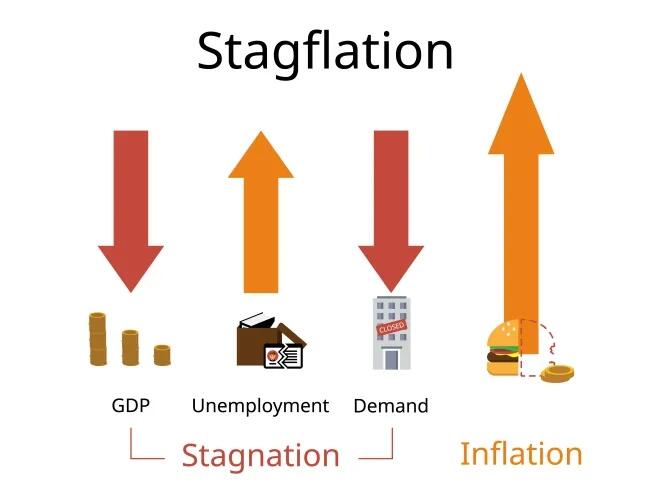
What we have here is a decline in the production of goods and services—an increase in the unemployment rate—and an increase in price inflation (i.e., we have stagflation). From this, Friedman has concluded that, as long as the increase in the money supply is unexpected, the central bank can engineer an increase in the economic growth rate. However, once individuals learn about the increase in the money supply and assess the implications of this increase, they adjust their conduct accordingly. Therefore, the stimulatory effect to the economy because of the increase in the money supply growth rate disappears.
In order to overcome this hurdle and strengthen economic growth, the central bank would have to surprise individuals by means of a much higher growth rate of the monetary inflation. However, after a time lag, individuals are likely to learn about this increase and adjust their conduct accordingly. Hence, the stimulatory effect of the higher growth rate of money supply on economic growth is likely to vanish again and all that will remain is much higher price inflation.
From this, Friedman concluded that—through expansionary monetary policy—the central bank can only temporarily generate economic growth. Over time, however, such policies are likely to result in higher price inflation. Hence, according to Friedman, there is no long-term trade-off between inflation and unemployment.
Why Expected Money Growth Undermines Economic Growth
In a market economy, a producer usually exchanges his goods and services for money. He then exchanges the money received for the goods and services of other producers. Alternatively, we can say that an exchange of something for something takes place by means of money.
Things are, however, not quite the same once money is generated out of “thin air” by inflation because of the expansionary central bank policies. Once inflation is employed, it sets in motion an exchange of nothing for something. This amounts to a diversion of resources from wealth-generators to the holders of the newly-generated money. In the process, wealth-generators are left with fewer resources at their disposal, which, in turn, weakens their ability to grow the economy.
An exchange of nothing for something, which sets the diversion of resources, will take place regardless of whether the increase in money supply is expected or unexpected. This means that, contrary to Friedman, even if the money growth is expected it will undermine economic growth. Now, if unexpected monetary policies can cause economic growth, why not constantly surprise individuals and cause economic growth?
What Causes Stagflation?
Increases in the money supply set in motion an exchange of nothing for something. This diverts resources from wealth-generators to non-wealth generators. Consequently, this weakens the wealth-formation process and, in turn, weakens economic growth.
What we have here is a situation whereby increases in money supply undermine the process of wealth-generation, thus hurting economic growth. At the same time, we have more money per goods. This means that the prices of goods are likely higher than before the increase in money supply took place. Hence, what we have here is an increase in prices of goods and a weakening in economic growth. This is branded, by popular description, as stagflation.
Stagflation emerges because of the increase in the money supply. Hence, whenever the central bank adopts an expansionary monetary stance, it also sets in motion stagflation in the months ahead. The fact that, over time, an inflationary expansion of money and credit may not always manifest through visible stagflation does not refute what we have concluded with respect to the consequences of increases in the monetary pumping on economic growth and prices.
What matters for the state of an economy is not the manifestation of stagflation—higher prices and higher unemployment—but increases in the money supply. It is inflationary increases in the money supply that undermine the process of wealth generation. The severity of stagflation is dependent upon the state voluntary, private savings. If savings are declining, then a visible decline in economic activity is likely to ensue. Moreover, on account of past monetary inflation and the consequent increase in price inflation, we will often see visible stagflation. Conversely, if savings are still growing, economic activity is likely to follow suit. Given the rising momentum of prices, we will have a positive correlation between economic activity and price inflation.
The symptoms of stagflation are not visible here because of increasing savings. We can conclude that, if on account of past monetary inflation, we do not observe the symptoms of stagflation this may imply that savings are still growing. Conversely, if we can observe the symptoms of stagflation, then it is most likely that the pool of savings is declining.
Conclusion
Increases in money supply set in motion an exchange of nothing for something. This diverts resources from wealth-generators to non-wealth-generators. Consequently, this weakens the wealth-generation process and, in turn, the pace of economic activity. When money enters goods markets, it means that we have more money per goods. This means that the prices of goods will tend to increase. Hence, what we have here is the increase in goods prices and a weakening in economic growth. This is what stagflation is all about. We suggest that the outcome of monetary inflation is always stagflation. It is not always visible though. As the pool of voluntary savings comes under pressure, the phenomenon of stagflation tends to become more visible.
https://ift.tt/x3QMvNU
from ZeroHedge News https://ift.tt/x3QMvNU
via IFTTT





0 comments
Post a Comment