
Trump Ready To Raise "Core Of China's Core Interests" In Xi Summit: Daily Schedule & What To Expect
Chinese President Xi Jinping is expected to raise the issue of increasingly costly US arms transfers to Taiwan during their bilateral summit at the end of this week, spanning Thursday through Friday. Taiwan of course remains the "core of China's core interests" - as Beijing has in the recent past characterized the issue. While Trump officials have previewed that it will be focused on trade and investment, the White House too is reportedly placing Taiwan and regional geopolitical hot button issues on the agenda.
"I'm going to have that discussion with President Xi," Trump told reporters at the White House, specifically on the question of weapons sales. "President Xi would like us not to, and I’ll have that discussion. That's one of the many things I’ll be talking about."
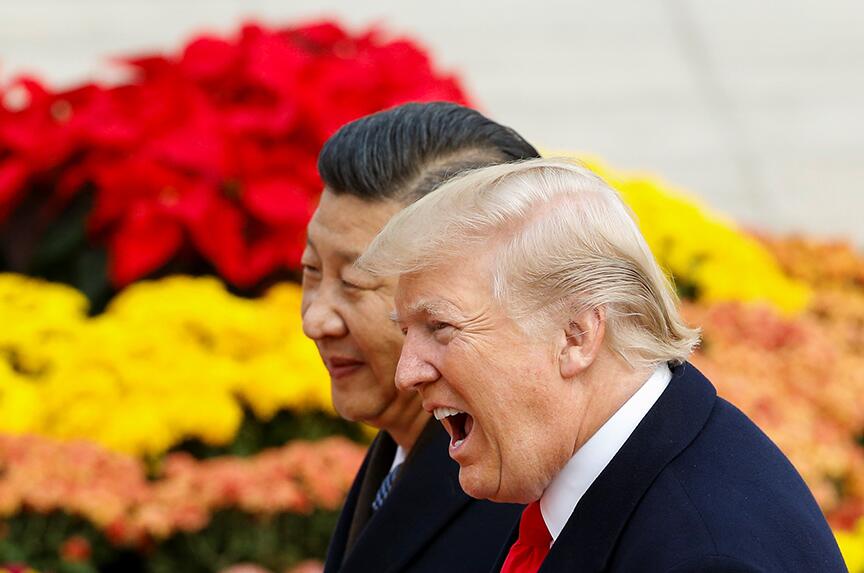
Also there's the looming question of the future of the Iran war and blockaded Strait of Hormuz. Currently there's a stalemated situation and supposed ceasefire which is barely holding. By many accounts, Trump was hopeful that the Iran 'excursion' would be wrapped up by now, but it now seems to be sliding into protracted quagmire - critics point out.
The WSJ says that Beijing is feeling confident as it prepares to receive Trump and what's looking to be a rather large entourage:
But behind the scenes, Beijing feels more emboldened, and more insistent on defending areas it regards as vital to its long-term strategic interests.
These include resisting U.S. pressure to relax its grip over global supply chains and fundamentally rebalance trade between the two countries. They also include urging Washington to look the other way as it pressures Taiwan, the self-ruled island that Beijing claims as its own, and as it projects military power across Asia.
“They feel very well about how last year played out,” said Jonathan Czin, a fellow at the Washington-based Brookings Institution and a former U.S. intelligence officer focused on China. “They showed they could weather the storm and the administration had to climb down from the tariffs and spend most of the past year trying to mollify China.”
As for more implications of the Iran war dragging on as Trump goes to Beijing, CNBC writes:
Iran’s ambassador to China Reza Rahmani Fazli in a Tuesday post on X pressed Tehran's case with Beijing, saying that the relationship between the two is too strong for the U.S. to overcome.
The bottom line is that higher energy prices are baked in for the foreseeable future. The price of crude oil makes up about half of the cost of a gallon of gas, according to the Energy Information Administration.
And U.S. elections are less than six months away. The 2026 midterm elections will be a crucial referendum on Trump and the Republican Party as they seek to retain a lock on both chambers in Congress.
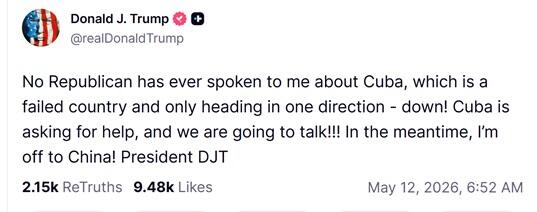
Trump early Tuesday put out the following message on Truth Social, teasing that the next regime change operations could be unleashed on China's small island-nation ally in America's immediate backyard...
For some further big picture analysis on how the Iran gambit has raised the stakes, and made the Beijing summit more unpredictable, the below is some fresh Rabobank commentary outlining related developments to watch:
In a case of curious timing, the US just imposed fresh sanctions on individuals and firms involved in facilitating Iranian oil sales to China, and Acting Secretary of the Navy Hung Cao yesterday released a new 30-year shipbuilding plan. That plan anticipates the acquisition of 11 nuclear-powered Trump class battleships, new underwater drones, and an ongoing review to the Ford class aircraft carrier design to increase lethality and reliability while reducing unit costs and production lead times. The planned expansion of the US fleet and shipbuilding industrial base is undoubtedly a reaction to China’s growing naval strength and substantial advantage in production capacity. The message to Xi is an unsubtle one.
The FT’s Gideon Rachman characterises Trump as arriving at Xi’s court in a state of supplication, having effectively lost the trade war vs China and the shooting war vs Iran. This perhaps overstates the weakness of Trump’s position by ignoring the fact that the US has tightened its grip on global energy supply chains and has shown that is has the power to put its foot on the hosepipe of Chinese energy imports whenever it likes. In the flurry of commentary over China’s bumper trade surplus in April, it seems to have been missed that import volumes for crude oil were down sharply, but values were higher. Yesterday’s April PPI figures for China also underscored the uncomfortable effects that the Iran war is having on the Chinese industrial economy.
Xi will be acutely aware of this, and he will also be aware that the US holds similar power to disrupt Chinese food imports if it was of a mind to do so. Seapower IS power, as the shipbuilding plan should remind us all. In this respect, Trump holds better cards than the FT is giving him credit for. Perhaps it is no coincidence that China bought more soybeans in April than it had done for months.
Some more of Trump's latest commentary amid his hope for a 'good' Xi meeting:
Trump: If you have the right president, I don't think Taiwan invasion will happen. I have a very good relationship with President Xi.
— Tymofiy Mylovanov (@Mylovanov) May 12, 2026
We're 9,500 miles away. He's 67 miles away. But there’s a lot of support for Taiwan from Japan and countries in that area. 2X pic.twitter.com/8ipHIKy4pM
Below is a preview of the day-by-day schedule and what to expect, via Newsquawk.
* * *
PREVIEW: Trump-Xi Summit to take place in Beijing on May 14th-15th
- US President Trump and Chinese President Xi are set to meet in Beijing for the first time since October 2025. The public tone is expected to be warm and friendly, while the substance of the meeting will cover a range of topics.
- No breakthrough is expected in US-China relations, with attention instead focused on implications for Iran and Taiwan.The situation in Iran will likely be one of the core topics, with some fearing an Iran-for-Taiwan bargain.
SCHEDULE
- Trump is expected to arrive in Beijing on the evening of Wednesday, 13th May.
- The main Trump-Xi talks are expected across Thursday, 14th May and Friday, 15th May.
THURSDAY
- The White House said Trump will meet Xi on Thursday at 10:15 Beijing time / 03:15BST / 22:15EDT.
- Thursday is expected to be the main ceremonial and diplomatic day, including a welcome ceremony, Temple of Heaven visit, formal bilateral meeting and state banquet.
- The banquet is scheduled for Thursday at 18:00 Beijing time / 11:00BST / 06:00EDT.
FRIDAY
- Discussions are expected to continue on Friday, including extended talks and a working lunch before Trump’s departure later in the day.
AGENDA
- Iran: A primary focus will be the war in Iran, with the US pressing China to use its influence over Tehran to support de-escalation, reopen the Strait of Hormuz and curb oil-funded escalation.
- Taiwan: Taiwan is expected to be one of the most sensitive issues, with concern focused on whether Xi pushes Trump for softer US language on Taiwan independence or restraint on arms sales.
- Russia: The US is expected to raise China’s economic ties with Russia, including revenue flows, dual-use goods, components, parts and potential weapons-related support.
- Strategic guardrails: The leaders are expected to discuss a possible formal AI communication channel to manage military and cyber risks, alongside nuclear arms-control issues, although Beijing remains cautious on nuclear arsenal transparency.
- Commercial: The summit could produce major “big win” announcements, including Chinese purchases of Boeing aircraft, agricultural products such as soybeans and beef, and energy.
- Board of Trade/Investment: Proposals are on the table for a bilateral Board of Trade and Board of Investment, designed to manage trade and investment flows through formal channels rather than relying mainly on tariff escalation.
DETAILS
Iran/Strait of Hormuz
- Primary summit focus: The war in Iran, which began after US and Israeli strikes on 28th February, is expected to be one of the dominant geopolitical issues at the meeting.
- US pressure on Beijing: Washington is said to be pressing China to use its influence over Tehran, given China’s role as a major buyer of Iranian oil, to push Iran towards a deal and support efforts to end the conflict.
- Strait of Hormuz: The US is expected to press China to help secure the reopening of the Strait of Hormuz.
- China’s position: Beijing has so far avoided joining a US-led pressure campaign against Tehran, while continuing to call for de-escalation and a diplomatic resolution.
- China’s exposure: China’s dependence on Gulf energy flows gives it a direct interest in ending the Hormuz disruption.
- Sanctions: Days before the summit, on May 11th, the US issued new sanctions against three individuals and nine companies accused of facilitating Iranian oil shipments to China.
Taiwan
- Arms sales: Trump said he will discuss US arms sales to Taiwan with Xi, alongside other sensitive issues, including Hong Kong media tycoon Jimmy Lai. The Trump admin announced a more than USD 11bln weapons package for Taiwan in December, the largest-ever US weapons package for Taiwan.
- No policy change: US officials have said the Trump-Xi summit signals no change in longstanding US policy toward Taiwan.
- China’s position: China said its stance against US arms sales to Taiwan is “consistent and clear.” Beijing continues to frame Taiwan as a core issue and a red line in US-China relations.
- Semiconductor angle: Taiwan’s strategic importance is also tied to the US technology supply chain, particularly semiconductors and advanced manufacturing.
- South China Sea: Regional security is likely to come up alongside Taiwan, military communication and wider US-China strategic competition. The South China Sea remains a persistent flashpoint, with US concerns around Chinese military activity and Chinese objections to US regional deployments and alliances in the region, such as the AUKUS security pact.
Iran-for-Taiwan Risk
- Linkage: There has been reporting and speculation that Beijing could seek to trade help on Iran or the Strait of Hormuz for US restraint on Taiwan, including softer language on Taiwan independence or reduced pressure around arms sales.
- Concerns: The concern is that Beijing may offer help on Iran or the reopening of the Strait of Hormuz in return for softer US language on Taiwan or restraint on arms sales. Politico reported that diplomats from Asian and European countries are worried Trump could make an off-script statement that appears to shift US policy on Taiwan. Taiwanese officials have expressed concern about being “on the menu” during the Trump-Xi talks.
- Shift in Language: The key wording risk is a shift from the current US formulation of “we do not support Taiwan independence” to Beijing’s preferred wording of “we oppose Taiwan independence.” Desks suggest that a shift would be significant as Beijing could use it to challenge routine US-Taiwan engagement, including arms sales, lawmaker visits and other political contacts.
- US Position: Despite the speculation, US officials have publicly stated that US policy toward Taiwan will not change at the summit.
China's Backing of Iran and Russia
- Direct confrontation: Trump is expected to press Xi over China’s economic and material support for Iran and Russia.
- Iranian oil: China remains a major buyer of Iranian oil, and Washington views those flows as helping Tehran withstand US pressure and finance military activity.
- Russia links: The US is also expected to raise China’s economic ties with Russia, including whether Chinese trade is helping Moscow sustain its war effort.
- Dual-use goods: Officials cited concerns around Chinese dual-use goods, components, parts and potential weapons exports to Iran and Russia.
- Iran weapons sanctions: On 8th May, the US imposed sanctions on individuals and companies, including China- and Hong Kong-based entities, accused of helping Iran obtain materials for Shahed drones and ballistic missiles.
- Iran oil sanctions: On 11 May, the US imposed separate sanctions on three individuals and nine companies accused of facilitating Iranian oil shipments to China.
- 50% tariff threat: Trump previously threatened 50% tariffs on imports from countries supplying military weapons to Iran, with no exemptions.
Trade
- Trump tariff stance: Trump commented that the US needs more tariffs, keeping tariff risk firmly on the table.
- Trade-truce extension: The two sides are expected to discuss whether to extend the existing trade-war truce.
- Unclear timing: A US official said it is not yet clear whether the agreement will be extended this week, but expressed confidence that it will eventually be extended.
- October meeting: Trump and Xi's last meeting in October in South Korea resulted in a pause to a trade war that had seen the US impose triple-digit tariffs on Chinese goods and Beijing threaten rare earth restrictions.
- Tariff Legality: Trump has vowed to reimpose some tariffs through alternative legal avenues after the Supreme Court said in February.
- Investments
- Trade and investment forums: Reports suggested that the US and China are expected to agree on forums to facilitate mutual trade and investment.
- Board of Trade / Board of Investment: A Board of Trade and Board of Investment may be formally announced, although officials said these mechanisms may require further work before implementation.
- Chinese purchase announcements: China is expected to announce purchases related to Boeing (BA) aircraft, US agriculture and energy.
- Sectors to watch: The main areas to watch are aircraft, agriculture, energy, trade flows, investment access, market-opening commitments, payments access, technology restrictions and regulatory approvals.
- Delegation: Executives from Tesla (TSLA), Apple (AAPL), Boeing (BA), GE Aerospace (GE), Meta Platforms (META), BlackRock (BLK), Blackstone (BX), Micron (MU), Mastercard (MA), Qualcomm (QCOM), Visa (V), Cargill, Coherent (COHR) and Illumina (ILMN) are part of, or linked to, the US business delegation. Cisco (CSCO) was invited but its CEO is not attending due to earnings, while NVIDIA (NVDA) CEO Jensen Huang is not attending.
AI
- AI channel: Trump and Xi are expected to discuss creating a formal US-China communication channel on AI-related security risks.
- US concern: US officials are increasingly concerned about advanced Chinese AI models and their potential military, cyber and intelligence uses.
- Military risk: Talks are expected to cover AI risks in autonomous weapons, cyber operations and military decision-making.
- Nuclear guardrails: AI may also be discussed alongside nuclear stability, including keeping AI out of nuclear launch decisions.
- Export controls: Any AI dialogue will sit against the backdrop of US chip controls and wider tech restrictions on China.
- Nuclear arms-control
- US stance: Washington has long sought nuclear arms-control talks with Beijing.
- China's stance: China has privately told the US it has no current interest in sitting down for nuclear arms-control discussions.
- No breakthrough: Expectations for a breakthrough on nuclear arms control remain low, but even agreement to continue dialogue would be net constructive.
Fentanyl
- US stance: The US is expected to press China on precursor chemicals and enforcement against supply chains linked to the opioid crisis.
https://ift.tt/l4BE7pk
from ZeroHedge News https://ift.tt/l4BE7pk
via IFTTT





0 comments
Post a Comment