
Berkshire Cash Hits A Record $397 Billion After Selling Most Stocks In 2 Years
The head of Berkshire may be new, but nothing has changed in the business model.
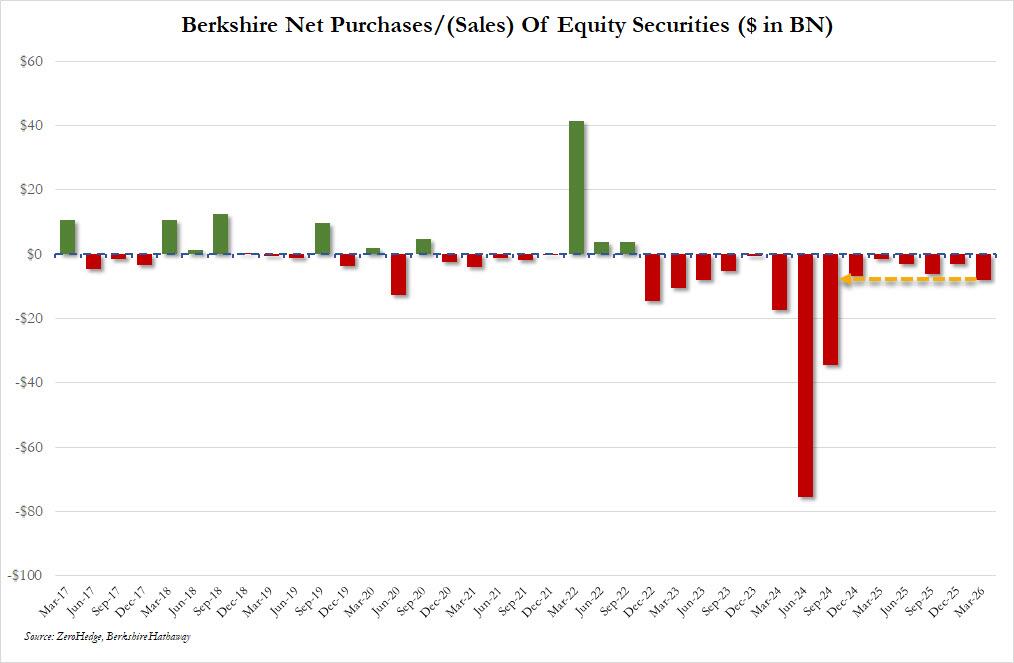
In Berkshire's first quarter Greg under Abel, who succeeded Buffett in January as Berkshire's chief executive, the company on Saturday reported a higher first-quarter operating profit even as economic uncertainty weighed on several of its consumer-oriented businesses. The Omaha, Nebraska-based conglomerate built by Warren Buffett and now led by Greg Abel also reported a record cash level, reflecting continuing difficulty finding investments that meet its value-oriented principles.The conglomerate also continued its trend of divesting its stock portfolio with the largest sales od equity securities in Q1 since mid-2024; it also unveiled the first, modest stock buyback since Q2 of 2024.
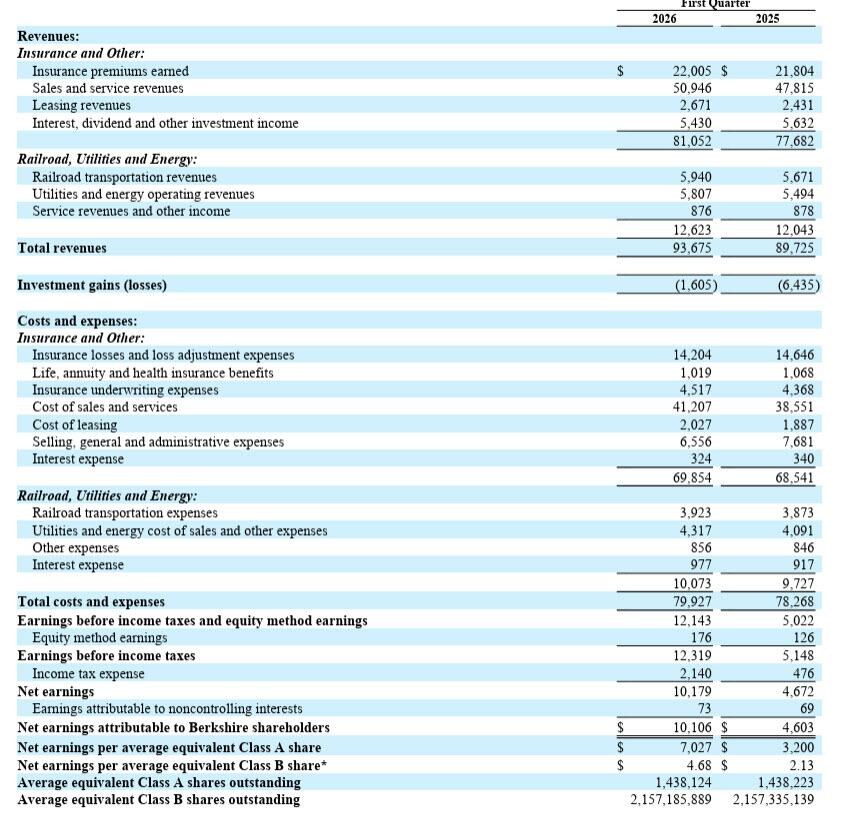
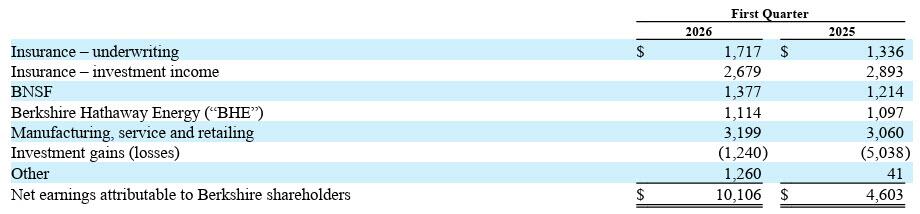
Profit from Berkshire's numerous businesses rose 18% to $11.35 billion, or about $7,891 per Class A share, from $9.64 billion a year earlier. Net income, including from common stock investments, more than doubled to $10.1 billion, or $7,027 per Class A share, from $4.6 billion thanks to a boost from an improvement in underwriting results in its vast insurance businesses (Berkshire has traditionally downplayed the relevance of net income, which because of accounting rules includes unrealized gains and losses on stocks it has no plans to sell, and its therefore especially volatile during periods of market stress).
Berkshire's earnings are closely watched because the conglomerate’s businesses, ranging from insurance to railroads to energy and manufacturing, provide a snapshot of the health of the US economy. The company owns dozens of businesses including Geico, the BNSF railroad, Berkshire Hathaway Energy, Dairy Queen and See's Candies. Yet while Berkshire is sometimes considered a microcosm of the broader U.S. economy, its focus on insurance and hard assets has left it out of step with broader market trends, including the prevailing euphoria over artificial intelligence.
Worries about the economy took a toll on several of Berkshire's consumer-oriented businesses. Berkshire said economic conditions weighed on building products businesses such as the Clayton Homes mobile home unit, while the Forest River RV unit, Fruit of the Loom and Squishmallows maker Jazwares reported lower revenue amid "higher economic uncertainty" and lower consumer confidence.
Underwriting earnings from the firm’s collection of insurance businesses surged to $1.7 billion, up about 29% from a year ago, when the units were hit by losses tied to the Los Angeles wildfires. Still, Geico posted a 35% decline in pretax underwriting earnings, as the unit faced more losses and spent more to gain new clients.
“Most of Geico’s peer group this quarter posted significantly improved underwriting results,” said Cathy Seifert, an analyst at CFRA Research, on the contrast between competitors and Geico. “They’re a big unit and that’s a big deterioration.”
Profit from all insurance operations rose 4% to $4.4 billion from a year earlier, when wildfires in Southern California hurt results in reinsurance and smaller insurance businesses. The overall improvement came despite the 35% profit drop at Geico, where accident claims and marketing expenses increased. Geico spent several years upgrading its underwriting discipline and technology, and is trying to reclaim market share it gave up to rivals such as Progressive. Abel said at the meeting that the insurance sector generally is "softening" and becoming "more challenging" as more capital flows into the market, making it harder for Berkshire to charge sufficient premiums for the risks it takes on.
Profit at its railroad unit BNSF rose 13% to $1.4 billion, helped by higher demand to ship grains, petroleum fuels, oilseeds and meals, and relieving pressure on BNSF management, led by CEO Katie Farmer, to improve the unit’s operating margin and close the gap with its most efficient peers.
The railroad has lagged some peers in operating margin, and Abel said in his first annual letter to Berkshire shareholders that improved efficiency and service were necessary. Abel had given the division’s management a clear mandate to improve the business on those fronts. He said at the meeting that while he’s pleased with the first-quarter results, there’s still room for improvement.
“We had heard that there was some cost efficiencies being implemented at BNSF, and that showed up in the first-quarter results,” Seifert said.
Elsewhere, Berkshire Hathaway Energy said profit rose 2%, as higher revenue from natural gas pipelines attributable to cold weather offset rising maintenance and wildfire prevention costs in utility businesses. Profit from manufacturing, service and retail operations rose 5% to $3.2 billion.
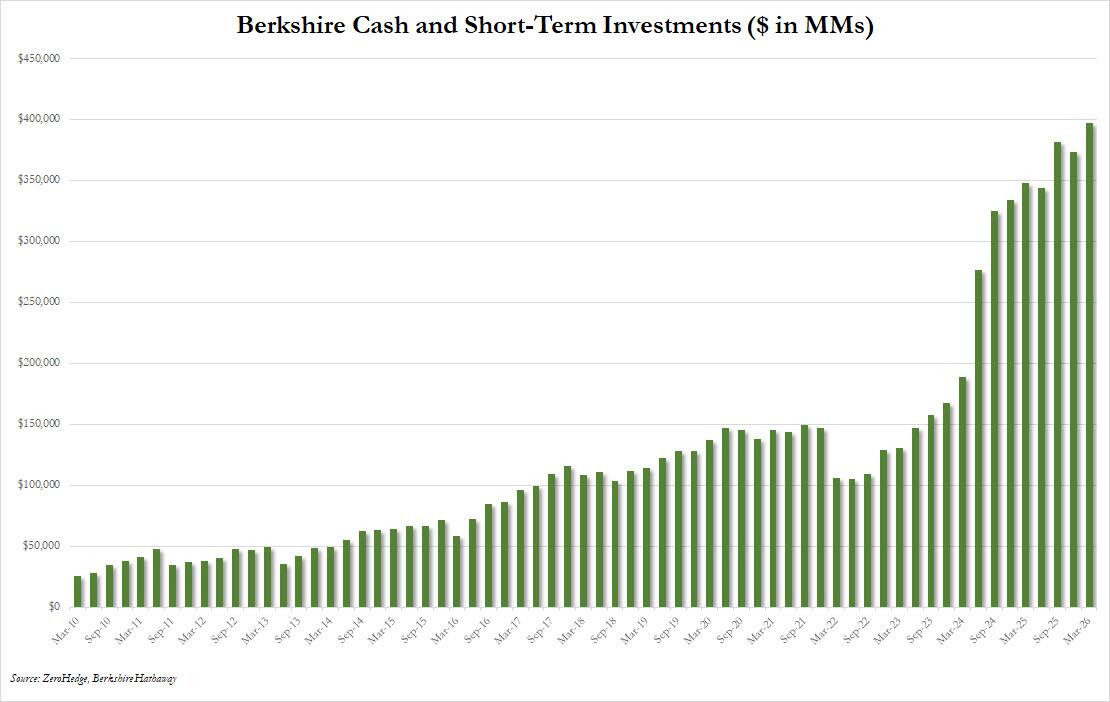
Earnings aside, Berkshire's cash hoard soared to a new record high just shy of $400 billion, or more than the US government traditionally has in its Treasury General Account (except for rare outlier occasions). As of March 31, Berkshire's total cash (held mostly in T-Bills) was $397 billion. The cash pile reflected the company's years-long inability to find a major acquisition, as well as sales of some of its largest stock holdings led by Apple.
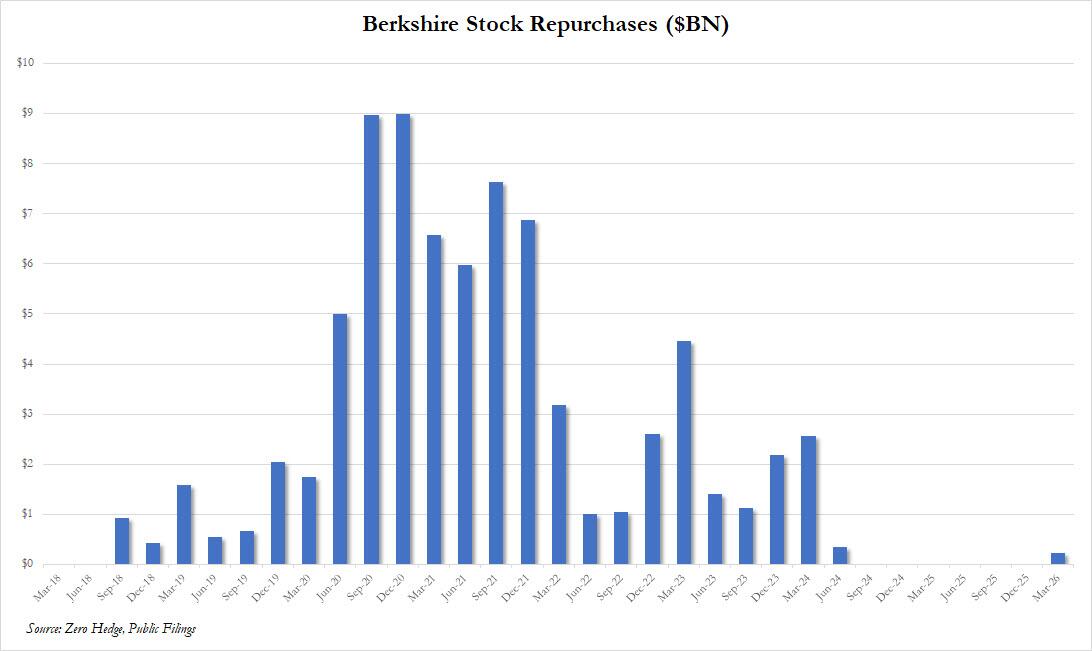
After a nearly two year hiatus without any stock buybacks, in Q1 Berkshire repurchased a modest $234 million of its own stock, the first buybacks since May 2024. It conducted no repurchases in the first two weeks of April.
More importantly, in Q1 Berkshire sold $8.1 billion more stocks than it bought, the 14th straight quarter it was a net seller of stocks, and the largest net sales since Q3 2024 when BRK sold almost $30 billion. Berkshire hasn't bought stock since Q3 2022. Berkshire paid $9.5 billion in January for Occidental Petroleum's chemicals business; it also decided against a new impairment charge on Kraft Heinz, one of its largest equity holdings, for now, even as the book value of its holding in the packaged food giant exceeds its fair value by $1.4 billion. Last year, the firm took a $3.8 billion hit, as the stock’s performance continued to disappoint.
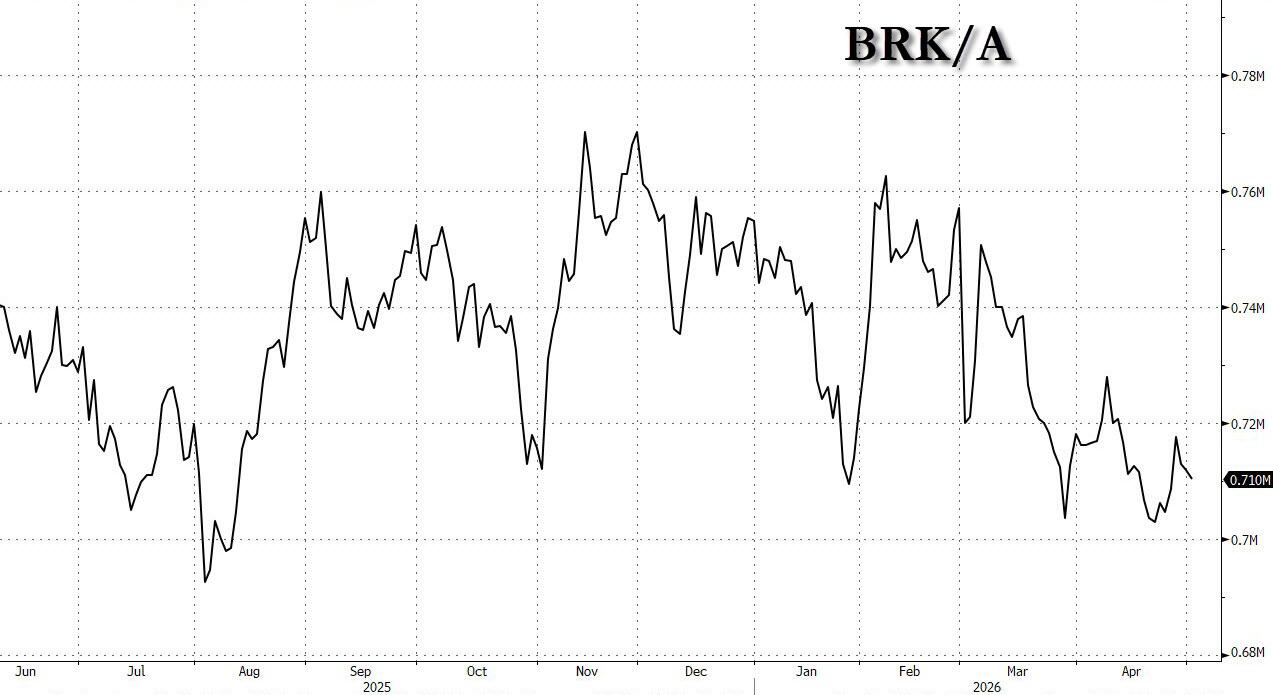
Results were released prior to Berkshire's annual shareholder meeting, which draws tens of thousands of people to Omaha, and this year they won't be happy; not only is the Oracle of Omaha no longer there, but Berkshire shares have significantly lagged the broader market since Buffett unexpectedly announced at last year's meeting when Abel would take over. In 2026, Berkshire Class A shares of the $1.02 trillion buy-and-hold behemoth have fallen 6%, a mirror image of the S&P's 6% ascent, and a far cry from the historic surge in Semiconductor names which are now the market's darling du jour.
Abel took to the stage and address shareholders in Omaha on Saturday for his inaugural annual meeting as CEO. This is the first time in decades that Buffett won’t be leading the event after the 95-year-old announced he would step down from his role last year, though he was still in attendance and even shared a few remarks to help kick off the meeting.
At the Omaha shareholder meeting earlier today, new CEO Greg Abel assured Berkshire shareholders that he will invest wisely and manage the conglomerate's massive cash stake without the burdens of bureaucracy, as he seeks to win over those cautiously hoping he is a worthy successor to Warren Buffett. Abel, 63, spoke at Berkshire's annual meeting in Omaha, Nebraska, four months after succeeding arguably the world's most famous investor as CEO.
To do that, he must earn the trust of investors now enamored with technology and artificial intelligence, rather than Berkshire's collection of insurers, retailers and hard-asset businesses in energy, industrials and manufacturing.
"As a conglomerate, we live by the fact that we hate bureaucracy," Abel said in response to a prerecorded question from Buffett, who also sat in a front-row seat. "We do not intend to be beholden to anyone. We start with that."
Still, attendance was down significantly from when Buffett and Vice Chairman Charlie Munger, who died in 2023, presided over meetings filled with their lively insights and banter about Berkshire, the economy, markets and life. Buffett and Munger drew capacity crowds in the downtown arena where the meeting took place, but several thousand of the approximately 18,000 seats were empty when Abel took the stage.
The meeting is the centerpiece of a weekend of shareholder events around Omaha, including investment conferences, private get-togethers, and shopping from Berkshire-owned businesses in an exhibit hall adjacent to the arena. Fewer people shopped. While thousands lined up outside the arena before doors opened at 7 a.m., the lines were considerably shorter than in recent years.
“I wanted to soak in the atmosphere and network with finance professionals,” said Jobby Chin, a finance student from Singapore attending her first meeting, who said she got in line at 2 am. Michael DiDonna, a fashion photographer from Oyster Bay, New York, said he arrived at 3:10 a.m. for his fifth meeting. "I want to feel a part of the monumental shift at the company," he said.
Buffett, for his part, assured the audience that "Greg is doing everything I did and then some," reprising comments he made last year when he announced his retirement as CEO. The 95-year-old also praised Apple, one of Berkshire's most successful investments, and its departing chief executive, Tim Cook. Buffett remains Berkshire's chairman.
In an interview with CNBC on the meeting's sidelines, Buffett fretted about a gambling mentality that has taken hold of some investors. "We've never had more people in a gambling mood than now," he said. "That doesn't mean investing is terrible, but it does mean that prices for an awful lot of things will look awfully silly."
Abel also assured shareholders he would not break up Berkshire, saying it operated effectively and its bench of expertise was strong. "We want Berkshire to endure," he said. Abel also said he is constantly evaluating opportunities to add to Berkshire's existing portfolio, whether that is acquiring public or private companies or a piece of a company.
Abel adhered to Buffett's mantra of patience, saying he would like to hold investments "forever" and not plow into any without understanding their economic prospects and risks. "It doesn't mean you need to deploy all your capital and spend all your money," he said.
He agreed with Berkshire's longtime insurance chief, Ajit Jain, who also answered questions from the stage, that it was important to say "no" if an investment did not look right. "It is very difficult to sit there and do nothing," Jain said, "while everyone else is being wined and dined by brokers and taken to London."
Abel praised a recent Oregon appeals court ruling that, for now, spared Berkshire's PacifiCorp unit from billions of dollars of potential liabilities for wildfires in 2020 that the utility maintains it did not cause. "We're back to first base" on the legal side, he said, meaning the threat has lessened.
https://ift.tt/dzxC62A
from ZeroHedge News https://ift.tt/dzxC62A
via IFTTT





0 comments
Post a Comment