Pilot Dies After Fiery F-16 Crash At South Carolina As Another Training Mission Goes Horribly WrongTyler DurdenWed, 07/01/2020 - 06:11
A routine training mission went horribly wrong late Tuesday after a General Dynamics F-16 Fighting Falcon crashed at Shaw Air Force Base in South Carolina.
Shaw Air Force Base officials announced early Wednesday morning that the pilot had died during the accident.
Base officials say an Air Force F-16CM Fighting Falcon assigned to the 20th Fighter Wing crashed around 2330ET while on a "routine training mission." The crash is under investigation, and there was no official word on the cause.
Emergency crews on the runway at Shaw Air Force Base after a F16 crashed Tuesday night. The pilot was taken to a nearby hospital for treatment. pic.twitter.com/umSpNMRV3G
A video surfaced on Facebook shows what appears to be the crash site within the airbase, presumably on the taxiway or runway. In the distance, emergency crews can be seen deploying water cannons to contain the fiery crash that engulfed the fighter jet.
The airbase is located about 8.5 miles west-northwest of downtown Sumter. It's home to the 20th Fighter Wing, which is always combat-ready.
This isn't the first costly (in terms of money and/or lives) training accident in recent months. Back in May, a Lockheed Martin F-35 Lightning II and Lockheed Martin F-22 Raptor were lost during two separate training missions in Florida that both went awry.
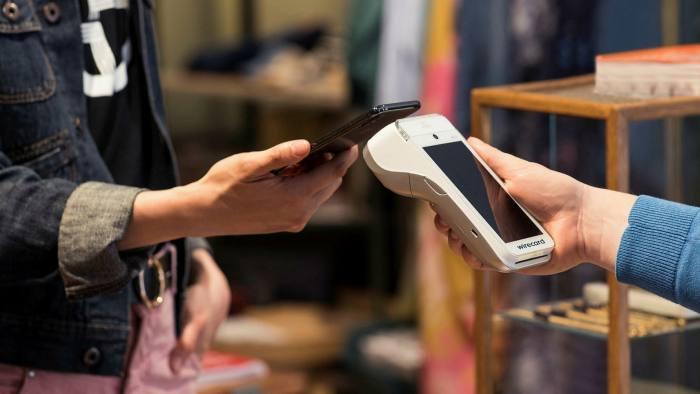
The scandal at Wirecard has not only exposed a multibillion-dollar fraud in the accounts and profound failures of oversight. It has also raised fresh questions of whether payments regulation in Europe has kept pace with the huge changes in the industry.
Once a sleepy arm of heavily regulated banks, the payments sector is being transformed by technological innovations, new legislation, new players and shifts in customer habits. Little wonder technology and payment-processing companies and banks are all vying to grab a share of the large and fast-growing market for digital payments.
Modern payment chains consist of an increasing number of companies that are interdependent but do not always have shared interests. They may be under the supervision of various authorities or even under no supervision at all.
That’s why last year my review of financial services for the Bank of England argued for a cross-authority review of payments regulation to reflect the shifting risks and gaps. The Wirecard debacle makes urgent action essential.
Technology and regulation have driven an unbundling of payments that historically were done under the roof of a regulated bank. The EU is especially vulnerable in this regard because it has been explicitly trying to break banks’ monopoly on payments. In addition, many European banks have raised capital by selling the parts of their businesses that work with retailers who want to accept cards.
This creates a challenge for policymakers who must decide which regulations should apply to those businesses while keeping a competitive system. Simon Gleeson of Clifford Chance argues in The Legal Concept of Money that a regulatory paradigm shift is needed; from an approach focused on entities to one based on activities.
A key lesson from the 2008 financial crisis was that some of the systemic importance of banks came from their function as payments providers to the real economy. If payments are systemic, then the largest payment companies must also be systemic once they exceed a certain size. Systemic companies must have appropriate oversight aimed at ensuring their resilience and operational continuity. It may not matter that a new payments company can get started with initial capital of just €50,000 and some insurance, but it does matter if additional oversight and systemic requirements do not kick in as the business becomes more important.
Some jurisdictions are leading the way. Singapore has recently introduced a three-tiered regulation for payment companies, which encourages innovation in smaller businesses, but imposes appropriate oversight on larger ones. Since the crisis, regulators have started forcing banks and clearinghouses to write living wills to govern how they could be wound down in a crisis. That requirement should now be applied to payments companies that are deemed systemic, with clear segregation of funds to ensure smooth transitions and alternatives for businesses and consumers.
In addition, the resilience of payments systems and their linkages should be tested with cyber penetration exercises. Such measures would make it easier for regulators to determine which companies are critical, and where there should be a pre-agreed plan in place of how they can step in for each other.
As payments data becomes increasingly valuable, we need to revise data-sharing rules. The EU’s second payments directive has created an unlevel playing field where banks are obliged to give customer data to unregulated businesses. Moreover, the liability when things go wrong can often rebound to the banks. Ana Botín, group chief executive of Santander, is right to argue that PSD2 should be amended to treat everyone involved in this activity the same way.
Digital payments innovation brings huge benefits to customers and businesses. The pandemic is accelerating our use of electronic payments and digital wallets. As a result, an even larger proportion of payments is likely to take place outside the tightly regulated perimeter of financial services. Wirecard’s bankruptcy underscores the urgency of next-generation payments regulation.
* * *
The writer, a former adviser to the governor of the Bank of England, chairs the sustainable finance committee at UBS
Dealmakers Keep Distance As Pandemic Crushes Global M&A To Decade Lows Tyler DurdenWed, 07/01/2020 - 04:15
Global mergers and acquisitions activity fell to its lowest levels in more than a decade in 1H20, as paralyzed dealmakers were unwilling to explore new opportunities as uncertainty plagued capital markets.
Data compiled by Bloomberg shows the value of M&A activity plunged 50% to $1 trillion in the first half from the year-earlier, marking the slowest period in dealmaking since 2012.
The first half in global capital markets was chaos - lockdowns and virus pandemic crippled supply chains and crushed consumers that will likely result in a recovery phase over several years. Sentiment shifted by mid-March, only after a rescue effort led by Fed, ECB, BOJ, and PBOC, slashing interest rates to zero and injecting trillions of dollars into global markets to arrest extreme volatility.
During times of extreme volatility, dealmaking is usually sidelined as companies protect balance sheets to weather a downturn.
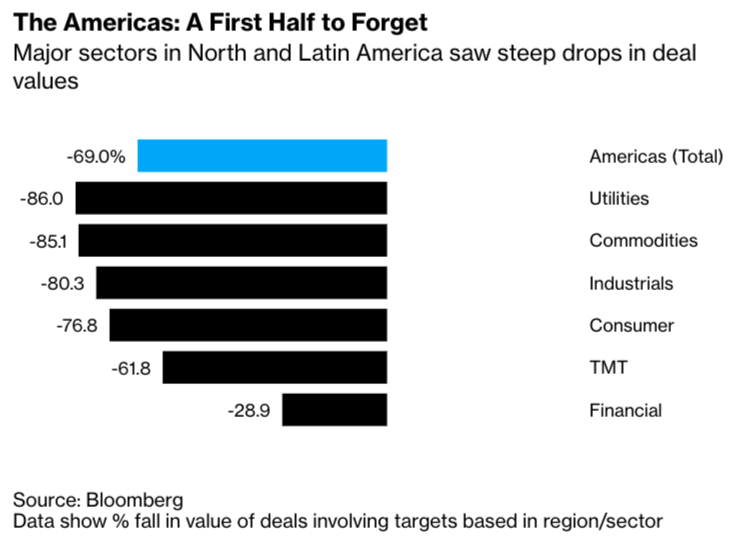
The biggest plunge in M&A activity was seen in the Americas, where the value of deals collapsed 69% in 1H20.
While every major industry has been hurt, the financial sector fared better than most. It was boosted by insurance brokerage Aon Plc’s $30 billion offer for Willis Towers Watson Plc and Morgan Stanley’s proposed $13 billion acquisition of E*Trade Financial Corp. The top three advisers on deals targeting the Americas so far in 2020 were Morgan Stanley, Goldman Sachs Group Inc., and JPMorgan Chase & Co. - Bloomberg.
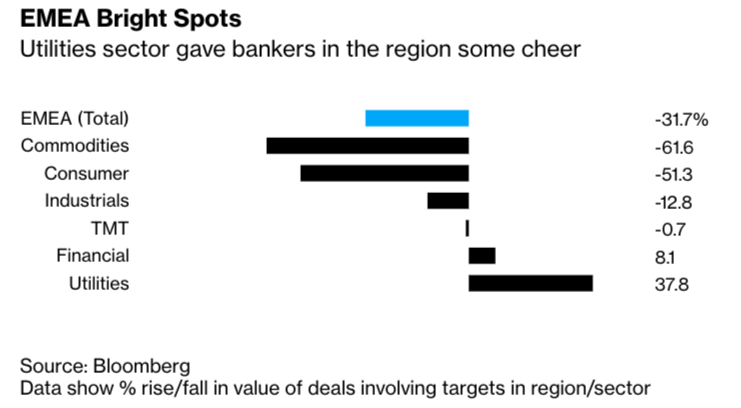
M&A activity in Europe, the Middle East, and Africa was down 32% during the period.
Large transactions that helped prevent a more dramatic drop include the $19 billion leveraged buyout of Thyssenkrupp AG’s elevator unit by Advent International and Cinven. There was also a recent flurry of activity in the Middle East, including Abu Dhabi’s sale of a $10.1 billion stake in its gas pipeline network that ranks as the biggest infrastructure transaction of the year. Goldman Sachs, JPMorgan and Rothschild & Co. were the busiest advisers on EMEA deals. - Bloomberg
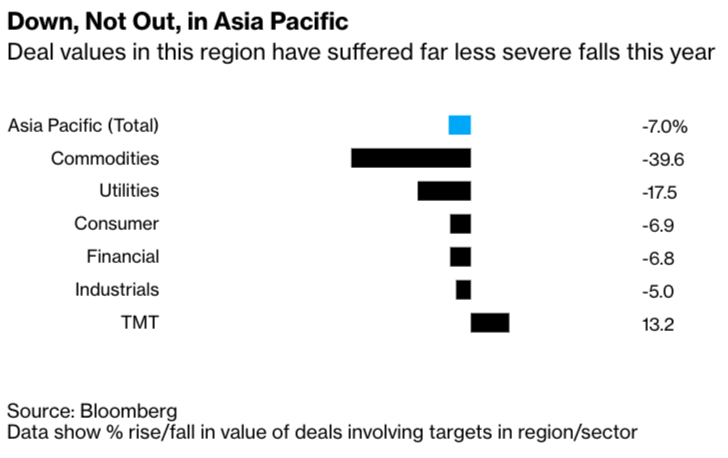
The Asia Pacific region fared the best, M&A activity slipped 7%.
The technology, media and telecommunications industry reported a 13% increase, helped by Indian billionaire Mukesh Ambani’s digital arm attracting $15 billion of investments from the likes of Facebook Inc. and KKR & Co. Another landmark transaction was Tesco Plc’s sale of Asian businesses to Thai billionaire Dhanin Chearavanont for more than $10 billion. The most active banks on deals in the region were Morgan Stanley, HSBC Holdings Plc and JPMorgan. - Bloomberg
Readers may recall, the global M&A bust was occurring well before the virus pandemic. As we noted in October 2020, "WeWork's catastrophic failed IPO had damaged capital market sentiment" - likely the markings of an early top.
We also said back then: "A slowdown in M&A deals is an ominous sign that Wall Street banks will see declining revenues in the quarters ahead."
More racist tweets by Cambridge University Professor Priyamvada Gopal have been unearthed, including one in which she spoke about her urge to “kneecap white men.”
Gopal caused controversy last week when she tweeted “white lives don’t matter,” prompting a petition demanding she be fired. However, Cambridge University responded by promoting her to a full professorship, despite the fact that the tweet was censored by Twitter for hate speech.
The media’s reaction was to portray Gopal as the victim of bullying while feigning infinitely greater outrage over a “white lives matter” banner that was flown over a soccer match in Manchester.
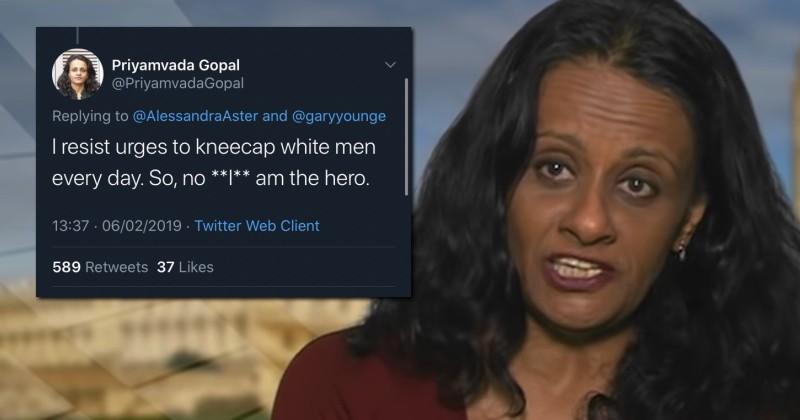
More hateful tweets have now been discovered, including one discussion where Gopal states, “I resist urges to kneecap white men every day. So, no **I** am the hero.”
Can @Cambridge_Uni please recognise that this is completely unacceptable and indefensible? How are her students supposed to feel safe? pic.twitter.com/Av6TPHWx0b
“Can @Cambridge_Uni please recognise that this is completely unacceptable and indefensible? How are her students supposed to feel safe?” asked Emma Webb.
“She’s racist. I think we need to stop this dumbass spiel that minorities cannot be racist because they absolutely can. She is racist and is getting away with because she’s not white. That’s just the fact of the matter,” remarked Dominique Samuels.
She’s racist. I think we need to stop this dumbass spiel that minorities cannot be racist because they absolutely can. She is racist and is getting away with because she’s not white. That’s just the fact of the matter.
— Dominique Samuels 🇬🇧 (@dominiquetaegon) June 29, 2020
Maybe these messages will lead to another petition demanding Gopal’s removal. The first one was deleted by Change.org after receiving over 20,000 signatures.
Cambridge University has stood by Gopal despite previously dismissing Noah Carl after 500 academics signed a letter challenging Carl’s research on race and intelligence.
The institution also previously rescinded its offer of a visiting fellowship to Jordan Peterson after a woke mob complained about his stance on political correctness and after he appeared in a photograph with a man wearing a t-shirt that said “I’m a proud Islamophobe.”
* * *
My voice is being silenced by free speech-hating Silicon Valley behemoths who want me disappeared forever. It is CRUCIAL that you support me. Please sign up for the free newsletter here. Donate to me on SubscribeStar here. Support my sponsor – Turbo Force – a supercharged boost of clean energy without the comedown.
Should Governments Save Lives Or Jobs Amid Pandemic?Tyler DurdenWed, 07/01/2020 - 02:45
It looked like the U.S. had reached the peak of its coronavirus infections on April 24 when it experienced 36,738 new daily cases, a figure that fell to 17,618 by May 11. Back then, it looked like the U.S. had put the worst of the pandemic behind it and President Trump consistently pressed for the economy to be reopened. While testifying in front of the Senate in mid May, Dr. Anthony Fauci, the top U.S. infectious disease expert, cautioned against reopening too early, stating that the virus could spiral out of control resulting in increased suffering and death as well as a setback on the road to economic recovery.
On June 26, the U.S. reported 45,300 new daily infections and at least 16 states have either paused of backtracked on reopening their economies. And as Statista's Niall McCarthy notes,the push to reopen led to a debate about whether it was better to to save lives and incur economic damage or press on with reopening without taking precautions to keep people safe.
Most countries around the world adopted the former strategy with Italy, Spain, France and Germany among those waiting until the infection rate dropped substantially so that effective testing, contact tracing and isolation strategies could be implemented. All of those countries are now reaping the benefits of that approach, opening up their economies in time for the busy summer holiday season.
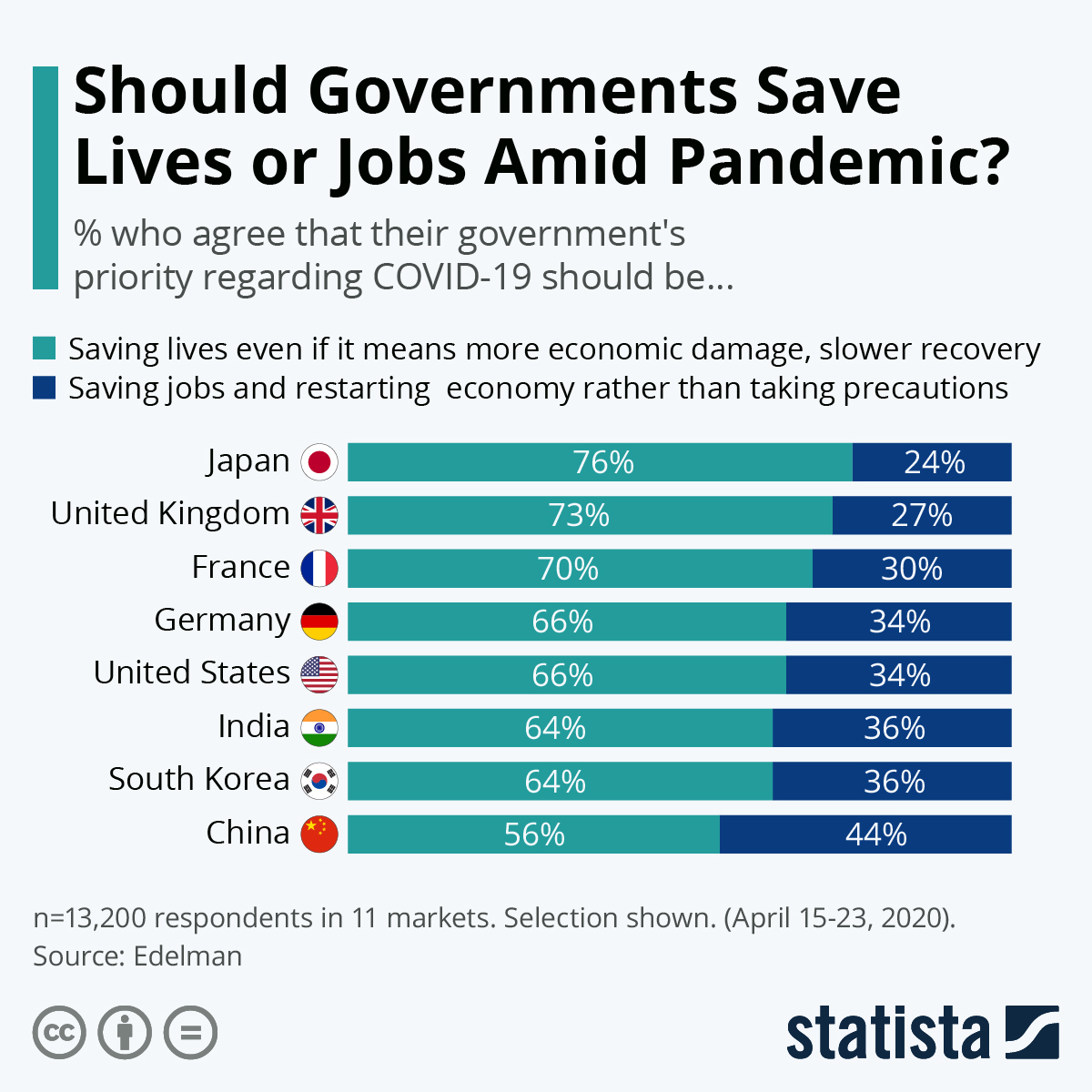
Edelman analyzed public attitudes to both approaches in a Spring Update to their Trust Barometer. Out of the 13,200 respondents polled across 11 countries, 67 percent agreed that the government should save as many lives as possible, even if it means the economy will sustain more damage and recover more slowly. 33 percent of respondents said it is becoming more important for the government to save jobs and restart the economy than to take every precaution possible to keep people safe from the virus.
On a country-by-country basis, Japan had the highest proportion of people valuing lives over economic recovery at 76 percent. Elsewhere, 66 percent of Americans say that saving lives should be the government's priority while 34 percent think the government should focus on saving jobs.
In China, where the coronavirus intitially took hold, 56 percent of respondents said the authorities should focus on saving people while 44 percent want the economy reopened, regardless of the impact on citizens.