English Ignore Social Distancing Pleas And Pack Beaches On Hottest Day Of SummerTyler DurdenSat, 08/01/2020 - 08:45
Millions of Britons across northern England have been placed under partial lockdown as a handful of hotspots have emerged in Manchester and other areas. But despite a pervasive sense of trepidation as outbreaks in Catalonia, Poland and elsewhere revive fears about a second wave hammering Europe, many in the UK are crowding on to beaches as temperatures reach record summer highs.
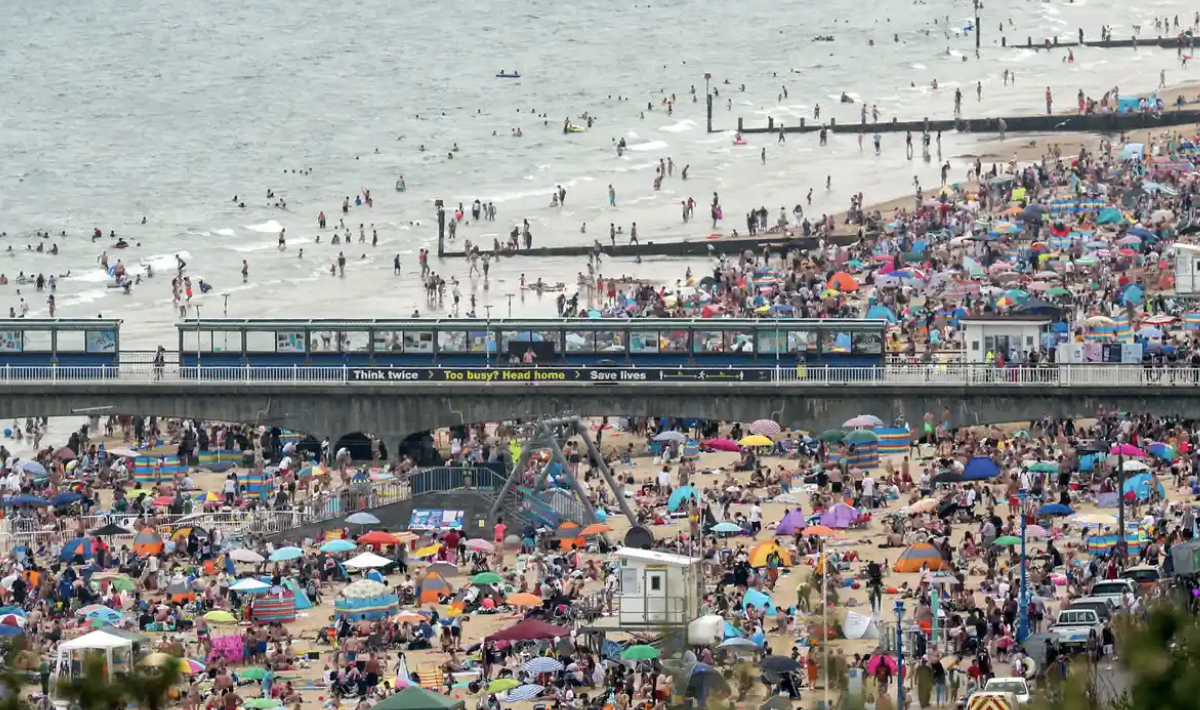
Footage going viral on social media shows packed beaches along the south coast of England as temperatures notched the hottest day of the year.
At Bournemouth, a resort town in southwestern England not far from Southampton, a major incident was declared last month because the beach became so packed, social distancing became impossible.
That's happening again, it appears.
Here's more from the Guardian, which documented groups of as many as 50 people, mostly consisting of teenagers and people in their early 20s.
Despite the warnings, groups of up to 50 teenagers, and men and women in their early 20s gathered. Security guards removed some men who were drinking under the pier but no attempts were made to close the beaches or to to ask people to leave.
One sun-seeker, 18-year-old Lizzie Jones from Portsmouth, who was on the beach with a dozen friends, said she felt perfectly safe and didn’t feel she was putting anyone at risk. “We’re out here in the fresh air. People are a bit close but I don’t think there’s much of a danger,” she said.
Some car parks were full, prompting scores of people to abandon their vehicles illegally.
A digital sign informed people that the beach was "too busy." A new app produced by the local authority, Bournemouth, Christchurch and Poole council, urged people to avoid long stretches of the beaches with the message: "Avoid, safe social distancing not possible."
Further east, the city council of Brighton and Hove expressed alarm over the number of people crowding its beaches.
We're concerned about the number of people in the city.
- If you're not already here, please don't travel to the city today
- There is limited capacity on public transport
- Large numbers make it impossible to maintain physical distancing pic.twitter.com/n7UxPpxp3N
— Brighton & Hove City Council (@BrightonHoveCC) July 31, 2020
Officials also warned visitors to some of the most popular beaches in Kent to find a less-crowded spot, or consider returning at "a quieter time".
— Communications Team (@ThanetCouncil) July 31, 2020
Another anonymous young man who spoke to the Guardian said he and his friends had taken public transit to the beach at Bournemouth: "It feels safe to me. I don’t know anyone who has had coronavirus. Until I do I don’t think it will feel real to me."
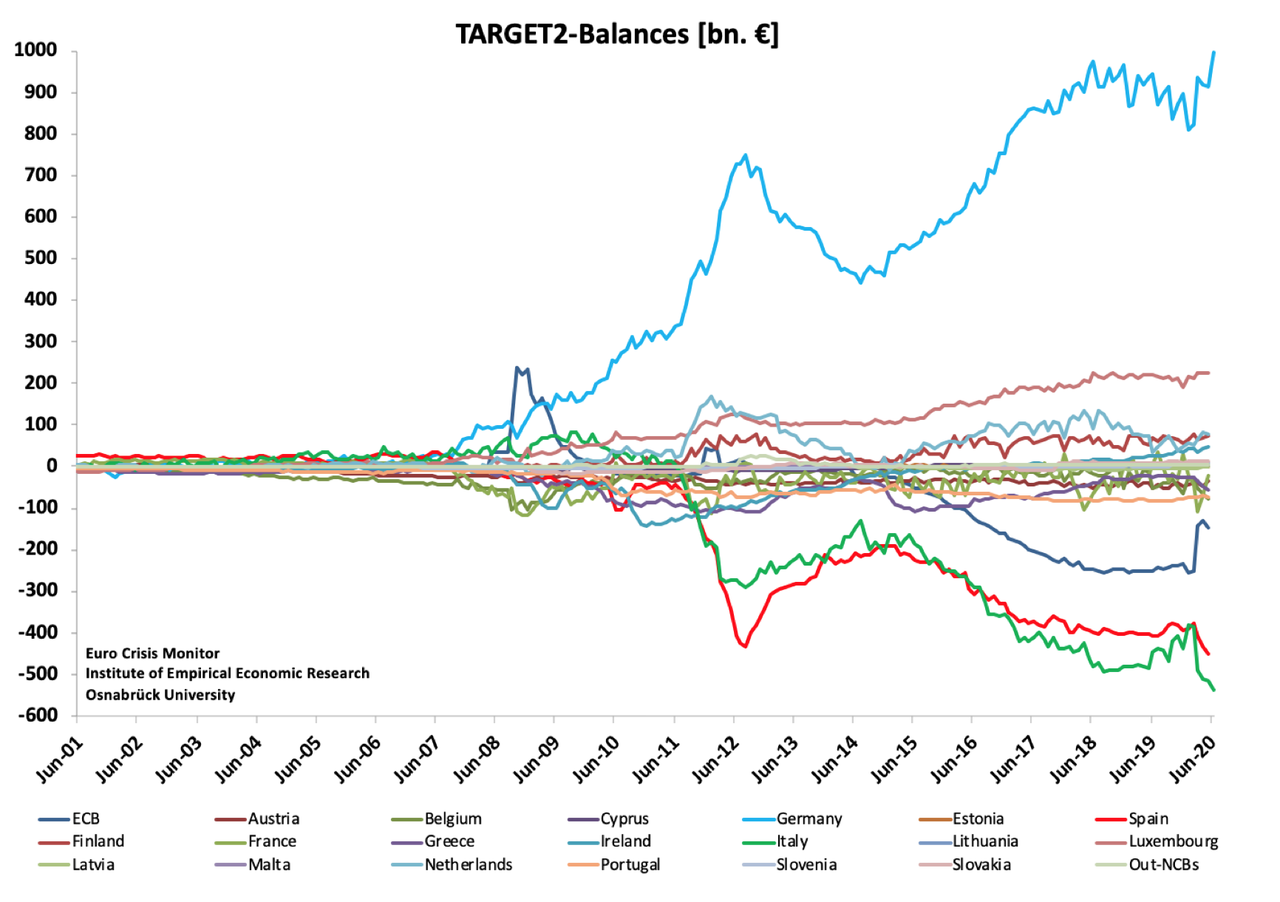
The Euro Crisis Monitor (below) shows the increasing imbalances in the TARGET2 settlement system between all its members: the ECB (itself with a €145bn deficit) and the national central banks in the Eurozone.
Other than minor differences reflecting net cross-border trade not matched by investment flows going the other way, these imbalances should not exist. But following the Lehman crisis and as the Eurozone developed its own series of crises, imbalances arose. Commentators have grown used to them, so have more or less given up pointing them out. But in the last few months, the apparent flight into the Bundesbank (€995,083m surplus) has gathered pace, as have the deficits for Italy (€536,722m) and Spain (€451,798m). It is time to take these rising imbalances seriously again.
Target2 — the ECB’s flexible friend
Target2 is the settlement system for transfers between the national central banks. The way it works, in theory, is as follows. A German manufacturer sells goods to an Italian business. The Italian business pays by bank transfer drawn on its Italian bank via the Italian central bank through the Target2 system, crediting the German manufacturer’s German bank through Germany’s central bank.
But since the Lehman crisis, and more noticeably the last eurozone crisis, capital flows appear to have gravitated from Portugal, Italy, Greece and Spain (the PIGS — remember them?) to principally Germany, Luxembourg, Netherlands and Finland in that order. Before 2008, the balance was maintained by trade deficits in Greece, for example, being offset by capital inflows as residents elsewhere in the eurozone bought Greek bonds, other investments in Greece and the tourist trade collected net cash revenues.
In this sense, it would be wrong to suggest that trade imbalances have led to Target2 imbalances. But part of the problem must be put down to the failure of private sector investment flows to recycle.
Then there is the question of “capital flight”, which is not capital flight as such.
The problem is not that residents in Italy and Spain are opening bank accounts in Germany and transferring their deposits from domestic banks, but more an example of the tragedy of the commons. The origin of this phrase applied to common grazing rights, where everyone in the parish can graze their livestock on common ground, but no one has the incentive to ensure it is properly managed, not overgrazed, and maintained free of gorse and bracken. Consequently, the ground becomes less productive over time. Similarly, the national central banks that are heavily exposed to potentially bad loans know that their losses, if materialised in a general banking crisis, will end up being shared throughout the central bank system, according to their capital keys.
The capital key relates to the national central banks’ equity ownership in the ECB, which for Germany, for example, is 26.4% of the total. If Target2 collapsed for any reason, the Bundesbank, to the extent the bad debts in the Eurosystem are shared, could lose a significant part of the trillion euros owed to it by the other national central banks. But it would be a step too far to say that some national central banks, such as those of Spain and Italy, are gaming the system. It appears to be a problem that simply arises as an unintended consequence of Target2.
If one national central bank runs a Target2 deficit with the other central banks, it is almost certainly because it has loaned money on a net basis to its commercial banks to cover payment transfers, instead of them progressing through the settlement system. Those loans appear as an asset on the national central bank’s balance sheet, which is offset by a liability to the ECB’s Eurosystem through Target2. But under the rules, if something goes wrong either with its own lending or another NCB’s lending, the costs are shared out by the ECB on the pre-set capital key formula. In theory, it is therefore in the interest of a national central bank to run a greater deficit in relation to its capital key by supporting its own banks. It is not necessarily a deliberate act of the Bank d’Italia or the Banco de España to make dodgy loans to their commercial banks; it is just how the system works, and the consequence of national pressures.
To understand how and why the problem arises, we must go back to the earlier crises following Lehman, which have informed national regulatory practices. If the national banking regulator deemed loans to be non-performing, the losses would become a national problem. Alternatively, if the regulator deems them to be performing, they are eligible for the national central bank’s refinancing operations. A commercial bank can then use the questionable loans as collateral, borrowing from the national central bank, which spreads the loan risk with all the other national central banks in accordance with their capital keys. Insolvent loans are thereby removed from the Italian and Spanish banking systems and dumped on the Eurosystem.
In Italy’s case, the very high level of non-performing loans peaked at 17.1% in September 2015 but has now been reduced to 6.9%. As PWC Italia wryly put it,
“Italian banks in response to market and regulatory pressure have halved the total stock of non-performing loans to €135bn in 2019 (vs €341bn in 2015) and at the same time they have set up their NPL platform and organisational controls that will allow to manage non-performing loans more quickly and efficiently and thus to face the incoming economic crisis in a more resilient way.”
Given the incentives for the regulator to deflect the non-performing loan problem from the domestic economy into the Eurosystem, it would be a miracle if much of the reduction in NPLs is genuine.
In the member states with negative Target2 balances such as Italy there has been a trend to liquidity problems for legacy industries, rendering them insolvent. With the banking regulator incentivised to remove the problem from the domestic economy, loans to these insolvent companies have been continually rolled over and increased. The consequence is that new businesses have been starved of bank credit, because bank credit in the member nation’s banks is increasingly tied up supporting businesses that should have gone to the wall long ago.
Officially, there is no problem, because the ECB and all the national central bank Target2 positions net out to zero, and the mutual sharing of liabilities between the national central banks keeps it that way. To its architects, a systemic failure of Target2 is inconceivable. But, because some national central banks end up using Target2 as a source of funding for their own balance sheets, which in turn funds their own dodgy commercial banks, some national central banks have mounting potential liabilities not of their own making, but rather the making of national bank regulators.
The Eurosystem member with the greatest problem is Germany’s Bundesbank, now owed close to a trillion euros through Target2. And the risk of losses is now accelerating both in their quantity, and given the economic consequences of Covid-19, the quality of the underlying loan-assets is rapidly deteriorating as well. The main culprits, the national central banks of Italy and Spain, at the same time are seeing their deficits increase rapidly. The Bundesbank should be very concerned. Its directors will be aware of the problem, particularly since it is now in the public domain.
One may ask how this “mythical surplus” fits in with the Bundesbank’s own balance sheet. As an asset, the surplus was about half of the Bundesbank’s total assets at 31 December 2019, and it finances, among other things, current accounts and deposit facilities of €560bn for its own risk-averse commercial banks. The Bundesbank’s silence in this matter is increasingly untenable.
Commercial banks are in deep trouble
The position for commercial banks in the eurozone, to say the least, is extremely fragile. For years, they have operated in the strait jacket of negative interest rates imposed by the ECB, which operate as a tax on the commercial banks’ liquidity. They can only offset it by buying government and other bonds with less of a negative yield, or with a positive yield. Alternatively, they can lend revolving capital to business customers and consumers for positive margin. And lastly, they can deploy balance sheets for purely financial purposes, which given underlying fundamentals is becoming a likely source of credit contraction.
One would have thought lending bank credit into the real economy would be the most urgent objective of monetary policy, but as we have seen, the increasing support for zombie corporations to prevent national write-offs precludes other lending for economic benefit. And the ECB’s policy objectives are divorced from this problem, which is the responsibility of the national central banks.
The ECB operates on a higher plain. The real consideration that sets the ECB’s interest rate policy is different: it needs to nurse the finances of insolvent member state governments. It does this through various asset purchase programmes, which allow the ECB to set and supress the cost of funding national deficits. Under its charter the ECB is not allowed to fund member states directly, but it can buy bonds in the secondary market. By buying government bonds, almost entirely from commercial banks, balance sheet space is created for the banks to buy further new issues of government bonds, thus resolving the funding problem.
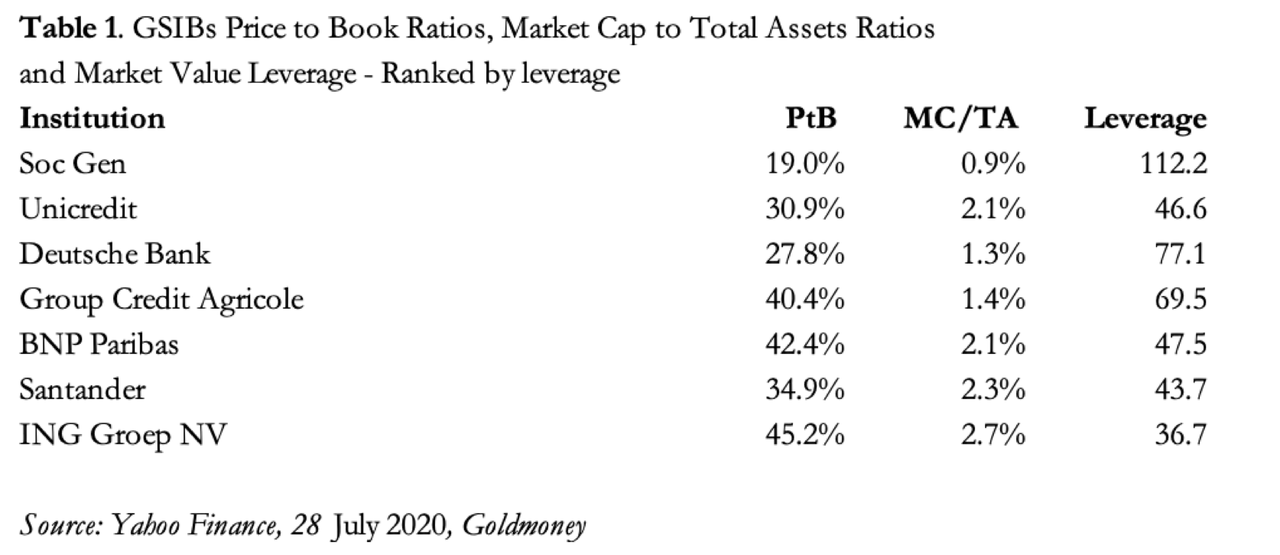
On the face of it, this is a win-win for the governments which are now being paid to borrow, and also for the banks. The yield on national government debt is always set to ensure that a positive return is obtained for the banks by subscribing for new bonds and selling them to the ECB at what amounts to a guaranteed price. But this zero-risk business comes with wafer-thin margins, which encourages excessive balance sheet expansion to compensate. Deutsche Bank, for example, has a ratio of total 2019 assets to equity of 21.4 times, Credit Agricole 28.1 times, BNP Paribas 20.1 times, and Société Generale 21.4 times. These high rates of leverage can only be borne by banks who can demonstrate very low rates of non-performing loans, a situation that will have changed fatally for all Eurozone banks as a consequence of COVID-19 lockdowns.
Other banks, such as UniCredit in Italy, have lower asset to equity ratios (14.4) and Santander in Spain (15.2), reflecting higher lending risks on their balance sheets as well as problems with non-performing loans. But these ratios are still far too high in the context of a contracting European and global economy. Even though the flood of money unleashed by the ECB and other central banks in response to the coronavirus has broadly remained in the financial economy and therefore is puffing up share prices everywhere, the market’s rating of the equity value of eurozone banks is very low. Table 1 shows how this affects balance sheet gearing from a shareholder’s point of view in the global systemically important banks in the eurozone — the GSIBs.
Even though they permit them to be outrageously high, the regulators focus on total asset to equity ratios becomes positively frightening when the true value of balance sheet equity judged by the market is taken into account. For the eurozone’s banking regulators to ignore the market ratings for these banks is a negation of their primary responsibility, to protect the public from bad banking practice.
The whole regulatory thing is a giant banking sham. As far as the ECB is concerned, the role of the commercial banks is to act as agents in its funding of member states’ budget deficits. But that problem has escalated suddenly in recent months putting additional strains on the whole Eurosystem. Yet the ECB continues to drive the commercial banks into the ground by forcing them towards yet higher ratios on the slimmest of margins in its quest to fund member government deficits.
To summarise the problems now faced through the creation of the Eurosystem:
The national central banks in the PIIGS are now using the Target2 settlement system as a means of their own balance sheet funding in excess of their capital key, which has the effect of burdening the central banks of Germany, Luxembourg, Finland and the Netherlands with excess liabilities in the event of a partial or complete systemic failure.
Instead of non-performing loans being dealt with at a national level, banks are encouraged to continually finance them and carry them on their balance sheet as being solvent. These loans are then used as collateral for funding from the Italian and Spanish central banks as well as those of Portugal and Greece, which are in turn financed through Target2 imbalances.
This situation surely should not be tolerated by the Bundesbank in particular, being exposed to close to a trillion euros in a settlement system that is being progressively corrupted by its users.
Funding government deficits, being the ECB’s primary and now exclusive objective, has led to extreme levels of operational gearing for the eurozone’s commercial banks, which can only result in an eventual collapse of the whole system. Share prices for the region’s GSIBs are in effect trying to discount this outcome.
The Eurosystem is unsuited to deal with a systemic shock on the scale it now faces and, on its realisation, can be expected to collapse.
National solvency issues
The underlying problem for the eurozone and the ECB is government spending deficits will continue to grow, and no attempt is being made to address this problem. In the process, events have corrupted the banking and settlement systems, setting national central banks against each other as debtors and creditors, and encouraging commercial banks into unsound practices by not writing off bad debts. We should be in no doubt the financial system of the eurozone is heading towards an eventual crisis which will destroy it.
Before COVID-19, the ECB might have been expected by its critics to continue on its path towards financial oblivion for a few more years yet. After all, top-down control systems can persist for decades despite everything, as long as the control is strong enough. But we should be in no doubt that lockdowns have had an undermining impact that calls the survivability of the Eurosystem into more immediate question.
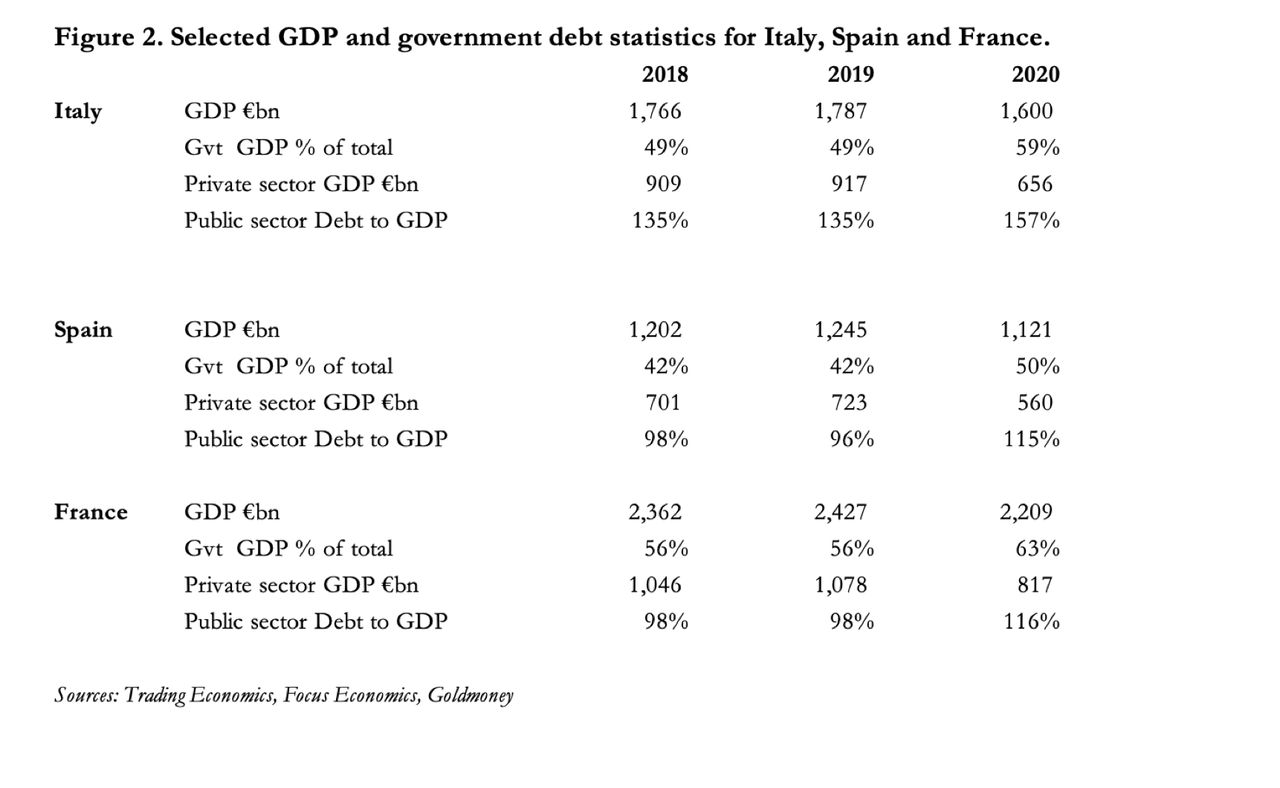
Table 2, which is of the relevant national statistics for Italy and Spain with the addition of highly indebted France, illustrates the problem emanating from lockdowns.
Forecasts for GDP in 2020 are consensus from Focus Economics. Debt to GDP statistics and their forecasts are from Trading Economics. From these, we can derive the economic effect on national private sectors. It is not widely appreciated that headline GDP numbers are bolstered by extra government spending, which when stripped out leaves the private sector exposed to significant falls in GDP on seemingly Panglossian forecasts. Thus, a 10.5% fall in consensus GDP expectations for Italy this year, after increased public spending in connection with the virus, translates into a fall of 28% in private sector GDP.
The effect on the Italian economy will simply lead to a new round of bankruptcies for all levels of Italian business, accumulating on the balance sheets of Italian banks. Similarly, we see Spain’s private sector contracting by 22.5%, and France’s by 24%. In all three cases, consensus forecasts for 2021 are for significant recoveries, conforming to a V-shape. With a second round of lockdowns increasingly likely, those forecasts are vulnerable to reality.
Forecasters are almost all Keynesian in that they expect government spending to stimulate economic recovery. But in reality, all that extra government spending can be expected to achieve is a statistical appearance of recovery through the creation of more bank credit to bolster government spending. But with the banking system commandeered to provide inflationary finance for governments and already having over-leveraged balance sheets (Table 1), prospects for economic recovery are remote.
As soon as it becomes clear that the recovery is going to take longer than anticipated we can expect the fragile confidence, that the ECB can continue to keep the show on the road, to evaporate. That is if, and not before, one or more of those highly leveraged eurozone banks does not face bankruptcy itself.
The consequences of financial dislocation
The developing situation embodied in the Target2 settlement system has concealed the rotten core of the Eurosystem. The consequences of imbalances, always dismissed by the authorities, are poorly understood and therefore ignored by financial commentators. But as we have seen, the Eurosystem and its Target2 settlement structure have fostered the concealment of bad debts at the national level, transferring them into the national central bank network.
The principal losers are Germany, Luxembourg, the Netherlands and Finland. Excepting Luxembourg, which can be expected to just go with the flow, the others could be determined enough to form the nucleus of a new currency area; but they are unlikely to do so before the Eurosystem implodes. To do so would actively destroy it, and the balance sheets of their own central banks as well.
The collapse of the Eurosystem would bankrupt the PIGS, and possibly other member states, cutting off all monetary financing. One would doubt, that even in such a crisis, there would emerge the political leadership with the strength, skill and determination to take these nations out of the crisis. As a centralising force, Brussels is utterly useless and will have lost all credibility. Furthermore, the collapse of the Eurosystem would mean the end of the euro as circulating money, so currency replacements, presumably on national lines, would have to emerge.
The ending of the euro will not be mourned. Those which it disciplined through its strength regretted the loss of a money they could print for themselves. And those who end up paying for its failure will have sacrificed all their peoples’ hard-won savings.
For the moment, the euro is strong against the world’s reserve currency. This strength comes partly from its moderate international trade surplus compared with the enormous US trade deficit, and the fact that the dollar is over-owned by foreigners while the euro is not. But in terms of purchasing power both currencies are on their different trajectories to purchasing power destruction.
The Fed’s policy of tying in the dollar to the fortunes of financial asset values is one form of currency destruction, but the euro will be destroyed if, and when, the flawed Eurosystem falls apart.
Hurricane Isaias Barrels Towards Virus-Infected South Florida Tyler DurdenSat, 08/01/2020 - 07:37
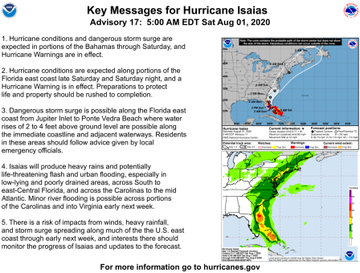
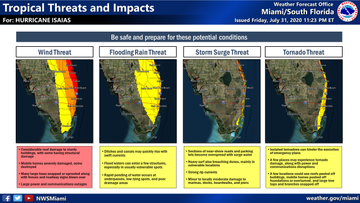
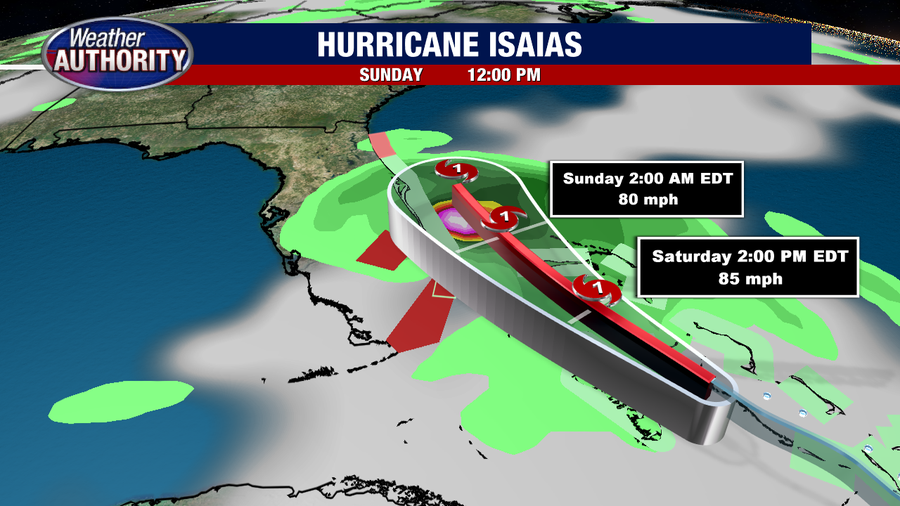
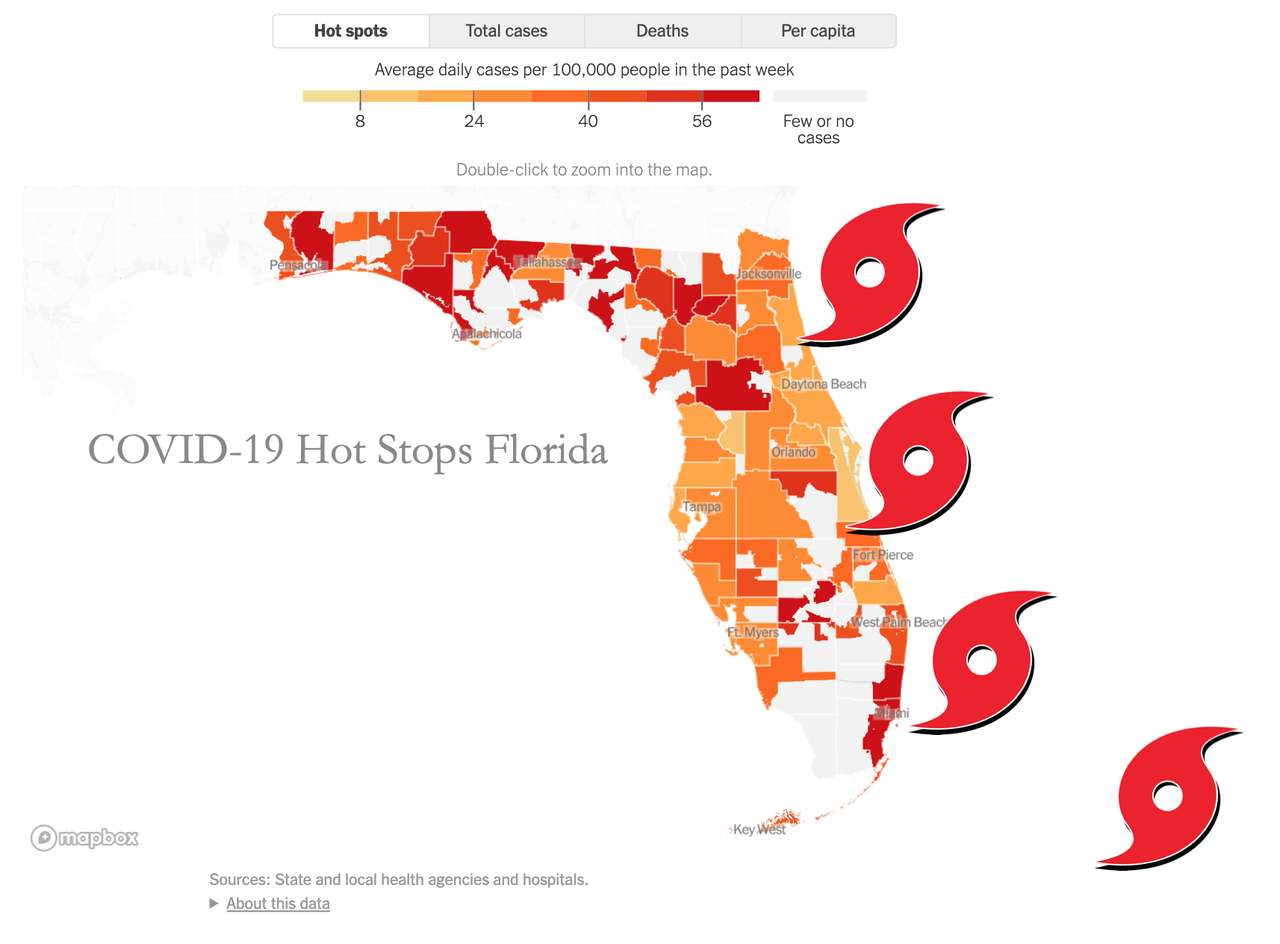
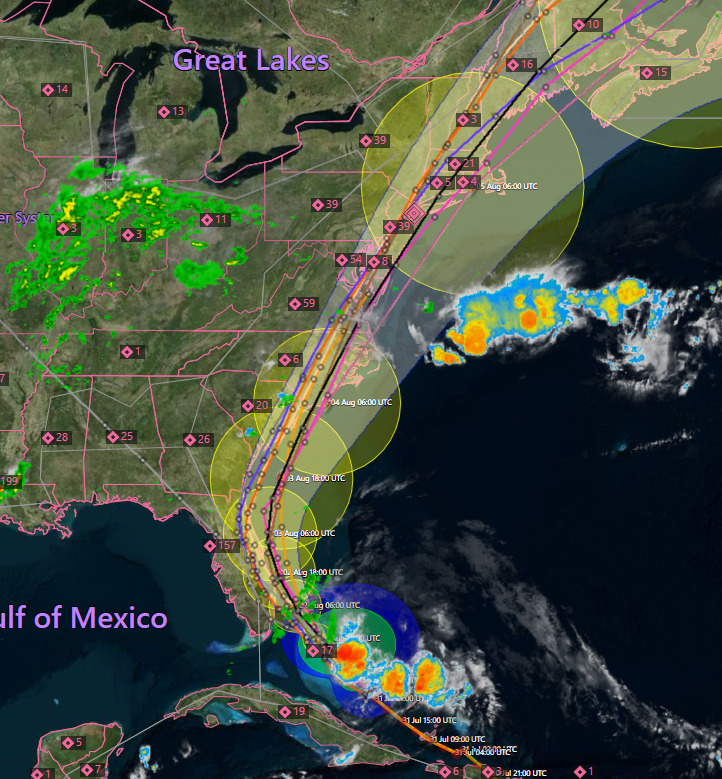
Hurricane Isaias has maximum sustained winds of around 85 mph Saturday morning, and strengthening is possible through the day as the storm barrels towards South Florida. The storm is slated to move up the East Coast later this weekend into next week, potentially unleashing torrential rain, high winds, and dangerous flooding in virus-infected states.
The Hurricane Center (NHC) latest Isaias update:
Hurricane warnings were posted for Boca Raton to the Volusia-Brevard county line. Miami Mayor Carlos Giménez told residents Friday that more than a dozen evacuation centers were ready to serve the community with social distancing measures.
"We still don't think there is a need to open shelters for this storm, but they are ready," Giménez said.
NHC expects 2 to 4 feet storm surge from Jupiter Inlet to Ponte Vedra Beach, with 1 to 3 feetjust north Miami Beach
Here's the current track of the storm.
Daily Mail tweets the hurricane may prevent NASA astronauts from returning to Earth on Sunday.
Hurricane Isaias may prevent NASA astronauts returning to Earth Sunday https://t.co/owaqZHO2O6
Florida has emerged as the epicenter of the COVID-19 outbreak, and the state registered a record 253 coronavirus deaths Friday with the hurricane fast approaching.
Florida Governor Ron DeSantis announced a state of emergency for counties along the Atlantic coast. He said the state is "fully prepared for this and any future storm during this hurricane season."
Spaghetti models show Isaias' potential track is to ride the Florida coastline late Saturday through early Monday. The storm is expected to follow the East Coast, arriving in North Caroline early Tuesday, and New York City by Wednesday.
Elsewhere in the Atlantic, NHC is "issuing advisories" for more potential storms to develop next week.
Julius Caesar’s crossing the Rubicon River in 49 BC in defiance of Roman law placed him and his army on a direct collision course with Rome, leading to the Civil War which established him as Roman dictator. It is a well-established metaphor for a point at which there is no going back and at which things will never be the same.
I predicted a few weeks ago that the UK Government would in the near future try to force everyone to wear facemasks in public.
Leave aside the plethora of information that makes it clear face masks are of practically zero benefit in everyday circumstances, and may in fact be dangerous, the forced wearing of facemasks is a transgression so fundamental and of such significance that it is difficult to adequately express.
It implicitly hands your body over to state control, and renders one of your most basic existential freedoms subject to state interference. For the first time, the right to exercise a choice of whether you should inhibit your respiratory faculties and hide your face in public is taken out of your hands. If you doubt the significance of this, try to remember the public outcry that followed a debate regarding banning the wearing of burkhas and hijabs in the face of Islamic terrorism, and the connotations this had for civil liberties at the time.
Facemask wearing is the visible hallmark of Asian states perceived in the West as repressive and authoritarian. It is a badge of serfdom, akin to the yellow star that Jews were forced to wear in Nazi Germany. There is no greater invasion of your person possible short of tattooing you with a number.
This astonishing about-turn in policy has not happened overnight or without preparation. It has been preceded by a cleverly-orchestrated media campaign which seeks to bizarrely turn established professional and scientific research on its head, making virologists, infection-control bodies and academics who have published papers for the medical profession into liars and charlatans.
This campaign has included editorials and blogs which talk in disapproving and accusatory tones of “mask-shirkers” and “mask-deniers” allegedly “refusing” to wear face masks. Leave aside the obvious fact that refusal cannot take place without a demand: in other words someone has to give you an instruction to which you reply, “No, thanks.”
Absent such a demand, you are not refusing anything, merely making a choice. And until now there has been no such demand. But those making this choice are now psychopaths and enemies of humanity without a shred of integrity, respect or regard for their fellow human beings.
When I returned from Asia early this year the advice was clear: face masks do not protect you from infection and it is not advised that you wear them.
What is more, face mask wearing was actively discouraged because of limited supplies required for hospital environments, where infection control is king and every precaution makes sense. Above all the only situation in which it is appropriate to wear a facemask in public is if you are unwell and have a cough, in which case why not stay at home?
But this piece of simple logic has been covered by the mask-advocates whose logic runs like this:
“You may have coronavirus without knowing it, and may infect others with your breath even at unlimited distances so you need to wear a mask.”
This covers all bases despite the evidence for this being at best negligible and at worst manipulated and dishonest.
It is part of the greater logic that renders every societal value worthless unless it contributes to the impossible task of making sure that not one single individual anywhere, ever, is infected with Covid-19. None of this means I think we should do nothing about this pandemic. But there is now a growing awareness that the cure proposed is not indefinitely sustainable and may in fact be worse than the disease.
The virtue-signalling of face-mask advocates is easily refuted. Facemasks have been available for decades for use in industry and ideas generally considered good are taken up by the public. Nobody needed the government to tell them to go out and buy a car or a television set.
So if you’re so convinced face masks are a good idea why has it taken the State to tell you before you came to this Eureka moment?
And for how many years or decades have you been going around disrespectfully infecting your fellow human beings by going out without a mask when you had a cold or the flu?
However, apparently all the established research is now wrong and face mask wearing is essential. It is a vast game of “Simon Says,” in which we only do anything when Simon says. And it won’t stop there. Expect newspapers like the Guardian to run sanctimonious editorials demanding that face-mask wearing be extended to pubs and restaurants, and eventually to every departure from your home.
Following this such a move will become policy: indeed, the British public will do what they are already doing, gleefully embracing this perverse doctrine, boasting of buying colourful face masks for their children, and showering anyone who has a different point of view with disapproval.
I’m forced now to doubt that we, the British people value our freedom as much as we profess to. We take to the streets in droves to embrace new forms of repression, such as an anarchistic movement that seeks to rewrite history and dismantle our police forces, or an anti-human death cult that seeks to suppress all human activity by frightening us all into believing we are destroying the Earth by existing.
But in the face of mounting attacks on our liberty and our freedom, we are silent. We have had our liberty taken away from us. Our movements are monitored. Our discussions are censored via social media. We are no longer free even to make fundamental choices about our bodies. A public that will silently accept these things has learned nothing from history, will accept anything and deserves its fate if that is a dystopian world-state.
We are no longer entitled to lecture other nations about being repressive states. Their representatives, quite rightly in my view would laugh in our faces. There is a growing fear in the minds of many of us that Western lockdowns may be permanent. The spectres of identity cards, martial law and forced vaccination now hover over us.
Dismissing this as “conspiracy theory” and accusing those who feel this way of an inhuman disregard for life is the rhetoric of fascism, a force that always thrives in the face of a perceived threat. I believe forced face-mask wearing in British streets is a brutal act that crosses the Rubicon, and finally signifies our descent into a de facto repressive state.
Back in 2014, hundreds if not thousands of conservatives and liberty movement activists converged on a farm in rural Clark County, Nevada. The purpose was to protest the incursion of federal government agents onto the property of the Bundy family, who had defied pressure from the Bureau of Land Management to stop allowing their cattle to feed on “federal land” in a form of free ranging. It was a practice that had been going on for decades and one that was required for the Bundy farm to survive, ended abruptly by environmental laws protecting a tortoise.
The Bundy family had been improving on the area with aquifers and other measures for generations without interference. The claim by the BLM and other agencies was that the farmers were destroying wildlife habitat with their cattle, yet the Bundy's land improvements had actually allowed wildlife to THRIVE in areas where animals would find life difficult or impossible otherwise.
The federal government became fixated on the Bundy's, and decided to make an example out of them. Their defiance of the crackdown on their use of the land was met with extreme measures, including their cattle impounded, their farm being surrounded and sniper teams placed in the hills nearby. The liberty movement saw this as the last straw, and so reacted at a grassroots level. The concern was that Bundy Ranch could become another Waco. They locked and loaded and went to defend the Bundy's.
I completely agreed at the time with the efforts surrounding Bundy Ranch and I still agree with them today. The federal government had overstepped its bounds on multiple occasions when it came to rural farmers in sagebrush country and everyone had finally had enough. The feds were faced with a group of armed liberty movement members and eventually ran away. They even gave the Bundy's back the cattle the feds had initially tried to confiscate. This event showcased the power of the people to repel tyranny when necessary.
The claim that the public is impotent against government force was summarily trounced. The action was not perfect, and there were many internal disputes and a plethora of mistakes, but overall it had achieved its goal. It sent a message to the establishment that if you try to assert unconstitutional force against the citizenry there is a chance a Bundy Ranch scenario might happen again, and next time it might not simply be a defensive measure.
I mention Bundy Ranch because I want to remind conservatives of their roots. We are a constitutional movement. We are a small government movement. We believe in individual rights, states rights and the 10th Amendment, as well as strict limitations placed on the federal government and state governments when they try to violate the Bill of Rights. If you don't believe in these things, you are not a conservative or a constitutionalist.
No government, whether state or federal, supersedes the boundaries placed upon them by the constitution. Once they violate those boundaries, they must be put in check by the citizenry, for the constitution is merely an object that represents an ideal. It can't defend itself. If a government undermines constitutional protections, it is not a failure of the constitution, it is a failure by the public to act.
Sadly, there are "conservatives" out there who supported the efforts at Bundy Ranch in 2014, but are now calling for federal overreach and martial law today. The very same people who argued vehemently against unconstitutional actions back then are arguing for bending or breaking the rules of the constitution now. This is something I have been warning about for years...
The greatest threat to freedom is not the government, extreme leftists or the globalist cabal; the greatest threat is when freedom fighters foresake their own principles and start rationalizing tyranny because it happens to benefit them in the moment. If freedom fighters stop fighting for freedom, who remains pick up the mantle? No one. And thus, the globalists and collectivists win the long game.
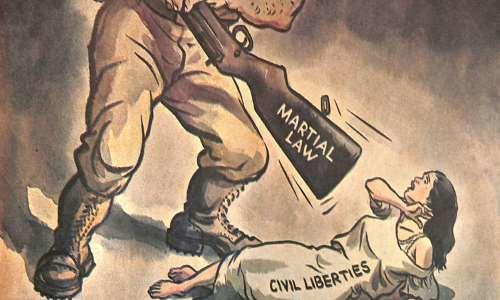
Right now there are two sides calling for martial law-like restrictions on the public, and both sides think they are doing what is best for society at large. They both believe they are morally justified and that totalitarian actions are necessary for “the greater good”. Both sides are wrong.
The Pandemic Puritans
On one side, we have a group made up primarily of political leftists but also some conservatives who say that the coronavius pandemic creates a scenario in which medical tyranny must be established to protect the public from itself. Leftists enjoy control in general and the pandemic simply offers an opportunity for them to act out their totalitarian fantasies in real life.
These are the people who wag their fingers at others on the street or in the park or at the beach for not “social distancing” properly. These are the people that inform on their neighbors, or inform on local businesses for not following strict guidelines. These are the people that get a thrill from forcing other people to conform.
This is not to say that precautions are not warranted, they certainly are. However, these precautions MUST be up to individuals, not enforced by bureaucracy. The moment you hand government ultimate power to dictate people's health decisions, personal daily activities, freedom of assembly and their ability to participate in the economy, you have given the government ultimate power to destroy our very culture. No government should be allowed to have that kind of influence.
The issue here is one of the greater EVIL, not the greater good. What is the greater evil? To avoid unconstitutional measures, avoid violating individual rights and allow the virus to spread faster than it normally would? Or, to completely throw out the Bill of Rights, individual liberty and economic security in the name of a brand of “safety” that is ambiguous and undefined?
As I write this, the state of New Jersey among others is implementing a draconian response against businesses that defy lockdown orders. NJ just arrested the owners of a gymnasium in Bellmawr who refused to close down. Even though they used social distancing measures and applied their own guidelines, the state has decided that citizens are children that must be controlled rather than adults that can make their own choices. This sets a dangerous precedence for the whole country.
Understand that small businesses that are not deemed “essential” by arbitrary decree from the state are on the verge of bankruptcy and collapse. Millions of people are having their livelihoods threatened by the lockdowns. Millions of jobs are at risk. Is the coronavirus really worth destroying our own economic system? Because that is EXACTLY what is happening right now. The US economy was already suffering from destabilization, and now the pandemic response is putting the final nail in the coffin.
If the economy tanks far more people will die from the resulting crisis of poverty, crime and civil unrest than will EVER die from the coronavirus pandemic. When you look at the big picture, how can anyone justify medical tyranny and martial law measures? There is simply no logical explanation for violating the economic and personal freedom of Americans in response to a disease. If some people die from the virus, so be it. Its a small price to pay to keep our freedoms intact. Furthermore, I would stand by that argument even if I get sick from the virus.
Sock Puppet Conservatives
There are people out there that like constitutional rights and civil liberties “in theory”, but in practice they view these rights as inconvenient to their goals. For these so-called “conservatives”, the Bill of Rights is only for peacetime. When war or domestic conflict rolls around, our rights are suddenly forfeit.
I use this particular metaphor often but I really can't find a better one:
Government power is like the “one ring” in Lord Of The Rings. Everyone desperately wants control of it. The side of evil thirsts for it. The side of good thinks that if only they had it they could use it for honorable ends; they think they can use it to defeat evil. They are wrong.
The “one ring” (government power) corrupts ALL. It cannot be controlled. It cannot be used for good. Eventually, it warps the minds of those who hold it, twisting them into something grotesque. Good people who exploit the ring end up becoming the very monsters they were trying to defeat, and evil wins.
Right now through the Trump Administration conservatives are being tempted with the "one ring". We are being tempted with ultimate government power. The leftist hordes and their actions are egregious. They act irrationally and foolishly. Their communist ideology and mindless zealotry is destructive and they openly seek the collapse of western civilization. But in the end this doesn't matter. They are nothing more than useful idiots for a greater agenda.
It's interesting that the only solution I see being presented in conservative circles lately is the use of federal power to crush the protests and riots. Again, this might seem like a reasonable action in the face of so much lawlessness, but if taken too far the implications are horrifying.
Some conservative groups are cheering the deployment of federal agencies to cities like Portland in the name of stopping civil unrest, but there is a fine line between law enforcement and martial law. And by martial law, I mean ANY government force that is designed to suppress or break civil protections. This does not only include a military presence, it can also include federal agencies overstepping their bounds, just as they did at Bundy Ranch.
In Portland and other cities like New York, federal agents and police have been snatching protesters off the street in unmarked vans without identifying themselves. Essentially, they are black-bagging people. This is the kind of behavior which real conservatives traditionally despise.
Yes, some of these protesters did in fact loot or participate in property damage; and some of them did absolutely nothing. This is being done under 40 US Code 1315 which was signed into law by Neo-con president George W. Bush after the 9/11 attacks as part of the tidal wave of unconstitutional Patriot Act measures that were railroaded through during mass fear and panic.
Conservatives have been warning for years about the potential for misuse of these laws to violate people's rights. Will we now support them because they are being enforced against people we don't like? I will say this: If an unmarked van with unidentified armed people tried to grab me off the street, I would do everything in my power to put a bullet in each and every one of them. And, I would not hold it against any person who did the same, even if they were my ideological opponent.
Some conservatives are calling for much more, including the deployment of the National Guard or a standing military presence. The use of such tactics opens the door to serious consequences, and I believe if we allow the federal government to bend the rules now, we set the stage for expansive martial law in the near future. By extension, labeling looters or rioters as “terrorists” also has dangerous implications. Those of us that were activists during the Obama years know how freely that label is thrown around by government and the media.
We might feel righteous in violating the civil liberties of social justice Marxists because of their insane behavior and the threat they pose to the stability of the country, but, what happens when the roles are reversed? During Bundy Ranch, conservatives were also being labeled “terrorists”, and who is to say we won't find ourselves in that position again? Would defying the pandemic lockdowns also be considered an existential threat to the country?
Uncomfortable Questions
There are some questions in all of this that are either not being asked or are being deliberately avoided. For example:
1) Why is it that the Trump Administration has not bothered to go after the elites and globalists FUNDING Antifa and BLM groups behind the unrest? Why does George Soros and his Open Society Foundation get to operate in the US with impunity? And what about the Ford Foundation? Members of that institution openly admit that they have been funding and organizing the social justice cult for decades. Shouldn't the men behind the curtain paying for the entire thing be targeted first, instead of going after the useful idiots? Perhaps the fact that Trump is surrounded by those very same elites in his cabinet has something to do with it...
2) If we support martial law measures, WHO are we giving that power to? Is it Trump, or the deep state ghouls that advise him daily? People like Wilber Ross, a New York Rothschild banking agent, Mike Pompeo, a long time Neo-con warmonger and promoter of mass surveillance, Robert Lightheizer, a member of the globalist Council On Foreign Relations, Steve Mnuchin, former Goldman Sachs banker, Larry Kudlow, former Federal Reserve, etc. Even if you think Trump has the best of intentions, can anyone honestly say the same for his cabinet?
3) When the left is "defeated" and the riots stop, will martial law simply fade away, or, is it a Pandora's Box that can never be closed again? And if it doesn't end, will supporters justify fighting against not just leftists, but also conservatives who will not tolerate it? I for one will be among the people that will not tolerate it.
Real Solutions
There are other much better solutions than martial law when confronting the leftist riots or the pandemic.
For the pandemic, stop trying to dictate public behavior. If individuals feel they are at risk from the virus, then they can take their own precautions. The only other option is to continue on the path of shutdowns and an informant society that will destroy this nation in a matter of months.
For the leftists, communities that stage an armed presence in the face of protests have ALL escaped riots and property damage. Sometimes Antifa and BLM decide to not even show up. We DON'T NEED a federal presence or a military presence to get the job done. We can do it ourselves. We already have proof that this strategy works.
And, if the lefties want to burn down their own neighborhoods and cities and local governments don't want to stop them, then I say let it happen. It's sad for the people in these places that had no dog in the fight, but maybe this will teach the locals to speak out against BLM or Antifa instead of remaining silent or virtue signaling their support in the hopes that their businesses won't be attacked. Maybe they should look for better government officials as well.
Finally, it's far past time to go after the elites that fund and engineer such groups. Remove their influence and I suspect many people will be shocked at how fast all this unrest and chaos suddenly disappears. Isn't this what people wanted Trump to do from the very beginning? And yet, nothing happens to the vampires at the top.
Only cowards demand everyone else give up their freedoms just so they can feel safe. The establishment is trying to pit the American people against each other as a means to pave a path to tyranny. I believe what the elites want more than anything else is to trick conservatives into forsaking their own principles. If we do, we become hypocrites that can no longer sustain a movement for freedom. By becoming the monster to fight the monster we hand our enemies victory. This is unacceptable.
* * *
If you would like to support the work that Alt-Market does while also receiving content on advanced tactics for defeating the globalist agenda, subscribe to our exclusive newsletter The Wild Bunch Dispatch. Learn more about it HERE