Malone: Human Cyborgs Are Just The Beginning
Authored by Robert W. Malone via Who is Robert Malone,
Ever since I wrote the substack article on human augmentation and the UK Ministry of Defence and the German Military Complex , discussing that these two organizations advocate for human augmentation in a report entitled “Human Augmentation – The Dawn of a New Paradigm“, I have been wondering if the US government, that is to say the US Department of Defense (DoD) and the Administrative State which controls it, has developed similar plans.
This week I did a little research starting with the key words – “human augmentation” and “DoD” and there “it” is. The “it” being the strategy playbook and battlefield field plan for creating human cyborgs…
For those who lust for more stimulation and shaping after reading the following, this substack also relates to our June 16 substack entitled “ARPA-H, Intelligence Community within NIH”.

To begin – there are various “hints” from various governmental agencies that human augmentation research is underway and has been ongoing for a number of years. For instance, this article:
DARPA’s Arati Prabhakar Tells Defense One That Cutting-Edge Biology Research Is the Future of National Security
Defense One, April 1, 2014
The ability to link human brains to machines, create new life forms and build Star Trek-style disease detectors will be the focus of a new Defense Department office soon.
The new office, named the Biological Technology Office, or BTO, will serve as a clearinghouse for Defense Advanced Research Projects Agency, or DARPA, programs into brain research, synthetic biology and epidemiology. The office will cover everything from brewing up tomorrow’s bioweapon detectors and connecting humans to computers to designing entirely new types of super-strong living materials that could form the basis of future devices. Here are the key areas in more detail.
This author does let “the cat out of the bag”, so to speak, by his use of the word “cyborg” in the article’s title. That is the “military’s new office for cyborgs.” But the actual content of the article does little to enlighten us as to what the DoD actually has planned.
It is getting hard to tell who is driving the bus here, the Pentagon or Paramount pictures’ script writers. Do DARPA locker rooms have pinups of Jeri Ryan? Do Androids Dream of Electric Sheep? Is Bruce Sterling actually a deep state operative and CIA consultant?

Moving on to more recent news.
Another fascinating title and article – this search was a little like following the bread crumbs to grannies house…
Researchers Help DoD Consider Challenges of Human Enhancement
DEVCOM CBC Public Affairs
November 18th, 2019
Peter Emanuel, Ph.D., the Army’s Senior Research Scientist for Bioengineering, sees a future 30 years from now where a U.S. Soldier can direct a swarm of drones in battle through a direct brain-to-machine connection using a neural implant. The implant also allows him to see exactly what each of those drones is seeing, then digitally integrate this information in his brain and send it as data to other machines, fellow Soldiers or his command and control element.
This is a little more helpful.
Note that the person being interviewed for this article is Dr. Peter Emanuel. This is important later on in this Substack. Trust me, it is a “Where’s Waldo” kind of thing.
Also, interesting that now the DoD is using the language “human enhancement” – so much softer and gentler than “human cyborg,” don’t you think?
This article is even a little more current. Of note – The COVIDcrisis most definitely took the spotlight off the whole “human cyborg” research agenda. Something tells me that the DoD didn’t mind that too much.
US Space Force Chief Scientist Says Human Augmentation ‘Imperative’
The Defense Post, May 05, 2021
Human augmentation should be embraced by the West to keep up with the competition, US Space Force chief scientist Dr. Joel Mozer said during an event last week at the Airforce Research Laboratory.
“In our business of national defense, it’s imperative that we embrace this new age, lest we fall behind our strategic competitors,” Mozer said.
Mozer added that unprecedented developments are forthcoming in areas such as artificial intelligence, which will allow the military to craft tactics and strategies that “no human could.” Autonomous programs will eventually provide real-time advice to commanders, and multiple autonomous agents will be able to assist commanders and decision-makers in reconnaissance and fire control.
The chief scientist further explained that human augmentation will eventually develop into technologies such as augmented reality and virtual reality — including “nerve stimulation” to enhance the simulation of physical sensations.
“You could put [an] individual into a state of flow, where learning is optimized and retention is maximized,” Mozer said. “This individual could be shaped into somebody with very high-performing potential.”
(I mean, who isn’t up for a little “nerve stimulation” among friends?)
The language used is really helpful in tracking the origins of the ideas. Bruce Sterling’s classic cyberpunk novel Schismatrix is all about the conflict between Shapers and Mechanists, Shapers being the group that alters the body through genetic modification and specialized mental training. Mechanists are the group that modifies bodies through computer software and external alterations.
Yeah, we’ve seen that movie too.
Then we have the Big Kahuna, the report that begins to lay out the true intent of the military in all of this.
This large, year-long assessment – commissioned by the Office of the Under Secretary of Defense for Research and Engineering and conducted by the DoD Biotechnologies for Health and Human Performance Council was published at the end of 2019. It is entitled:
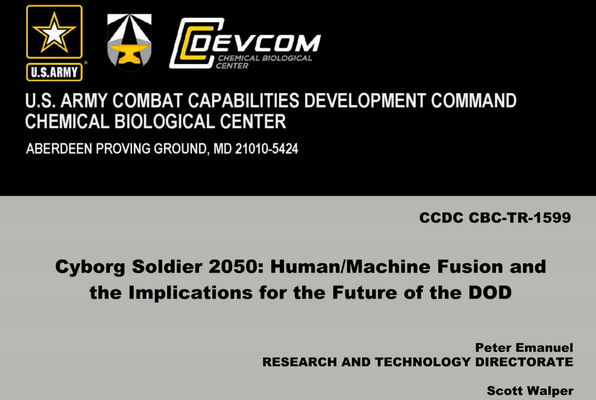
“Cyborg Soldier 2050: Human/Machine Fusion and the Implications for the Future of the DoD”
Subject terms: “Cyborg” and “Human/Machine Enhancement”
That abstract of that assessment reads:
Abstract: The Office of the Under Secretary of Defense for Research and Engineering (Alexandria, VA) established the DOD Biotechnologies for Health and Human Performance Council (BHPC) study group to continually assess research and development in biotechnology. The BHPC group assesses scientific advances for improved health and performance with potential military application; identifies corresponding risks and opportunities and ethical, legal, and social implications; and provides senior leadership with recommendations for mitigating adversarial threats and maximizing opportunities for future U.S. forces. At the direction of the BHPC Executive Committee, the BHPC study group conducted a year-long assessment entitled “Cyborg Soldier 2050: Human/Machine Fusion and the Impact for the Future of the DOD”. The primary objective of this effort was to forecast and evaluate the military implications of machines that are physically integrated with the human body to augment and enhance human performance over the next 30 years. This report summarizes this assessment and findings; identifies four potential military-use cases for new technologies in this area; and assesses their impact upon the DOD organizational structure, warfighter doctrine and tactics, and interoperability with U.S. allies and civil society.
This analysis was made public when published, but then COVIDcrisis soon overwhelmed us all and it quickly faded from public memory.
If you didn’t read this report back in the beginning of 2020 or if you have forgotten about it, below is the executive summary of this 50 page report (or click on the linked title above to read the whole report):
EXECUTIVE SUMMARY
A DoD Biotechnologies for Health and Human Performance Council (BHPC; Alexandria, VA) study group surveyed a wide range of current and emerging technologies relevant to assisting and augmenting human performance in many domains. The team used this information to develop a series of vignettes as case studies for discussion and analysis including feasibility; military application; and ethical, legal, and social implication (ELSI) considerations. Ultimately, the team selected four vignettes as being technically feasible by 2050 or earlier. The following vignettes are relevant to military needs and offer capabilities beyond current military systems:
- ocular enhancements to imaging, sight, and situational awareness;
- restoration and programmed muscular control through an optogenetic bodysuit
- sensor web;
- auditory enhancement for communication and protection; and
- direct neural enhancement of the human brain for two-way data transfer.
Although each of these technologies will offer the potential to incrementally enhance performance beyond the normal human baseline, the BHPC study group analysis suggested that the development of direct neural enhancements of the human brain for two-way data transfer would create a revolutionary advancement in future military capabilities. This technology is predicted to facilitate read/write capability between humans and machines and between humans through brain-to-brain interactions. These interactions would allow warfighters direct communication with unmanned and autonomous systems, as well as with other humans, to optimize command and control systems and operations. The potential for direct data exchange between human neural networks and microelectronic systems could revolutionize tactical warfighter communications, speed the transfer of knowledge throughout the chain of command, and ultimately dispel the “fog” of war. Direct neural enhancement of the human brain through neuro-silica interfaces could improve target acquisition and engagement and accelerate defensive and offensive systems.
Although the control of military hardware, enhanced situational awareness, and faster data assimilation afforded by direct neural control would fundamentally alter the battlefield by the year 2050, the other three cyborg technologies are also likely to be adopted in some form by warfighters and civil society. The BHPC study group predicted that human/machine enhancement technologies will become widely available before the year 2050 and will steadily mature, largely driven by civilian demand and a robust bio-economy that is at its earliest stages of development in today’s global market. The global healthcare market will fuel human/machine enhancement technologies primarily to augment the loss of functionality from injury or disease, and defense applications will likely not drive the market in its later stages. The BHPC study group anticipated that the gradual introduction of beneficial restorative cyborg technologies will, to an extent, acclimatize the population to their use.
The BHPC study group projected that introduction of augmented human beings into the general population, DOD active duty personnel, and near-peer competitors will accelerate in the years following 2050 and will lead to imbalances, inequalities, and inequities in established legal, security, and ethical frameworks. Each of these technologies will afford some level of performance improvement to end users, which will widen the performance gap between enhanced and unenhanced individuals and teams. The BHPC study group analyzed case studies and posed a series of questions to drive its assessment of the impact to DOD programs, policies, and operations. The following are the resulting recommendations (not listed in order of priority): (RM- I have only posted the top summaries for these recommendations, please go to the report for more detail).
1. DOD personnel must conduct global assessments of societal awareness and perceptions of human/machine enhancement technologies.
2. U.S. leadership should use existing and newly developed forums (e.g., NATO) to discuss impacts to interoperability with allied partners as we approach the year 2050. This will help develop policies and practices that will maximize interoperability of forces.
3. DOD should invest in the development of dynamic legal, security, and ethical frameworks under its control that anticipate emerging technologies.
4. Efforts should be undertaken to reverse negative cultural narratives of enhancement technologies.
5. DOD personnel should conduct tabletop wargames and targeted threat assessments to determine the doctrine and tactics of allied and adversarial forces.
6. The U.S. Government should support efforts to establish a whole-of-nation approach to human/machine enhancement technologies versus a whole-of-government approach.
7. The DOD should support foundational research to validate human/machine fusion technologies before fielding them and to track the long-term safety and impact on individuals and groups.
This rabbit hole then led me to the DARPA website – and wow! This research -to create human cyborgs, it is actually happening.
A quick glance at the Biological Technology Office and DARPA reveals that programatic goals of building cyborg capabilities are being conducted at an astounding rate. The webpage search engine allows a search of the non-classified programs already being developed. So, one can go to this site and envision many, if not most of these technologies listed as being used for warfare. The military is developing human augmentation for military uses, not civilian. This is important to keep in mind.
So, I spent a little time searching and webmining the more “interesting” DARPA projects. Below are just a few of the abstracts of research projects being funded by DARPA and the DoD:
The Measuring Biological Aptitude (MBA) program aims to address the need for a more capable fighting force by helping individual warfighters identify, measure, and track personalized biomarkers related to training and peak performance for specialized roles. If the program succeeds, MBA technologies will give warfighters the ability to understand the underlying biological processes that govern their performance. Specifically, these technologies would elucidate the internal expression circuits (e.g., genetic, epigenetic, metabolomic) that shape militarily relevant cognitive, behavioral, and physical traits. New devices for continuously tracking these expression circuits could be integrated into the body to provide instantaneous user feedback, helping the warfighter to improve performance throughout training, assessment, selection, and mission execution for a given military specialty.
DARPA’s multi-year AI Next portfolio of programs and investments seeks to develop contextual reasoning in artificial intelligence systems to improve human/machine teaming.
The Agile Teams (A-Teams) program aims to discover, test, and demonstrate generalizable mathematical abstractions for the design of agile human-machine teams and to provide predictive insight into team performance. While human-machine teams have been the subject of considerable past work in artificial intelligence and autonomy, designing agile team architectures remains largely a trial-and-error enterprise. The A-Teams program seeks to create a systematic methodology to design teams that best use the capabilities of both humans and machines and that can achieve enhanced performance in uncertain, dynamic, and co-evolving environments. These new abstractions will be validated using experimental testbeds aimed to support reproducible evaluation of human-machine team architectures in a diverse range of problem contexts.
The Hand Proprioception and Touch Interfaces (HAPTIX) program is pursuing key technologies to enable precision control of and sensory feedback from sensor-equipped upper-limb prosthetic devices. If successful, the resulting system would provide users near-natural control of prosthetic hands and arms via bi-directional peripheral nerve implants.
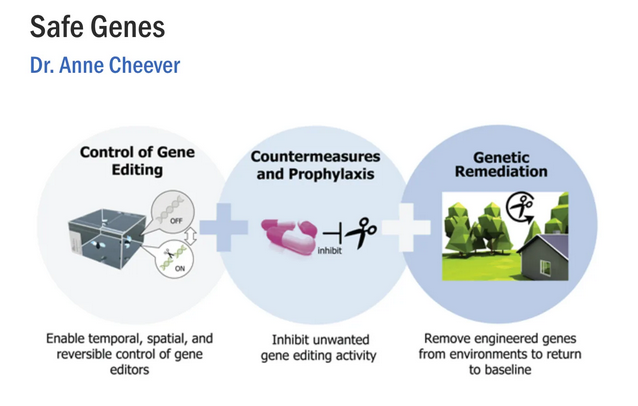
The Safe Genes program supports force protection and military health and readiness by protecting Service members from accidental or intentional misuse of genome editing technologies. Additional work will leverage advances in gene editing technology to expedite development of advanced prophylactic and therapeutic treatments against gene editors. Advances within the program will ensure the United States remains at the vanguard of the broadly accessible and rapidly progressing field of genome editing.
Safe Genes performer teams work across three primary technical focus areas to develop tools and methodologies to control, counter, and even reverse the effects of genome editing—including gene drives—in biological systems across scales. First, researchers are developing the genetic circuitry and genome editing machinery for robust, spatial, temporal, and reversible control of genome editing activity in living systems. Second, researchers are developing small molecules and molecular strategies to provide prophylactic and treatment solutions that prevent or limit genome editing activity and protect the genome integrity of organisms and populations. Third, researchers are developing “genetic remediation” strategies that eliminate unwanted engineered genes from a broad range of complex population and environmental contexts to restore systems to functional and genetic baseline states.
Overall, the Safe Genes program is creating a layered, modular, and adaptable solution set to: protect warfighters and the homeland against intentional or accidental misuse of genome editing technologies; prevent and/or reverse unwanted genetic changes in a given biological system; and facilitate the development of safe, precise, and effective medical treatments that use gene editors.
The Next-Generation Nonsurgical Neurotechnology (N3) program aims to develop high-performance, bi-directional brain-machine interfaces for able-bodied service members. Such interfaces would be enabling technology for diverse national security applications such as control of unmanned aerial vehicles and active cyber defense systems or teaming with computer systems to successfully multitask during complex military missions.
Whereas the most effective, state-of-the-art neural interfaces require surgery to implant electrodes into the brain, N3 technology would not require surgery and would be man-portable, thus making the technology accessible to a far wider population of potential users. Noninvasive neurotechnologies such as the electroencephalogram and transcranial direct current stimulation already exist, but do not offer the precision, signal resolution, and portability required for advanced applications by people working in real-world settings.
The envisioned N3 technology breaks through the limitations of existing technology by delivering an integrated device that does not require surgical implantation, but has the precision to read from and write to 16 independent channels within a 16mm3 volume of neural tissue within 50ms. Each channel is capable of specifically interacting with sub-millimeter regions of the brain with a spatial and temporal specificity that rivals existing invasive approaches. Individual devices can be combined to provide the ability to interface to multiple points in the brain at once.
To enable future non-invasive brain-machine interfaces, N3 researchers are working to develop solutions that address challenges such as the physics of scattering and weakening of signals as they pass through skin, skull, and brain tissue, as well as designing algorithms for decoding and encoding neural signals that are represented by other modalities such as light, acoustic, or electro-magnetic energy.
The Neural Evidence Aggregation Tool (NEAT) program aims to overcome current limitations by developing a new cognitive science tool that identifies people at risk of suicide by using preconscious brain signals rather than asking questions and waiting for consciously filtered responses. By aggregating preconscious brain signals to stimuli, NEAT would determine what a person believes to be true, false, or indeterminate about specific types of knowledge that could be used to detect signs of depression, anxiety, or suicidal ideation earlier and more reliably than ever before. If successful, NEAT will not only significantly augment behavioral health screening, but it could also serve as a new way to assess ultimate treatment efficacy, since patients will often tell their clinicians what they think the clinician wants to hear rather than how they are truly feeling. Ultimately, NEAT intends to augment current behavioral health screening programs by providing clinicians with previously unavailable information to enable earlier interventions and more reliable measures of successful treatment.
The research activities that are being conducted by DARPA and the DoD are considerable. Even the small sampling of abstracts published above only begins to document just how large this endeavor is.
These technologies are further along than we might think, and we deserve to know more about them. This is the future that our government is planning for us, whether we like it or not, and it is a future that is opaque. From genetic engineering to new synthetics development for neural implants, to replacing and enhancing limbs for warfare – our military is “going there.” But the truth is, some places “we” shouldn’t go. Just because they “can,” doesn’t mean they “should”.
If you have learned anything since January 2020, I hope that you have learned to question the wisdom and insight of the insider cliques within the US Government and “Administrative State” who believe that it is acceptable to march ahead with genetic and mechanical engineering of human beings without meaningful oversight, let alone self awareness and any sense of bioethical boundaries.
If we truly wish to have a say in these new technologies, society (which is to say “we”) must be informed. “We” have a right to be informed. That means you and me. As these technologies develop, transhumanism will become all the rage. Think about that. These new technologies will be what future generations will have to look forward to. Human cyborgs are their futures. They, that is human cyborgs, will be our children and our grandchildren.
We are Borg. Resistance is futile. You will be assimilated. Your life as it has been is over. From this time forward, you will service us.
Thanks, Paramount. We need more “normalizing their vision of the future” in our lives please.

The military is already working on propaganda to “reverse negative cultural narratives of enhancement technologies.” So, once again – we are being played before we even know what the playing field looks like.
Like I said before, we have all seen that movie too.
The full scope of this program needs to be revealed to the American people. Although the executive report barely mentions gene editing technologies, the military is investing heavily in them and clearly with the intention of using them for the war fighter. The executive report barely skims the surface of the research that is currently being carried out by DARPA, and that is only one office within the Department of Defense. The public’s right to know about this research and what the final goals are is crucial. Congress must demand answers and must demand open and transparent responses. As the report rightly points out, what happens in the military will make its way into the public sphere. We have a right to know what is being planned for our future “evolution.” I don’t use that word lightly. But that is how the UK Ministry of Defence has labeled human augmentation research.
Turns out that Silicon Valley darling and Klaus Schwab’s evil mini me Yuval Noah Harari (author of Homo Deus, which literally means “Man God”) is not so far out there in his thinking as we had thought.
The bioethics of human augmentation are complex. The regulatory processes must be developed before the technologies come into being, not the other way around. People must envision how these technologies will be used in civilian life, in military life and as life-saving treatments. People need to decide if and which of these technologies really are for the good of society. People need to become involved now.
That starts with education. Which begins with transparency by our government. In future Substacks, I hope that you and I will begin exploring the bioethics, the impact of these technologies, privacy issues, the targets, future visions of society and just what this all means.
After all, what could possibly go wrong?
Reposted from the author’s Substack
https://ift.tt/wQ7mVMJ
from ZeroHedge News https://ift.tt/wQ7mVMJ
via IFTTT