"Shoot. Me. Now.": New Insight Into Obama-Biden Relationship Offers Clues On Former President's Refusal To Endorse
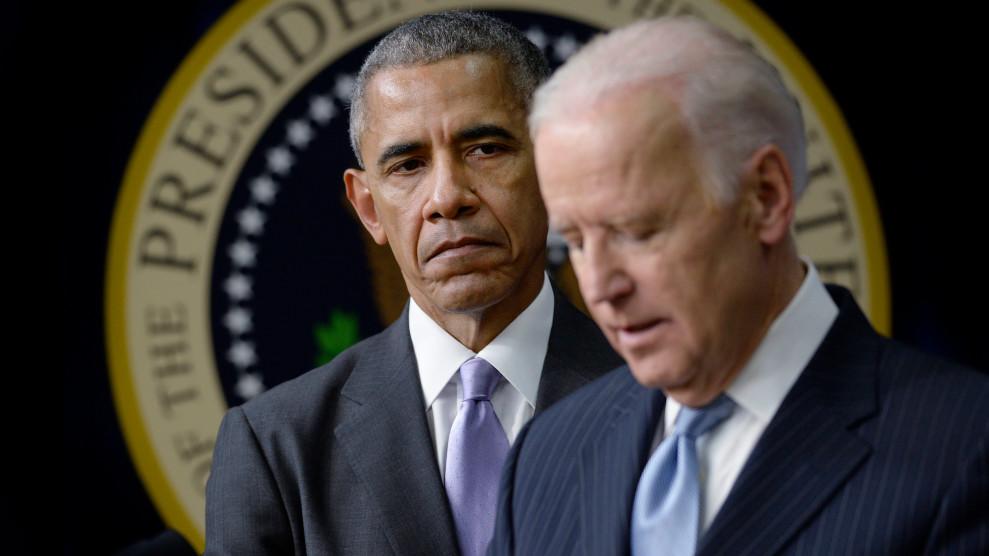
An upcoming book chronicling the relationship between Barack Obama and Joe Biden reveals that the 'bromance' the two grew to share during the White House years has fizzled in the post-White House years, according to "Barack and Joe: The Making of an Extraordinary Partnership."
Written by the Washington Post's nonfiction editor, Steven Levingston, Barack and Joe sheds light on trials and tribulations between the two very different politicians, which may explain Obama's refusal to endorse Biden's 2020 bid for the White House, according to the Daily Mail.
The obvious answer is that Obama worked with the guy for eight years and knows he's a gaffe-prone, gropey, hair-sniffing racist with political baggage - but feel free to continue reading.
While the two men did develop a strong affection for one another, there were times Biden drove Obama over the edge as the book reveals a younger Obama once rolled his eyes at Biden's constant babbling, sending a note to his adviser saying: 'Shoot. Me. Now.'
And it was a political embarrassment for Biden when Obama failed to step up and support his former vice president in both the 2016 and 2020 presidential races. -Daily Mail
In 2016, Joe was passed over in favor of Hillary Clinton - as Obama was reportedly more concerned about what a GOP victory would mean for his doomed health care program, among other things.
"Joe, despite his many virtues, was just another white guy, one in a long line of American presidents — hardly the symbol of the Teutonic change that Obama hoped would mark his place in the history books," writes Levingston.
"Barack had placed his bet on Hillary, the one he believed would confirm his revolutionary stamp on American's political culture - the first black president passing the baton to the first woman president."
As far as the 2020 election, Obama said in January 2019 that Democratic party leadership needed "new blood."
Biden, meanwhile, said he doesn't want Obama's endorsement - stating that "Whoever wins the nomination should win it on their own merits," after Obama declined to support him.
That said, Obama has met with other potential presidential candidates, including Texas Congressman Beto O'Rourke, prior to Biden's decision to run.
What had been an unprecedented closeness between a president and vice president had changed.
'Now they were two high profile politicians considering their own futures' — and no longer brothers in arms they once were.
In the beginning, 'from a gaffe-meister, Biden had shaped himself into a conscientious, well informed partner to the president emerging as the heart to Obama's brain', write the authors.
Biden always had his eye on the Oval Office and made a promise to his son, Beau, when he was dying of brain cancer in 2015, that he would try for a third run for the presidency despite his lousy track record. -Daily Mail
The rest of the Daily Mail's article - along with Levingston's book - rattles off Obama and Biden's on-again / off-again trials and tribulations, such as the time Biden said of Obama "I mean you got the first sort of mainstream African American who is articulate and bright and clean and a nice-looking guy," to which Obama noted that there had been prior black presidential candidates - all of whom were (arguably) articulate - Jesse Jackson, Shirley Chisholm and Al Sharpton.
When Obama picked Biden as his running mate, he said "I love this guy and he's got heart."
Now, Biden has nothing but problems - and there's no sign of Obama's aforementioned love for him.
And how do Hong Kong, and the Hong Kong protests, fit into China’s economic and political future?
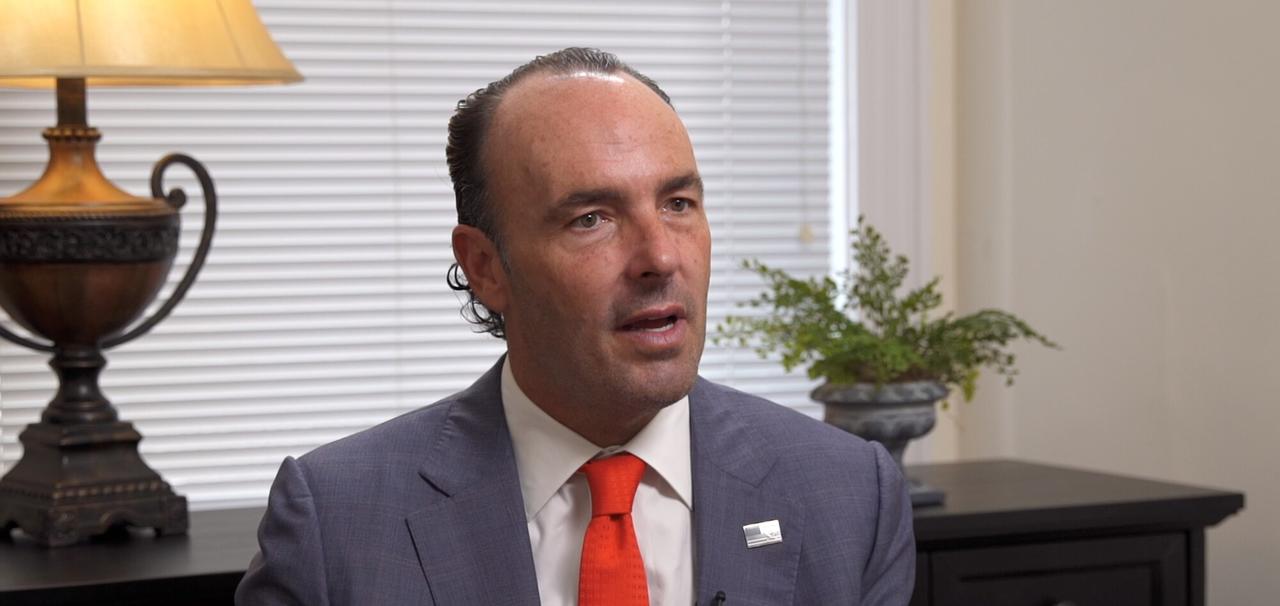
Today we sit down with Kyle Bass, the Founder and Chief Investment Officer of the Hayman Capital Management hedge fund, and a founding member of the Committee on the Present Danger: China.
We discuss the implications of China’s massive credit-to-GDP ratio, communist China’s non-performing loans and culture of bribery, the role of Wall Street in the US-China trade relationship, and Kyle Bass’s thoughts on the future.
* * *
American Thought Leaders is a new Epoch Times show available on Facebook and YouTube.
South Korean Consumer Prices Just Did Something They've Never Done Before
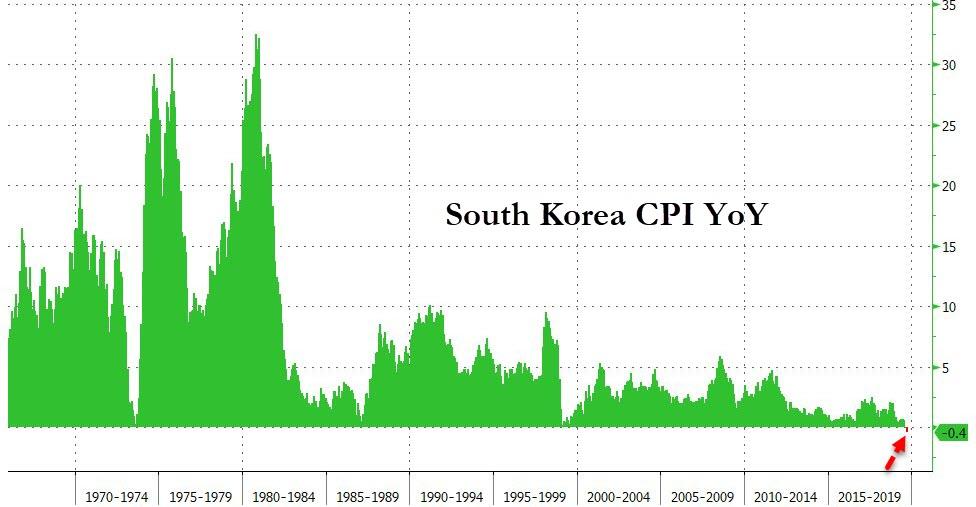
Underscoring the hit to domestic demand, as the economy grapples with collapsing exports, for the first time ever (data back to 1966), South Korean consumer prices "fell" year-over-year in September.
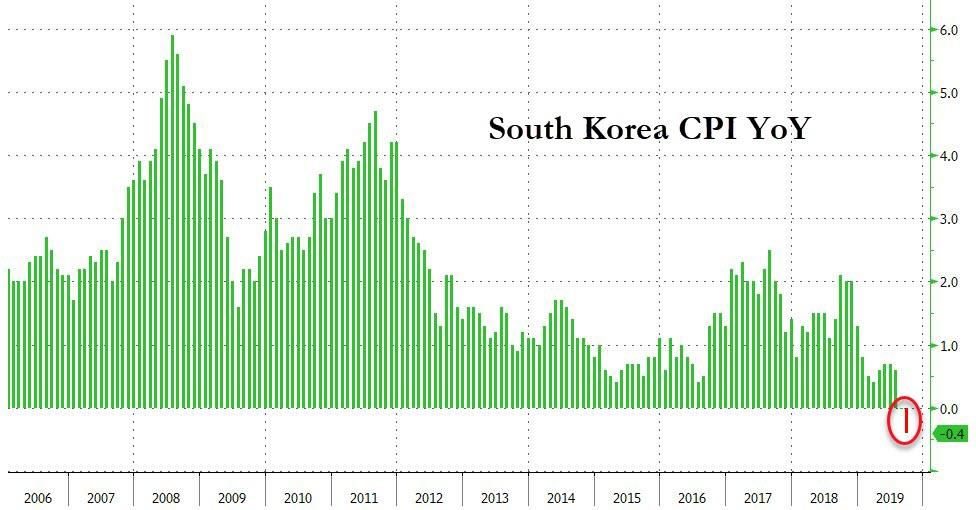
The benchmark consumer-price index fell 0.4% in September from a year earlier after being flat in August - already the slowest pace on record in the country. The latest reading missed the median market forecast of a 0.3% decrease.
Source: Bloomberg
Zooming in makes it even clearer that 2019's sudden shift to global easing has not helped... at all!
Source: Bloomberg
Negative inflation is likely to add fuel to a growing debate over whether the risk of deflation is imminent in South Korea and what policy action needs to be taken, which is ironic since BOK Governor Lee last week dismissed concerns of deflation as “excessive.”
The Bank of Korea in July cut interest rates for the first time in three years, lowering its 2019 growth and inflation forecasts to 2.2% and 0.7%, respectively, from its earlier estimates of 2.5% and 1.1%.
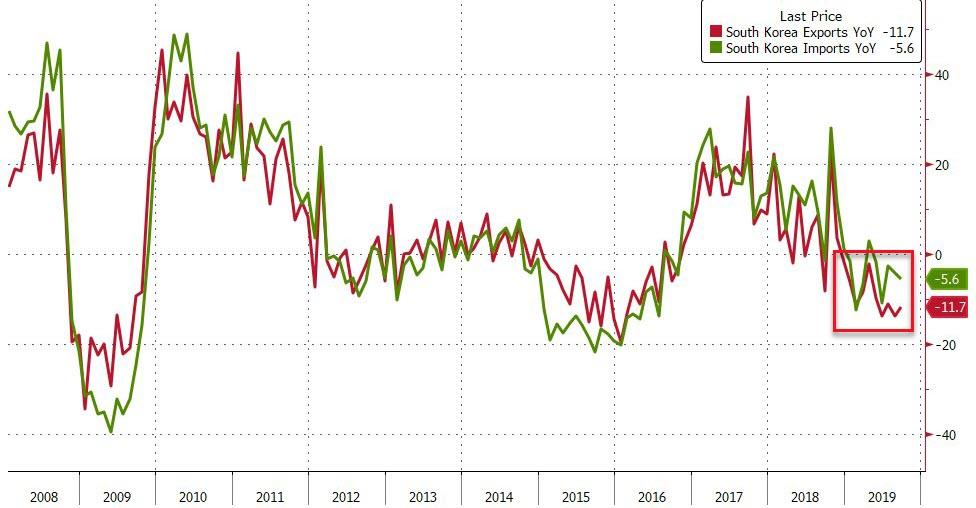
Trade data also notably disappointed tonight with both exports and imports tumbling more than expected...
Source: Bloomberg
The Finance Ministry was quick to dampen any concerns that this price deflation is actually deflation by issuing a statement that confirmed "South Korea is not facing deflation," stealing a page from The Fed's playbook by claiming that the dip in inflation is "temporary," pointing out through their crystal ball that CPI "will likely rise above 1% after next year."
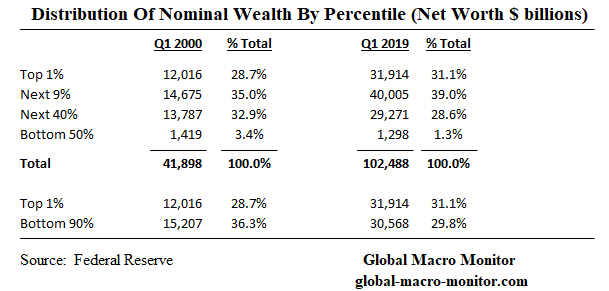
We illustrate the stark contrast in the growth of household wealth between the different percentile groups since Q1 2000
The top 1% of households now hold more wealth than the bottom 90%
The aggregate nominal wealth of the bottom 50% of households has fallen by almost 10 percent since 2000, from 3.4 percent of total household wealth to just 1.3 percent
The share of the top 1% is now over 31 percent and has grown by over 165 percent since Q1 2000
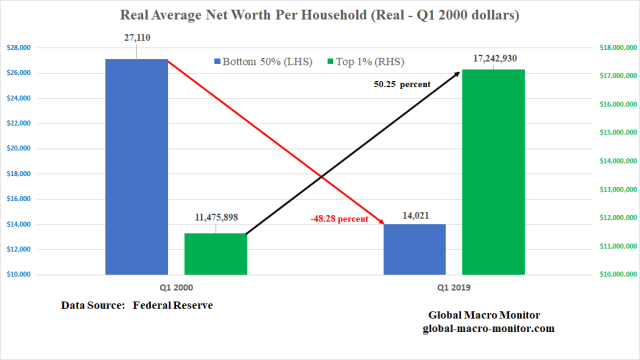
The average wealth per household of the bottom 50% has declined 25 percent in nominal terms and 50 percent in real purchasing power compared to the 1%’s increase of 118 percent and 50 percent, respectively
The widening wealth gap is a major factor in the rise of populism in the U.S. and the debate over a wealth tax will be a central focus of the 2020 presidential election
Asset inflation resulting from quantitative easing (QE) has contributed to the widening wealth gap
Long pitchforks and water cannons
Wealth Tax Talk
We hear a lot these days about wealth taxes. A new wealth tax on the upper echelons of the top 1% of wealthiest households will likely be at the center of the 2020 presidential campaign.
This kind of rhetoric and these ideas just don’t happen in a vacuum and are gaining political momentum. Our analysis will illustrate how it is based and moored in the two-decade-long change in the country’s distribution of wealth.
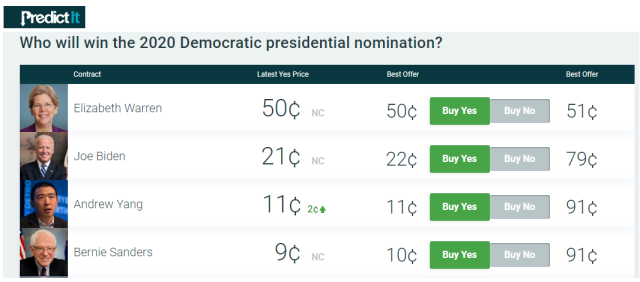
The prediction markets now give Elizabeth Warren a 50 percent probability of winning the Democratic nomination compared to only 21 percent for Joe Biden.
Here is a little snippet of Elizabeth Warren’s plan for a wealth tax from her campaign website.
..an Ultra-Millionaire Tax on America’s 75,000 richest families to produce trillions that can be used to build an economy that works for everyone — elizabethwarren.com
During the next week, we will present a series of posts analyzing wealth distribution in the United States, which seems to have reached a political tipping point. The top 1% of American households now have more wealth than the bottom 90% compared to 79 percent of the bottom 90% in Q1 2000.
In this post, we briefly present some data and charts on the growing wealth inequality between the top 1% and the bottom 50% of U.S. households.
Changes In Wealth For Average Household
Just a few caveats before looking at the following charts.
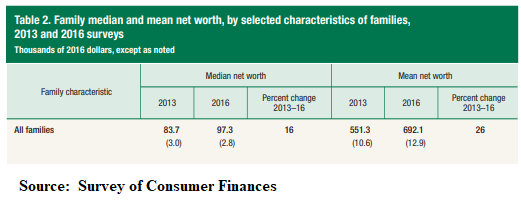
Note the significant differences between the average and median data points, which is the result of the top-heavy distribution of wealth in the U.S. where 70 percent of household wealth is now held by the top 10%, pulling up and distorting the average.
Second, our estimate of the number of households, which we have sourced from the Census Bureau and extrapolated for the current year. There is an ongoing debate about what constitutes a household and a family. Nevertheless, we are very confident our estimates in the following two charts are very good and close approximations of the data that will be eventually published in the next SCF, which should be out in a year or two.
The Raw Data
The following table illustrates the aggregate wealth data from the Fed’s new Distributional Financial Accounts (DFA). Note we use the terms “wealth” and “net worth” interchangeably.
Though the DFA time series begins in 1989, we use Q1 2000 as our base year not only because it represents the beginning of the new Millenium but it was also the quarter of peak aggregate nominal wealth for the bottom 50% of households.
Key Takeaway
The most stunning takeaway, at least for us, from the table is that the nominal aggregate wealth of the bottom 50% has declined, underscore fallen in nominal terms, over the past 19 years. That is almost a 10 percent decline while, at the same time, the wealth of the top 1% has increased by 166 percent. The share of the total household wealth of the bottom 50% has dropped from a mere 3.4 percent in 2000 to 1.3 percent in Q1 2019.
The aggregate wealth of the top 1% relative to the bottom 50% has increased from a factor of 8.5 to 24.6 from Q1 2000 to Q1 2019. Stunning and politically dangerous.
The data are even starker when taking into account that household formation has grown by over 20 percent since the beginning of 2000.
Real Average Wealth/Net Worth Per Household
Go no further to understand America’s rising populism and growing political conflict than the above two charts. It also illustrates the country’s two-speed economy and the sharp contrast of the economic well being of the top percentile groups and the bottom 50% of U.S. households.
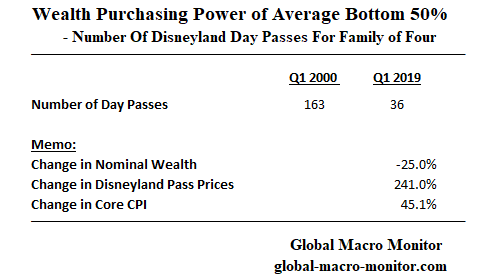
Real-World Example Of Wealth Decimation
It is hard to comprehend the decimation in purchasing power of the wealth of the average household on the other side of middle from 2000 to 2019 but let us help with a simple real-life example.
In 2000, the average wealth per household of the bottom 50%, assuming a family of four, could purchase 163 day passes at Disneyland. In 2019, however, given the decline in nominal wealth and the increase in Disneyland ticket prices, which have outpaced core CPI by more than 5x, fell to just 36 days.
Official Inflation Data Flawed
Just an aside, the relative increase in Disney tickets illustrates why we are so skeptical of and think the official inflation data calculated by the government underestimates real-world price increases, which are what truly matter with respect to a consumer’s real purchasing power.
Yes, we do understand relative price changes and that Samsung large screen televisions are much less expensive than they were in 2000.
Another Data Caveat
One should not make the mistake of viewing the above comparisons as a panel study. That is there is no doubt that some households were in the bottom 50% in 2000 are now in the top 1%, and vice versa.
In addition, the data are averaged with a range from a deeply negative net worth for the lowest percentiles of the bottom 50% to around $100k of the top percentile of the bottom 50%. Ditto for the top 1% where a few of the highest percentile households hold over $100 billion in wealth and the lowest of the top 1%, i.e., the 99th percentile of all U.S. households, is just over $10 million.
Keep that in perspective, folks, during your meditation on the data.
Why The Wealth Divergence?
One, or the major factor of the wealth divergence is that the returns earned on assets such as stocks, bonds, and equity in private businesses have greatly exceeded the growth of wages, which have been nothing short been dismal over the past 20 years. The several rounds of quantitative easing (QE) and the subsequent asset inflation have greatly contributed to the problem, increasing the support for some kind of a People’s QE.
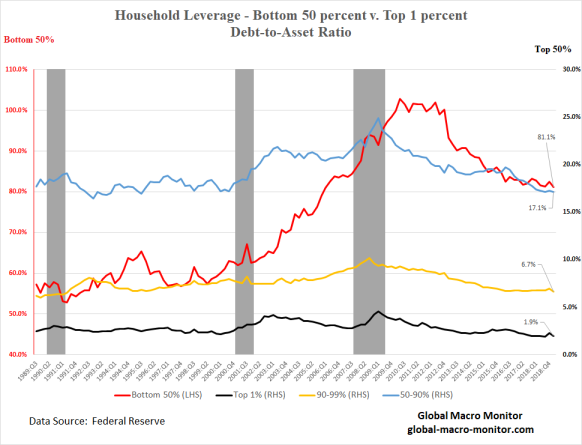
We also illustrated in an earlier post how debt-laden the bottom 50% is relative to other percentile groups.
Upshot
So, there you have it, folks.
It doesn’t take a Ph.D. economist or political scientist to understand what, we believe, is the biggest problem in today’s political economy. Just contemplate and study the few charts and data points above.
It will certainly be one of the main drivers of the 2020 presidential election and the winner will most likely be the candidate who convinces the majority of the electoral college or voters in the swing states, that he/she can best fix the problem or, more darker, is better at exploiting the rage against it. Yikes!
Either way, we suspect the 2020 campaign will be very ugly.
The concept of fairness in the distribution of resources is not just political but the literature increasingly shows is more innate. The perception of fairness also triggers more cooperation and helps an economy and society become more efficient and run more smoothly.
See our June post, The Innate Angst Of Inequality, or take a few minutes to view the video in the Appendix at the bottom of this post.
Can Markets Handle A Hard-Left Turn?
We are not so sure asset markets can handle and sustain a hard-left political turn. We are fairly certain, however, the current trajectory of the distribution of household wealth is not politically sustainable.
We are hoping for new policies that focus more on equitable growth, pulling the lower middle and bottom 50% of households up to close the wealth gap rather a radical redistribution of wealth program. The quickest but ugliest path to close the wealth gap is for both public and private equity markets to take, say, a 50 percent hit, which will end up hurting the most vulnerable.
I recall a conversation with one of my lefty political science professors during the dot.com crash. I asked if he was happy that the wealth gap between the richest man in the world at the time, Bill Gates, and the poorest person (maybe it was me) was cut in half with the crash of the Nasdaq. He responded, “no, let’s not do it that way.” Good for him.
Wealth Tax As An Investment In Social Stability
Nevertheless, some sort of redistribution of wealth from the uber-wealthy is inevitable, in our opinion. After all, the top of the top 1% have taken down an extraordinarily disproportionate share of the increase in total household wealth since 2000. They should view some sort of a wealth tax as an investment in the country’s social infrastructure and political stability in order to protect the totality of their asset holdings.
Whatever the scenario, the markets are vulnerable and to extract ourselves from this mess it is going to take some very effective and competent leadership with lots of nuance and finesse. 'Apollo 13'-like leadership and finesse.
…to return the [Apollo 13] astronauts safely, a new return trajectory had to be calculated and that is where his education in physics, as well as his experience at NASA, came into play. Calculating that return trajectory was like threading a needle from 70 feet away, he said. “We had to be accurate.”
“Apollo 13 was a test of real leadership and how we took a potential tragedy and turned it into a success,” he said. “All of us had a conviction to ride Apollo 13 to the end. We never thought we couldn’t do it.’ — Cherokee Phoenix
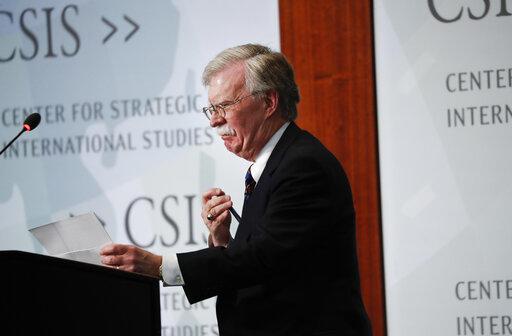
Bolton Slams Trump's "Bromance" North Korea Policy In First Public Remarks Since Ouster
Bolton took President Trump's "bromance diplomacy" to task on North Korea at an event at the DC think tank Center for Strategic and International Studies on Monday, after a reporter asked him point blank about the "warm letters" exchanged between the two leaders. The AP reports of his comments:
Asked during the question-and-answer session if “bromance diplomacy” is effective — a reference to the warm letters that Trump has exchanged with Kim — Bolton declined to comment. There is, though, “no basis” to trust any statements from the North Koreans.
“This is a government that has essentially violated every international agreement it has ever made,” he said.
Without naming the president directly, the recently oustered Bolton generally rebuked Trump's policy toward Pyongyang, after he has met with Kim Jong Un a total of three times, including at a historic DMZ summit on June 30, at which time then national security adviser Bolton happened to be in sent toMongolia.
"Every day that goes by makes North Korea a more dangerous country," Bolton said. "You don't like their behavior today, what do you think it will be when they have nuclear weapons that can be delivered to American cities?"
“Under current circumstances, he will never give up nuclear weapons voluntarily,” Bolton said at the think tank hosted conference, referencing Kim. Bolton further said he expects a bad ending to the current dubious US track and strategy.
“If you believe, and you may not, that it is unacceptable for North Korea to have nuclear weapons at some point military force has to be an option,” Bolton said in his characteristically hawkish and bellicose tone.
Trump for his part had previously described Bolton's view's as hurting progress on Korea “very badly” and that “maybe a new method would be very good.”
Earlier this month Bolton was reported to have ripped Trump's policies in a more direct way at a closed-door event, where his criticisms focused on Iran. Bolton explained to a luncheon hosted by the conservative Gatestone Institute "everybody in the White House had agreed on a retaliatory strike" on Iran in the wake of the Sept. 19 Saudi Aramco attacks.
But as the former national security explained sarcastically,“a high authority, at the very last minute," without telling anyone, decided not to do itand intervened to dissuade Trump. That "high authority" was identified as the increasingly vocally anti-interventionist FOX pundit Tucker Carlson.