| 0 comments ]

America Wages Economic Warfare On The Globe By Weaponizing Its Mawkish Culture

Authored by Denis A. Conroy for The Saker Blog,

American nationalism binds the whole-to-its-parts by using narrative to weaponize emotions and broadcast the idea of American ‘wholeness’ as somehow exceptionally greater than the sum of its parts.
There can be no doubt that zealotry became the dynamic forging the American character . First and foremostly, enunciations spat out by bearded prophets were carried on the winds of ontological time and eventually landing on the shores of the new world along with bible and crucifix to stave off inequities and help shape a mind-set (and foreign policy) for those taking possession of the Kingdom of God. A colonial policy that inevitably consigned the population of the occupied territories into misery and poverty would in time come to be regarded as regime change. The Protestant reformation was always about gilding the God narrative with a work ethic equal to the sum of its mercantile whole.

To this very day, individual achievements take precedence over collective values as missionary zeal is believed to have the potential to sublimate the libido and divert energy into productive work activities. The nub of the narrative being the ineffable Protestant-cum-existentialist credential underpinning the virtues of 19th century Anglophile culture that found ways of appeasing the mind with dreamlike emoluments to convey the promise of earthly rewards for the industrious of mind…or simply put; mercantilism became a-one-size-fits-all solution for man’s irascible struggle with his existential hairshirt.

In time, European mercantile classes would invasively penetrate every corner of the globe for the purpose of wealth extraction. Those who sought material gratification would eventually come to define democracy as freedom to pursue individual desires. What emerged from this was class-identified gentrification and fake sugar-coated democracy supporting a form of fake-individuality that created a class system based on the exploitation on just about everything.

As time passed the existential stature of the state grew, while the existential stature of the individual remained the same. With the advent of mercantilism came a national economic policy designed to maximize exports and minimize imports, with the state taking a more adversarial role in all business arrangements. For the state to be greater than the sum of its parts meant exporting a greater quantity of its manufactured products to its trading partners while minimising the amount of goods they imported from them.

To do this it was necessary to devise policies that aimed to reduce a possible current account deficit and achieve a current account surplus. Mercantilism introduced a national economic policy aimed at accumulating monetary reserves through a positive balance of trade, especially in finished goods…fine policies in theory, but when push came to shove in the competitive arena, greed inevitably exposed these polices to the raw ‘talents’ of people like Sheriff Trump and most of his contemporaries , who interpret business as dealership and mawkishly set out to wage economic warfare on all and sundry.

The practice of sucking in wealth associated with the resources of Africa, India, the Americas, India and other Asian destinations was so successful that Britain…almost inadvertently…found itself in possession of an empire. It had reached a plateau where the sum was greater than its parts and to sustain its ‘sum-status’ meant creating an alliance of collusive narratives to justify its pre-eminence…and the best way to do so and retain control of the narrative was to resort to propaganda and trophy issues that would weaponize the emotions of the population. Hence the modern state found a way to prioritize itself at the expense of the individual. Over time, business cartels in tandem with the government would create ever more contextual paradigms for the individual to deal with.

What was required to sustain the status quo was a narrative to make the people feel proud of the fact that they were part of a-top-dog-team in action. Once the authors of the narrative realized that propaganda, when coupled with patriotism, could produce adherents imbued with convictions that were inherent in the narrative, they realized that language itself could cement a profitable relationship between buyer and seller and public relations became a force unto itself.

If you were part of the bourgeoisie who came into existence in the 19th centuries as a consequence of the wealth pouring into Europe and Britain from the colonial exploitation of Africa or India, Ireland, Asia etc. and your conscience was troubled by virtue of being party to a culture sliding grandiosely up its own existential arse, you could find balm within the isolated confines of the psychiatrist’s couch if your pockets were deep enough. If you were of a humble disposition, there was the pastor or the priest who could deal with your existential woes. If you made it to the 20th century you probably would have become so conditioned by events as to be unaware of other people’s suffering…and if you made it to the 21 century…perish the thought!

It was in this phase of history that commerce cleverly entered the business of explaining the meaning of existence per educational fiat…for a price! Thereafter it would be secular experts who explained the meaning of life to anybody who could afford to pay for enlightenment while simultaneously repressing revolutionary instincts that could, in the first instance, allow the light of reason to filter through.

With the crafting of the existential narrative, more and more people came to see themselves as parts in a new whole. Personal history became the curveball of the 20th century, promoting a vision of America as utopia on steroids, which in turn, produced a sky-is-the-limit kind of optimism. America had long taken over from where Britain had left off after experiencing a fin de siecle stampede through its pearly gates in the 19th century which eventually produced an adrenaline rush to end all adrenaline rushes by the time it put a man on the moon. The net result was that American industry became kingpin for a century which left it convinced of its own invincibility.

When did America start to believe that it had to possess the biggest nuclear arsenal for it to feel that ‘whole’ America had become greater than the sum of its rival’s parts? Which raises the question; given the way power is used by the modern democratic-capitalist state, is the American constitution merely an example of baggage retained for baggage sake? Is there anything beyond raw power that may define its essence? Does it have an essence, or is it merely guided by some dark light that emanates from a single word…’democracy’…that stands alone on the blank piece of paper that was placed in a bottle and cast upon the ocean with information that might help ‘the people’ fulfil their desires?

Do the people not see that they need to be free from illusions that enfold them before they can revolutionize their system…and move on?

The elites who control the narrative remain invisible, they are neither deep nor surface stakeholders, they simply control the money flow. They are the sum-total of the faceless state, protected by protocols, secret intelligence agencies and the reality of the military budget that is put in place to maintain top-dog status for the elites and the illusions that comfort the multifarious minions now quarantined in citizen- zones that continue to emasculate their revolutionary spirit.

The current impeachment process in America best illustrates the sterility the population is immiserated in. They should be impeaching themselves (instead of looking for a scapegoat) for their inability to confront their own record. They seem unaware that they are party to a bloodbath that has devastated much of the Middle East and many other societies across the globe.

Once again, Americans are involved in the early stages of an election that leaves the question of America’s foreign policy in the too hard basket. A charade that would make Machiavelli blush. But alas, when blush comes to shove, American might is a God given right and collateral damage is not something that would soon alter the tone of its pugnaciously thick-skinned approach to reality.

Then there is ever more evidence of the schism that is corporate existentialism as opposed to individual existentialism. The former owning the right to squash the latter ever since Corporate America took the civil out of civilisation by assiduously seeking to remove voices/data/information/truth and honourable journalism from serving the public interest.

To observe how Julian Assange, Chelsea Manning, Edward Snowden (also Daniel Ellsberg, Jeffrey Wigand, Thomas Andrew Drake and Frank Serpico) were treated for divulging the execrable crimes of the American state are odious to say the least. That so many Americans, in condoning “the whole is greater than the sum of its parts” mentality, and dismissive of the service their whistle-blowers are providing, is appalling. A new class of people have come into existence and they hate whistle-blowers because they speak truth to power…pity the millions of Americans who don’t think that way!

And what does the MSM really think of all this? That the New York Times continues to readily publish Bibi Netanyahu’s blandishments concerning existential threats to Israel while ignoring the fact that Palestine have had their country invaded and countless Palestinians now live under appalling conditions where existential rights do not even apply to them. The hurt that is inflicted on Palestinians is akin to the hurt that can be extended to say, Julian Assange, because both insidiously demean the human spirit.

These are actions that highlight the schism that exists between governance and the governed…existence of the state in relation to the existence of the individual…or any other agent in the individual legal zone we recognise as being separate from the privileged existential zone of governments that includes corporations who enjoy limited liability by virtue of their status in law. Existentialism, at the individual level, is a concept born of leisure (think affluence), but when dealing with fiscal reality, finds its sovereignty somewhat overshadowed by the external trappings of an existential system designed to keep the checks and balances that favour the imperial narrative.

Six months ago when the US Government slammed Assange with 17 charges under The Espionage Act for publishing the Chelsea Manning Leaks, indications were that these actions were taken to stifle the existence of a precedent that challenged the rights of a government to suppress the existence of truth itself; eventually it became their right to gag the message and the messenger.

The American police state is a multi-billion-dollar boondoggle meant to keep the property and the resources of the American people flowing into corrupt government agencies and their corporate partners. In its present incarnation, it unmistakably exists as a pariah whose insidious meddling in other people’s systems knows no limitations. It unrelentingly spews out lies at every opportunity which vaunt variations on a theme of America’s self-righteous greatness ad nauseam. Its porous foreign policy exists to suck-out the essence of vulnerable states that are exposed to the gravitation pull of weaponised systems such as Wall Street and The Pentagon.

The systems that have weaponized American culture have spawned a host of ‘yes’ men and women…the MSM is aglow with them. The emotional and intellectual life of main street America is ominously self-righteous and defensive. To understand how reflexive American politics is, is to discover…by merely surfing channels…that the American public has become the meat in a political-duopoly sandwich.

To listen to Elizabeth Warren expostulating on Bolivia attests to a form of political incest that bedevils America. The Massachusetts Senator wanted to air her foreign policy bona fides in an interview with a former Barack Obama administration apparatchik on the podcast “Pod Save America.”

Warren praised Trump’s strategy of appointing the deflated Venezuela coup leader Juan Guaido as president and declared, “I support economic sanctions.” She also described the country’s democratically elected president Nicolas Maduro as a “dictator.” …although the interview was conducted back in February, video clips have recently resurfaced and gone viral on social media.

Which brings me back to the observation that America’s mawkish culture is viral in ways that are mainly lethal for those it disapproves of. It behaves like a giant octopus forever extending its tentacles into places that it wishes to exploit or annihilate. And behold The American Posse has morphed into stealth forces that operate outside of international law, human decency or basic accountability. It abhors the idea that leaders like Nicolas Maduro could curb the extortionist practices of corporate America and set about eliminating poverty in his beloved Bolivia. Worst of all is the fact that the American public condones regime change and all the other rapacious practices it is known for.
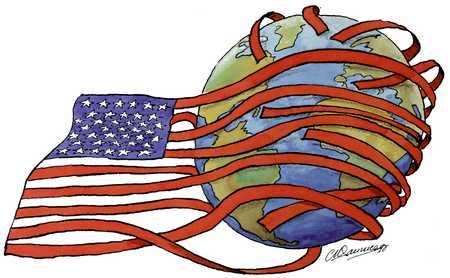
Sadly, America has become like an illiterate robot in a mathematical minefield stomping and headbutting everyone and everything it perceives as a competitor while waving its nuclear missiles and pruning shears at spectres of the existential sub-particle kind that threaten to lead humanity in a direction where it might discover that dancing the socialist fandangle might be o.k. after all.

Tyler Durden Sat, 11/30/2019 - 19:30
https://ift.tt/33A4sKA
from ZeroHedge News https://ift.tt/33A4sKA
via IFTTT

America Wages Economic Warfare On The Globe By Weaponizing Its Mawkish Culture SocialTwist Tell-a-Friend
| 0 comments ]

Epstein Tapes? Sordid Case Takes A Bizarre Turn After Mystery 'Hacker' Emerges

Shortly after Jeffrey Epstein's August death in a Manhattan detention facility, a shadowy figure claiming to have set up encrypted servers for the convicted sex offender told several attorneys and the New York Times he had a vast archive of incriminating evidence against powerful men stored on overseas servers, including several years worth of the financier's communications and financial records which allegedly showed he had vast amounts of Bitcoin and cash in the Middle East and Bangkok, and hundreds of millions of dollars' worth of gold, silver and diamonds.

Going by the pseudonym Patrick Kessler, self-described 'hacker' said he had "thousands of hours of footage from hidden cameras" from Epstein's multiple properties, which included former Israeli Prime Minister Ehud Barak, lawyer Alan Dershowitz, and Prince Andrew, along with three billionaires and a prominent CEO, according to the Times.

It has been long speculated that Epstein recorded his high-profile guests as part of an international blackmail operation.

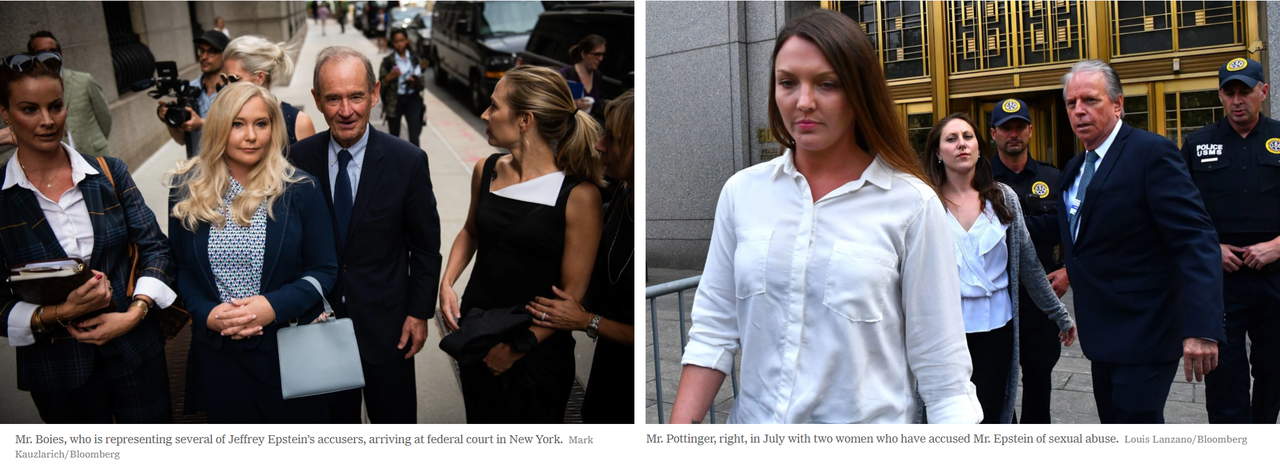
Armed with nothing more than blurry photos of what he claimed were high-profile individuals in compromising situations, Kessler approached lawyers representing several Epstein accusers,  John Pottinger and David Boies - the former of whom suggested that billionaire Sheldon Adelson - an ally of Israeli Prime Minister Benjamin Netanyahu - might pay for the alleged footage of Barak.

According to excerpts viewed by The Times, Mr. Pottinger and Kessler discussed a plan to disseminate some of the informant’s materials — starting with the supposed footage of Mr. Barak. The Israeli election was barely a week away, and Mr. Barak was challenging Prime Minister Benjamin Netanyahu. The purported images of Mr. Barak might be able to sway the election — and fetch a high price. -New York Times.

After several weeks, the attorneys invited the New York Times to speak with Kessler in mid-September. Then things got even more unbelievable. Following a mid-September meeting with The Times in the Boies Schiller offices, Kessler went rogue - contacting the paper and accusing Boies and Pottinger of an extortion plot against the subjects of said tapes.

Barely an hour after the session ended, the Times reporters received an email from Kessler: “Are you free?” He said he wanted to meet — alone. “Tell no one else.”

...

Kessler complained that Mr. Boies and Mr. Pottinger were more interested in making money than in exposing wrongdoers. He pulled out his phone, warned the reporters not to touch it, and showed more of what he had. There was a color photo of a bare-chested, gray-haired man with a slight smile. Kessler said it was a billionaire. He also showed blurry, black-and-white images of a dark-haired man receiving oral sex. He said it was a prominent C.E.O.

"At one point, he showed what he said were classified C.I.A. documents," writes the Times.

Weeks after the meeting, the lawyers struck a deal with the Times during the last Friday in September. They would send a team overseas to download Kessler's evidence from his servers (and had alerted the FBI and the US Attorney's Office in Manhattan of their intention to do so), and would then share all the evidence with the paper on the condition that they would have discretion over which men could be written about, and when.

Separately, Kessler had arranged to give the Times his evidence using a convoluted series of steps. On the day the data was to be transmitted, Kessler canceled at the 11th hour, claiming 'a fire was burning' and he had to flee to Ukraine. 

In early October, Kessler said he was ready to produce the Epstein files. He told The Times that he had created duplicate versions of Mr. Epstein’s servers. He laid out detailed logistical plans for them to be shipped by boat to the United States and for one of his associates — a very short Icelandic man named Steven — to deliver them to The Times headquarters at 11 a.m. on Oct. 3.

Kessler warned that he was erecting a maze of security systems. First, a Times employee would need to use a special thumb drive to access a proprietary communications system. Then Kessler’s colleague would transmit a code to decrypt the files. If his instructions weren’t followed precisely, Kessler said, the information would self-destruct.

Specialists at The Times set up a number of “air-gapped” laptops — disconnected from the internet — in a windowless, padlocked meeting room. Reporters cleared their schedules to sift through thousands of hours of surveillance footage.

On the morning of the scheduled delivery, Kessler sent a series of frantic texts. Disaster had struck. A fire was burning. The duplicate servers were destroyed. One of his team members was missing. He was fleeing to Kyiv.

Except two hours later, Kessler contacted Pottinger and didn't mention any emergency. Instead, he asked Pottinger to formulate two schemes for prying up to $1 billion from potential targets with the footage which the Times suggested may have been a trap.

Pottinger obliged, describing two options for capitalizing on the evidence. The first, a "standard model" for legal settlements, would include splitting the money among Epstein's victims, a charitable foundation, Kessler, and the lawyers - who would get up to 40%.

In the second hypothetical, the lawyers would approached the high-profile men, convince them to hire them to ensure they wouldn't get sued, and then "make a contribution to a nonprofit as part of their retainer."

Pottinger would effectively represent a victim, settle their case, and then represent the victim's alleged abuser - a legal, yet morally questionable practice for an attorney to engage in.

Dershowitz and the weird recorded phone call

In late September, Dershowitz's secretary related a message that Kessler wanted to speak with him about Boies - with whom Dershowitz has a long-running feud. Dershowitz recorded the call, during which Kessler said he no longer trusted Boies and Pottinger.

"The problem is that they don’t want to move forward with any of these people legally," said Kessler, adding "They’re just interested in trying to settle and take a cut."

“Who are these people that you have on videotape?” Mr. Dershowitz asked.

“There’s a lot of people,” Kessler said, naming a few powerful men. He added, “There’s a long list of people that they want me to have that I don’t have.”

“Who?” Mr. Dershowitz asked. “Did they ask about me?”

“Of course they asked about you. You know that, sir.”

“And you don’t have anything on me, right?”

“I do not, no,” Kessler said.

“Because I never, I never had sex with anybody,” Mr. Dershowitz said. Later in the call, he added, “I am completely clean. I was at Jeffrey’s house. I stayed there. But I didn’t have any sex with anybody.”

As the Times asks, "what was the purpose of Kessler’s phone call? Why did he tell Mr. Dershowitz that he wasn’t on the supposed surveillance tapes, contradicting what he had said and showed to Mr. Boies, Mr. Pottinger and The Times? Did the call sound a little rehearsed?"

Dershowitz told the Times he has no idea why Kessler called him.

Holding out hope

In a November 7 email, Boies told the Times "I still believe he is what he purported to be," adding "I have to evaluate people for my day job, and he seemed too genuine to be a fake, and I very much want him to be real."

That said, he also noted "I am not unconscious of the danger of wanting to believe something too much."

Ten days later, Mr. Boies arrived at The Times for an on-camera interview. It was a bright, chilly Sunday, and Mr. Boies had just flown in from Ecuador, where he said he was doing work for the finance ministry. Reporters wanted to ask him plainly if his and Mr. Pottinger’s conduct with Kessler crossed ethical lines.

Would they have brokered secret settlements that buried evidence of wrongdoing? Did the notion of extracting huge sums from men in exchange for keeping sex tapes hidden meet the definition of extortion?

Mr. Boies said the answer to both questions was no. He said he and Mr. Pottinger operated well within the law. They only intended to pursue legal action on behalf of their clients — in other words, that they were a long way from extortion. In any case, he said, he and Mr. Pottinger had never authenticated any of the imagery or identified any of the supposed victims, much less contacted any of the men on the “hot list.”

When the Times showed Boies text exchanges between Kessler and Pottinger, he "showed a flash of anger and said it was the first time seeing them." 

Eventually, Boies concluded that Kessler was probably a con man.

"I think that he was a fraudster who was just trying to set things up," adding that he had probably baited Pottinger into writing things that were more nefarious than they really were.

Pottinger, meanwhile, claims he was stringing Kessler along - "misleading him deliberately in order to get to the servers."

Despite Kessler's story falling apart, the Times asks if his claims are plausible.

Did America’s best-connected sexual predator accumulate incriminating videos of powerful men?

Two women who spent time in Mr. Epstein’s homes said the answer was yes. In an unpublished memoir, Virginia Giuffre, who accused Mr. Epstein of making her a “sex slave,” wrote that she discovered a room in his New York mansion where monitors displayed real-time surveillance footage. And Maria Farmer, an artist who accused Mr. Epstein of sexually assaulting her when she worked for him in the 1990s, said that Mr. Epstein once walked her through the mansion, pointing out pin-sized cameras that he said were in every room.

I said, ‘Are you recording all this?’” Ms. Farmer said in an interview. “He said, ‘Yes. We keep it. We keep everything.’”

During a 2005 search of Mr. Epstein’s Palm Beach, Fla., estate, the police found two cameras hidden in clocks — one in the garage and the other next to his desk, according to police reports. But no other cameras were found.

So - it appears that Kessler was either a fraud or an operative, and the entire saga may have been designed to cast doubt over whether tapes actually exist. Or, Kessler is for real - and for some reason hasn't found a way to release the videos. That said, since he says he's not interested in extortion, what's the hold-up?

Tyler Durden Sat, 11/30/2019 - 19:00
https://ift.tt/2L9ar2J
from ZeroHedge News https://ift.tt/2L9ar2J
via IFTTT

Epstein Tapes? Sordid Case Takes A Bizarre Turn After Mystery 'Hacker' Emerges SocialTwist Tell-a-Friend
| 0 comments ]

In Shocking Blow To Merkel, Germany's SPD Elects Leftist Leaders, Risking Coalition Government Collapse

Merkel's last term as German chancellor has been a series of relentless blows to her reputation and legacy, as the former leader of Europe finds herself trapped and increasingly powerless in a world that has grown hostile to her style of governing.

The latest shock came on Saturday, when the German Social Democratic Party (SPD) announced the winner of its leadership contest as both coalition partners of Germany’s Grand Coalition were transitioning their party leaderships after disappointing results in opinion polls and at regional elections.

Whereas consensus had widely expected finance minister Olaf Scholz and regional politician Klara Geywitz to preserve their control over the SPD after topping the first round of voting, the result announced just after 6pm CET showed that with a vote of 53% to 45%, SPD members elected Norbert Walter-Borjans, a former minister in the regional state of North Rhine-Westphalia, and Saskia Esken, an MP from Baden-Württemberg, as their new leaders.

The outcome was a blow to Merkel and her coalition government, as the duo of Walter-Borjans and Esken represent the left-leaning segment of the SPD and have been highly skeptical of the SPD's role in the Grand Coalition government.

SPD's new leaders, Norbert Walter-Borjans and Saskia Esken

The surprising swing to the left for Germany's (formerly) centrist and fiscally prudent Grand coalition threatens to trigger a prolonged phase of political uncertainty in Germany, because as Bloomberg notes, "the victory of Walter-Borjans and Esken, who favor taxing the rich, boosting welfare spending and abandoning Germany’s long-standing policy of a balanced budget, will certainly weaken pro-government forces."

Goldman Sachs agrees: in a Thursday note by the bank's European strategist Sven Jari Stehn, he wrote that a victory by Walter-Borjans and Esken increases the risk that the SPD pulls out the coalition because under a left-leaning SPD "there would be a diminished consensus within the coalition" as the newly elected duo is demanding a re-negotiation of parts of the coalition agreement, and seeking to increase federal fiscal spending and investment.

Whereas this would be a virtually impossible concession for the CDU to make during its own leadership transition, Goldman does not expect "an immediate dissolution of the coalition", even though the collapse of Germany's current coalition is now just a matter of time.

"I never said we need to leave,” Walter-Borjans said after the results of the election were announced on Saturday evening. "We must improve the policies and perhaps loosen the black zero," he said in reference to Merkel’s balanced budget policy, news that would be met over champagne and caviar everywhere from the ECB to Brussels, to the IMF, all of whom have been demanding that Germany boost its fiscal stimulus.

Ironically, it's now only Angela Merkel who stands in the way of Germany doing away with its "black zero" balanced budget policy, and any deviation would almost surely mean the end of the Chancellor's political career.

The fate of Germany's fiscal stimulus has emerged as arguably the most important topic for Europe's economic future.

While Germany avoided a technical recession by the narrowest of margins, growth continues to slow and will drop to an estimated 0.5% this year, one-fifth the rate of what it was in 2017, largely as a result of the global trade war and China's collapsing credit impulse, although the ECB's recent monetary boost has certainly helped delay the day of reckoning.

Ironically, after a tumultuous year in which the SPD and Merkel’s Christian Democrats both faced intense power struggles, Germany’s political and business elites had hoped for a period of calm and continuity; instead they are now looking at what appears to be an almost certain collapse of the ruling coalition.

As Bloomberg notes, in hopes of delaying political chaos, Merkel this week had made an unusual plea to see the alliance through to 2021, saying there was still much to be done. Finmin Scholz also argued that his party is achieving more of its objectives in government than it ever could in opposition, even if it needed to compromise. But Walter-Borjans managed to tap the dissatisfaction of many Social Democrats who feel their party has abandoned its working-class origins and should abandon an alliance with conservatives.

Meanwhile, as Goldman points out, the CDU/CSU coalition is not immune to internal tensions either. Since Annegret Kramp-Karrenbauer (AKK) took over the CDU leadership last year, both European and regional elections failed to show a turnaround in voter support that would have cemented her leadership of the party. While AKK’s critics refrained from a rival leadership bid at last week’s CDU party convention, her position remains uncertain. Absent a substantial improvement in her approval ratings, there will be an aggressive race for the CDU’s lead candidate for the next general election scheduled for the fall of 2021, with candidates from both the centre and the right of the party likely throwing their hats in the ring when the nomination process begins in late 2020. A more right-leaning candidate could also raise questions about the viability of the current coalition, especially with the SPD now turning a sharp left turn.

To be sure, Merkel may still fight to preserve the coalition, but that would come at a major cost: during the campaign Esken and Walter-Borjans said their price for staying includes billions of euros of government investment in climate and education, a 12 euro per hour minimum wage, and wage negotiations that should be made obligatory for employers. While such demands were seen as unacceptable by Merkel’s CDU and its leader, AKK, told delegates at a convention in Leipzig last week that she would refuse to renegotiate the coalition agreement that the two factions completed in March 2018, now that the numbers are in, Merkel may have no choice but to bend the knee.

In other words, while today was another major loss for Merkel, fans of MMT around the world are rejoicing as Germany is now one step closer to launching an ECB-monetized fiscal stimulus.

What happens next?

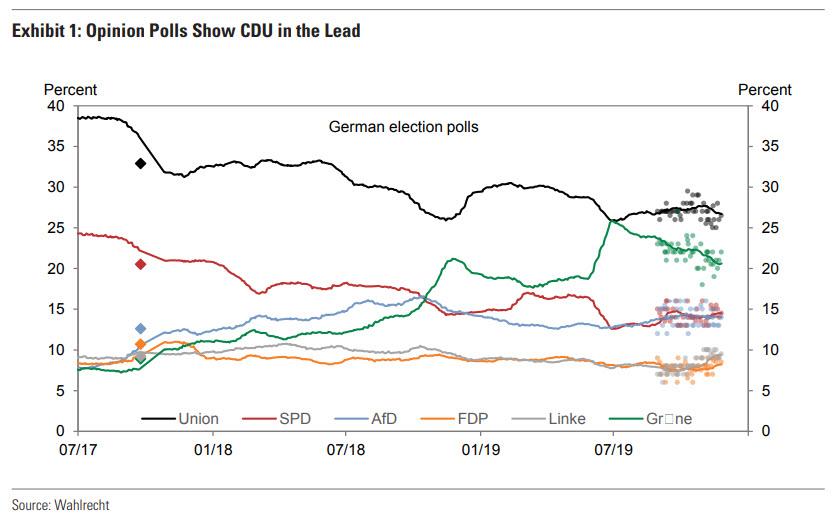
According to Goldman, notwithstanding the risks involved in the leadership transitions, the bank still expects the Grand Coalition to last through 2020 and, even in the event the coalition is dissolved, snap elections would not be triggered automatically as the hurdles to dissolving parliament are high. Neither coalition partner currently has a strong incentive to seek fresh elections as both are polling well below their 2017 election results, and the Greens continue to poll ahead of the SPD.

A CDU/CSU minority government is therefore the more likely option in the event of a breakup of the Grand Coalition, providing relative stability during Germany’s European Council Presidency in the second half of 2020.

As for Germany's economy, Goldman expects the Esken/Walter-Borjans leadership to increase the chance that the fiscal space made available in the 2020 budget is fully exploited rather than under-delivering on the planned easing as in previous years seeing they have indicated to favor a looser fiscal stance. This could add stimulus worth 0.2% of GDP in 2020, but it would still fall significantly short of the easing space afforded by both national and EU rules. Should the Grand Coalition
break up, a CDU-led minority government would imply downside risks to Goldman's ur baseline.

So while today's result was a clear sign that at least one German party is turning sharply left, and thus more likely to endorse fiscal stimulus, Germany still faces an uphill climb before it concedes, a climb that may last well into 2021 by which point the global economic recession would make a German stimulus a moot point. 

Tyler Durden Sat, 11/30/2019 - 14:12
https://ift.tt/2Y0qepE
from ZeroHedge News https://ift.tt/2Y0qepE
via IFTTT

In Shocking Blow To Merkel, Germany's SPD Elects Leftist Leaders, Risking Coalition Government Collapse SocialTwist Tell-a-Friend
| 0 comments ]

LA County Intoduces E-Voting System: Not Hand-Marked, Not Paper, Not Hand-Counted In Public

Authored by Lambert Strether of Corrente, via NakedCapitalism.com,

No doubt Los Angeles County’s VSAP (“Voting Solutions for All People”) rollout will not be covered as a debacle. The real question is: If there were a debacle — like, say, a case of election fraud — would we even know? Doubtful.

Just what we want in a voting system! In this post, I’ll give a brief overview of issues with electronic voting. Then I’ll look at VSAP as an institution. Next, I’ll show why the VSAP system is not only insecure, but likely to make money-in-politics even worse than it already is.

We’ve covered electronic voting before — see herehere, and here — and if you want to understand why hand-marked paper ballots, hand-counted in public (HMPBCP) is the world standard, you can read them, especially the first. In this overview, I’ll make a few high-level observations about electronic voting in general.

Digital systems can never be shown not to have bugs. As Computer Science Elder God Edgers Dijkstra wrote: “Program testing can be used to show the presence of bugs, but never to show their absence!” Many bugs in many important programs persist for years before they are discovered. A list would include Flash in IE6 (persisted 12 years), OpenSSL (15 years), LZO data compression (18 years), and bash (25 years). None of these examples are outlier programs or trivial; they are all used by millions, essential to enterprises, networks, etc. Each of these bug is an insecurity waiting to happen. And that’s before we get to Trojan Horses, which are bugs introduced deliberately by a developer for purposes of their own. In fact, I would go so far as to argue that any voting system decision maker who advocates electronic voting is doing so for reasons other than security, given that HMPBCP is available, which amounts to saying that such a decision maker regards a certain amount of exploited bugs — election fraud — as acceptable.

Now, of course we all use programs all the time: We have programs to turn on our lightbulbs, call cabs, download pr0n, etc. I’m using a program now to write this post! However, if we put voting machine software on the same plane as commercial software, we’re arguing that a central-to-mission function of democracy — the vote — is on the same plane as the very convenient ability to check the contents of our refrigerator from our cellphone. Lest I be thought curmudgeonly in this, recall the example of Bolivia, where one reason the vote was challenged was the use of an unauthorized server for data transmission of the count. Contrast that with the recent vote in Hong Kong, where there were many images of people marking paper ballots, and of people counting them, in public (in fact, of people demanding to be let in to observe). Imagine if electronic systems had been used: First, the Mainland would have had every incentive to have compromised the software, and might well have done so successfully; second, electronic systems, because they are always buggy, are always open to challenge. The fallout could have been extremely ugly at the geopolitical level. Nor would the people’s will have been respected.

With that, lets turn to Los Angeles County and VSAP. As with any software project, we need to understand the requirements. Here is what I can find on the extremely spiffy and well-budgeted VSAP site: “The Design Concepts“:

The final concept created for VSAP incorporates features driven by the project principles as well as focus group feedback, input and in-person testing.

The concept system features touch-screen technology with a simple user interface, both audio and visual output and a built-in scanner, printer and ballot box. The new voting system will provide voters with options to scan in QR coded ballots from their phone, enter their ballot choices in-person at the polling location or vote-by-mail with printed ballots.

(Note that the concept very explicitly does not say that hand-marked paper ballots will be available at polling locations; only vote by mail.) I note with alarm that the concept document includes no mention of security, or even that the voters vote be accurately recorded and tabulated. Let’s look elsewhere for that. From the aforementioned “Principles“:

TRUST The voting system must instill public trust and have the ability to produce a physical and tangible record of a voter’s ballot to verify the ballot was marked as intended before it is cast and to ensure auditability of the system. It must demonstrate to voters, candidates, and the general public that all votes are counted as cast.

(A little too much focus on PR for my taste: “instill,” “demonstrate.”) Note the fundamental equivocation, which I have underlined: The paper is not the ballot; the paper is only a record of the ballot, which is digital. More:

INTEGRITY The system must have integrity, be accountable to voters, and follow existing regulations. System features must protect against fraud and tampering. It should also be easy to audit and produce useful, accessible data to verify vote counts and monitor system performance.

“System features must protect against fraud and tampering.” See comments on bugs above. There is nothing insecure about counting ballots by hand in public. That’s why you count them in public. Finally:

TRANSPARENCY The processes and transactions associated with how the system is set up, run, and stored should be easy for the public to understand and verify. This should include making hardware components available for inspection, and source code to the extent that the manner of doing so would not jeopardize system security or availability

VSAP is being marketed as open source, but that underlined section is an awfully big qualifier. We’ll have to see how it works out in practice.

So, these design concepts and principles are the closest I can come to a requirements document (and I did look using several search tools, as well as doing an image search for diagrams). So, although VSAP uses “ballot marking devices,” we don’t know what requirements they are supposed to meet, and so have no way to judge the success of the VSAP system. If you, readers, can do better, please put your results in comments.

So, the VSA site reads like public relations to me. For completeness, here’s an image of the county-wide rollout:

Dear Lord. A “voting experience”? So the tiny little alarm head began to ring a little louder, and with this press release it began to clamor: “Votem Corp Selected For LA VSAP Project In Partnership With Smartmatic“:

An innovative voter-centered election system will modernize the way Los Angeles County citizens will cast their ballots. In partnership with Smartmatic, who was awarded a contract to assist LA County in the design, construction, and deployment of the new voting solution, Votem will facilitate the development of the new system’s interactive ballot display.

“We are extremely pleased to be taking this important step forward in delivering on our commitment to modernize the voting experience in Los Angeles County and to lead in the development and implementation of a non-proprietary, publicly-owned voting system that is responsive to the needs and behavior of our electorate,” said Dean Logan, Registrar of Voters, following the awarding of the contract at the Board of Supervisors meeting on Tuesday.

Votem and its team will be responsible for the interactive ballot display and implementation, as designed by and for Los Angeles County, in partnership with IDEO, during prior phases of the VSAP initiative that focus on security, accessibility and usability. The interactive sample ballot display will allow for voters to mark their choices on their mobile device – anywhere, anytime – and then scan in their QR code in person for fast and easy voting at a vote center.

(Hold that thought on QR codes. As it will turn out, the QR code is the actual ballot.) Votem, eh? NC readers will be familiar with Votem, since Votem was involved in CalPERS corrupt election process (see herehere, and here). Of the Votem’s many problems, this one seems to be, well, the juiciest. Yves analyes a Votem “CalPERS Tabulation Incident Report” and concludes:

[T]he Incident reports starts with five Big Lies, which is quite impressive in such a short space:

The 2018 CalPERS Public Agency Member Election was conducted by the Everyone Counts/IVS Joint Venture. Everyone Counts has since been acquired by Votem, Corp. The election team and tabulation platform remained the same.

First, the election vendors admitted in 2017 (just the way CalPERS finally confessed that “CalPERS Direct” was not direct investing) that its election “joint venture” was no such thing. It was an operating agreement between K&H Printers-Lithographers, Incorporated, dba Integrity Voting Systems, and Everyone Counts, Inc.6 In keeping, the two parties signed the agreement as separate entities.

Second, the parties nevertheless attempted to depict the contract repeatedly as a joint venture, even stating in the operating agreement that the services were to be provided in the name of the “”IVS/Everyone Counts Joint Venture”. So Votem also misrepresented the name by putting “Everyone Counts” first, implying it is the more important player. We have the agreement embedded at the end of our second post. It makes very clear that K&H Printing, operating as IVS, was the dominant party.

Third, Votem falsely stated that the elections were conducted by the soi disant joint venture. That is false because Everyone Counts defaulted on the agreement by selling its assets to Votem before the election was over.

Fourth, Votem says it acquired “Everyone Counts”. It did not do so. It acquired only Everyone Counts’ assets, deliberately leaving the liabilities and the legal entity behind.

Finally, Votem claims that it acquired “Everyone Counts” after the election. This is false, since the sale of assets closed before the election was over and days before the tabulation took place.

So, underneath all the glossy PR, and the rollout, and the stakeholders, and the lavish website, we have a prime contractor that’s an extremely shady business entity. One, morever, in charge of the ballot!

With all that set-up, let’s quickly move to the critique from the HMPBCP world. First, from the essential Bradblog, “L.A. Registrar Won’t Answer Qs About County’s New Unverifiable Touchscreen Vote Systems.” Here is where the QR code becomes important:

The new VSAP system is a touchscreen Ballot Marking Device or BMD, which prints out a computer-marked paper ballot summary of votes selected via the touchscreen, before using another computer, an optical-scanner, to read the non-human readable QR Code that is also printed on the ballot summary. The QR Codes are used to tally votes. While the QR Code (a type of barcode) cannot be verified for accuracy by voters, it is also impossible with such systems to know if any voter has even verified the human-readable portion of the ballot summary at all, much less correctly, after an election. Studies reveal that most do not verify computer-marked ballots at all, and that of the minority who do, most don’t recall the details or selections on the ballot they voted just moments earlier. That’s just one of the many reasons why most cybersecurity and voting systems experts warn against the use of such systems which are now proliferating — and sometimes replacing verifiable hand-marked paper ballot systems — in many states and counties across the country before 2020. (The list of states where counties or the entire state are moving to BMD systems include a number of key battleground states. Such systems are planned for use next year, or are already being used, in OH, WI, PA, TX, WV, KY, NY, NJ, KS, TN, IN, SC, NC and, yes, CA, unless the public prevents these plans.)

(There’s much, much more; read the whole thing, especially Los Angeles residents.) For readers who think they have never seen a QR code, it’s like a bar-code in two dimensions, and it looks like this:

I wanted to find the requirements document and if possible some process flow diagrams, but I’ll take BradBlog at his word. The flow for a Ballot Marking Device would be something like: Voter makes selections on touch-screen (software, hence buggy and insecure), selections are stored (ditto) and printed out (ditto) on a page with a human-readable receipt reflecting the touchscreen selections, and the ballot itself, which is the QR code, which is not human-readable. The page is then scanned (ditto) and QR code is then tabulated (ditto). The sleight of hand is, of course, the ballot itself. A human may think that their reciept, which they can read to check that it matches what they selected on the touch screen, also matches the QR code, which they cannot. But there’s no reason on earth to think that! And the unreadable QR code, since that is what is tabulated, is the ballot! Take the matter out of the delusional digital realm. Suppose voting worked like this: You voted by hand-marking a yellow paper ballot. You then handed the yellow paper ballot to an official who, behind a screen so you could not see, then marked a blue ballot that you could not read, seaked it so you could not read it, and then handed the blue ballot back to you and told you to put it in the ballot box, that’s your vote. Does that make any sense? That is how a “Ballot Marking Device” works.

Worse, the QR code ballots reinforce the power of money in politics. Recall that “The new voting system will provide voters with options to scan in QR coded ballots from their phone.” Well, security aside, game that out. From Knock LA, “The Campaign Finance Problem is About to Get Worse“:

Voters who like to fill out their sample ballot in advance and bring it to the polls will be particularly interested in the new Interactive Sample Ballot (ISB) feature. This will allow them to store their choices to a “Poll Pass” containing a QR code and then reload it into the Ballot Marking Device. This is an option that will “help expedite the voting process” by negating the need to individually mark each line on the ballot while in the polling center. This will be particularly useful on a ballot that will be extraordinarily long now that local elections will be folded into the presidential ballot. Unfortunately, this convenience will come at a steep price for our democracy.

Instead of building in assurances that the Poll Pass could only be used by the person who created it, the designers left the system open so QRs can be created by third parties and then be distributed for use at the polls. This would significantly increase the effectiveness of the slate mailers that inundate mailboxes prior to an election[1].

While the casual voter may believe that the strategically named organizations that publish slate mailers have carefully screened candidates for inclusion, the truth is that most are nothing more than a pay to play form of political marketing. Inclusion on these ads has more to do with the ability to pay than the views of the included candidate. The ability to pre-fill a voter’s ballot will make inclusion on these mailers even more valuable and put candidates not funded by special interest groups at even more of a disadvantage.

Groups like the California Charter School Association (CCSA), which have already shown the willingness to throw ethics aside in order to win elections, will find the new system even more valuable. Their printed materials could highlight popular candidates without even mentioning their favored candidate while still embedding their choice within the QR code. The unsuspecting voter who does not check all the way down the ballot at the polling place would be casting a vote for a candidate they took no action in choosing and may, in fact, oppose. By creating different slates to cover multiple candidates in races that attract the most attention, groups like CCSA could magnify their effect on the election. They could even print one slate on their mailer and include a QR code that placed a completely different set of names on the ballot.

Given the role that liberal Democrats think the donor class should play in politics, this may not be an issue for VSAP.

Conclusion

G-a-a-a-a-a-h! All that design! All those principles! And at the end of the day we have a system where the voter doesn’t know the vote they cast, and that reinforces the power of big money. Some clever lawyer needs to bring suit on this and fight it all the way to the Supreme Court (who, I suppose, can choose to put the final nail in the democracy’s coffin, or not). Oh, and VSAP hopes a lot of other jurisdictions adopt its system. Swell.

Tyler Durden Sat, 11/30/2019 - 13:30
https://ift.tt/37TNn1y
from ZeroHedge News https://ift.tt/37TNn1y
via IFTTT

LA County Intoduces E-Voting System: Not Hand-Marked, Not Paper, Not Hand-Counted In Public SocialTwist Tell-a-Friend
| 0 comments ]

Starbucks Barista, Who Called Cop "PIG" On Thanksgiving, Fired

A Starbucks employee who printed the word "PIG" on the labels of a Kiefer, Oklahoma police officer's coffee has been fired, according to the company.

The Kiefer police officer went to the Glenpool Starbucks on Thursday to pick up five drinks for dispatchers working on Thanksgiving, according to Police Chief Johnny O'Mara in a Facebook post.

"What irks me is the absolute and total disrespect for a police officer who, instead of being home with family and enjoying a meal and a football game, is patrolling his little town," he added.

"This cup of coffee for a ‘pig’ is just another little flag," the post continues. "It’s another tiny symptom and a nearly indiscernible shout from a contemptuous, roaring and riotous segment of a misanthropic society that vilifies those who stand for what’s right and glorifies the very people who would usher in the destruction of the social fabric. It’s another tiny pinprick into the heart of men and women who are asking themselves more often: ‘Why am I doing this?'"

Starbucks called the incident "absolutely unacceptable," adding that they are "deeply sorry to the law enforcement officer who experienced this," according to CNN.

"The Starbucks partner who wrote this offensive word on a cup used poor judgement and is no longer a partner after this violation of company policy," reads a company statement. "This language is offensive to all law enforcement and is not representative of the deep appreciation we have for police officers who work tirelessly to keep our communities safe."

The company issued a joint statement with the Kiefer police department, saying they're using the incident "as an opportunity to leverage our shared platforms to promote greater civility."

The Seattle-based coffee chain will meet with Kiefer police to discuss other ways to work together, and will host a Coffee with a Cop event where baristas and and members of the community will be educated as to "the critical role dispatchers and police offers play in keeping our communities safe."

Tyler Durden Sat, 11/30/2019 - 13:00
https://ift.tt/2Y2XmNv
from ZeroHedge News https://ift.tt/2Y2XmNv
via IFTTT

Starbucks Barista, Who Called Cop "PIG" On Thanksgiving, Fired SocialTwist Tell-a-Friend