| 0 comments ]

America The Victim: Are Enemies Lining Up For Revenge In The Wake Of COVID-19?

Authored by Philip Giraldi via The Strategic Culture Foundation,

When in trouble politically, governments have traditionally conjured up a foreign enemy to explain why things are going wrong.
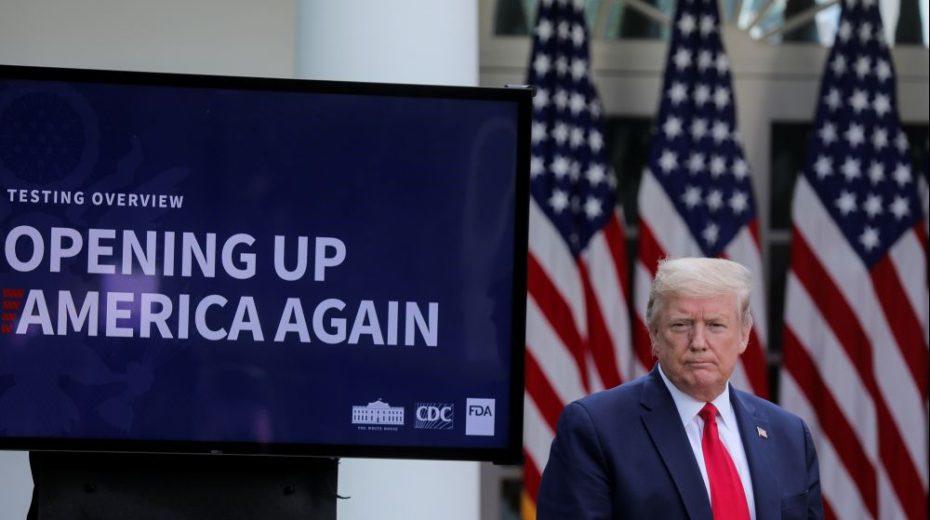
Whatever one chooses to believe about the coronavirus, the fact is that it has resulted in considerable political backlash against a number of governments whose behavior has been perceived as either too extreme or too dilatory. Donald Trump’s White House has taken shots from both directions and the response to the disease has also been pilloried due to repeated gaffes by the president himself. The latest mis-spoke, now being framed by Trump’s press secretary as sarcasm, involved a presidential suggestion that one might consider injecting or imbibing disinfectant to treat the disease, either of which could easily prove lethal.

So, the administration is desperate to change the narrative and has decided to hit on the old expedient, namely seeking out a foreign enemy to distract from what is going on in the nation’s hospitals. The tale of malevolent foreigners has been picked up by a number of mainstream media outlets and has proven especially titillating because there is not just one bad guy, but instead at least four: China, Russia, North Korea and Iran.

The accepted narrative is that America’s enemies are now taking advantage of a moment of weakness due to the lockdown response to the coronavirus and have stepped up their attacks, both physical and metaphorical, on the Exceptional Nation Under God.

The most recent claim that the United States is being targeted involves an incident in mid-April during which a swarm of Iranian gunboats allegedly harassed a group of American warships conducting a training exercise in the Persian Gulf by crossing the bows and sterns of the U.S. vessels at close range. The maneuvers were described by the Navy as “unsafe and unprofessional” but the tiny speedboats in no way threatened the much larger warships (note the photo in the link which illustrates the disparity in size between the two vessels).

Donald Trump characteristically responded to the incident with a tweet last Wednesday: “I have instructed the United States Navy to shoot down and destroy any and all Iranian gunboats if they harass our ships at sea.” Although no context was provided, the president commands the armed forces and the tweet essentially defined the rules of engagement, meaning that it would be up to the ships’ commanders to determine whether or not they are being harassed. If so, the would be able to open fire and destroy the Iranian boats. Of course, there might be a physical problem in “shooting down” a gunboat that is in the water rather than in the air.

In the Mediterranean the threat against the U.S. consisted of two Russian jet fighters flying close to a Navy P8-A submarine surveillance plane. The Russian fighters were scrambled from Hmeymim air base in Syria after the U.S. aircraft approached Syrian airspace and Russian military facilities. One of the fighters, a SU-35 carried out an “unsafe” maneuver when it flew upside down at high-speed 25 feet in front of the Navy plane.

Also in mid-April, North Korea meanwhile fired cruise missiles into the Sea of Japan amidst rumors that its head of state Kim Jong Un might be dead or dying after major surgery. President Trump was unconcerned about the missiles and also commented that he had received a “nice note” from the North Korean leader.

Wars and rumors of wars notwithstanding, China continues to be the principal target for Democrats and Republicans alike on Capitol Hill. GOP congressmen are reportedly urging sanctions against China while there are already a number of coronavirus lawsuits targeting Chinese assets in U.S. courts, at least one of which has a trillion dollar price tag. Theories about the deliberate weaponization of the Wuhan virus abound and they are also mixed in with stories of how Beijing unleashed the weapons and is now engaged in Russia style social media intervention to promote the notion that the United States has proven incapable of handling what has become a major medical emergency. However, those who are pushing the idea that the Chinese communist party has declared war by other means fail to explain why the government in Beijing is so keen on destroying its largest export market. If the U.S. economy goes down a large part of the Chinese economy will go with it, particularly if China’s second largest export market Europe is also suffering.

The craziness of what is going on in the context of the disruption caused by the coronavirus has apparently increased the normal paranoia level at the top levels of the U.S. government. Pentagon plans to fight a war with Russia and China simultaneously, first mooted in 2018, are still a work in progress in spite of the fact that Washington has fewer cards to play currently than it did two years ago. The economy is down and prospects for recovery are speculative at best, but the war machine rolls on. Many Americans tired of the perpetual warfare are hoping that the virus aftermath will include demands for a genuine national health system that will perforce gut the Pentagon budget, leading to an eventual withdrawal from empire.

In spite of the hysteria, it is important to note that no Americans have been killed or injured as a result of recent Iranian, Russian, Chinese and North Korean actions. When you station ships and planes close to or even on the borders of countries that you have labeled as enemies it would be reasonable to expect that there will be pushback. And as for taking advantage of the virus, it is the United States that has suggested that it would do so in the cases of Iran and Venezuela, exerting “maximum pressure” on both countries in their times of troubles to bring about regime change.

If those countries that are accustomed to being regularly targeted by the United States are taking advantage of an opportunity to diminish America’s ability to intervene globally, no one should be surprised, but it is a fantasy to make the hysterical claim that the United States has now become the victim of some kind of vast international conspiracy.

Tyler Durden Thu, 04/30/2020 - 23:00
https://ift.tt/2Yn8wPB
from ZeroHedge News https://ift.tt/2Yn8wPB
via IFTTT

America The Victim: Are Enemies Lining Up For Revenge In The Wake Of COVID-19? SocialTwist Tell-a-Friend
| 0 comments ]

Yuan Crashes After Trump Weighs Blocking Retirement Fund Access To Chinese Stocks As War Of Words Escalates

Having tumbled yesterday on the first set of headlines reporting on the Trump administration's plans to seek 'COVID reparations' amid accusations of Chinese 'meddling' in the US election (obviously not in favor of Trump), the Chinese yuan legged dramatically lower in this evening's illiquid session which sees most of Asia closed for May Day, after Bloomberg reports that Trump is exploring blocking a government retirement fund from investing in Chinese equities considered a national security risk.

Trump made his initial threats from the Rose Garden at the White House Monday after he was pressed by a reporter over a German newspaper report suggesting that China should be issued a $160 billion invoice for the impact on Europe's economy.

The president responded he had a "much easier" idea:

"We have ways of doing things a lot easier than that," Trump told the coronavirus press briefing. "Germany’s looking at things, and we’re looking at things, and we’re talking about a lot more money than Germany’s talking about."

"We haven’t determined the final amount yet. It’s very substantial," Trump added, suggesting it would be significantly more than the $160 billion floated in German media.

Asked whether he was considering the use of tariffs or even a debt write-offs for China (something which Larry Kudlow vehemently rejected earlier on Thursday), Trump would not offer specifics.

“There are many things I can do,” he said. “We’re looking for what happened.”

Since then various plans have been proposed, but Trump escalated the war of words further, during an Oval Office interview with Reuters  published Wednesday night,  saying that he thinks that China is determined to see him lose the November election based on Beijing’s response to the coronavirus, and that he is considering various ways to punish the Chinese government which he he again blamed for allowing the virus to spread across the world.

"China will do anything they can to have me lose this race," Trump said in the interview and said he was looking at different options in terms of consequences for Beijing over the virus. “I can do a lot,” he said.

Which was quickly followed by denials from Chinese Foreign Ministry spokesman Geng Shuang, saying that China has no interest in interfering in internal U.S. affairs (unless of course that 'affair' involves investigating the origin of COVID-19). China hopes some people in U.S. won’t drag country into its internal processes, Geng said.

And tonight, Bloomberg reports that, after months of pressure from concerned lawmakers, according to a person familiar with the internal deliberations, the Trump admin is planning an executive order to block a 2017 decision that The Thrift Savings Plan, the federal government’s retirement savings fund, would transfer a massive $50 billion to an international fund which would mirror the MSCI All-Country World Index.

The issue being China's addition to the index, and thus the fund being forced to allocate significant capital to the Chinese stock markets, at a time when the gloves between the two nations are clearly off.

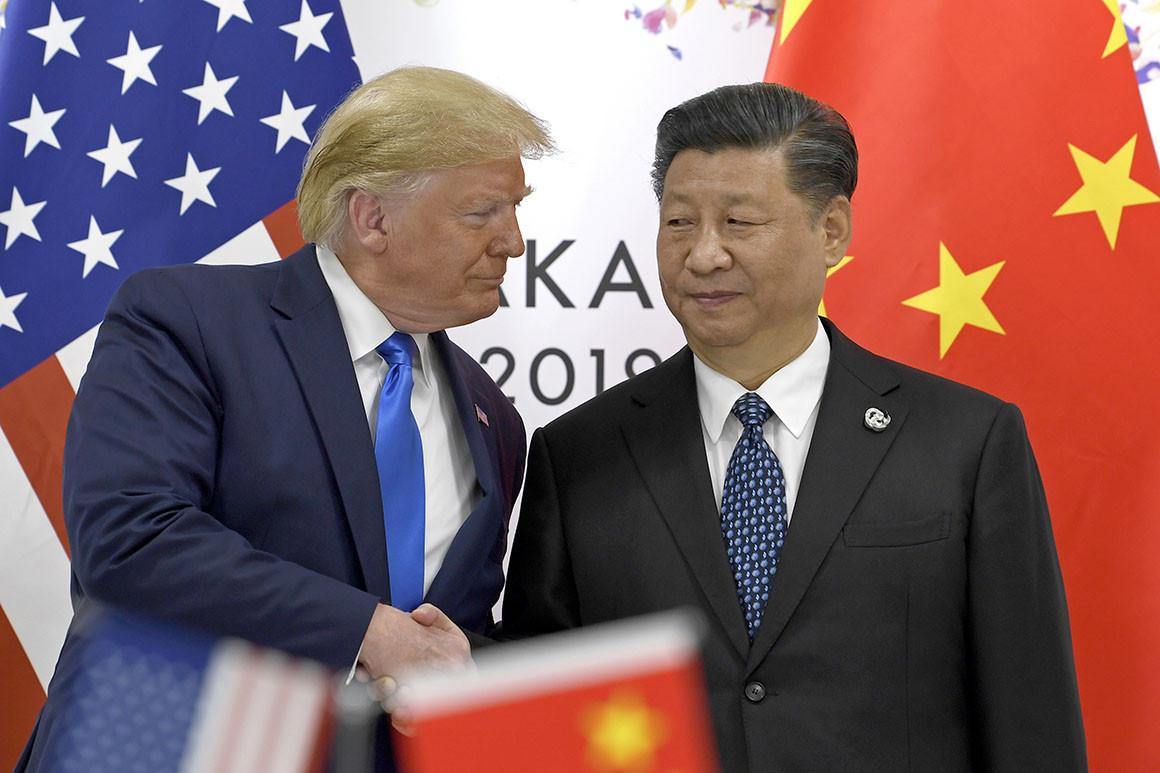
Needless to say, the optics of the US halting capital from entering China would be staggering and could result in a reversion of China-bound capital flows across all Western countries until the current war of words between Trump and Xi rages. The only problem is that, as we noted yesterday, this particular war of words could last a long time, since there is no longer any impetus to kiss and make up, and if anything, Trump will only escalate the anti-China sentiment into the election (and after), to keep pounding that the collapse resulting from the coronavirus pandemic is not his fault, but rather's Beijing, even as China pursues a mirror image approach, blaming the US for launching the pandemic.

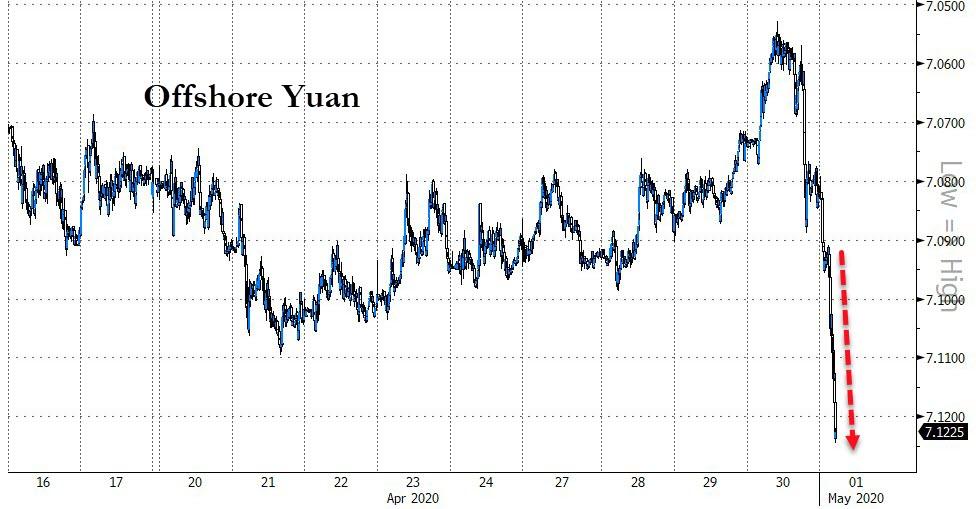
The most obvious market reaction for now is in Offshore Yuan which has collapsed in the last two days, extending losses tonight...

Source: Bloomberg

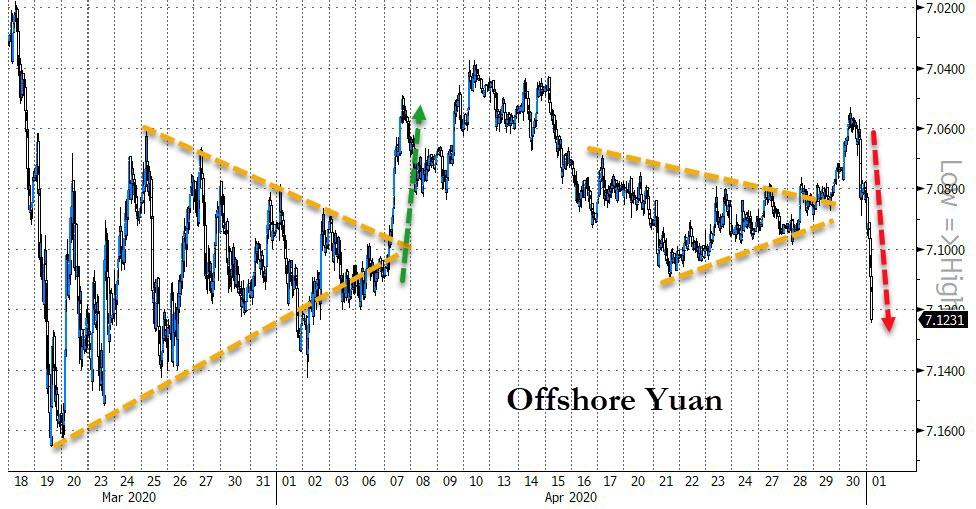
Of course, much of Asia is on May-Day holiday so liquidity is low, but Yuan's move is significant nevertheless...

Source: Bloomberg

Bloomberg reports that Senator Marco Rubio, a Florida Republican, applauded reports of the move in a statement Thursday.

“It’s outrageous that five unelected bureaucrats appointed by the previous administration have ignored bipartisan calls from Congress to reverse this short-sighted decision, and I applaud President Trump for directing his administration to take swift action preventing this from going forward,” he said.

We would expect China to be furious at this discussion and wonder what they will do to stall this move - one suggestion, given the weakness in US equity futures overnight, is to push volatility back into US markets - to shake the faith in the dramatic market rebound (that The Fed enabled).

Tyler Durden Thu, 04/30/2020 - 22:52
https://ift.tt/3bTI581
from ZeroHedge News https://ift.tt/3bTI581
via IFTTT

Yuan Crashes After Trump Weighs Blocking Retirement Fund Access To Chinese Stocks As War Of Words Escalates SocialTwist Tell-a-Friend
| 0 comments ]

Restaurant Recovery Begins As Money Spent On Dining Posts First Increase In Weeks

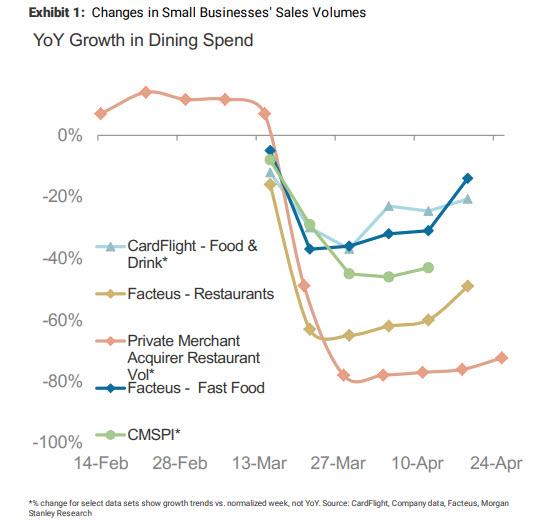
Today's -4.8% GDP print was dire, but it would have been even worse had it not been for a spike in discretionary spending as Americans found themselves under house arrest for the second half of March. Given the importance of consumer spending on GDP, we looked at trends in the restaurant space amidst Covid-19 related headwinds, courtesy of Clover data compiled by Morgan Stanley. What we found is that for the first time in weeks there was a clear WoW improvement in dining spend, an indication that the worst is over for the restaurant industry. 

Here are some observations from the dining trends chart below:

  • Small business food and drink saw a slight WoW improvement, with volumes down 21% the week ending April 19th vs a normalized level, compared to the prior week's down 25%.
  • Broader restaurant trends also improved WoW, with restaurant sales now down 49% YoY the week ending April 19th (vs. -60% YoY the week prior). QSR continues to perform better than restaurants,now down 14% YoY (vs. down 31% YoY the week prior)

Confirming the above observations, a new survey from Hospitality Trends indicates that pent-up demand for restaurants is elevated, even as many consumers maintain their off-premises frequency.

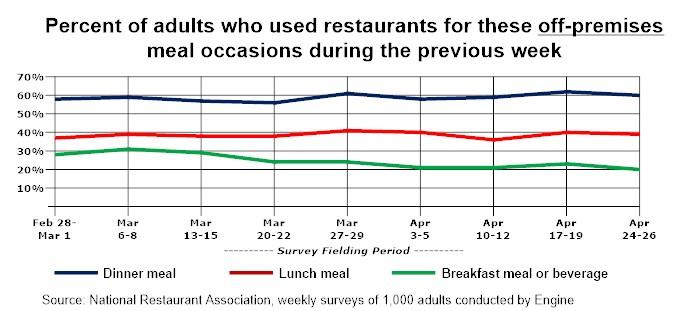
While takeout and delivery are the only restaurant options available for the vast majority of consumers across the country, based on weekly surveys conducted by the National Restaurant Association beginning in late-February, the proportion of consumers using these off-premises options remained remarkably consistent throughout the coronavirus crisis.

In fact, six in 10 adults say they ordered takeout or delivery from a restaurant for a dinner meal last week – a level that has held relatively steady during the past two months. In addition, an off-premises lunch purchase was made by roughly four in 10 adults during each of the last nine weeks. 20% of consumers say they picked up a breakfast meal, snack or beverage in the morning from a coffee shop or restaurant last week. This is down from roughly three in 10 adults who reported similarly in late-February.

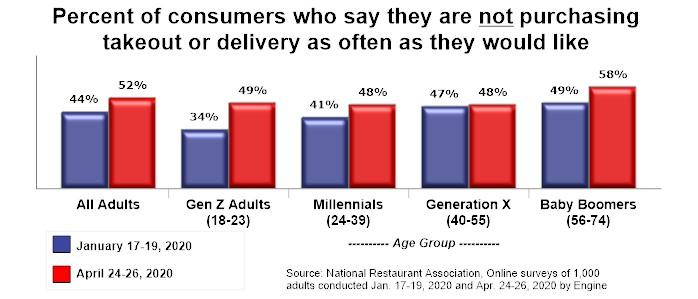
For restaurants that are offering off-premises options, the good news is that many consumers want more. 52% of adults say they are not ordering takeout or delivery from restaurants as often as they would like. As a point of comparison, 44% reported similarly when the Association fielded the same question in mid-January.

58% percent of baby boomers say they would like to order takeout or delivery more frequently right now. This is roughly 10% points higher than their counterparts in the younger generations.

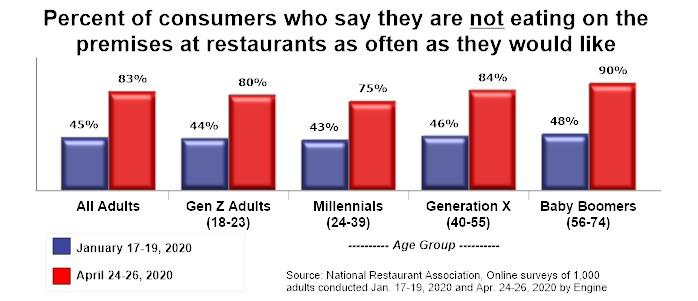
Not surprisingly, a strong majority of consumers say they would like to be dining out at restaurants more frequently – as this option is largely unavailable throughout most of the country. 83% of adults say they are not eating on the premises at restaurants as often as they would like. This is up from 45% who reported similarly in mid-January, and by far the highest level in the two decades that the Association has been fielding this survey question.

Baby boomers (90%) are the most likely to report that they would like to be eating at restaurants more often, though at least three in four adults in each age group want to increase their frequency. This suggests that as dining room doors being to reopen, pent-up demand among consumers will be strong.

Tyler Durden Thu, 04/30/2020 - 22:40
https://ift.tt/3f5QYNH
from ZeroHedge News https://ift.tt/3f5QYNH
via IFTTT

Restaurant Recovery Begins As Money Spent On Dining Posts First Increase In Weeks SocialTwist Tell-a-Friend
| 0 comments ]

Deutsche Bank Capitulates: Starts Charging Negative Rate On All New Deposit Accounts Over €100,000

It has been a long time coming and it's finally here.

When the ECB first unleashed negative rates across Europe in 2014, banks were loathe to match the central bank's deposit rates for their clients to those charged by the ECB over fears depositors would simply take their money and go elsewhere. After all, the premise of paying a bank for the privilege of holding your money is still absolutely insane to most normal people.

However, as the years went by, and as the ECB's negative rates kept rising - or rather dropping - banks were forced to quietly admit they had no choice and starting at the very top, targeting only corporate clients and the biggest depositors, European banks started imposing negative deposit rates while hoping they could avoid going all the way to the smaller savers.

Indeed, just last November, Deutsche Bank vowed that it would pass on negative interest rates only to larger corporate customers or the deposits of wealthy individuals and spare most retail clients, Deputy Chief Executive Officer Karl von Rohr said, explaining that German banks have already paid several billion euros in penalty rates for their deposits with the European Central Bank and Deutsche Bank’s payments amount to “several hundred million euros for 2019."

Now, less than half a year later, the Frankfurt-based bank - which itself is in dire financial straits - has capitulated and to avoid paying the ECB's punitive rate will soon introduce negative interest rates for even its medium depositors.

A Deutsche Bank spokesman told Handelsblatt that "The ongoing pressure from negative interest rates makes it necessary for Deutsche Bank to charge custody fees for new accounts exceeding €100,000 starting May 18, 2020." The "deposit rate" of -0.5% is equal to the rate the ECB charges banks for money parked there.

"This helps us on the earnings side, but above all it helps to prevent further inflows of particularly high deposits that cost us money," wrote Manfred Knof, head of the bank’s German private customer business, to his employees. This applies "especially in the event that other banks further adjust their conditions and their customers are looking for an alternative for their deposits with us."

In other words, with the ECB flooding the European financial system with a tsunami of liquidity - one which it expanded today with yet another meaningless long-term refi operation as if that will do anything to help banks who can  no longer earn a net interest margin arb become solvent - Europe's banks no longer need deposits, and in fact will do everything they can to push away all but the smallest depositors. The good news, for now, is that "existing account contracts are not affected" however we expect that to change soon.

So with European banks finally cracking down on the bulk of their depositors instead of just the top 1% and corporate clients, what happens next?

Well, savers who collectively owns trillions in European bank deposits that are now non grata have two options: either pull the money out, convert it to cash and store it in a safe (something Germany has a lot of experience with especially in late 2016 when Deutsche Bank was on the verge of collapse, sparking a rush to buy safes) where it is outside of the financial system - this is precisely the alternative the ECB prepared for several years ago when it stopped printing the €500 banknote, or more likely, buy alternative physical assets which - in a time of pervasive deflation and negative rates - do not charge a penalty rate, such as gold or even cryptos.

So if over the next few months a wave of "mysterious" buying emerges and lifts all non-traditional assets which prevent central banks from imposing penalty rates, we will know why: the real great rotation has finally begun.

Tyler Durden Thu, 04/30/2020 - 22:20
https://ift.tt/2Yn4aYL
from ZeroHedge News https://ift.tt/2Yn4aYL
via IFTTT

Deutsche Bank Capitulates: Starts Charging Negative Rate On All New Deposit Accounts Over €100,000 SocialTwist Tell-a-Friend
| 0 comments ]

LatAm Bailout Veteran Says Emerging Market Crisis Is The "Worst He's Ever Seen"

With the Nasdaq set to erase all of its 2020 losses after strong earnings from the tech giants, and stocks generally surging on the assumption that, as UBS put it, "lockdowns are lifted by the end of June and do not need to be re-imposed", especially with today's favorable if conflicting remdesivir news, it is easy to forget that emerging markets are facing their private hell as a result of widespread economic shutdowns, poor healthcare conditions which will only exacerbate the coronavirus pandemic, the dollar's relentless strength, and trillions in dollar-denominated debt maturing in the next few years which the chronically strong US dollar will make prohibitively impossible to repay.

But don't take our word for it: according to Bill Rhodes, CEO of Rhodes Global Advisors and a veteran of countless international bailouts in the 1980s and 1990s, the debt crisis that’s erupted across the world’s emerging markets is "the worst he’s ever seen."

Rhodes, 84, is perhaps the world's foremost expert on emerging markets in peril: the former Citigroup executive is a veteran of the 1980s Brady Plan that re-set the clock for Latin America’s struggling economies by creating a new debt structure for developing nations that’s largely in place to this day.

"It’s going to be difficult,” Rhodes said in an interview with Bloomberg discussing the coming EM crisis. "You need to have some sort of coordination between the private and the public sectors."

Pedestrian walks through the deserted Plaza de Mayo in Buenos Aires on March 20. Photographer: Sarah Pabst/Bloomberg

The problem: three decades after a coordinated rescue of emerging markets orchestrated by US Treasury Secretary Nicholas Brady (the person responsible for the term Brady Bonds) the global pandemic is again challenging the world for a solution, and this time a raft of private bondholders must also be on board. More than 90 nations have already asked the IMF for help amid the pandemic.

The first challenge is that the $160 billion debt renegotiated during the Brady Plan pales next to the $730 billion that the Institute of International Finance says must be restructured by the end of 2020; the final number could be far greater.

Adding to the difficulties of the next global bailout, unlike 1989, when the loans were mostly held by banks and defaults had already happened, now it’s split between hundreds of creditors ranging from New York hedge funds to Middle Eastern sovereign wealth funds and Asian pension funds. Getting them all in the same room will be a challenge, forget about getting them all to agree on one outcome.

Following in the footsteps of forbearance protocols enabled across the US, academics and officials are pushing for steps that would allow developing nations to pause bond payments through at least 2020, if not even longer, until the coronavirus fades and economies stabilize enough to analyze debt sustainability. And since one's debt is always someone else's asset, that proposal is upsetting creditors on Wall Street who depend on those funds to keep their portfolios afloat and to generate current income.

Meanwhile, G-20 leaders and multilateral organizations are already working toward relief for nations to stay current on debt. The IMF and Paris Club asked the Washington-based IIF to coordinate a standstill, and the United Nations is calling for a new global debt body.

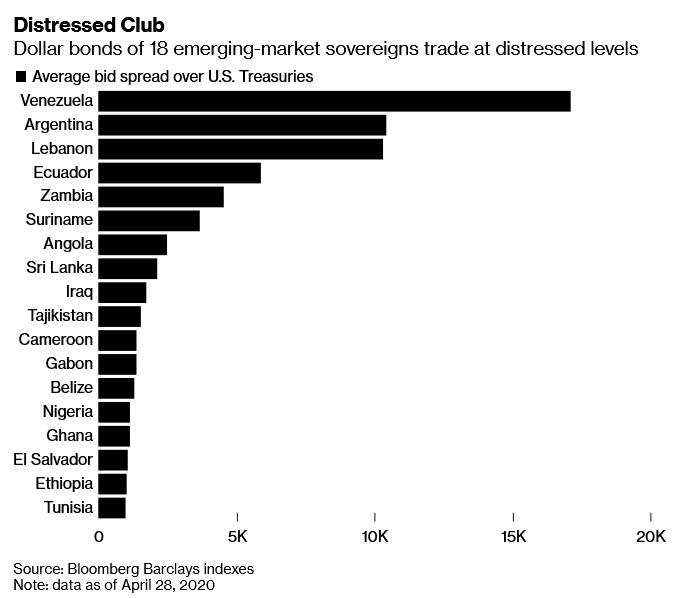
The other big challenge is that bureaucrats have to not only reach a solution, they have a strict time limit in which to do so: dollar-denominated debt from 18 developing nations already trades at spreads of at least 1,000 basis points over U.S. Treasuries. While the top three insolvent outliers - Venezuela, Argentina and Lebanon - were grappling with their own problems before the pandemic, others are fast approaching those levels amid currency sell-offs and record-shattering outflows.

Rhodes' dire warning echoes that of another EM expert: Anna Stupnytska, Fidelity International’s head of global macro and investment strategy, told Bloomberg "I’m really worried about emerging markets," adding that Brazil, Mexico, Colombia, South Africa, India and Indonesia may be among the most vulnerable to a virus-related crisis. She expects the coming months to be critical.

Stupnytska, who isn't expecting a V-shaped economic recovery anywhere, said that weak public health systems, political worries and doubts on central bank independence are "really unhelpful" for EM nations, and that other than parts of Asia, large sections of developing nations are yet to see a peak in coronavirus cases.

"So we are potentially looking at some emerging markets crisis even over the next few months."

With the clocking ticking, some sort of forbearance on debt payments - currently the most popular idea to help emerging markets - has to be agreed upon and soon; it would also need to extend beyond 2020, according to Anna Gelpern, a law professor at Georgetown University who spent six years at the Treasury. A coordination group could offer standardized terms to all of a country’s creditors that automatically push out payments, however how all creditors will get on the same page is unclear. After all, with memories still fresh of the massive profits Elliott Management earned by holding out on the Argentina debt restructuring early this century, what is to prevent all creditors to pursue this path?

Bloomberg agrees, noting that "it will be no easy task to convince private creditors, especially those with large emerging-market exposure, to take a hit by deferring debt payments."

Zambia has started talks to postpone its arrears, while Argentina has proposed a plan to restructure its debt that includes a three-year payment moratorium. Neither country has found much traction with its creditors who demand a payment and in full upon maturity.

"Countries that look to markets and are willing to engage market participants have found success in bridging the Covid financial shock," said an optimistic Hans Humes, CEO of Greylock Capital Management, which has been involved in most emerging-market restructurings over the past quarter-century. Many would disagree with his cheerful assumption.

Then again maybe creditors will find it in their bank accounts, if not hearts, to grant a reprieve: bondholders already granted Ecuador a delay on coupon payments until August, which may save the government as much as $1.35 billion this year, as it deals with one of the region’s worst virus outbreaks and a sell-off in oil.

Alternatively, "the time and resource costs of pursuing market debt relief may outweigh the benefits,” especially if a country plans to default anyway, Goldman's Dylan Smith wrote in an April 17 note. Plus, "it is not clear that the fiduciary duties of large bondholders toward their investors would allow them to provide lenience to debtors, even if they privately support the initiative."

And you thought OPEC deals were complicated.

Lee Buchheit, a four-decade veteran of the restructuring world, said forcing each nation to renegotiate on its own would only exacerbate the pain. "Here we have a planet-wide phenomenon that is going to make a number of countries have to face unsustainable debt positions."

Tyler Durden Thu, 04/30/2020 - 22:00
https://ift.tt/2KMnSVx
from ZeroHedge News https://ift.tt/2KMnSVx
via IFTTT

LatAm Bailout Veteran Says Emerging Market Crisis Is The "Worst He's Ever Seen" SocialTwist Tell-a-Friend