| 0 comments ]

Google Says New 'Contact Tracing' App To Launch In Coming Weeks Tyler Durden Fri, 07/31/2020 - 21:05

Shortly after launching a new contact-tracing program in Ontario, a top Google executive said in a blog post published Friday that 20 US states and territories (roughly 45% of the country's population) are "exploring" using the tool Google built with Apple to create new contact-tracing programs, and that the new apps are set to launch in the coming weeks.

Google had previously said in May that three states, Alabama, North Dakota and South Carolina, would be launching apps using the exposure notification tool. Those states are still using the protocols, it appears.

Additionally, the company said during its update that 16 countries and regions outside the US have launched apps using the Apple-Google tool, while other countries - including France and the UK - have sought to build their own tools from scratch, though the UK infamously pivoted, abandoned its custom system, and adopted the Google-Apple protocol.

However, the UK has yet to launch this new app, and it's unclear when it will be ready, as the Telegraph recently reported.

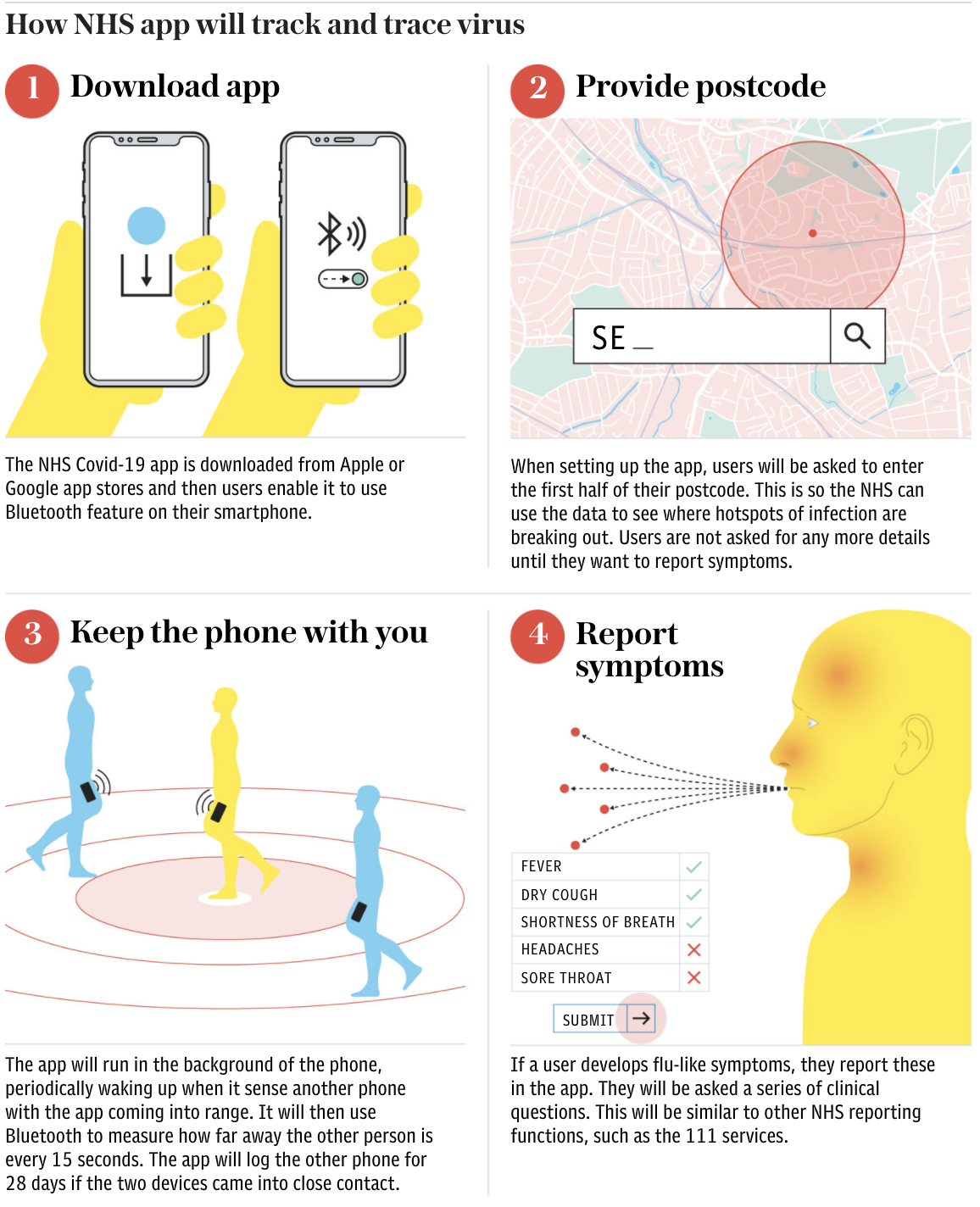
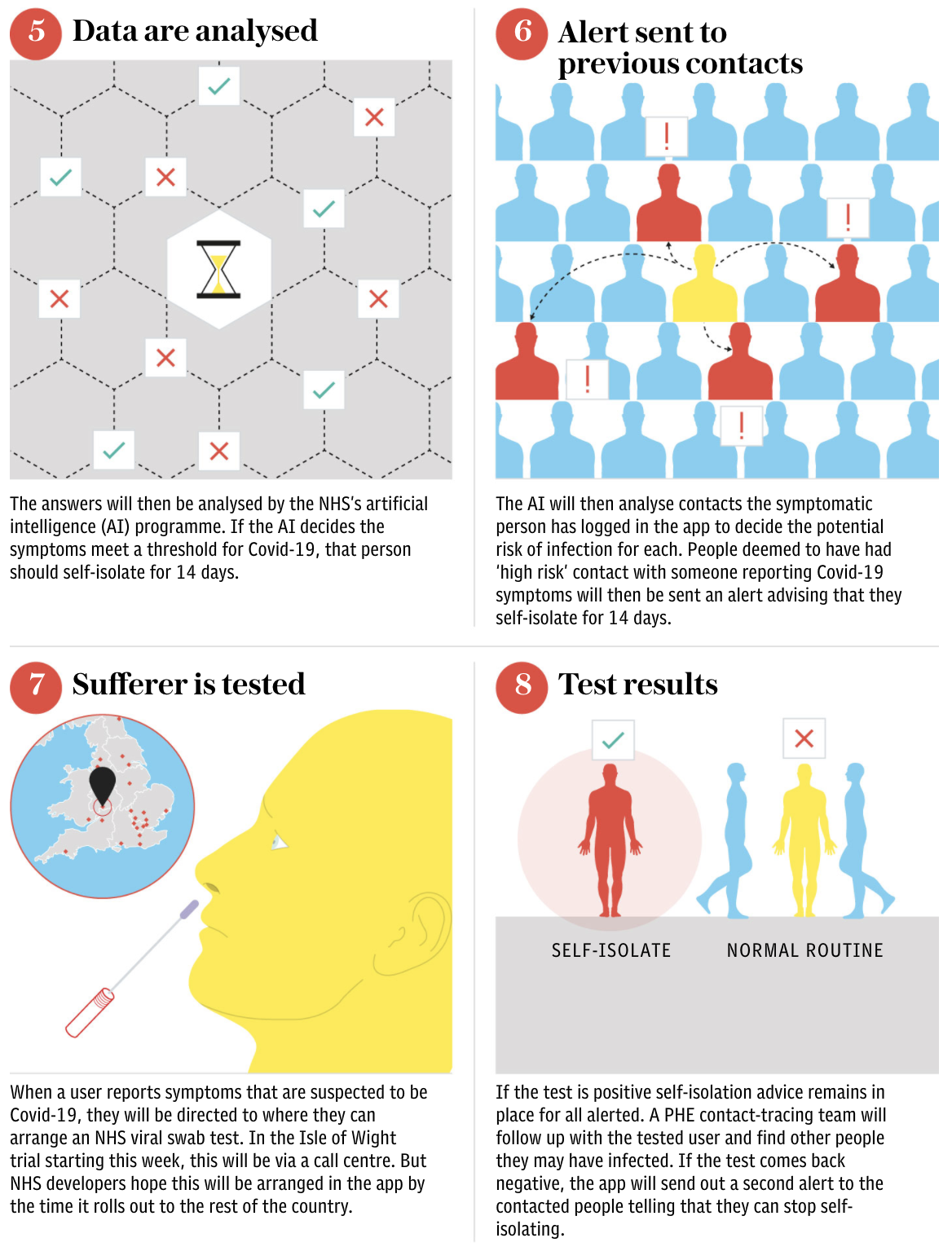
Here's how the UK's app-based system (which is based on the Google-Apple system) is supposed to work, per the Telegraph.
Source: The Telegraph

The technology should enable users to track whether they came in contact with any infected people via bluetooth signals.

VP of Engineering David Burke penned the post, which was published Friday afternoon on the East Coast. Read it in full below:

* * *

In May, we partnered with Apple to launch the Exposure Notifications System (ENS) and made it available to public health authorities around the world in their fight against COVID-19. The ENS allows public health authorities to develop apps that augment manual contact tracing efforts while preserving the privacy of their citizens. As of today, public health authorities have used ENS to launch in 16 countries and regions across Africa, Asia, Europe, North America and South America, with more apps currently under development.

In the United States, 20 states and territories—representing approximately 45 percent of the U.S. population—are exploring apps based on ENS. We expect to see the first set of these apps roll out over the coming weeks. The Association of Public Health Laboratories also announced recently that it will host a national key server to support all U.S. states, which will allow people with Exposure Notification apps to receive alerts even if they travel across state borders.

We’ve continued to improve the technology and provide more transparency based on feedback we’ve received from public health authorities and other experts. Public health authorities will continue to make their own decisions about how exposure notifications become part of their plans in controlling COVID-19, and we will work to improve the technology in response to their feedback. Here are some of the changes we’ve already made, as well as some upcoming additional changes.

Improvements to the Exposure Notification API

Since the Exposure Notification API was publicly released in May, we’ve spoken with dozens of public health authorities to understand how the API could be improved to help them better manage the COVID-19 pandemic while preserving privacy. Based on this feedback, we recently launched an update to the API, which includes the following changes:

When an exposure is detected, public health authorities now have more flexibility in determining the level of risk associated with that exposure based on technical information from the API.

Bluetooth calibration values for hundreds of devices have been updated to improve the detection of nearby devices.

The API now supports interoperability between countries, following feedback from governments that have launched Exposure Notification apps.

To help public health authorities build apps more efficiently, we’ve added reliability improvements for apps and developer debug tools.

We’ve improved clarity, transparency and control for users. For example, the Exposure Notifications settings on Android now include a simple on/off toggle at the top of the page. In addition, users will also see a periodic reminder if ENS is turned on.

Technical guidance and transparency

We’ve heard feedback that public health authorities and developers want more technical guidance about how ENS works. In response, we’ve published the following resources over the last few weeks:

Reference verification server to help guide public health authorities in building a server that allows verification of test results when users report themselves as positive for COVID-19.

Implementation code showing how the Exposure Notification API works underneath the hood.

Telemetry design explaining what de-identified diagnostics data is collected to ensure that ENS is functioning properly and securely.

Additional technical resources will be publicly shared as we continue to improve ENS.

Education and privacy protections

The Exposure Notifications website has more information about ENS, and offers educational and technical resources, as well as the latest updates.

As a quick reminder, here are some of the core privacy protections that were built into ENS:

You decide whether you want to use Exposure Notifications—it’s off unless you turn it on.

ENS doesn’t use location data from your device.

Your identity is not shared with Google, Apple or other users.

Only public health authorities can use this system.

Finally, we’ve received questions about why your Android device location setting has to be turned on if you want to use an Exposure Notification app. We want to explain why this particular setting needs to be on, and how you can control your location settings on Android.

To be absolutely clear, ENS does not use device location, and the policies for using ENS prohibit public health authority apps from requesting or collecting device location. Instead, ENS uses Bluetooth technology to detect when two devices are near each other, without revealing the location of either device. While Bluetooth scanning doesn’t necessarily reveal location, it can in some cases be used to infer your device’s location. For example, if a shopping app scans for the Bluetooth signals of a stationary Bluetooth beacon located inside a store, then the app could infer that you went to that store. So in 2015, with privacy in mind, we designed the Android operating system to prevent Bluetooth scanning unless the device location setting is on. At that time no one could have anticipated that Bluetooth scanning might one day be helpful in controlling a global pandemic like COVID-19.

Our engineering teams have been working to update the next version of Android with Exposure Notifications in mind. On Android 11, which will soon be released, users will be able to use Exposure Notification apps without turning on the device location setting. We’re making this update for Exposure Notifications only, given that ENS has been designed in such a way that neither the system nor the apps using it can infer device location through Bluetooth scanning, and apps that are allowed to use ENS are subject to additional policies that disallow automatic collection of location. All other apps and services will still be prohibited from performing Bluetooth scanning unless the device location setting is on.

But even in current versions of Android, when you turn on the device location setting, your phone continues to prohibit access to any apps, including Google apps, that don’t have permission to use device location. The device location setting is like a circuit breaker in a house: When it’s on, power is flowing to the house, but you can turn the lights on or off in each room. If you turn on the device location setting to use ENS, it won’t affect the decisions you’ve already made about specific apps. You can always view and change which apps have access to your device location by going to Settings > Location > App permissions.

We’re committed to supporting public health authorities as they build tools to fight COVID-19. We’ll continue to improve ENS based on feedback, while ensuring that people can trust in the privacy-preserving design of this technology.

* * *

Source: Google


https://ift.tt/33b6EvH
from ZeroHedge News https://ift.tt/33b6EvH
via IFTTT

Google Says New 'Contact Tracing' App To Launch In Coming Weeks SocialTwist Tell-a-Friend
| 0 comments ]

Why The Iran-China Oil Alliance Is So Important Tyler Durden Fri, 07/31/2020 - 20:45

Via Defense and Foreign Affairs,

The steady rise in U.S. strategic competition with the People’s Republic of China (PRC) over trade and the South China Sea already has so many dimensions that it is sometimes easy to ignore shifts in the PRC’s behavior in other areas. On July 6, 2020, Iranian Foreign Minister Javad Zarif announced that Iran was negotiating an agreement with the PRC - with which it long has had trade and strategic links - which would now make the two countries the equivalent of strategic partners.

This expanded U.S.-PRC competition to new parts of the world. Perhaps more importantly, the move is a substantive and significant response to India’s success in militarily outmaneuvering the PRC in Kashmir during June 2020.

The PRC-Iran accord means the end of Indian use of the Iranian port of Chah Bahar and the construction of a rail link from that port city northward to link with a new rail spur into Afghanistan. India’s moves into Kashmir in 2019-2020 are widely perceived in Beijing to presage a new move by India to cut off the PRC-Pakistan landbridge through Pakistani controlled Azad (Free) Kashmir, giving India its own landbridge to Central Asia.

Thus, after the confrontation between the Indian Army and People’s Liberation Army (PLA) troops in the Ladakh region of Kashmir on June 15-16, 2020, Beijing determined it would respond by cutting Indian access to Central Asia through Iran. The first signs came as the Iran-PRC deal was announced and the Iranian government canceled the Chah Bahar to Zahedan rail link which was to be built by India, citing Indian delays on the 628 km project. The Iranian government said that it would complete the line on its own, with a $400 million investment from the Iranian National Development Fund to the Iranian Railways.

Indian Prime Minister Narendra Modi had gone to Tehran in May 2016 to sign the Chah Bahar deal, but work was indeed delayed as India fretted that the project might invoke U.S. sanctions against India.

The PRC-Iran agreement could involve serious military ties and lead to major PRC defense sales to Iran, involve some $400 billion in PRC economic investment over 25 years, and lead to a major PRC role in modernizing Iranian railroads, ports, 5G Networks, and telecommunications generally. In return, the PRC would get discounted supplies of Iranian oil products and gas for the next 25 years.

The PRC would be able to make Iran part of its Belt and Road Initiative (BRI), and be able to establish free trade zones in Iran in Maku in the northwest, Abadan in Khuzestan Province near Iraq, and Qeshm island just inside the Persian Gulf near the Strait of Hormuz.

The agreement would give the PRC access to Jask, a major Iranian port outside the Strait of Hormuz. The PRC began developing its strategic position in the Persian Gulf region during the Iran-Iraq war as far back as 1980-1988. And the PRC presence in the Persian Gulf has only increased since that time.

PRC activity over the last decade shows a clear intent to secure its energy imports from the Persian Gulf, compete with the U.S. and India, and look toward a day when it would be as real a power in the Persian Gulf and the Indian Ocean as it was striving to be in Asia and Pacific.

The PRC had also made Pakistan a key partner in its Belt and Road Initiative, and the PRC now plays a key part in developing and managing the Pakistani port of Gwadar, on the Arabian Sea. The PRC also invested some $10.7 billion into transforming an Omani fishing village into the special Economic Zone Authority of Duqm. But, significantly, Oman has reserved significant parts of the maritime facilities at Duqm for British and U.S. forces.

The PRC has taken these steps for both economic and strategic reasons. In 2019, Beijing attempted, without success, to bring Saudi Arabia and the United Arab Emirates into its orbit. It found it could not, however, have a strategic relationship with Iran and the Arabian Peninsula states simultaneously. It stayed with the more significant choice, Iran.

It is vital to the PRC to secure its access to the Persian Gulf oil and gas, and limit U.S. capability to influence this flow to the PRC during a crisis or war. The PRC imports more than 70 percent of its petroleum, and gets more than 40 percent of its supplies from the Persian Gulf.

Iranian-PRC trade and strategic linkages in many ways circumvent U.S. attempts to sanction the leadership of both states. At a time when both sanctioned states have come under great pressure, the new alliance, then, offers Beijing and Tehran some real respite and strategic resilience. Adding Russia into the mix only widens the trading zone of both states.

The real challenges, however, comes from whether the PRC economy can be sustained for the duration of the new accord, and whether an Indian military thrust to cut off the Pakistan corridor to the PRC will cause grave difficulties for Beijing.

But, certainly, the new deal with Iran is Beijing’s signal that it is planning for the day when the Pakistan corridor to the Indian Ocean may be lost to it.


https://ift.tt/317F13R
from ZeroHedge News https://ift.tt/317F13R
via IFTTT

Why The Iran-China Oil Alliance Is So Important SocialTwist Tell-a-Friend
| 0 comments ]

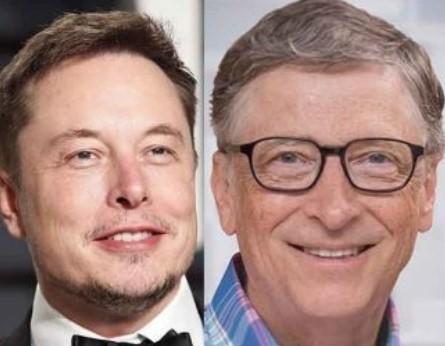
Responding To Criticism, Elon Musk Tells The World That Him And Bill Gates Are Not "Lovers" Tyler Durden Fri, 07/31/2020 - 20:25

"The rumor that Bill Gates & I are lovers is completely untrue." 

Those are the actual words that the CEO of $270 billion Tesla tweeted out on Thursday, probably when he should have been working, in response to comments that Bill Gates made the day prior on CNBC.

Gates had appeared on CNBC to talk about the conspiracy theories associated with the coronavirus pandemic and, in the process, wound up taking a shot at Musk, who has been notoriously wrong about almost all of his coronavirus predictions (for instance, that there would be no new cases by the end of April).

Gates said of Musk: “Elon’s positioning is to maintain a high level of outrageous comments. He’s not much involved in vaccines. He makes a great electric car. And his rockets work well. So he’s allowed to say these things. I hope that he doesn’t confuse areas he’s not involved in too much.”

This, of course, set off Musk, who had to stop whatever humankind-altering project he was working on at the time (monkeys solving Rubik's cubes?) and respond on Twitter. He also wrote "Billy G is not my lover," a lame reference to the Michael Jackson song "Billy Jean".

Recall, back in March we reported that America's favorite sociopath CEO had Tweeted out that the coronavirus panic was "dumb". Just hours after that, he again took to Twitter to double down on his statement and defend his reasoning using a word salad of half-assed smart-sounding terms that amounted to one giant non-sequitur.

Asked by another Twitter user what his reasoning was for calling the coronavirus panic "dumb", Musk responded by Tweeting:

"Virality of C19 is overstated due to conflating diagnosis date with contraction date & over-extrapolating exponential growth, which is never what happens in reality. Keep extrapolating & virus will exceed mass of known universe!"

We can't believe we're going to say this: but we're rooting for Bill Gates on this one.


https://ift.tt/33chzoQ
from ZeroHedge News https://ift.tt/33chzoQ
via IFTTT

Responding To Criticism, Elon Musk Tells The World That Him And Bill Gates Are Not "Lovers" SocialTwist Tell-a-Friend
| 0 comments ]

Universal Basic Income Is Not An Economic Savior Tyler Durden Fri, 07/31/2020 - 20:05

Authored by Lance Roberts via RealInvestmentAdvice.com,

According to a new study by the left-leaning Roosevelt Institute, a universal basic income could permanently make U.S. economy trillions of dollars larger. While such socialistic policies sound great in theory, history, and data, show it isn’t the economic savior it is touted to be.

What Is A Universal Basic Income (UBI)

To understand why the theory of universal basic incomes (UBI) is heavily flawed, we need to understand what UBI is.

Basic income, also called universal basic income (UBI), is a public governmental program for a periodic payment delivered to all citizens of a given population without a means test or work requirement. Basic income can be implemented nationally, regionally, or locally, and is an unconditional income sufficient to meet a person’s basic needs (i.e., at or above the poverty line).

The idea of guaranteed income is not a new thing. According to Wikipedia:

“The concept of a state-run basic income dates back to the early 16th century when Sir Thomas More’s “Utopia” depicted a society where every person receives a guaranteed income. 

In the late 18th century, English radical Thomas Spence, and American revolutionary Thomas Paine, declared their support for a welfare system that guaranteed an assured basic income. Nineteenth-century debate on basic income was limited, but during the early part of the 20th century, a basic income called a “state bonus” was widely discussed. 

In 1946, the United Kingdom implemented unconditional family allowances for every family’s second and subsequent children. In the 1960s and 1970s, the United States and Canada conducted several experiments with negative income taxation, a related welfare system. From the 1980s and onward, the debate in Europe took off more broadly, and since then, it has expanded to many countries around the world. “ 

While the idea of a UBI sounds good in theory, as discussed previously, they fail to work in reality.

UBI Won’t Increase Economic Growth

“More money in people’s pockets will lead to stronger economic growth.” – J.M. Keynes

Such is the underlying sentiment behind a universal basic income and its impact on economic growth. Unfortunately, it simply isn’t true.

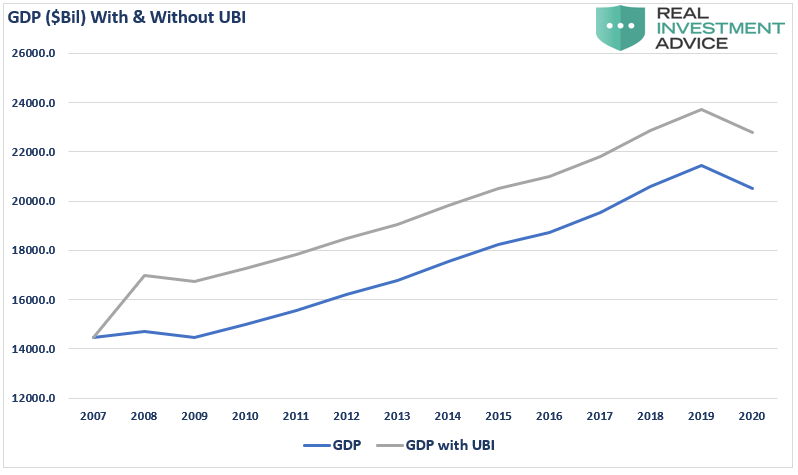
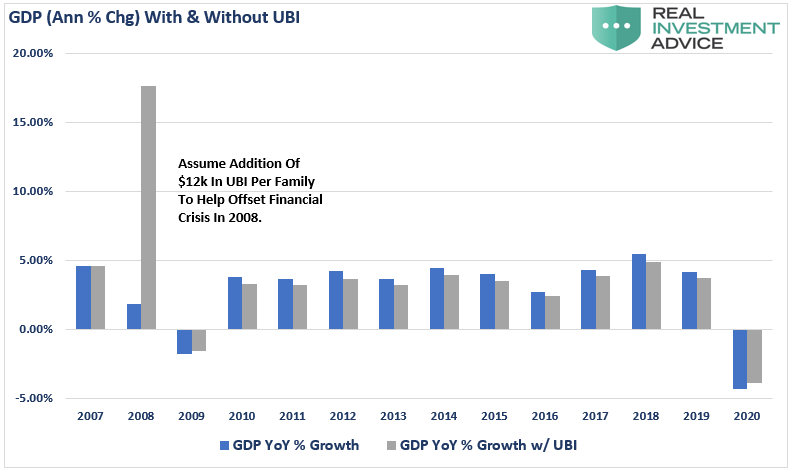
Let’s run a hypothetical example using GDP from 2007 to the present. (I am using estimates of -4.3% for 2020 GDP growth) In 2008, in response to the “Financial Crisis,” Congress passes a bill providing $1000/month ($12,000 annually) to 190 million families in the U.S. 

The chart below shows the economy’s annual GDP growth trend assuming the entire UBI program shows up in economic growth. For those supporting programs like UBI, it certainly appears as if GDP is permanently elevated to a higher level. 

When you look at the annual rate of change in economic growth, which is how we measure GDP for economic purposes, a different picture emerges. In 2008, when the $12,000 arrives at households, GDP spikes, printing a 17% growth rate versus the actual 1.81% rate.

However, beginning in 2009, the benefit disappears. The reason is that after UBI is injected into the system, the economy normalizes to the new level after the first year. Also, notice that GDP grows at a slightly slower rate as dollar changes to GDP at higher levels print a lower growth rate.

UBI’s Dark Side

Of course, the money to provide the $12,000 UBI benefit had to come from somewhere.

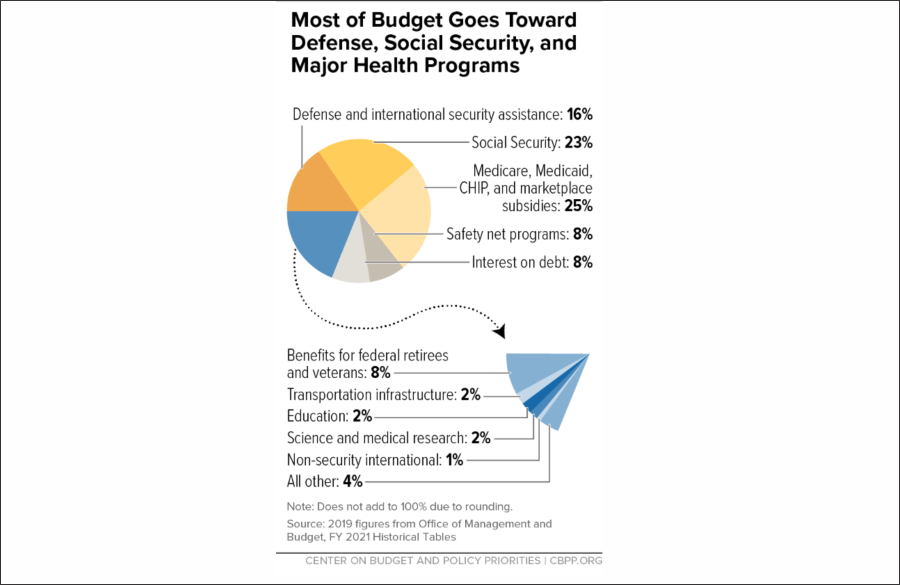
According to the Center On Budget & Policy Priorities, in 2019, roughly 75% of every tax dollar went to non-productive spending. 

“In the fiscal year 2019, the Federal Government spent $4.4 trillion, amounting to 21 percent of the nation’s gross domestic product (GDP). Of that $4.4 trillion, federal revenues financed only $3.5 trillion. The remaining $984 billion came from debt issuance. As the chart below shows, three major areas of spending make up most of the budget.”

Think about that for a minute. In 2019, 75% of all expenditures went to social welfare and interest on the debt. Those payments required $3.3 Trillion of the $3.5 Trillion (or 95%) of the total revenue collected.

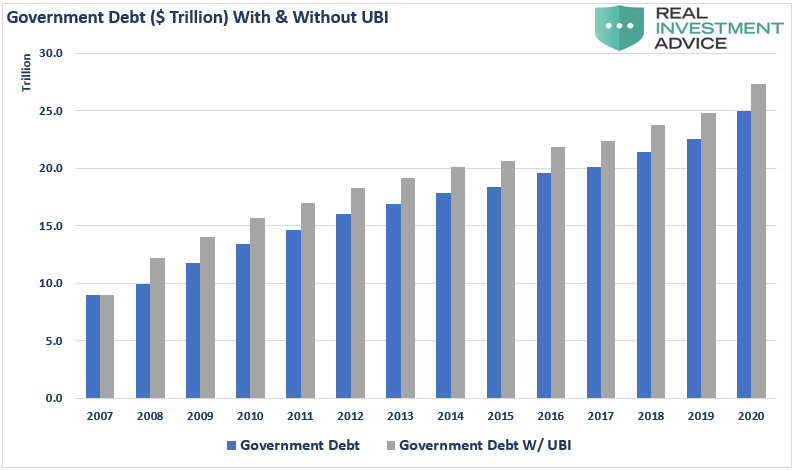
That was BEFORE the shutdown of the economy due to COVID-19. Given the subsequent decline in economic activity occurring this year, those numbers become markedly worse. Given this bit of data, all universal basic income payments would have had to come solely from debt.

The table below shows the increase in total Federal Debt adjusting for the annual UBI payment. 

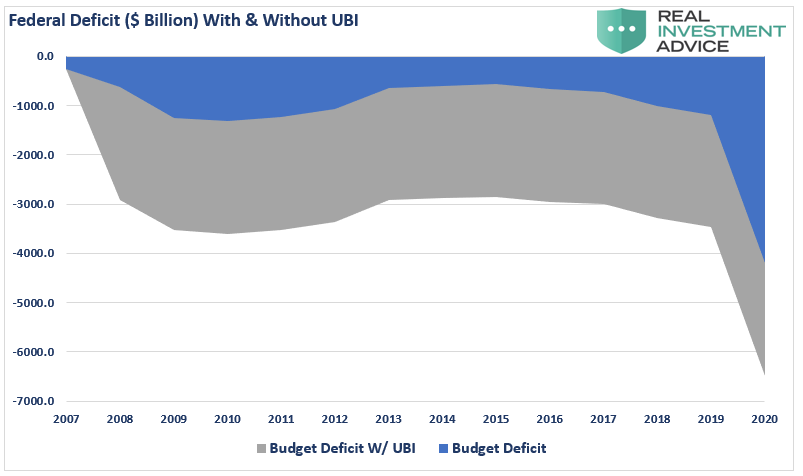
The chart below takes our hypothetical example and compares the impact of the additional debt on the Federal deficit from the implementation of UBI.

While the “theoretical models” assume that UBI will create enough economic growth and prosperity to “offset” the increase in debt, 40-years of history suggest otherwise.

UBI Won’t Increase Economic Growth

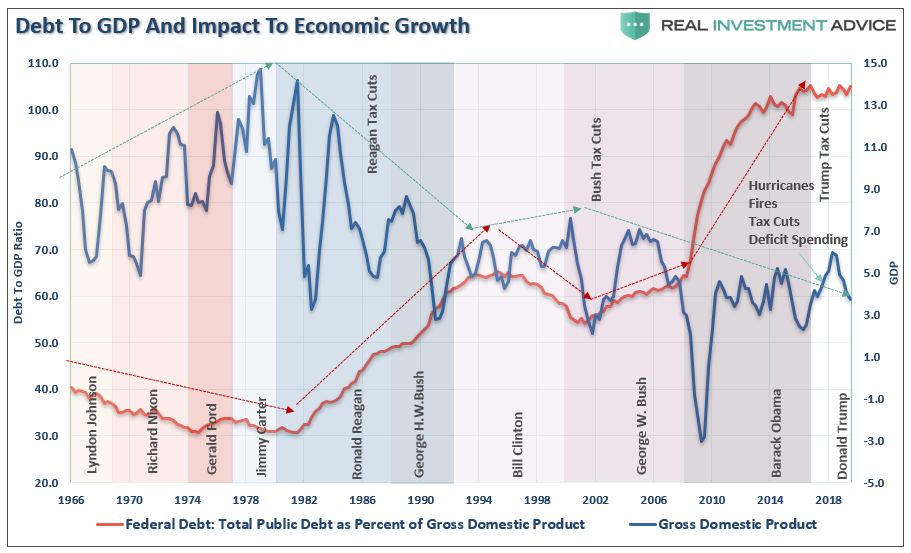
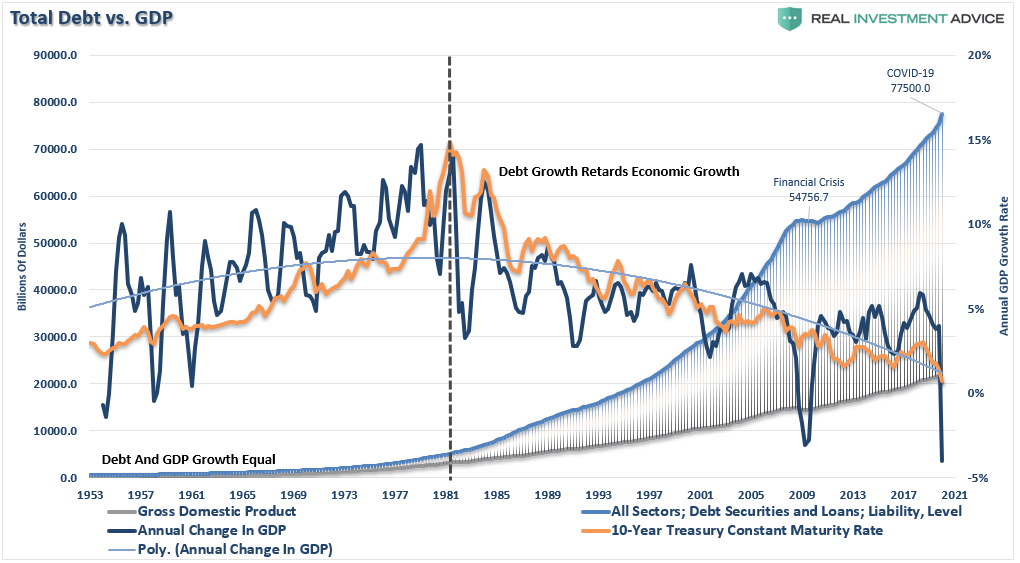
As discussed previously, there is a high correlation between debts, deficits, and economic prosperity. 

“The relevance of debt growth versus economic growth is all too evident, as shown below. Since 1980, the overall increase in debt has surged to levels that currently usurp the entirety of economic growth. The growth in debt continues to divert more tax dollars away from productive investments into the service of debt and social welfare.”

However, simply looking at Federal debt levels is misleading.

It is the total debt that weighs on the economy.

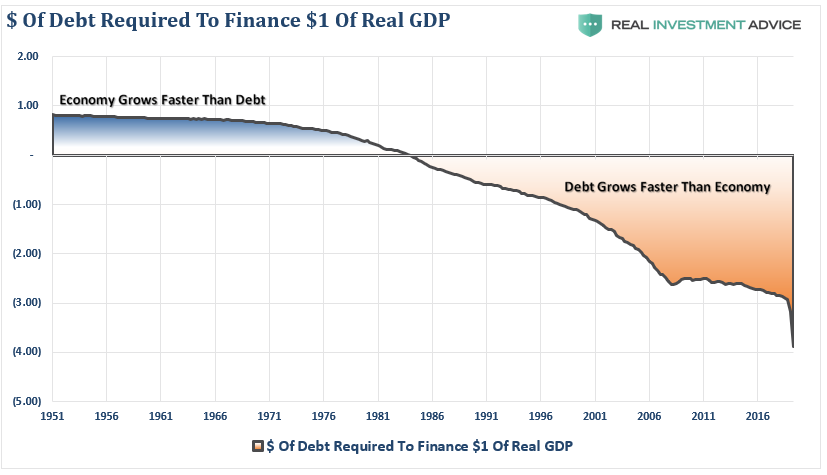
Under the current economic situation, it currently requires nearly $4.00 of debt to create $1 of economic growth. However, if you added UBI into the equation, it would require roughly $5 per $1 of growth. (Unfortunately, at the current spending rate, the U.S. will be approaching the $5 mark by the end of 2020)

If you don’t understand the implications of debt on economic growth, let me rephrase the analysis for you.

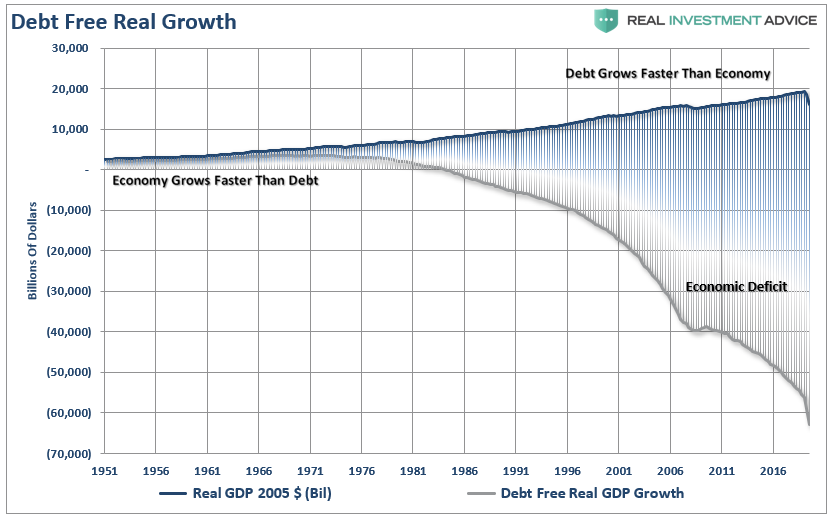
For instance, in the 30-years from 1952 to 1982, the economy ran at a surplus. That surplus fostered rising economic prosperity in the U.S. which averaged roughly 8%. 

Since 1980, the economic deficit has continued to erode economic prosperity. As shown, there has been no organic growth without increases in debt. Due to the need to increase debt to fund it, UBI would only succeed in exacerbating the situation.

The UBI Test Has Already Failed

The United States already has a semi-UBI plan. It is an effectively bankrupt system called “Social Security.” 

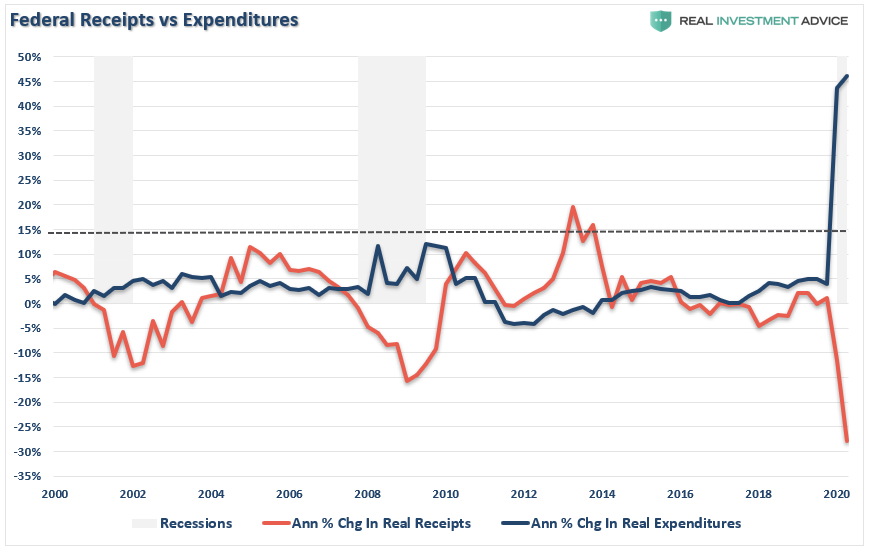
The collapse in economic growth has resulted in a collapse in Federal Tax revenue needed to pay for the massive social welfare schemes in the U.S.

It now requires more than of 100% of tax receipts just to meet the mandatory spending of social welfare and interest on the debt. In other words, we are now going into debt more just to provide social assistance.

How bad is it?

Social Security will be insolvent and unable to pay the full value of promised benefits by 2035. Social Security’s costs will exceed its income by 2020, according to a new report published Monday by the program’s trustees.

At the end of 2018, Social Security was providing income to about 67 million Americans. About 47 million of them were over age 65, and the majority of the rest were disabled. If nothing changes, the Social Security Trust Fund will be fully depleted by 2035. If such occurs, the program will impose across-the-board cuts of 20 percent to all beneficiaries.”

Getting Worse

That report, dire in its warning already, was issued before the “Pandemic” and “economic shutdown.”

Meanwhile, demographics are blowing up the basic premise of the funding of Social Security. There were 2.8 workers for every Social Security recipient in 2017. That’s down from 3.3 in 2007, and that’s way down from the 5.1 workers per beneficiary that existed in 1960.

Furthermore, the two programs function mostly as a giant conveyor belt to transfer wealth from the young and relatively poor to the old and relatively rich. Such allows the average person (who now lives to be 78) more than a decade of taxpayer-funded retirement.

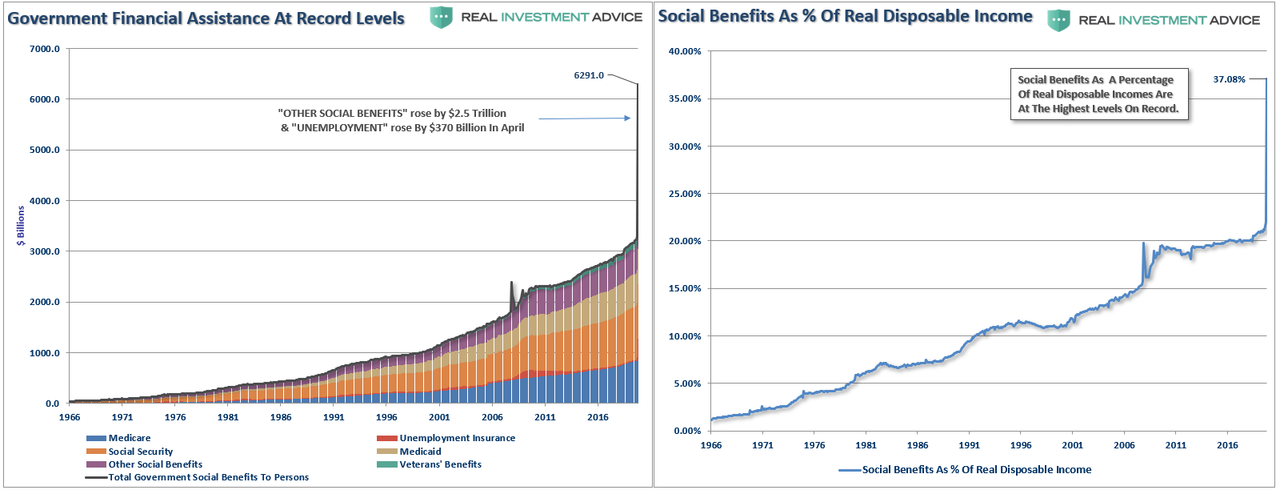
Welfare now makes up the highest percentage of disposable personal incomes in history despite record low unemployment, rising wage growth, and the longest economic expansion in U.S. history.

During the “Great Depression,” the economically devastated masses would form “breadlines.” Today, those “breadlines” form at the mailbox. Without government largesse, many individuals would be living on the street.

The chart above shows all the government “welfare” programs and current levels to date. The black line represents the sum of the underlying sub-components. Since the onset of the “pandemic,”  both unemployment insurance and “other benefits” have surged by $3 trillion. Those increases are in excess of the continued increases in all other benefits, like social security, Medicaid, and Veterans’ benefits.

Importantly, for the average person, these social benefits are critical to their survival. Government assistance now makes up ~38% of real disposable personal incomes. With more than 1/3rd of incomes dependent on Federal assistance, it should not be surprising the economy continues to struggle. Recycled tax dollars used for consumptive purposes, has virtually no impact on increasing economic activity.

Conclusion

In its essential framework, a universal basic income sounds excellent. Everyone has their basic needs covered. Then they can go out and produce and not worry about covering critical bills. In reality, the additional income is quickly absorbed into the economy as prices rise (inflation) to compensate for the extra spending. After the first year, the UBI has to be increased or no longer has any benefit. 

Therein lies the trap with all socialistic programs.

While UBI, along with free healthcare, education, childcare, etc., sounds great, they are NOT productive investments that have a higher return than the carrying cost of the debt. In actuality, history suggests these welfare supports have a negative multiplier effect in the economy.

Most telling is the inability of the current economists, who maintain our monetary and fiscal policies, to realize the problem of trying to “cure a debt problem with more debt.”

The Keynesian view that “more money in people’s pockets” will drive up consumer spending, with a boost to GDP being the result, has been wrong. It hasn’t happened in 40 years.

We fear that these socialistic programs, which promises “free everything” with no consequences, instead delivers inflation, generates further income inequality, and ultimately higher social instability and populism. Such has been the result in every other country which has run such programs of unbridled debts and deficits.

While UBI sounds excellent at the conversational level, so does “communism” and “socialism.” In practice, the outcomes have been vastly different than the theory.

As Dr. Woody Brock aptly argues:

“It is truly ‘American Gridlock’ as the real crisis lies between the choices of ‘austerity’ and continued government ‘largesse.’ One choice leads to long-term economic prosperity for all; the other doesn’t.”

Take your pick. 


https://ift.tt/3180xFO
from ZeroHedge News https://ift.tt/3180xFO
via IFTTT

Universal Basic Income Is Not An Economic Savior SocialTwist Tell-a-Friend
| 0 comments ]

Egypt Receives Advanced Russian Fighter Jets Over US Lingering Sanctions Threat Tyler Durden Fri, 07/31/2020 - 19:45

Ignoring the lingering threat of Washington sanctions, Egypt is moving forward with a purchase of large batch of Russian Su-35 "Flanker" jet fighters

The first batch of Su-35's are now said to en route to Cairo this week, after in 2019 Egypt signed an agreement to purchase more than 20 Su-35 fighter jets from the Kremlin in a $2 billion deal.

The whole arrangement is awkward for the US defense establishment, given that it works so closely with the Egyptian military, and has done so for years going back to the Camp David Accords. 

Via The Drive

Last last year, soon after the controversial deal was inked, a US official announced that the "United States could impose sanctions on Egypt and block it from future military sales if it goes ahead with a purchase of Russian warplanes" — but now that the planes have reportedly already been shipped, it'll be interesting to see if the threat is followed through upon.

The news and analysis source Middle East Monitor previously offered the central rationale to Washington's objections to its ally Egypt acquiring the aircraft: in addition to the obvious problem of the Kremlin's growing influence in the region, the US has for decades honored its unofficial policy of ensuring that Israel keeps a "qualitative edge" over all potential rivals when it comes to defense technology. 

The US has previously threatened other countries with sanctions under its Countering America’s Adversaries Through Sanctions Act (CAATSA) for purchases of Russian military equipment (Serbia being a recent example, related to rumors that it's mulling S-400 anti-air acquirement).

Cairo eyeing the advanced Russian fighter might be viewed as an especially insulting affront by the Trump administration especially given that as the second largest recipient of foreign aid historically (after Israel), Washington has provided billions in economic and military aid to Egypt over the past years, including its F-16 fighters.


https://ift.tt/2XfWw0F
from ZeroHedge News https://ift.tt/2XfWw0F
via IFTTT

Egypt Receives Advanced Russian Fighter Jets Over US Lingering Sanctions Threat SocialTwist Tell-a-Friend