| 0 comments ]

Spoos Hug 4,200 In Thin Holiday Trading As Global Stocks Close Out 4th Month Of Gains

It was anything but "sell in May"...

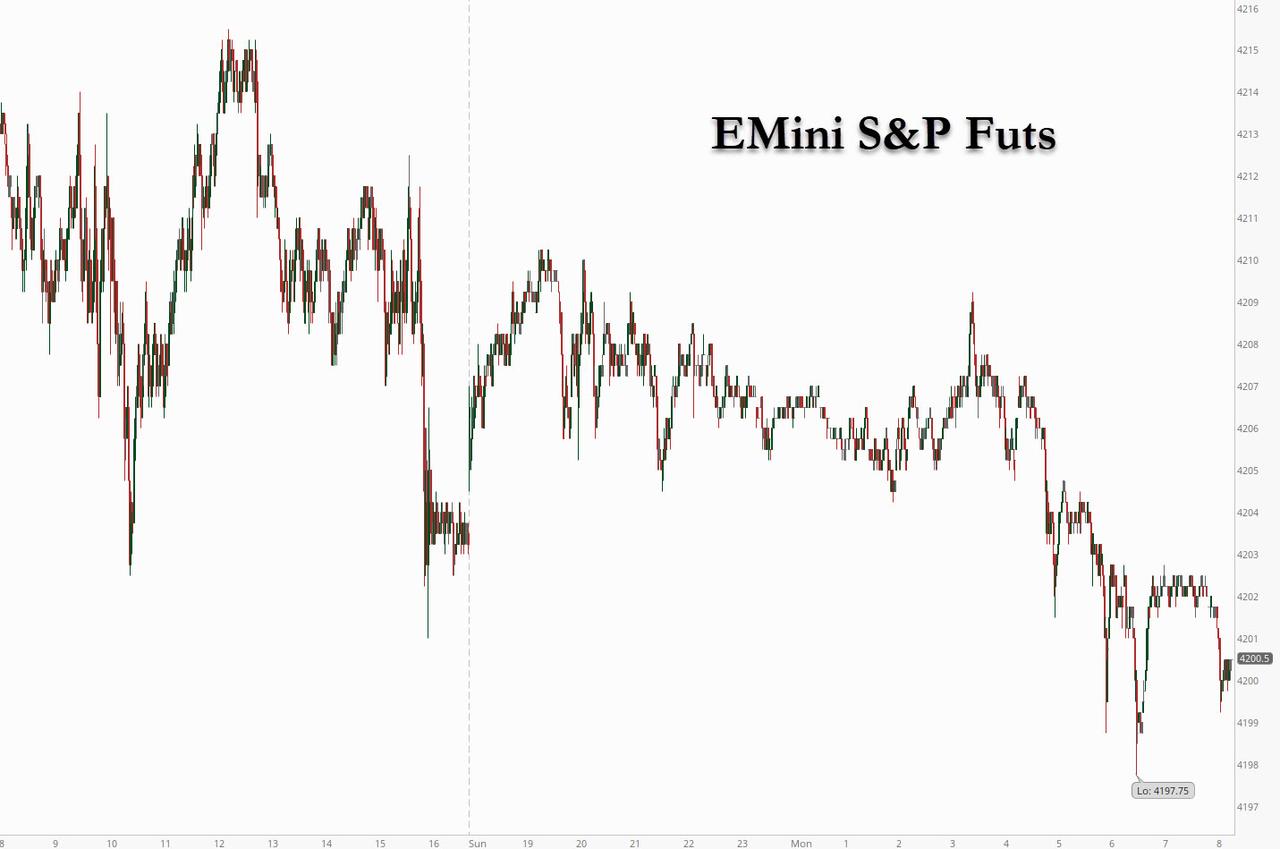
With US markets closed for Memorial Day, Emini futures traded virtually at 4,200 amid light volumes as world stocks were firmly on track to post a fourth straight month of gains on Monday.  MSCI’s index of world stocks drifted 0.1% higher, putting the gauge on track for a 1.4% gain for May. It is the longest monthly rising streak for the index since August 2020, when it marked a five-month run of gains, according to Reuters.

S&P 500 and Nasdaq 100 futures swung between small gains and losses amid shortened trading hours due to the Memorial Day holiday in the U.S. The dollar was steady against a basket of peers.
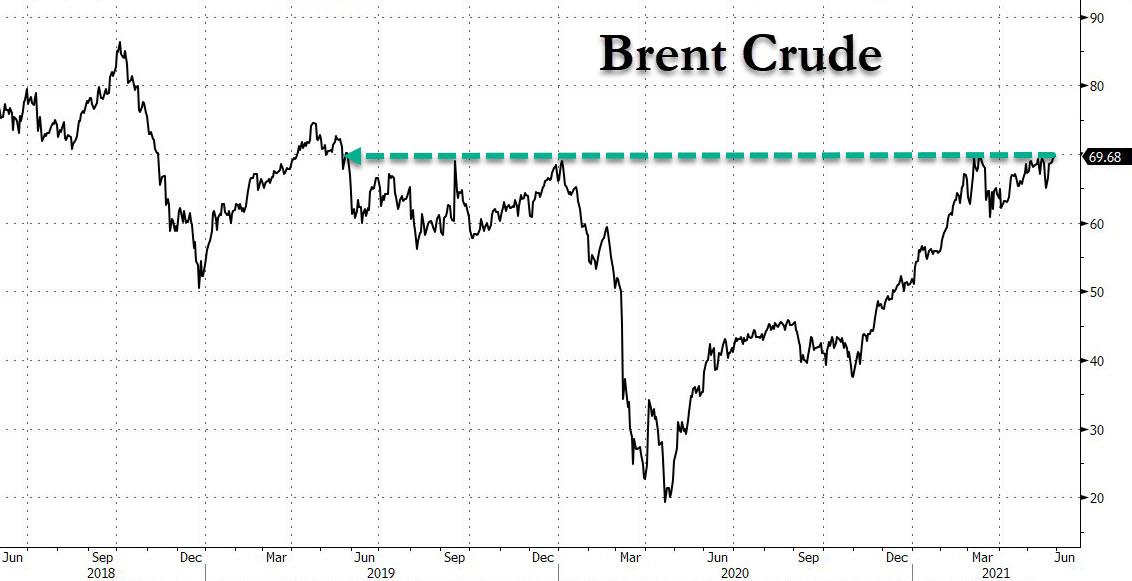
The dollar continued to struggle ahead of a slew of European and U.S. data this week that will provide a clearer picture on the global economy’s recovery path, while Brent was trading just shy of $70 after OEC

With US traders out, European stocks struggled for direction as markets awaited fresh catalysts, with the US payroll data later this week set to provide further clues on the outlook for the biggest economy. Europe's Stoxx 600 index fluctuated in a narrow range. Spain’s Endesa SA dragged the utilities sector lower following reports the Spanish government is preparing to rein in windfall profits for power producers. Deutsche Bank AG dropped after the Federal Reserve warned that its compliance programs aren’t adequate. U.K. markets were closed for a holiday. Here are some of the biggest European movers today:

  • Cattolica jumped as much as 14% in Milan trading after Assicurazioni Generali offered to buy all the shares it doesn’t already own in the Italian insurer at EU6.75 apiece in cash.
  • Norwegian Air gained as much as 13% after the battled airline resumed flying in Sweden on Monday. The company said it will offer 31 destinations from Stockholm and two from Gothenburg in the summer.
  • Spanish utilities fell Monday with Endesa down as much as 5.4% after reports during the weekend that the government is preparing to rein in so-called windfall profits from nuclear and hydraulic energy plants.
  • Solutions 30 shares slumped as much as 14% after the technology-services company said it will hold its annual shareholder meeting and a special meeting on June 30 although it hasn’t yet chosen a new accounting firm, while the company’s auditor refused to certify 2020 accounts.

Earlier in the quiet session, Asian stocks rose with the benchmark gauge on track to outperform the S&P 500 Index for the first month since January. The MSCI Asia Pacific Index went up 0.3%, buoyed by shares in Indonesia and Taiwan. China’s CSI 300 Index closed 0.2% higher Monday, extending gains after its best weekly surge since February on the back of record foreign buying of local stocks. Meanwhile, Malaysian stocks were among the day’s biggest decliners, with the benchmark index sliding 0.7% after the government imposed a two-week nationwide lockdown to curb a surge in Covid-19 infections. Shares in Japan and the Philippines also fell. Still, the Asian gauge is poised to gain more than 1% in May, in its second straight monthly advance as inflation concerns ease globally and the dollar weakens. The MSCI Emerging Markets Index, in which China has the largest weighting, climbed 1.1% Monday to its highest level since March 4. “We expect equities to nudge higher on strong earnings,” Nomura Holdings Inc. strategists led by Chetan Seth wrote in a mid-year outlook report on Asia Pacific equities. “Modest tightening of global liquidity in 2H implies multiples remain constrained and thus earnings growth/revisions will be the key to take stocks higher.” The brokerage has a year-end target of 900 for the MSCI Asia ex. Japan Index, implying a 1.8% upside from its Friday’s close.

Japanese stocks fell as investors took advantage of Friday’s rally to trim holdings as they assess the economic impact of the state of emergency for the nation’s major cities. Electronics makers and machinery companies were among the heaviest drags on the Topix, after being some of the biggest boosts to the gauge’s jump at the end of last week. SoftBank Group was the top contributor to the decline in the Nikkei 225 Stock Average after a report said Credit Suisse Group AG will no longer do any new business with the Japanese firm. Shares of Renesas Electronics Corp. slid after the Japanese automotive chip maker announced that it will raise $2 billion from a stock sale to fund its purchase of Apple Inc. supplier Dialog Semiconductor Plc. “Japanese equities are prone to a selloff” given the gain on Friday, said Hajime Sakai, the chief fund manager at Mito Securities Co. in Tokyo. Whether the Nikkei 225 can head back toward 30,000 “will depend on how soon the country can go back to normalizing economic activity,” he said. Shares are underperforming the broader MSCI Asia Pacific Index after economic figures illustrated the pandemic’s impact. While factory output increased at a faster pace in April, retail sales dropped last month. Domestic demand remains subdued amid another virus wave and a third state of emergency the government extended last week until June 20. Shoji Hirakawa, the chief global strategist at Tokai Tokyo Research Institute, said the Nikkei 225 may waver near 29,000, a key psychological level for the market. The blue-chip gauge closed above that level for the first time in almost three weeks on May 28, while the Topix climbed the most since March 1

Despite the popular mantra that this is the month to sell, May has proven to be a decent month for asset markets but that may not last as policymakers are increasingly faced with the dilemma that inflation is running hot while the underlying structural economy is still struggling to gain traction. The Fed is facing growing pressures to taper between record usage of its reverse repo facility (as half a trillion dollars are now parked at the Fed earning nothing due to a monster liquidity glut), and surging inflation which may or may not be transitory.

Until then, however, sentiment is bullish with global stocks trading near a record, lifted by the ongoing economic recovery from the pandemic and injections of stimulus. The rally has so far weathered concerns that price pressures could force an earlier-than-expected reduction in central bank support. But investors remain sensitive to the risk, and Friday’s U.S. non-farm payrolls report could buffet markets if it changes perceptions of the rebound’s strength.

“Policy makers have committed to accepting a higher level of inflation, higher volatility in inflation and as that happens you will see inflation moving structurally higher,” Mixo Das, JPMorgan Asia equity strategist, said on Bloomberg TV. “I don’t think this is in the prices yet.”

“The question is, therefore, whether by September the Federal Reserve will be in a position to announce a tapering of its bond purchases starting next year, and the odds are quite decent though it might be delayed to December,” said Sebastien Galy, a strategist at Nordea.

There’s no Treasuries cash trading today, after the 10-year yield closed just below 1.6% on Friday. Among central banks debating inflation trends, the European Central Bank is perhaps the outlier with both policymakers and investors on the same page when it comes to expecting a return to below-target inflation, according to Ulrich Leuchtmann, head of FX and commodity research at Commerzbank. That was evident in the bond markets too, where yields on benchmark German debt remained well below recent highs.

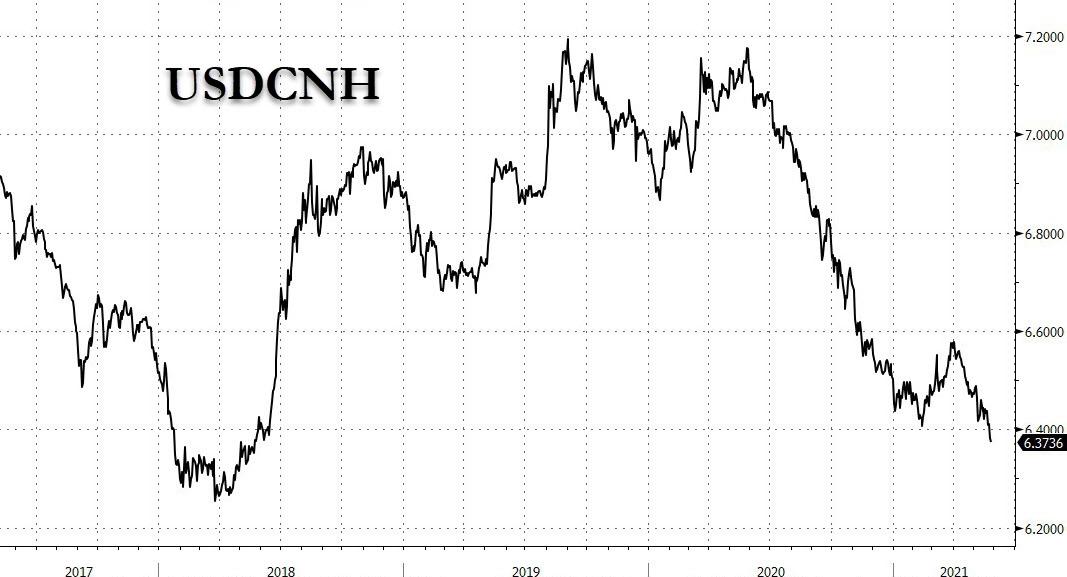
In FX, the yuan was the big mover in global currency markets after policymakers directed financial institutions to hold more foreign exchange in reserves, a move that analysts say was aimed at curbing yuan strength. In the offshore markets, the yuan currency weakened 0.23% versus the U.S. dollar with analysts at ING arguing that Beijing’s latest move will slow the currency’s rise but won’t halt it completely.

In commodities, crude oil rose with Brent approaching $70 as the market focused on an OPEC+ supply policy meeting early this week, while gold headed for the biggest monthly advance since July and most industrial metals gained. Concerns about global inflation and slowing growth have proved to be a boon for gold, with prices for the yellow metal rising 8% this month, vaulting comfortably above $1,900.
Unusually quiet cryptocurrencies showed some signs of volatility in holiday-stricken trading with bitcoin rising 4% to $37,000 while its smaller rival Ethereum climbed 8% to $2,578. Crytpos recovered Friday and weekend losses after Bank of Japan Governor Haruhiko Kuroda became the latest central banker to bash bitcoin and its peers amid fears the capital outflow will spoil the central bankers' digital currency plans.

The main event of the week will be U.S. payrolls on Friday with median forecasts at 650,000, but the outcome is uncertain following April’s unexpectedly weak 266,000 gain. Although U.S. inflation data last week was above estimates, another big miss on the jobs front would heap pressure on the Fed to postpone plans to wind down its stimulus. On the other hand, a 1MM print or higher and taper talk speculation will return.  The Fed next meets on June 16, and this week will be the last chance for members to discuss policy before a pre-meeting blackout period starts on June 5.

* * *

A quick look at global markets courtesy of NewsSquawk

Asian equity markets began the week subdued with risk appetite sapped amid holiday closures for key global markets, month-end factors and as the region also digested mixed Chinese PMI data. ASX 200 (-0.2%) traded marginally lower with the index pressured by underperformance in energy, tech and financials although downside was cushioned by strength in metal-related stocks, especially gold miners after the precious metal reclaimed the USD 1,900/oz status and domestic producers came close to topping China in terms of the world’s largest gold output during Q1. Furthermore, Australia's tensions with its largest trading partner continued to linger with the government readying to launch a second WTO action in its trade dispute with China after finalising consultation with wine exporters in recent weeks. Nikkei 225 (-1.1%) underperformed after the extension of the state of emergency for Tokyo and several other prefectures on Friday in an effort to slow COVID-19 infections and as the Olympic games remain on the line, with mild currency inflows and weaker than expected Industrial Production and Retail Sales figures adding to the headwinds for the Japanese benchmark. Hang Seng (-0.5%) and Shanghai Comp. (-0.2%) conformed to the uninspired mood after mixed Chinese PMI data in which the headline Manufacturing PMI slightly missed expectations but Non-Manufacturing PMI topped forecasts. The factory activity data was seen as a stabilization which was said to support analysts’ views that China’s economic activity could be peaking in Q2, while reports late last week added to the China crackdown narrative with the securities regulator paying greater attention to fluctuations in commodity prices recently and vowed to take action on future market violations. Finally, 10yr JGBs were flat despite the risk averse tone in Japan as price action was constrained amid the similar lacklustre trade in T-notes and following weaker demand at the 2-year JGB auction.

Stocks in Europe trade without a firm direction (Euro Stoxx 50 -0.2%), as the tentative sentiment reverberated from APAC amid low volumes as UK and US participants observe domestic holidays. That being said, some money could be funnelled into crypto markets in the absence of cash stocks. Back to Europe, sectors are mixed with no overarching theme or bias and narrow breadth of the market. Travel & Leisure resides as a narrow outperformer alongside Construction and Financial Services, whilst Telecoms, Healthcare, and Banks reside on the other end of the spectrum. Of note for the auto sector, Stellantis (+0.2%) has been forced to reduce more operations amid the chip shortage. Food and Beverages saw a firm start to the week, potentially as Danone (+1.1%) and Nestle (+0.1%) cheered China's child policy relaxation whereby it will permit up to three children from the prior of two. Nestle, however, drifted lower thereafter as reports suggested that 60% of its mainstream good and drink products do not meet the "recognised definition of health". In terms of other movers, Deutsche Bank (-1.6%) is pressured following source reports that the US Federal Reserve has warned the Co. that it is failing to address shortcomings in anti-money-laundering controls – with the central bank's frustration reportedly escalating to the point a fine could be issued. One to keep an eye on the broader inflationary narrative – UK homebuilder Travis Perkins has warned customers of "considerable" cost increases due to rises in raw material prices. It said the increases could affect its other brands, which include Keyline and BSS. Travis Perkins said the price of bagged cement would rise by 15%, chipboard by 10% and paint by 5% from Tuesday.

In FX, the Dollar and index have lost momentum after their pre-weekend short squeeze that was likely exacerbated by the fact that the final trading day of the month coincides with US and UK market holidays. However, most Greenback vs G10 pairs remain relatively rangebound and in familiar territory, as evident in the DXY rotating in a tight range around the 90.000 level (between 90.123-89.961) that has been pivotal for so much of May, following the Buck’s decline from peaks early on. Looking ahead, external factors look set to dictate on Memorial Day for obvious reasons, but there could be some last minute rebalancing left to do or late fine-tuning of positions, and to recap this should mildly favour the Dollar against the Yen especially.

  • AUD/NZD - Having failed to sustain momentum when last within striking distance of 0.7800 vs its US counterpart and losing out to the Kiwi in wake of last week’s hawkish RBNZ rate guidance, the Aussie is holding comfortably above 0.7700 and has rebounded further from near 1.0600 lows awaiting Tuesday’s RBA policy meeting that may be more upbeat given recent economic developments. Nevertheless, the Aud/Usd and Aud/Nzd rebounds look more corrective at this stage amidst somewhat mixed credit data and Chinese PMIs, while Nzd/Usd is consolidating either side of 0.7250 in wake of comments from RBNZ Assistant Governor Hawkesby stressing conditionality surrounding the revised OCR path and warning markets not to pre-empt a hike. Next up for the Antipodeans, AIG’s manufacturing PMI and NZ building consents.
  • JPY/EUR/CHF/CAD/GBP - All narrowly divergent vs their US rival, with the Yen firmly back over 110.00 irrespective of Japanese ip and retail sales falling short of consensus, the Euro straddling 1.2200, Franc rotating around 0.9000, Loonie meandering from 1.2087-36 and Pound hovering under 1.4200. Meanwhile, Sterling is also marginally lagging the single currency circa 0.8600 in late May UK Bank holiday trade and with the Euro weighing up latest dovish ECB commentary via Visco against firm Eurozone inflation data. Elsewhere, not much independent direction from latest weekly Swiss sight deposits as domestic bank balances dipped, but Canadian PPI and current account data may Usd/Cad some impetus later.

In commodities, WTI and Brent futures trade higher but off best levels at the time of writing as volumes are dry amid the absence of UK and US players, and against the backdrop of the JCPOA meeting in the run-up to tomorrow's back-to-back JMMC/OPEC+ confabs, slated for 13:30BST/08:30EDT. Sources via EnergyIntel have suggested that it is more likely that the current quota (through to July) will not be altered. Still, the return of Iranian oil is said to be one of the main topics at the upcoming meeting – with the situation contingent on developments in nuclear negotiations, which are said to have persisting sticking points. Note, participants expect the official announcement of a deal last week. Nonetheless, the Iranian oil minister hit the wires this morning and suggested that Iran, under specific requirements, could ramp up output 6.5mln BPD (vs last reported 2.5mln BPD). As a reminder, reports earlier this month citing the National Iranian Oil Corp suggested that under the most optimistic scenario, Iran could return to pre-sanctions levels of almost 4mln BPD in around three months. Iran has stated that it will not accept an OPEC quota until production levels return to pre-sanction levels. In terms of price action, WTI July has reclaimed a USD 67/bbl handle (vs low USD 66.41/bbl), and Brent Aug trades on either side of USD 69.50/bbl (vs low USD 68.75/bbl) – with some potential tailwinds from China widening its child policy and the OECD upgrading its 2021 forecasts across the board for major economies. Elsewhere, spot gold and silver tread water in tight ranges around USD 1900/oz and USD 28/oz amid a lack of fresh drivers and ahead of key risk events later this week, including the US jobs report and US ISM surveys. Turning to base metals, with the absence of LME, Shanghai copper overnight rose amid threats from the Chilean strikes at BHP mines, solidifying supply woes. Meanwhile, steel and iron ore futures in China rebounded, with traders citing a robust supply/demand balance despite jawboning from China.

Tyler Durden Mon, 05/31/2021 - 08:59
https://ift.tt/3p6NeRw
from ZeroHedge News https://ift.tt/3p6NeRw
via IFTTT

Spoos Hug 4,200 In Thin Holiday Trading As Global Stocks Close Out 4th Month Of Gains SocialTwist Tell-a-Friend
| 0 comments ]

Founder Of Black Lives Matter Chapter Quits After Learning the "Ugly Truth"

By Jack Phillips of The Epoch Times

A Black Lives Matter chapter founder in Minnesota has resigned, claiming that the organization isn’t concerned about helping black communities or helping improve the education quality in Minneapolis, according to a video published last week.

Rashard Turner, the founder of a Black Lives Matter chapter in neighboring St. Paul, said he started the branch in 2015 but became disillusioned roughly a year after becoming “an insider” within the left-wing organization, according to a video released by TakeCharge—a group that rejects various provisions promoted by Black Lives Matter, including critical race theory-linked claims that the United States is inherently racist.

“After a year on the inside, I learned they had little concern for rebuilding black families, and they cared even less about improving the quality of education for students in Minneapolis,” Turner said in the video.

“That was made clear when they publicly denounced charter schools alongside the teachers union. I was an insider in Black Lives Matter. And I learned the ugly truth. The moratorium on charter schools does not support rebuilding the black family. But it does create barriers to a better education for black children. I resigned from Black Lives Matter after a year and a half. But I didn’t quit working to improve black lives and access to a great education.”

Representatives for Black Lives Matter didn’t respond to a request for comment by press time.

Approximately a year after George Floyd’s death in Minneapolis, support for the group has plummeted in the United States, according to a recent poll from Morning Consult. Only 48 percent hold favorable views about the organization, down from 61 percent last May.

A USA Today survey found that 36 percent of Americans now would describe Floyd’s death as a murder, down from 60 percent last summer.

A poll in May conducted by the newspaper revealed that the Black Lives Matter call to “defund the police” has even less support, with only 18 percent of respondents supporting it.

It comes amid recent controversies surrounding Patrisse Cullors, a co-founder of the organization who resigned after a series of reports about her real estate portfolio and finances. Following the reports’ publication last month, Cullors asserted that she didn’t misuse any donations to Black Lives Matter.

In a statement last week, Cullors—a self-described “trained Marxist”—said, “With smart, experienced, and committed people supporting the organization during this transition, I know that BLMGNF is in good hands … The foundation’s agenda remains the same—eradicate white supremacy and build life-affirming institutions.”

Cullors told The Associated Press that her departure was planned more than a year in advance and wasn’t related to the reports about her finances and her multiple homes, claiming they “were right-wing attacks” meant to defame her character.

Tyler Durden Mon, 05/31/2021 - 08:30
https://ift.tt/2SJRqdW
from ZeroHedge News https://ift.tt/2SJRqdW
via IFTTT

Founder Of Black Lives Matter Chapter Quits After Learning the "Ugly Truth" SocialTwist Tell-a-Friend
| 0 comments ]

Currency Wars Return: China Hikes FX Reserve Ratio For First Time In 14 Years In Bid To Weaken Yuan

The signs were clear last Thursday when China's PBOC held an unexpected, improvised meeting with major forex market players after which the central bank published a statement that exchange rate can’t be used as a tool to stimulate exports via depreciation nor to offset impact of rising commodity prices via appreciation. While many had been looking in the rearview mirror, discussing the recent surge in the yuan, and speculating that the PBOC meeting was merely a warning from Beijing that the marcantilist nation (which in recent years has specialized in exporting deadly viruses in the pursuit of a grand reset) wouldn't look too fondly on more appreciation...

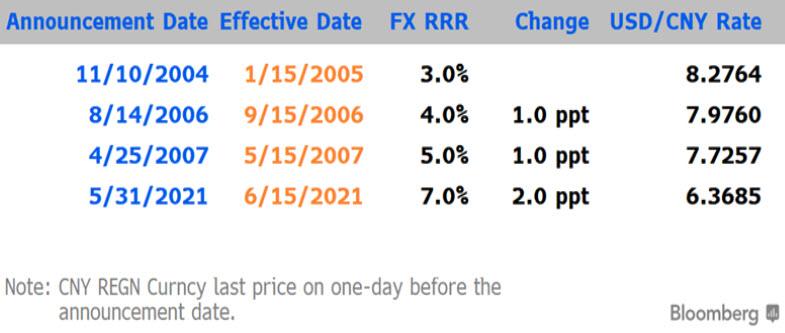
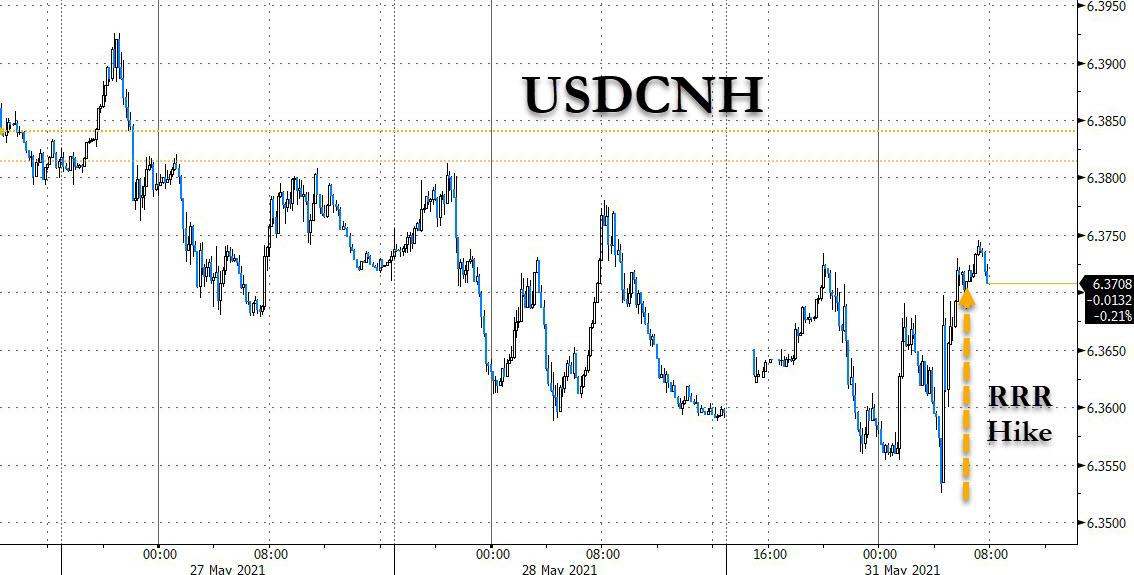
... the reality is that the PBOC's verbal jawboning against a stronger yuan (and by extension, against a weaker dollar) was a warning for more tangible action on Tuesday, when shortly after the offshore Yuan spiked above 6.36 a little after 4am ET, the PBOC unexpectedly announced that for the first time in 14 years, it would hike the required-reserve ratio on foreign currency deposits at financial institutions from 5% to 7% effective from June 15, in an attempt to slow the yuan's appreciation, in line with official rhetoric.

This was the first FX RRR hike since May 2007, after its appreciation following yuan reform in 2005.

According to Bloomberg's David Qu, "deploying a tool rarely used underscores the authorities’ determination to maintain yuan stability, a crucial factor for external trade. It signals the authorities are becoming less tolerant of yuan gains and have started to act, after verbal interventions."

Banks will now have to hold extra dollars with the PBOC instead of making loans or selling the dollars for yuan in the interbank market, with the latter likely to pressure the PBOC to absorb it in the form of funds outstanding for foreign exchange. The central bank may be reluctant to do that in order to avoid explicit FX intervention and unnecessary yuan liquidity injections in exchange.

Predictably, the announcement hit the yuan, with the offshore yuan sliding from 6.355 to 6.375 before resuming its upward crawl...

... as traders realized that the RRR hike would have limited impact on the yuan’s exchange rate over the longer term, since it does not shift fundamental factors driving yuan strength, such as the difference in policy stances of the PBOC and the Federal Reserve, with China far tighter (for now).

Quantifying the move, Australia & New Zealand Banking Group head of Asia research Khoon Goh said that with total FX deposits at $1 trillion, banks will need to set aside an extra $20BN, which will tighten FX liquidity and prompt banks to buy dollars, weakening the yuan if not dramatically.  Which is why according to Goh, while the PBOC has sent a strong signal that it wants to slow down the pace of yuan appreciation by raising the FX reserve requirement, the actual impact of the move is likely to be small after the initial adjustment.

Meanwhile, banks will probably reduce USD interest rates they offer to offset the increased reserve requirement, pushing the yield advantage further in favor of yuan deposits. This may encourage corporates and households to convert existing FX deposits into yuan; exporters may also decide to convert more of their foreign currency receipts into yuan rather than hold them as FX deposits.

Commenting on the move, UBS FX strategist Rohit Arora said that the weekend commentary and the USD liquidity draining move was a signal of the PBOC’s discomfort with rising one-way yuan expectations.

“China’s cyclical support is peaking -- so perhaps what’s looking like a one-way trend today will start looking different down the line when China growth is underperforming major DM economies.” And while UBS sees a possibility of a potential appreciation to low 6.20s in the near-term, the bank's year-end forecast for USD/CNY is 6.40 with some downside risks.

“It’ll be a slow grind with sustained policy restraint”, said Arora adding that “while it might be tempting to believe that the elevated inflation may have catalyzed a policy shift, one week is too small a sample set to conclude a shift in a decades-long FX regime of a ‘managed float'.”

Tyler Durden Mon, 05/31/2021 - 08:13
https://ift.tt/3i6UYBl
from ZeroHedge News https://ift.tt/3i6UYBl
via IFTTT

Currency Wars Return: China Hikes FX Reserve Ratio For First Time In 14 Years In Bid To Weaken Yuan SocialTwist Tell-a-Friend
| 0 comments ]

With Delegitimized Government Looming, Honor This Memorial Day Differently

By Mark Glennon of Wirepoints.

How? If we could ask those we honor this Memorial Day how best to do it, what would they say? This year, I submit that they would answer differently than they might have in most years past.

I suspect many would say to forget their names and their deeds for now. They would ask us, instead, to see what they would no doubt see with clarity: that America, particularly Illinois, is allowing the slow undoing of the what they died for. They would ask us to honor them by committing ourselves to reversing course. They would ask us to consider the consequences that will come if we don’t.

Stated most simply, they died to protect a democratic republic, essential elements of which are likewise simple – democratic rule bounded by certain unalienable rights.

Both of those elements are being unwound today. Should that continue, Americans will gradually come to see that the foundations of government legitimacy are gone. That looming threat should be our primary concern today, for if Americans conclude that their government no longer derives its powers justly – in the manner articulated by the Founders – then division, strife and violence far worse than we have seen in the last few years will certainly come.

Is it exaggeration to say that the essential elements of legitimate government are being unwound?

As the Founders wrote in the Declaration of Independence, “let facts be submitted to a candid world:”

  • Much of America no longer believes in freedom of expression and openly supports censorship. That means democracy cannot be real. Congressional hearings on tech censorship were filled with demands by many in both the House and Senate for more censorship. Only 53% of college students support freedom of speech. Universities provide endless examples of thought persecution that would have been unthinkable in decades past.

  • Here in Illinois, incumbent officeholders are once again about to select who their voters will be, instead of the other way around. It’s Democrats who are drawing obscenely gerrymandered maps in Illinois, but Republicans are doing it in many other states. Blame the United States Supreme Court, which essentially punted two years ago on partisan gerrymandering, leaving incumbent politicians free to do as they want.

  • Courts across most of America, particularly in Illinois, have looked away as emergency pandemic rules trampled the unalienable rights they are supposed to protect regardless of majority rule, including freedoms of association, travel, assembly, religion, property, equal protection and due process. Legislatures, too, have handed away their role as a third branch of government in favor of vastly expanded executive authority exercised through emergency rules.

  • Young voters are coming of age who’ve been blinded by government K-12 schools that have been made into instruments of political indoctrination. A twisted version of “equity” is now woven into most every part of their curricula, then in turn woven into most every piece of new legislation and regulatory action. Officeholders, sworn to uphold the Constitution, somehow see no conflict embracing Critical Race Theory, which holds that the Constitution was designed to perpetuate slavery, and they force that teaching on schools.

  • Voting means nothing unless it is informed vote, and media corrupted beyond recognition have unquestionably tipped countless elections. National media now openly distort news, suppress stories that don’t fit their narrative and often outright lie. In November’s election, 37 congressional races were decided by margins of 5% or less. Illinois alone had two House seats decided by margins of 2% or less. Media surely have an impact at least as big as those margins. Innumerable down-ballot, state and local races undoubtedly were also tipped by national media bias. Journalism schools now openly teach students to forget about objectivity and write, instead, to promote their own philosophies.

Now, incumbent politicians in Illinois have proposed a state constitutional amendment that would give public unions unprecedented power to advance their own “economic interest” by overriding all other forms of government.

And in Washington, the infamous, 800-page “For the People Act” was already passed by the House and now pends in the Senate. It would strip state and local government of control over elections, vastly expanding federal power to make elections universally partisan.

Disagree with some of the above if you want, but nobody can argue that large and growing numbers of Americans do not disagree, and that perceptions ultimately may be most important. Peace and stability require public confidence that the essential elements of legitimate government be present.

That confidence has been eroding quickly and is near a breaking point. If a large portion of Americans conclude that their government is no longer legitimate, and that their the power to fix it through a fair, democratic process has been eliminated, the consequences are almost too difficult to imagine.

This Memorial Day, when you visit or see the pictures of the graves, remember not just their names but why they are there, and consider what they would want. They would want to be remembered for dying to save a democratic republic. They would want America to reverse the course it is now on.

Tyler Durden Mon, 05/31/2021 - 07:10
https://ift.tt/3wK1lPd
from ZeroHedge News https://ift.tt/3wK1lPd
via IFTTT

With Delegitimized Government Looming, Honor This Memorial Day Differently SocialTwist Tell-a-Friend
| 0 comments ]

China Allows Families To Have Up To 3 Children Amid Dramatic Drop In Birth Rates

As concerns about China's looming population decline intensify (stoked by news that the country's birthrate fell to its lowest level in 2020 since CCP record-keeping began in 1949), Chinese news agency Xinhua reported Monday morning that the Politburo has decided to allow couples to have up to three children.

It's not clear when the policy will take effect, but the meeting focused on policy changes that could be implemented in the period between now and 2025, and also included other important changes, like a commitment to "prudently lift the retirement age in a phased manner," according to Xinhua.

The decision to lift the maximum number of births is the biggest shakeup to the CCP's notoriously strict family planning policies since the Party abolished China's one-child policy back in 2015. But it's not exactly a surprise: Internal dissatisfaction with the population growth rate had led to top party officials openly discussing the shortcomings of the two-child policy with western media, a sign that a major rethink was likely on its way, as we pointed out back in January.

Source: FT

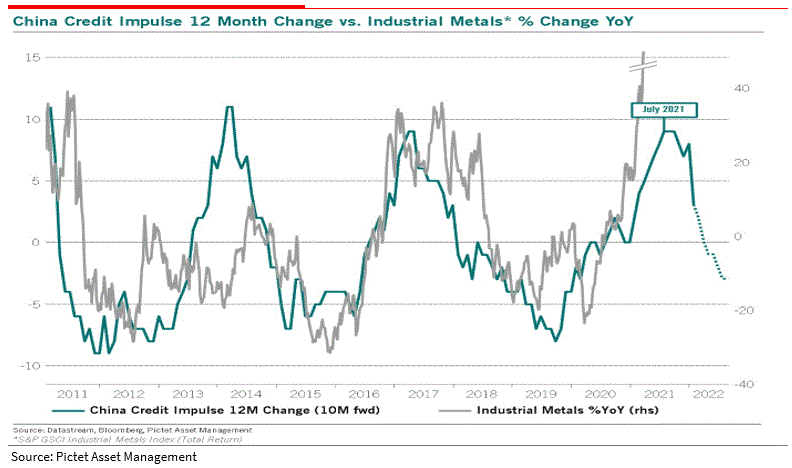
Now, that rethink has arrived just as China's all-important credit impulse has turned negative and concerns about GDP growth, which had already begun to slow even before the pandemic (remember 2019 saw the slowest growth in a decade), are prompting the Politburo to shake things up.

Additionally, it's worth noting that the decision to allow couples to have up to three children comes just weeks after Beijing published the results of China's latest census, which set off additional alarm bells that China's working-age population was shrinking relative to the size of its retired population. The census showed that China reported only 12MM births last year, the lowest annual reading since 1961, and down 18% from 2019.

Here's more on the decision, which was made Monday during a Politburo meeting presided over by President Xi Jingping, from Bloomberg News. The decision was made to help improve the "population's structure," according to a statement from Xinhua.

China will allow all couples to have a third child, a surprise move aimed at slowing the nation’s declining birthrate as risks to the economy’s long-term prospects mount because of a rapidly aging population.

In a meeting presided over by President Xi Jinping Monday, the Communist Party’s Politburo decided to ease the current two-child restriction, saying “allowing every couple to have three children and implementing related support policies will help improve the population’s structure,” according to a report by the official Xinhua News Agency. It wasn’t clear when the move would take effect, although the meeting discussed major policy measures to be implemented in the period to 2025.

China has been gradually reforming its stringent birth policy that for decades limited most families to only having a single child, with a second child allowed since 2016. However, that reform did little to reverse the declining birthrate and further relaxation of the limits is unlikely to lead to a sustained increase.

At 1.41 billion, China's population is the biggest in the world, but increasingly economists worry that the "pandemic effect" will cause it to start shrinking before 2025 (it was previously thought that the decline would begin around 2030).

“The Politburo probably saw the latest census results and with all the public consensus about a change, it’s easier now to make a decision,” said Henry Wang, president of the Center for China and Globalization, a think-tank linked to China’s government. “They probably need some time before they completely drop” the birth restrictions, he said. “If this adjustment doesn’t help, then that would help them make a future decision,” he added.

Bloomberg's Eric Zhu, a China-focused economist, said the new policy is "a step in the right direction but it’s not enough to head off an inevitable demographic drag on the economy. Other steps, including birth- and parenting-friendly policies and an increase in the pension age, are needed as quickly as possible if China stands a chance of slowing a looming decline in its workforce and crunch from an aging population."

Demographers expect that even with a looser birth policy, China's population will likely continue to shift as Chinese citizens embrace the trend toward smaller family sizes that has taken hold in North America and Europe. "For those people who are rich, relaxing the policy will encourage them to have more children but for the common citizens, like the middle class or even the lower class, they don’t have enough incentive to make use of this new policy," said Vivian Zhan, an associate professor of Chinese politics at the Chinese University of Hong Kong.

Shares of companies producing baby formula and other childcare and fertility-related products and services jumped on the news. Milk formula maker Beingmate Co. Ltd. rose as much as 10% in Shenzhen, while fertility clinic service provider Jinxin Fertility Group Ltd. surged almost 24% in Hong Kong. Shares of French food maker Danone climbed as much as 1.6% in Europe.

Over the long term, China's aging population will contribute to rising prices while growth sputters, unless the state commits to expanding pensions and committing more resources to caring for the elderly, while continuing to ensure growth in China's industrial and high-tech sectors as well. Last time around, when China lifted the one-child policy in 2013, the country's population growth accelerated mildly during the following years, but that bump quickly faded as the pressures of modern life increasingly make small families more practical.

Tyler Durden Mon, 05/31/2021 - 06:35
https://ift.tt/3c5b7DL
from ZeroHedge News https://ift.tt/3c5b7DL
via IFTTT

China Allows Families To Have Up To 3 Children Amid Dramatic Drop In Birth Rates SocialTwist Tell-a-Friend