| 0 comments ]

How Regular Exercise Restructures The Brain

Authored by Ross Pomeroy via RealClear Science (emphasis ours),

Physical activity can do wonders for the body. Exercise can trim weight, chisel muscles, and strengthen the lower back, among many other benefits. Less overt, but no less consequential, physical activity can also buff up your brain. Science is increasingly revealing that the brains of those who regularly work out can look very different compared to the brains of people who don't.
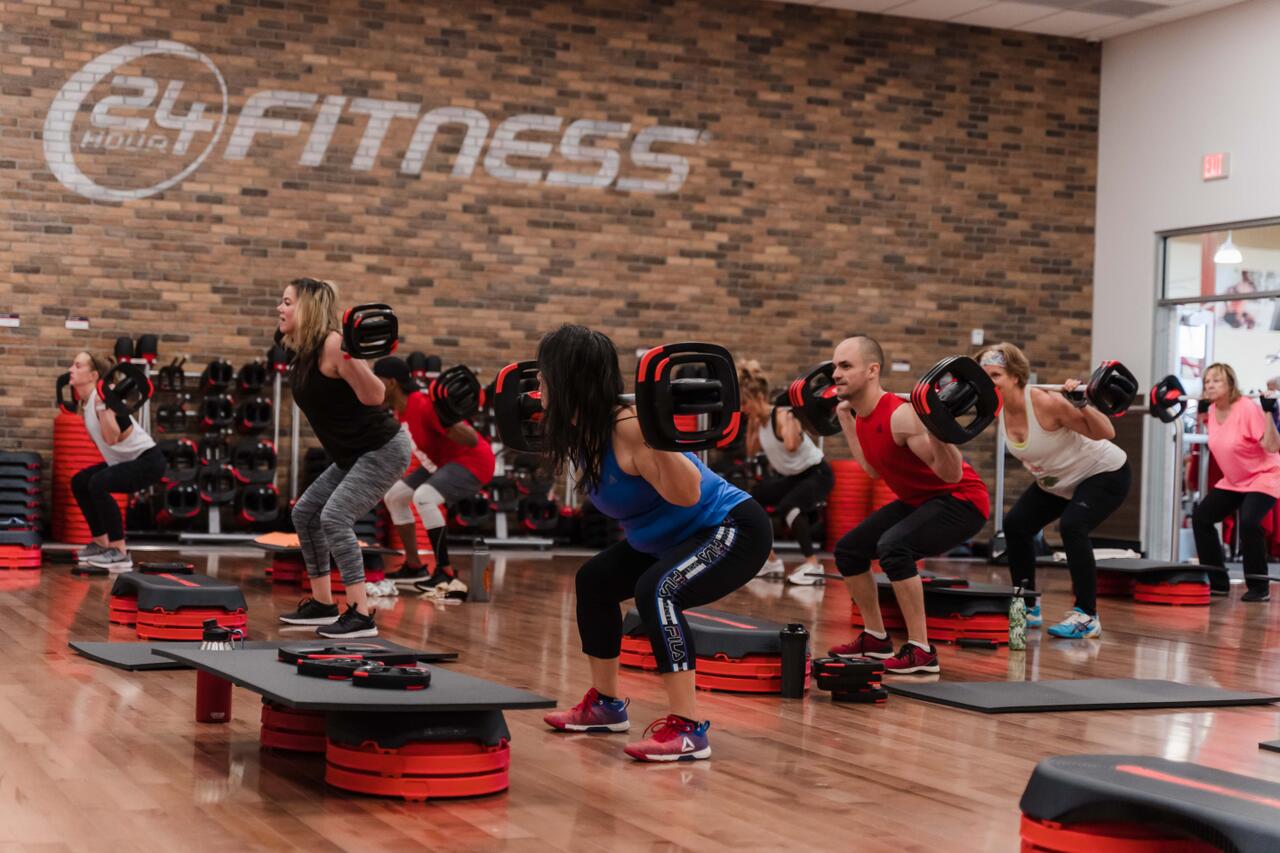
24 Hour Fitness Weighted Group Exercise Class (Photo: 24 Hour Fitness)

Changes can start to occur in adolescence. Reviewing the scientific literature in 2018, researchers from the University of Southern California found that for teens aged 15-18, regular exercisers tended to have larger hippocampal volumes as well as larger rostral middle frontal volumes compared to healthy matched control teenagers. The hippocampus is most commonly associated with memory and spatial navigation, while the rostral middle frontal gyrus has been linked to emotion regulation and working memory. Studies suggest that these structural changes translate to improved cognitive performance and better academic outcomes.

Exercise's brain augmenting qualities extend into adulthood, even though the brain tends to be less 'plastic' (easily changed) as we get older. Rutgers University scientists beautifully demonstrated this in a study published early last year:

The researchers recruited older African Americans, all previously sedentary, to complete twenty weeks of twice-weekly cardio-dance exercise classes held at local churches and senior centers. As compared to the control group comprised of community members of similar age and background who did not exercise, those in the program showed significant improvements in dynamic brain connectivity (or “neural flexibility”) in their hippocampus and surrounding medial temporal lobe, as measured using resting-state functional MRI.

In another study, published in August 2019, scientists looked at 45 sets of adult identical twins, who, within their pair, all differed greatly in physical activity levels. "More active co-twins showed larger gray matter volumes in striatal, prefrontal, and hippocampal regions, and smaller gray matter volumes in the anterior cingulate area than less active co-twins," the researchers found.

The scientists also probed the twins' cognitive abilities.

"More physical activity may expedite preconscious processing of visual stimuli and, in somatosensory domain, improve selective attentional processing by dampening the strength of unattended deviant somatosensory signals," they added.

The brain alterations do appear beneficial, but current twin studies are too small, and the participants too young, to find whether exercise-induced changes can actually reduce the risk of cognitive disorders or improve outcomes such as education or income.

Researchers have also tried exercise interventions on much older adults, even those with Alzheimer's disease, to see if physical activity could repair their stricken brains. In 2016, a team of scientists recruited 68 older individuals with probable Alzheimer's disease to determine whether moving more could help with their symptoms. Some subjects aerobically exercised for 150 minutes per week while others underwent a less rigorous control regimen of stretching and toning for 26 weeks. Compared to the control group, the aerobic exercise group improved more on the Disability Assessment for Dementia at the study's conclusion. Boosts to cardiorespiratory fitness were also linked to improvements in memory and reduced atrophy of the hippocampus.

Working out also augments the brains of otherwise healthy older adults. Getting thirty minutes of physical activity each day does seem to preserve brain volumes in adults over age 70 compared to sedentary individuals, according to a study published in August of last year. Moreover, higher cardiorespiratory fitness was linked to lower levels of brain atrophy in the research.

One way exercise can induce changes in the brain is by increasing levels of the protein brain-derived neurotrophic factor (BDNF) in the blood, which is linked to neurogenesis. More BDNF may mean more new neurons in the brain. Regular exercise also increases the growth of additional blood vessels in the brain and helps maintain current ones, leading to boosted blood flow for the oxygen-hungry organ. Lastly, physical activity seems to keep microglia in good working order. Microglia "constantly check the brain for potential threats from microbes or dying or damaged cells and clear any damage they find," Áine Kelly, a Professor in Physiology at Trinity College Dublin wrote for The Conversation.

Regularly moving one's body may be the closest thing there is to a health panacea, for both outside the skull and inside.

Tyler Durden Sat, 01/29/2022 - 19:30
https://ift.tt/nGbSupB4P
from ZeroHedge News https://ift.tt/nGbSupB4P
via IFTTT

How Regular Exercise Restructures The Brain SocialTwist Tell-a-Friend
| 0 comments ]

Opportunity Knocks: Ukraine Seeks US Money, Loans, Weapons While Downplaying 'Russian Invasion'

At a moment Ukraine's top defense leadership, as well as President Volodymyr Zelensky himself, is urging the Biden administration to calm its dangerous and hyped rhetoric regarding a possibly "imminent" Russian invasion of Ukraine (Kiev has said all week that all indicators suggest this just isn't so), it seems the Zelensky government will at least use the occasion to get what it wants from Washington. Or, put another way, perhaps the quid pro quo now emerges after the Ukrainians long kept mum on the Biden family and Burisma scandal.

We could add that Kiev is now so openly pushing back against White House assessments as to the actual level of the 'Russia threat' on Ukraine's borders, that it's proving quite awkward and embarrassing for team Biden. As Northeastern University political science professor Max Abrahms put it this week (while generally addressing mainstream media and pundits), "You guys aren’t making a big enough deal of this weird dynamic that American leaders are more worried than Ukrainian leaders of Russia invading Ukraine. This needs to be explained."

Now Axios is reporting in an exclusive: "The chairman of Ukraine's parliament has sent a letter to eight U.S. senators outlining four specific requests for security assistance and sanctions that Kyiv believes will help deter a Russian invasion."

Again, it appears the logic for Ukraine's government is that it might as well make use of the tense situation, understanding full well the "threat" is hugely inflated, to get what it wants out of the US hawks. After all, the opportunity for US billions to pour in has never been hotter.

Thus far Biden has only prepared far-reaching anti-Russia sanctions only in the scenario of a Putin-ordered offensive into Ukraine. As Axios observes...

  • Like the Ukrainian government, Republicans are pushing for the bill to impose some sanctions now, before Russia invades.
  • But Ukraine's intervention in yet another U.S. legislative fight is unlikely to please a Biden administration already frustrated with President Volodymyr Zelensky.

The awkward but advantageous quid pro quo is fast becoming apparent to many...

"Ukraine denies"

CNN's White House correspondent Natasha Bertrand cited a top admin official who complained that Zelensky is contradicting Biden's assessment of the Russia threat, "But at the same time" is busy "asking for hundreds of millions of dollars in weapons to defend against one."

Here are the four specific requests in the new letter sent by Ukraine to the US administration, said to be approved by Zelensky's himself, according to Axios sources:

  1. "Expedited and higher-impact security assistance, including air defense, anti-ship and anti-armor capabilities, and flexible loans and financing mechanisms."
  2. "Immediate, mandatory sanctions" against the operator of the Nord Stream 2 pipeline, which the letter calls "no less an existential threat to Ukraine's security and democracy than the Russian troops on our border."
  3. "A clear trigger" for sanctions based on Russia's actions, with a lower threshold than what has been outlined in the current Democratic-sponsored legislation under consideration.
  4. "Mandatory pre-trigger and post-trigger sanctions against all of Russia's most significant financial institutions."

The eight senators who were directly appealed to (all Russia hawks, it should be noted), are as follows: Bob Menendez (D-N.J.), Jim Risch (R-Idaho), Rob Portman (R-Ohio), Jeanne Shaheen (D-N.H.), Chris Murphy (D-Conn.), John Cornyn (R-Texas), Lindsey Graham (R-S.C.) and Ben Cardin (D-Md.)

Sen. Menendez, it should be noted, is pushing his "mother of all sanctions" bill as a threat to hold over Putin's head. 

Meanwhile...

Ukraine's letter can be read here.

Tyler Durden Sat, 01/29/2022 - 19:00
https://ift.tt/hZfki2xGC
from ZeroHedge News https://ift.tt/hZfki2xGC
via IFTTT

Opportunity Knocks: Ukraine Seeks US Money, Loans, Weapons While Downplaying 'Russian Invasion' SocialTwist Tell-a-Friend
| 0 comments ]

Waking Up And Derailing The Great Reset

Submitted by QTR's Fringe Finance

This week, I had to opportunity to speak to one of my all time favorite podcasters, Tom Bodrovics from Palisades Gold Radio about my arguments from my latest article on inflation, called “Inflation Is The Kryptonite That Will End Our Decades-Long Monetary Policy Ponzi Scheme”.

The Age Of Censorship

First, on the podcast, I talk about how we live in an age where narratives can’t be questioned without you being considered a conspiracy theorist and how Substack is filling an important free market demand for uncensored content. I first touched on this when I started writing on Substack back in August of 2021 in this article called “Ending Social Media Censorship And The Meteoric Rise of Substack”.

On the podcast, I also point out that there are two narrative shifts occurring right now: Covid and inflation.

Inflation Marks An Impasse For the Fed

Regarding inflation, the Fed is at a fork in the road between popping the stock market bubble or allowing persistent inflation to brutalize the middle and lower class (or, as Jerome Powell put it this week, ‘some people are prone to suffer more’). 

I tell Tom that the Fed is trapped, and unlike in the past, they don’t have a viable way out. In the past they were able to avoid inflation and the Fed was able to pretend to successfully engineer the appearance of monetary prosperity, I told Tom. Now, there is no way for the average person to ignore Fed policy with high inflation. The Fed is running out of excuses and room to wiggle.

“The Fed’s feet are being held to the fire in a way that has never occurred before…politicians aren’t going to be able to overpromise anymore, as reality takes hold. Inflation is now the number one political issue in the country,” I tell Tom.

I also tell Tom that crypto has brought financial understanding to a new generation who want to understand monetary policy. Despite my criticisms of crypto, namely that (1) many of its advocates are charlatans, (2) it is most certainly a risk asset and (3) we can never be certain a cataclysm in crypto won’t occur, it is helping a younger generation quickly understand the flawed nature of our existing system.

This, in turn, is a huge problem for the Fed because the new generation understands the Central Banking ponzi scheme.

A Hyperinflationary Mindset Is Right Around The Corner

I also tell Tom that we’re not far from a hyperinflationary mindset in the country and that our leaders, who believe they can micromanage the economy and are stunned when their actions don’t work, are terribly ignorant. I wrote about this months ago when President Biden shut down the nation’s oil pipeline projects and then mulled the high price of gas in the coming months.

Instead, Harris Kupperman in a recent interview with me told me that oil traders “will break the Fed” and will make Jerome Powell “cry uncle”. Kupperman thinks oil prices are going higher and simply cannot be stopped.

The Covid Pivot Is Next, And Beware Of The Great Reset

I also spoke to Tom about why I think capitalism and common sense are going to end vaccine mandates and intrusion into our lives - something I wrote about at length just hours ago.

Finally I talk about Klaus Schwab’s “Great Reset” idea. I note that a large amount of people are seeing the global elite’s future plans for a system that will strip us of civil liberties while enriching central planners. I tell Tom that I don’t believe globalists have a viable way out of the system as it stands today.

This runs hand-in-hand with Part 1 of an interview with George Gammon I did this week, where George reminded us that the global only care about “usurping control”.

The more educated people become to the system, the fewer options will be left for the elite, I tell Tom.

“We’re all just in different stages of waking up.”

You can listen to my entire interview with Palisades Gold Radio, for free, here:

If you are still not a Fringe Finance subscriber and would like to read any of the above content - and because I know many of you are coming over from PGR - I’d love to have you on board and can offer you 35% off your first year as a subscriber. This is the steepest discount I can reasonably offer and this coupon only lasts for the next few days: Get 35% off for 1 year

Tyler Durden Sat, 01/29/2022 - 18:30
https://ift.tt/fJg3uZj51
from ZeroHedge News https://ift.tt/fJg3uZj51
via IFTTT

Waking Up And Derailing The Great Reset SocialTwist Tell-a-Friend
| 0 comments ]

Less Than Half Of Americans Trust Business "To Do The Right Thing"

A strong level of trust with customers is going to prove hugely important for recovering businesses when the pandemic finally comes to an end (or at least progresses to a stage closer to normality). As Statista's Martin Armstrong details below, a survey by Edelman Research polled 36,000 respondents in 28 countries about their trust in business to "do the right thing" in November 2021.

The research found that people in China, Indonesia and India have the highest trust at 84 percent, 81 percent and 79 percent, respectively.

Infographic: How Trust In Business Varies Around The World | Statista

You will find more infographics at Statista

The figure was far lower in the United States at 49 percent while it was lower still in Russia at just 34 percent. In all, eleven countries saw an increase in trust in business, while eleven recorded a decrease. Interestingly, business is trusted more than government in 23 out of the 28 countries surveyed. Average trust in business globally was 61 percent, compared to 52 percent in government.

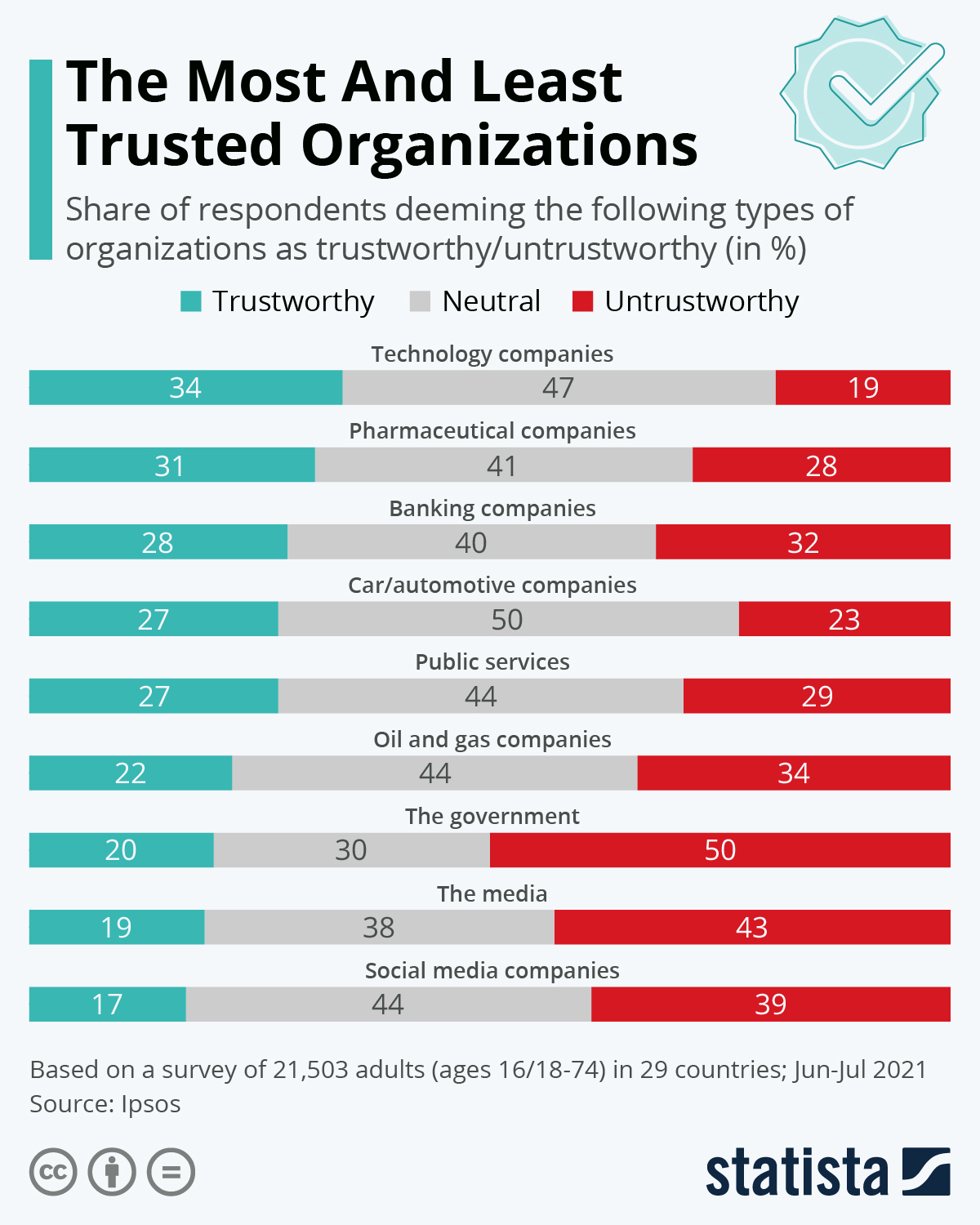
Tech, pharma and car companies were the only organizations in 2021 with a net positive trustworthiness rating worldwide. 34, 31 and 27 percent of participants in the annual Ipsos Global Trustworthiness Monitor deemed these types of corporations to be deserving of their trust. As our chart shows, governments, media companies and social media corporations have the worst trust-to-mistrust ratio of all sectors.

Infographic: The Most And Least Trusted Organizations | Statista

You will find more infographics at Statista

The positive attitude towards pharmaceutical companies, which gained six percent on the results of 2018, can be explained with the handling of the coronavirus pandemic and the rapid and effective production of vaccines, although the decision to not lift patent restrictions on illness-preventing and potentially life-saving inoculations has come under scrutiny by activists and medical professionals over the past years. We wonder what will happen to this pharma cred now that vaccines are failing to live up to their promises?

The banking sector managed to gain even more ground with an increase of eight percent to a total of 28 percent deeming banks trustworthy, with 62 percent of Chinese respondents claiming banking organizations can be trusted. This is contrasted by 32 percent of respondents claiming to not trust banking companies, netting the sector fifth place when viewed through the lens of the most untrustworthy organization types. Mistrust in the media and social media companies has potentially been exacerbated by the coverage of the pandemic and, in the case of social media giant Meta, the scandal surrounding whistleblower Frances Haugen furthering calls for regulation of Big Tech due to its negative influence on its users.

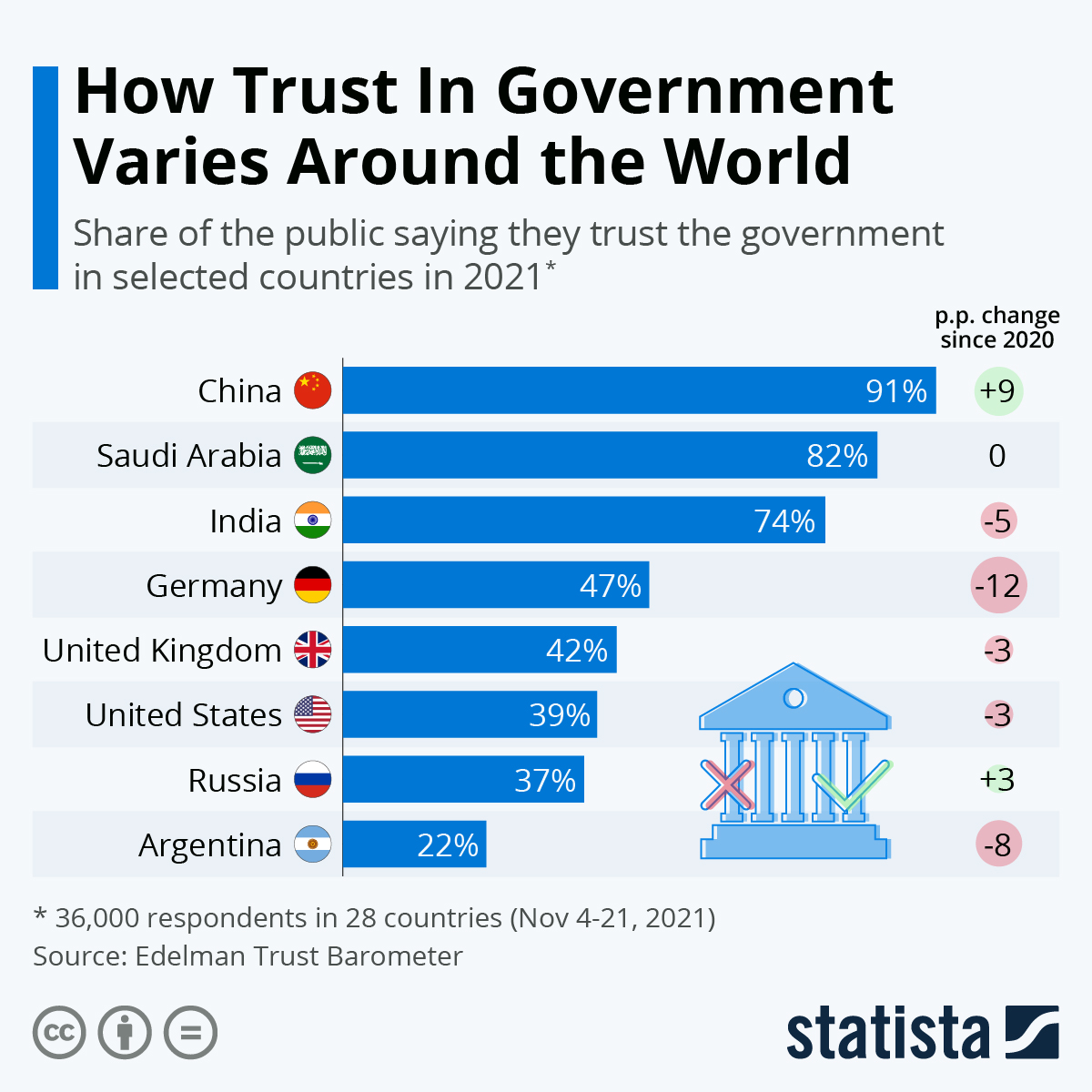
It's not just business, Statista's Martin Armstrong took a look at the global levels of trust in government. When Joe Biden moved into 1600 Pennsylvania Avenue, one of his administration's most important promises was to bolster trust in the American government and the healing of social divisions. Unfortunately, as his approval rating has collapse, along with distrust inside of government, the nation is more divided than ever though, and a new survey has found that a mere 39 percent of the U.S. public trusted the government in late 2021 - a 3 percentage point decrease on 2020.

The findings come from Edelman Research's latest Trust Barometer which polled 36,000 people in 28 countries about their trust in various institutions in November 2021. The U.S. figure is far lower than many other countries, with trust in government in Canada and Australia standing at 53 percent and 52 percent, respectively. It is also slightly lower than the UK where the government's Brexit strategy has proven highly controversial with public approval of the institution 42 percent in late 2021.

Infographic: Where Trust In Government Is Highest and Lowest | Statista

You will find more infographics at Statista

Some of the highest levels of trust in government were seen in Asia where 91 percent of Chinese respondents said they had trust, along with 82 percent of people polled in Saudi Arabia and 74 percent in India. The lowest rating was found in Argentina, where just 22 percent of respondents said they trusted their government there.
 

While the share of respondents mistrusting government and media might seem high, they have been largely consistent with minor swings over the years according to Ipsos experts. Since its initial run in 2018, the Ipsos Global Trustworthiness Monitor aims to dispel the idea that general trust in institutions and organizations is in crisis by surveying more than 20,000 adults in over 20 countries per year.

Tyler Durden Sat, 01/29/2022 - 18:00
https://ift.tt/710rzMVak
from ZeroHedge News https://ift.tt/710rzMVak
via IFTTT

Less Than Half Of Americans Trust Business "To Do The Right Thing" SocialTwist Tell-a-Friend
| 0 comments ]

The Wild Card To Watch For Oil Markets In 2022

By Tsvetana Paraskova of OilPrice.com

As talks on reviving the so-called Iranian nuclear deal enter a critical stage with the window of opportunity for a comprehensive agreement closing, oil markets are on edge once again about how the outcome of the ongoing negotiations would impact supply and demand balances later this year and early next year. 

The Biden Administration launched in April 2021 indirect talks with Iran, via the partners in the Joint Comprehensive Plan of Action (JCPOA), about a possible return of the United States and Iran to the deal. Talks have been struggling since the start. They were suspended for months until a new Iranian president and administration took office and were relaunched at the end of last year, with little progress made so far. 

At the start of the talks in April, oil analysts first expected a legitimate return of Iranian oil to the market at some point in late 2021. As the negotiations dragged on and were suspended during the summer, the market pushed back the timeline for a return of Iranian barrels to 2022. This year, many analysts again pushed back that timeline to early 2023 if talks result in an agreement, considering that there would likely be a gap of six to nine months—and possibly more—before Iran starts to export oil without U.S. sanctions. 

Whether a deal could be reached in the coming weeks and months would influence estimates of oil market balances because Iran could raise its oil exports by 1 million barrels per day (bpd) within the first year of no-sanction exports. 

A full return to the deal and the removal of American sanctions would push oil prices lower as the surplus on the market would rise, upending current estimates. The longer the nuclear talks drag on, the longer it would take Iran to start ramping up its oil exports in case of an agreement.  

However, there could be very little time left to reach a deal. 

U.S. Secretary Antony Blinken warned earlier this month that the window of opportunity for a deal is closing. 

“We have, I think, a few weeks left to see if we can get back to mutual compliance,” Secretary Blinken told NPR in an interview on January 13. 

“This negotiation is urgent, and progress has not been fast enough. We continue to work in close partnership with our allies, but the negotiations are reaching a dangerous impasse,” British Foreign Secretary Elizabeth Truss told the UK Parliament on Tuesday.  

“Iran must now choose whether it wants to conclude a deal or be responsible for the collapse of the JCPOA. If the JCPOA collapses, all options are on the table,” Truss added. 

Earlier this week, Iran suggested that it may consider direct talks with the United States.

“If during the negotiation process we get to a point that reaching a good agreement with solid guarantees requires a level of talks with the US, we will not ignore that in our work schedule,” Iranian Foreign Minister Hossein Amir-Abdollahian said, quoted by AFP

U.S. State Department Spokesperson Ned Price said on Tuesday: “We do believe that it would be more productive to engage directly with Iran when it comes to JCPOA, when it comes to other issues.”  

Still, progress is not being made, and the Western countries in the JCPOA and the United States are concerned that dragging on talks further would allow Iran to advance its nuclear-weapon activities.

If the ongoing talks in Vienna collapse, it would likely be very bullish for oil prices as it would not only tighten expected market balances for 2023 and 2024, but it could also additionally increase the tension in the Middle East with a renewed U.S.-Iran standoff. 

“So much has changed since 2015,” Helima Croft, Global Head of Commodity Strategy at RBC Capital Markets, told Bloomberg.

“Iran is now a nuclear-threshold state. Would they be willing to relinquish that status? It’s not guaranteed,” Croft added, commenting on the possibility that talks could collapse.  

The oil market will continue to keep a close eye on the talks, which seem like the wild card for prices later this year and next. Last week, Goldman Sachs said it was pushing its Iran ramp-up forecast to the second quarter of 2023 due to lack of progress in the negotiations, as it joined other Wall Street banks in predicting $100 oil as soon as this year. 

Tyler Durden Sat, 01/29/2022 - 17:30
https://ift.tt/kRQ283FKx
from ZeroHedge News https://ift.tt/kRQ283FKx
via IFTTT

The Wild Card To Watch For Oil Markets In 2022 SocialTwist Tell-a-Friend