| 0 comments ]

Meat From Animals Vaccinated With mRNA Vaccines May Soon Make Its Way Into The US Food Supply

Authored by Megan Redshaw via The Epoch Times (emphasis ours),

Shrimp have become the latest addition to a growing list of food sources targeted by mRNA gene therapy technology. An Israeli company seeking to bring mRNA vaccines to shrimp farming has raised $8.25 million from a group of venture capitalists to promote and improve animal health in marine species through its orally administered RNA-particle platform.

(Kateryna Kon/Shutterstock)

ViAqua, a biotechnology company, created an RNA-based vaccine product that uses ribonucleic acid interference (RNAi) to manipulate gene expression in shrimp. RNAi is a biological process where RNA molecules are used to inhibit gene expression or translation by neutralizing targeted mRNA molecules.

The vaccine comes in the form of a coated feed supplement designed to enhance resistance to white spot syndrome virus (WSSV)—a viral infection that causes an annual loss of about $3 billion and a 15 percent reduction in global shrimp production. ViAqua suggests RNA molecules can inhibit the expression of genes that cause disease with every meal containing its coated product.

According to a 2022 proof-of-concept study, the nanovaccine was roughly 80 percent effective in a lethal WSSV challenge model and exhibited excellent in vivo safety profiles. Yet the risks of altering gene expression in shrimp and the effects of consuming vaccinated shrimp are unknown.

"Oral delivery is the holy grail of aquaculture health development due to both the impossibility of vaccinating individual shrimp and its ability to substantially bring down the operational costs of disease management while improving outcomes," said Shai Ufaz, CEO of ViAqua in a press release. "We are excited to bring this technology to market to address the need for affordable disease solutions in aquaculture."

ViAqua plans to begin production in India in 2024 and believes its technology has numerous applications in aquaculture and beyond, according to their press release.

mRNA Vaccines Are Already Used in Pigs

The aquaculture industry is not the only market being targeted with mRNA vaccines. Genvax Technologies, a startup creating mRNA vaccines for animals, in 2022 secured $6.5 million in funding to develop a self-amplifying mRNA (saRNA) platform that allows for rapid development of a herd or flock-specific vaccine matched 100 percent to the circulating variant at the root of a disease outbreak.

Genvax’s technology involves inserting a specific transgene or “gene of interest” matched to the variant strain into the platform. The saRNA then generates an antibody response without requiring the whole pathogen to be matched to the circulating strain.

In April 2022, Genvax was awarded a $145,000 grant by the Foundation for Food and Agriculture Research to develop an saRNA vaccine for African swine flu (ASF) in collaboration with the U.S. Department of Agriculture. ASF is a highly contagious virus with a 100 percent swine mortality rate but has never occurred in the United States.

According to a 2022 paper published in eClinicalMedicine, saRNA technology uses lipid nanoparticles (LNPs) to encapsulate saRNA. When injected as a vaccine, the LNP encapsulation facilitates “endosomal uptake and release into the cytoplasm of target cells in vivo.” This novel technology has “significant and previously untested potential” to be used in drugs and vaccines.

Advertisement - Story continues below

Genvax isn’t the first company to harness mRNA technology in pigs. Merck, in 2018, introduced SEQUIVITY, a “revolutionary swine vaccine platform” that uses RNA particle technology to create “customized prescription vaccines against strains of influenza A virus in swine, porcine circovirus (PCV), rotavirus and beyond.”

SEQUIVITY uses electronic gene sequencing to generate RNA particles that, when injected into an animal, provide instructions to immune cells to translate the sequence into proteins that act as antigens, similar to how the COVID-19 vaccine causes the body to generate spike proteins. The idea is that the animal’s immune system, when challenged with the actual live pathogen, will recognize the antigen and elicit an immune response.

According to Merck, their RNA participle technology allows for the development of a “safe and flexible” custom swine flu vaccine in only eight to 12 weeks compared to traditional vaccines that take years to develop.

Although it is claimed vaccines utilizing RNA technology are safe and effective, studies appear to be scarce with little to no research to determine what effects consuming pork from vaccinated pigs may have on the human body.

mRNA Vaccines in Cattle Raise Concerns Among Producers

According to the National Cattlemen’s Beef Association, mRNA vaccines are currently not licensed for use in U.S. beef cattle. The vaccines are being developed to treat and prevent diseases in cattle, whose meat could make its way to the dinner table.

Ranchers-Cattlemen Action Legal Fund United Stockgrowers of America (R-CALF USA), a national, non-profit organization with more than 5,000 members dedicated to ensuring the continued profitability and viability of the U.S. cattle industry, has raised concerns over using mRNA vaccines in cattle.

In April 2023, R-CALF USA met with medical doctors and a molecular biologist regarding the status of mRNA injections in the global protein supply chain. Veterinarian Max Thornsberry reported that some researchers have found that mRNA and its coded virus could pass to humans who have consumed dairy or meat products from an mRNA-injected animal.

Mr. Thornsberry raised concerns about the full impact and unknown long-term effects of consuming meat from animals injected with mRNA vaccines and called for more extensive research. Although the United States has not yet approved an mRNA vaccine for use in cattle, the country is increasing imports of beef from other countries that either vaccinate cattle with mRNA vaccines or plan to.

This points to the urgent need for MCOOL (mandatory country of origin labeling),” Mr. Thonsberry said. “Consumers deserve the right to choose whether to consume beef from a country where mRNA injections are being given to cattle, and the only way they can have that choice is if Congress passes MCOOL for beef.”

R-CALF USA plans to develop a policy direction for the organization at an upcoming meeting, but “strongly reinforces the need for mandatory country of origin labeling” of beef immediately so that American consumers will know if the beef they are buying comes from a country that is using the controversial mRNA technology in their cattle.

In an op-ed posted on its website, R-CALF USA CEO Bill Bullard said the organization has been attacked for its position and accused by pharmaceutical-backed publications of "fearmongering and misinformation."

“Iowa State University researchers submitted a multi-year research project to the U.S. Department of Agriculture to test a cattle mRNA vaccine system for bovine respiratory syncytial virus (RSV) infection,” Mr. Bullard said.

According to the submission, researchers planned to test the mRNA on cattle during the second year of the project with a completion date of 2026. It would be naïve not to assume that such a research project signals an effort to obtain approval for mRNA injections in U.S. cattle,” he added.

Mr. Bullard encouraged others not to “simply trust the pharmaceutical companies and the government” and says his organization “intends to learn the truth by continuing to disclose differing scientific findings, seeking more research into the long-term effects of mRNA injections for cattle, and demanding more transparency from pharmaceutical companies and the government."

Meanwhile, the organization has stated it believes people have a right to know whether the meat they consume has come from animals injected with mRNA technology.

Several states have already drafted or proposed legislation seeking to require the labeling of products derived from animals administered mRNA vaccines, including Tennessee, Idaho, Arizona, Texas, and Missouri.

Tyler Durden Wed, 09/27/2023 - 18:20
https://ift.tt/YMFD49L
from ZeroHedge News https://ift.tt/YMFD49L
via IFTTT

Meat From Animals Vaccinated With mRNA Vaccines May Soon Make Its Way Into The US Food Supply SocialTwist Tell-a-Friend
| 0 comments ]

"Highly Likely": China's 'Batwoman' Warns Of New COVID Outbreak

Shi Zhengli, the Peter Daszak collaborator whose Wuhan virus database was altered 48 hours before the Chinese government ordered virus samples destroyed in the early days of the pandemic, and whose team was using genetic engineering to create 'chimeric SARS-like viruses to test on humanized mice' at the lab across town from ground zero for Covid-19, has warned that it's 'highly likely' that we'll see another coronavirus outbreak.

"If a coronavirus caused diseases to emerge before, there is a high chance it will cause future outbreaks," she warned in a recent paper co-authored with colleagues.

In this study Shi’s team from the Wuhan Institute of Virology, evaluated the human spillover risk of 40 coronavirus species and rated half of them as “highly risky”.

Of these, six are already known to have caused diseases that infected humans, while there is evidence that a further three caused disease or infected other animal species. -SCMP

"It is almost certain that there will be future disease emergence and it is highly likely a [coronavirus] disease again," the study warned, after looking at various viral traits - including population, genetic diversity, host species and any previous history of zoonosis – diseases that jump from animals to humans.

Shi and pals also identified potential zoonotic hosts for a new Covid pathogen (of which there are none for Covid-19), including bats, rodents or possible intermediary hosts such as camels, civets, pigs or pangolins - which the damage control 'natural origin' types (such as Daszak) have been desperately trying to locate to exonerate themselves.

Shi Zhengli (L) and Peter Daszak (R) share a toast...

Shady Shi...

According to the US State Department, "several researchers inside the WIV became sick in autumn 2019, before the first identified case of the outbreak, with symptoms consistent with both COVID-19 and common seasonal illnesses."

"This raises questions about the credibility of WIV senior researcher Shi Zhengli's public claim that there was "zero infection" among the WIV's staff and students of SARS-CoV-2 or SARS-related viruses."

Zhengli came under fire in 2015 over her controversial 'gain-of-function' research creating chimeric bat viruses designed to infect humans (but suggesting that an emergent coronavirus that's over 96% similar to a bat coronavirus could have escaped from Zhengli's lab is a conspiracy theory).

According to a 2021 statement by former UK Conservative leader Iain Duncan Smith - a member of the Inter-Parliamentary Alliance on China, the revelations are yet another example of a Chinese coverup.

"China is clearly trying to hide the evidence," he said, adding "It is vital that there is a thorough investigation into what happened but China seems to be doing all it can to stop that happening. We don’t know what was going on in that laboratory. It may well be the case that they played around with bat coronaviruses and made some kind of mistake. Unless China opens itself up to scrutiny, the world will assume they have something to hide."

According to the State Department, "starting in at least 2016 - and with no indication of a stop prior to the COVID-19 outbreak -- WIV researchers conducted experiments involving RaTG13, the bat coronavirus identified by the WIV in January 2020 as its closest sample to SARS-CoV-2 (96.2% similar).

Further, "The WIV has published a record of conducting "gain-of-function" research to engineer chimeric viruses. But the WIV has not been transparent or consistent about its record of studying viruses most similar to the COVID-19 virus, including "RaTG13," which it sampled from a cave in Yunnan Province in 2013 after several miners died of SARS-like illness."

Also of note, "hundreds of pages of information" spanning over 300 studies conducted by WIV were wiped from a database, including some which discuss passing diseases from animals to humans - which were published online by the state-run National Natural Science Foundation of China (NSFC), and are no longer available, according to the Daily Mail.

Secret military activity

The State Department further noted that "Secrecy and non-disclosure are standard practice for Beijing," adding that "For many years the United States has publicly raised concerns about China's past biological weapons work, which Beijing has neither documented nor demonstrably eliminated, despite its clear obligations under the Biological Weapons Convention."

According to the release, "Despite the WIV presenting itself as a civilian institution, the United States has determined that the WIV has collaborated on publications and secret projects with China's military. The WIV has engaged in classified research, including laboratory animal experiments, on behalf of the Chinese military since at least 2017."

Tyler Durden Wed, 09/27/2023 - 17:20
https://ift.tt/2H3KS56
from ZeroHedge News https://ift.tt/2H3KS56
via IFTTT

"Highly Likely": China's 'Batwoman' Warns Of New COVID Outbreak SocialTwist Tell-a-Friend
| 0 comments ]

Bonds & Bullion Purged As Crude & King-Dollar Surge Into Qtr-End

Well that was a day - summarized perfectly by JPM's head of cash trading Matt Reiner who wrote this morning that "equities are trading as though hope and confidence are dwindling out of the system" before a big squeeze this afternoon slapped some lipstick on this negative gamma pig.

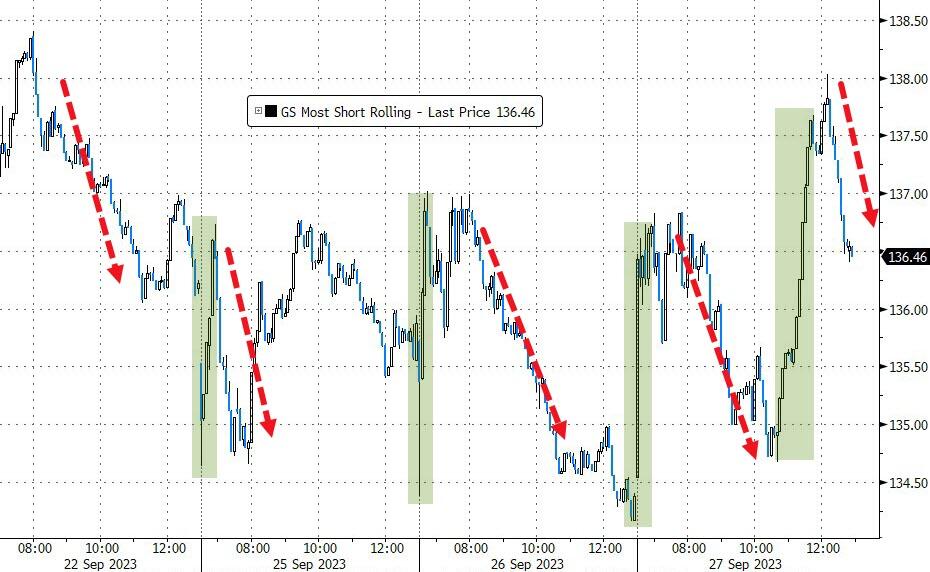
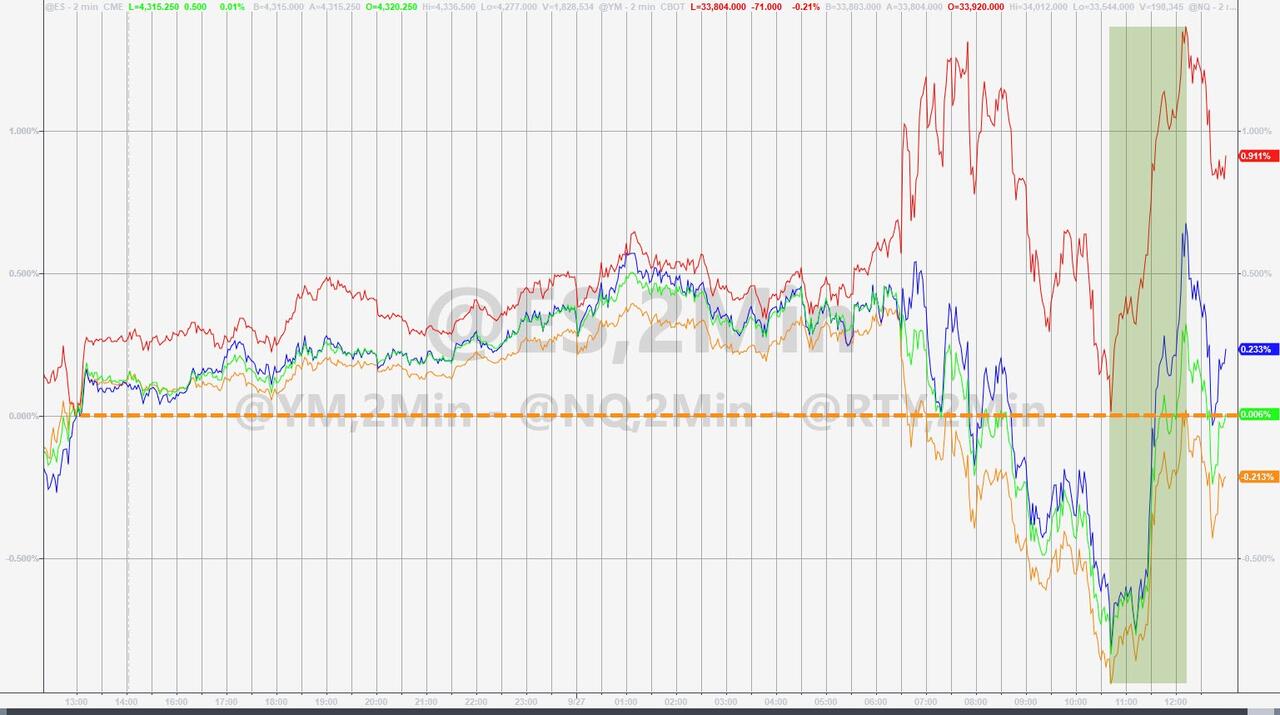
For the 3rd day in a row, the machines tried (and failed) to ignite a short-squeeze early on... but around 1400ET, something snapped and the squeeze was in and equity markets went vertical. BUT... the ignited momentum ran out of steam quite quickly...

Source: Bloomberg

The late day squeeze-gasm lifted everything green (even The Dow briefly) but as the squeeze ran out of ammo, so did the rally. The Dow was red, S&P unch, Nasdaq very modestly higher and Small Caps solidly higher...

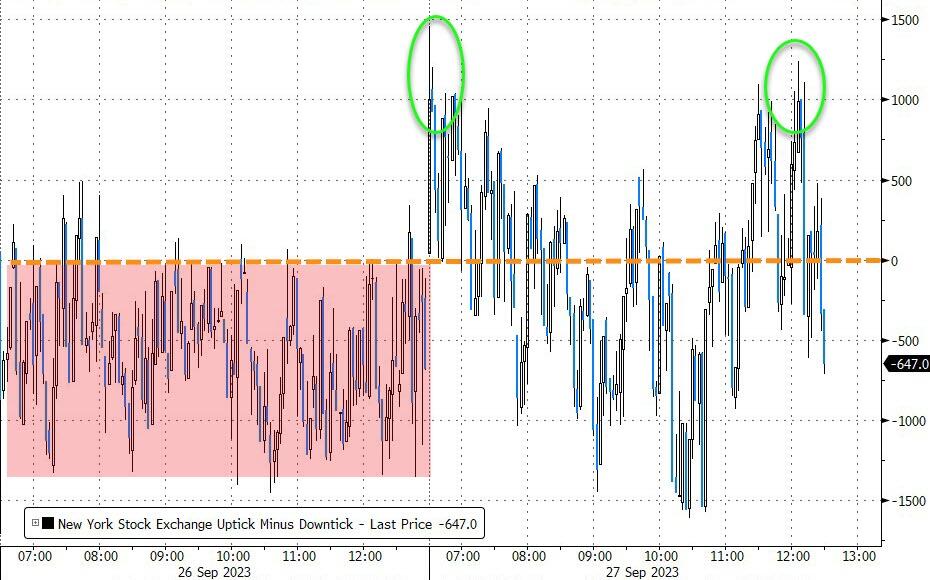
The big panic-buy program is evident in the intraday TICK data...

Source: Bloomberg

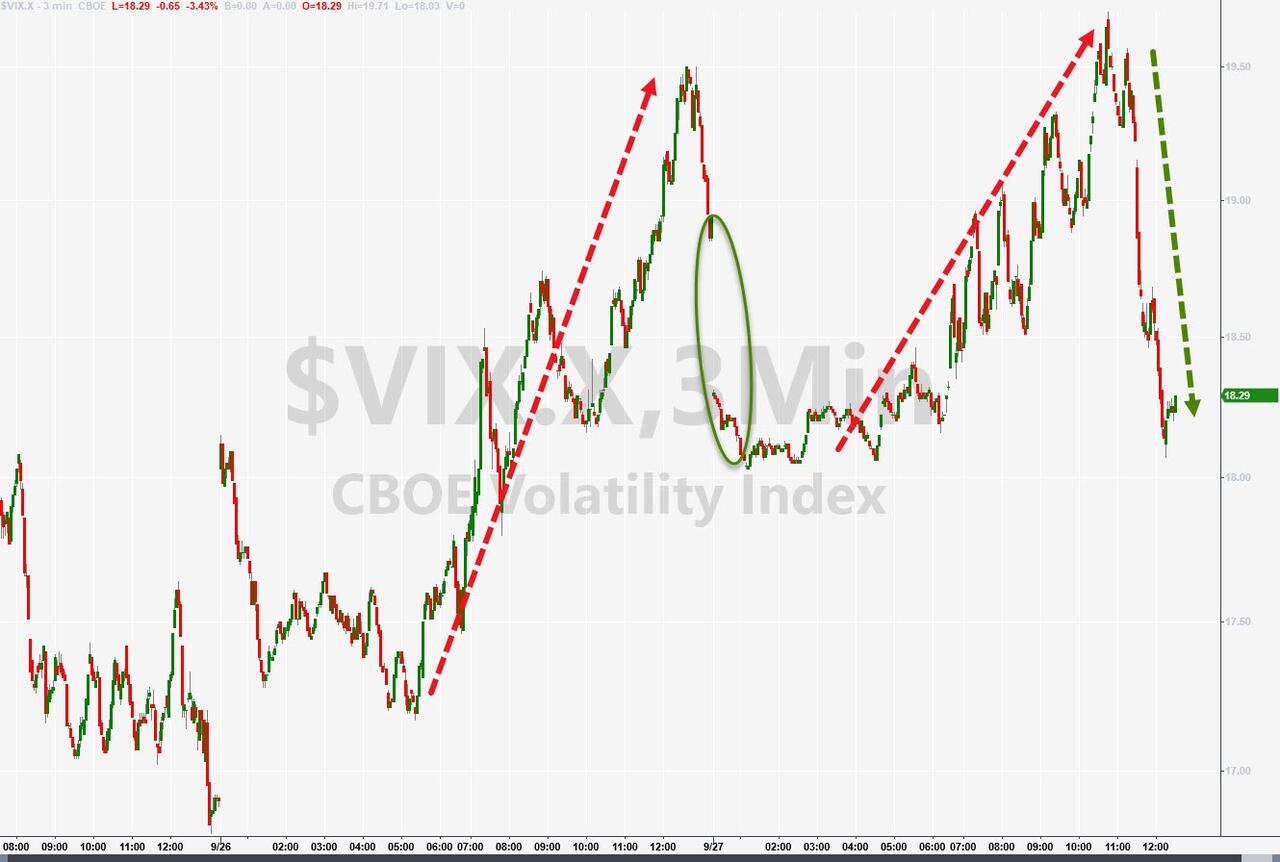
VIX was monkeyhammered lower around the 1400ET timeframe...

If you need a reason why we exploded higher this afternoon, it's simple: Kolanovic!!

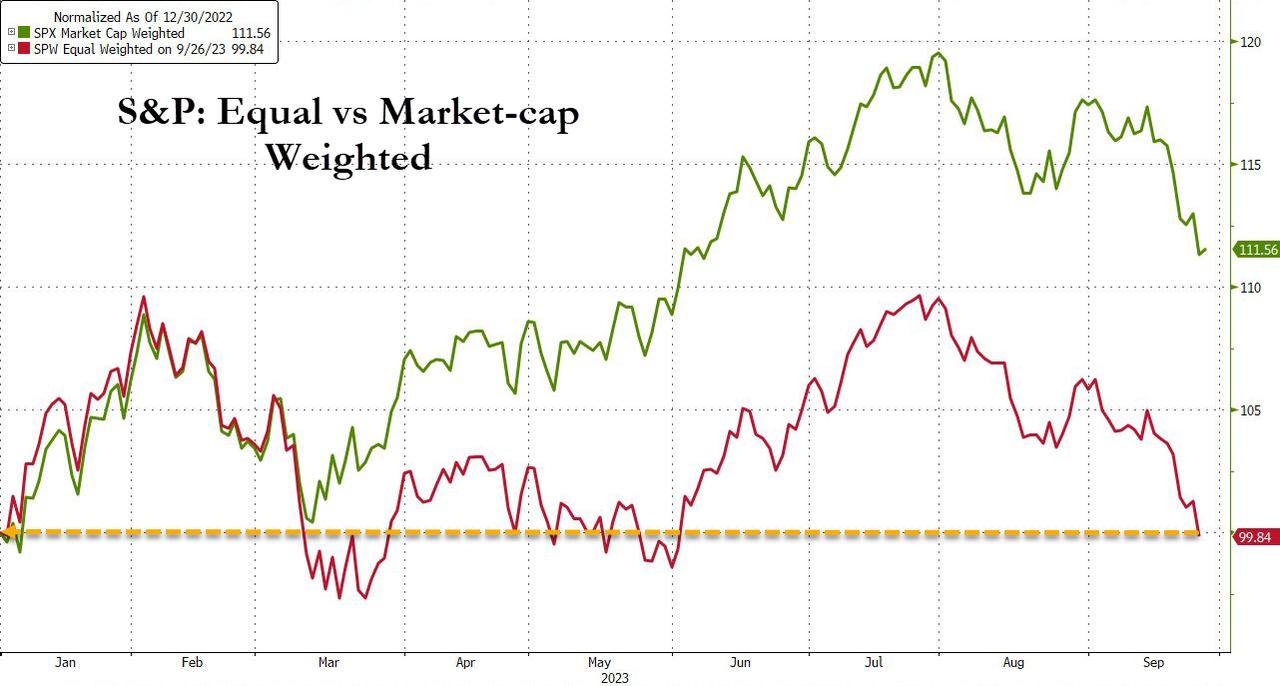
And before we leave equity-land, the equal-weighted S&P just went red YTD...

Source: Bloomberg

But we are seeing multiple sigma moves across multiple markets now with bitcoin, yields, and gold all swinging violently as the dollar and crude just keep surging

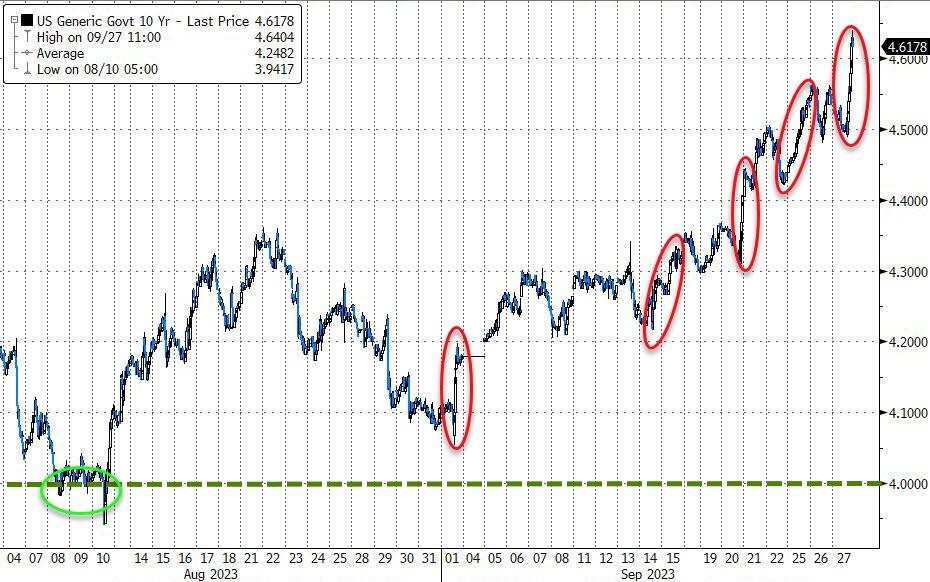
Treasuries were clubbed like a baby seal again today with whole curve up 6-9bps with 10Y blowing out above 4.60%...

Source: Bloomberg

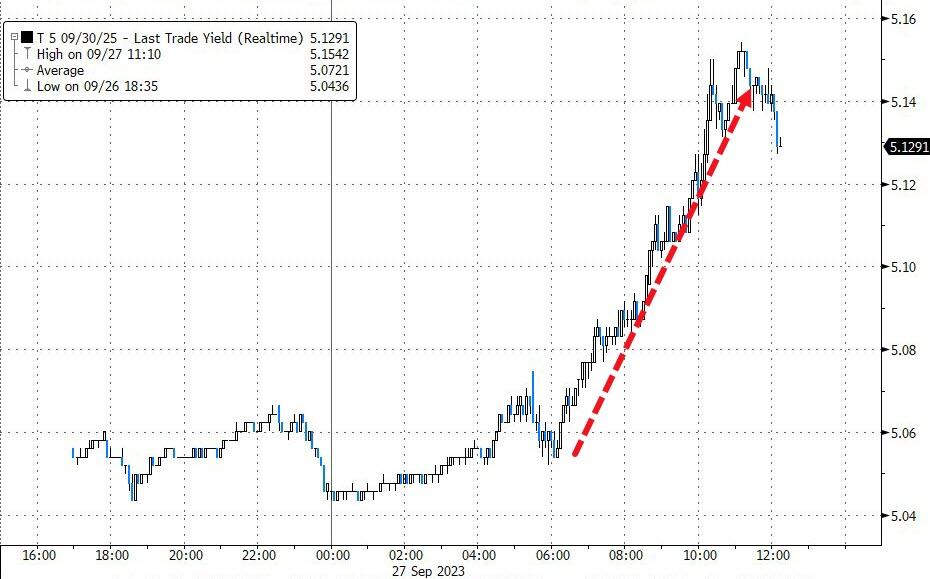
The freshly-minted 2Y yield also soared today...

Source: Bloomberg

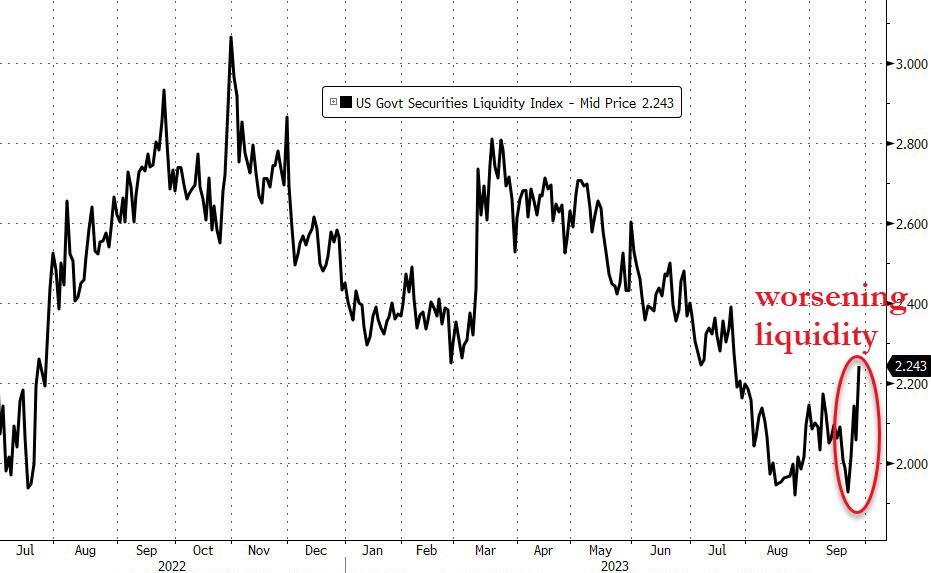
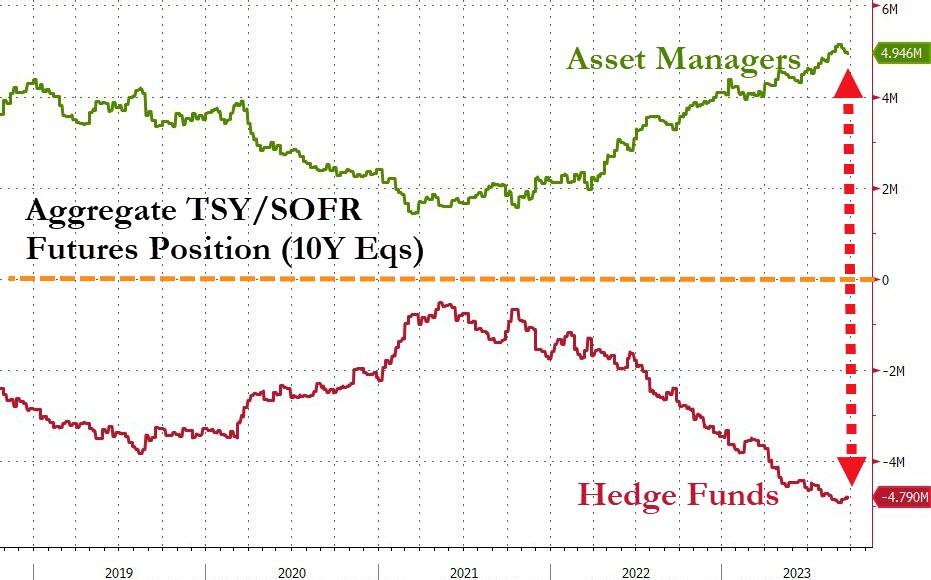
One thing of note - and its very premature - but there are some signs of liquidity stress appear in the Treasury market...

Source: Bloomberg

...and with the basis-trade threat as large as its ever been, it's worth keeping an eye on any signs of trouble.

Source: Bloomberg

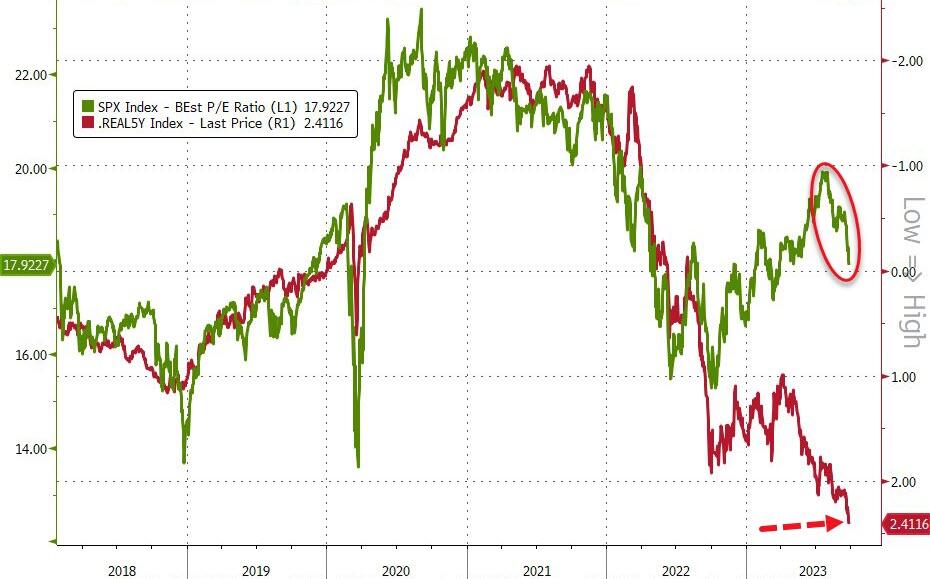
Real rates continue to soar (and S&P valuations are starting to retreat)...

Source: Bloomberg

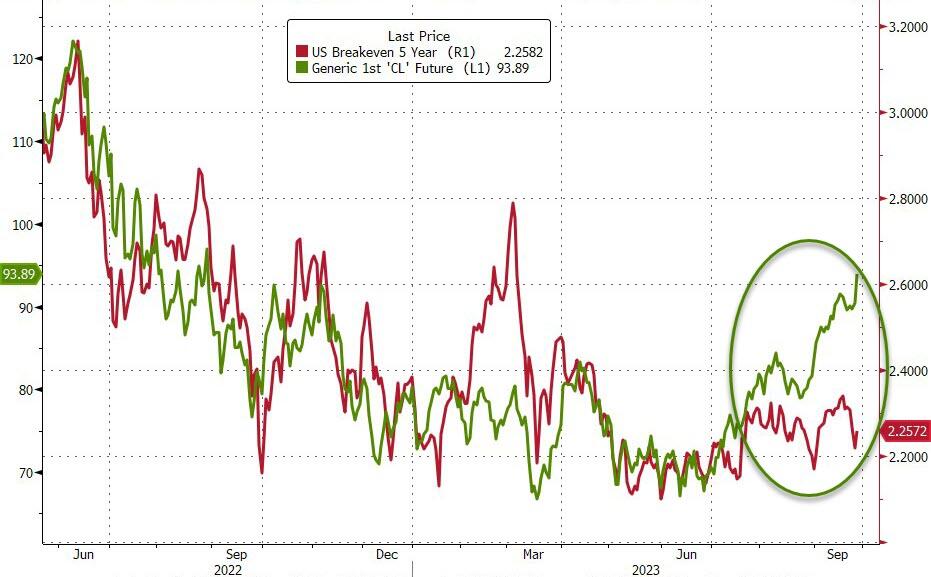
But, while crude prices are soaring, breakevens are flat...

Source: Bloomberg

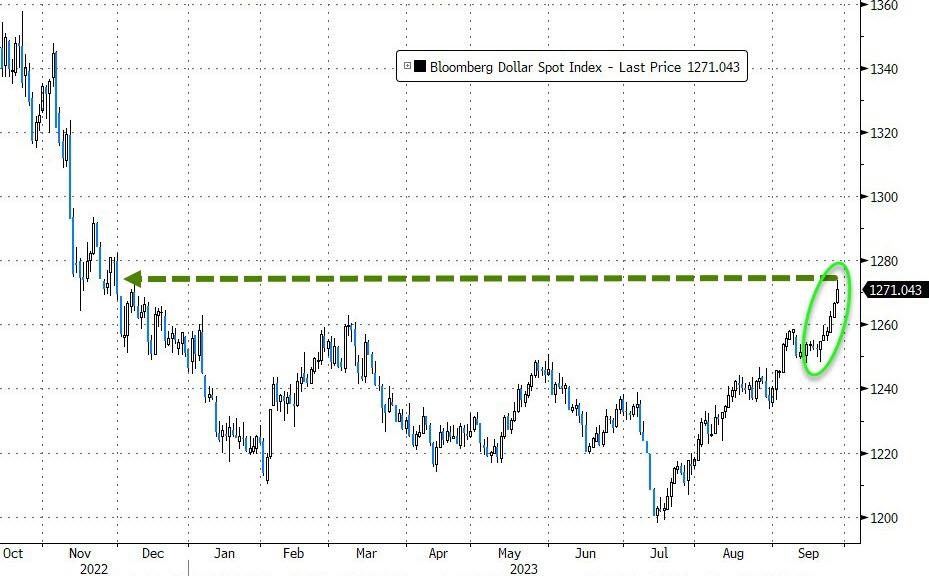
The dollar surged for the 6th day in a row, now at its highest since Nov 2022...

Source: Bloomberg

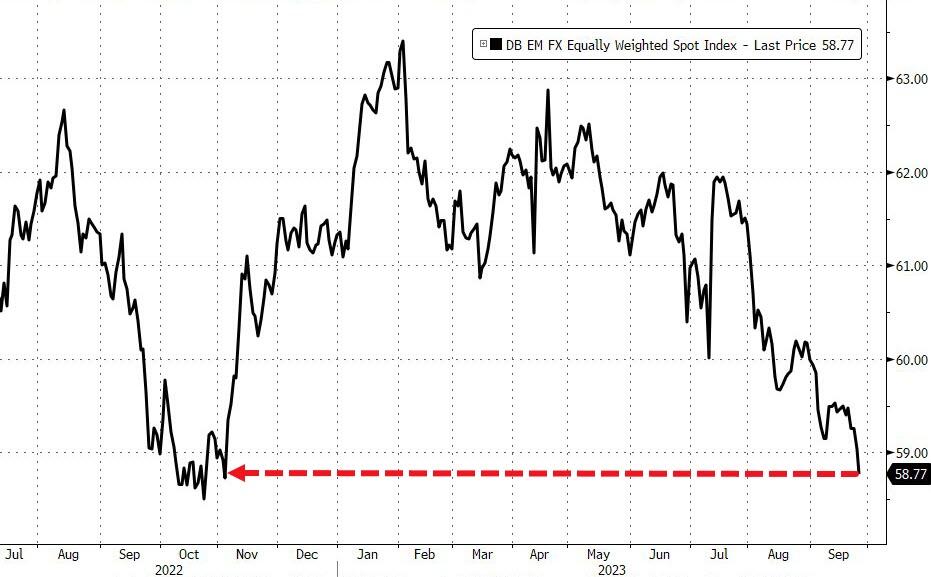
...and as the dollar soars, so Emerging Market FX tumbles to its lowest since Nov 2022...

Source: Bloomberg

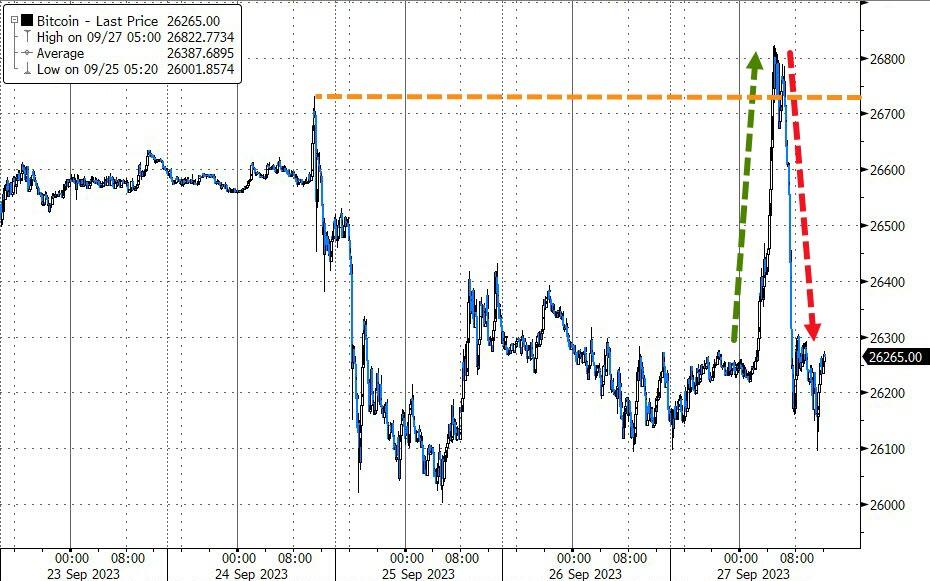
Bitcoin pumped-and-dumped on the day... for no good reason at all...

Source: Bloomberg

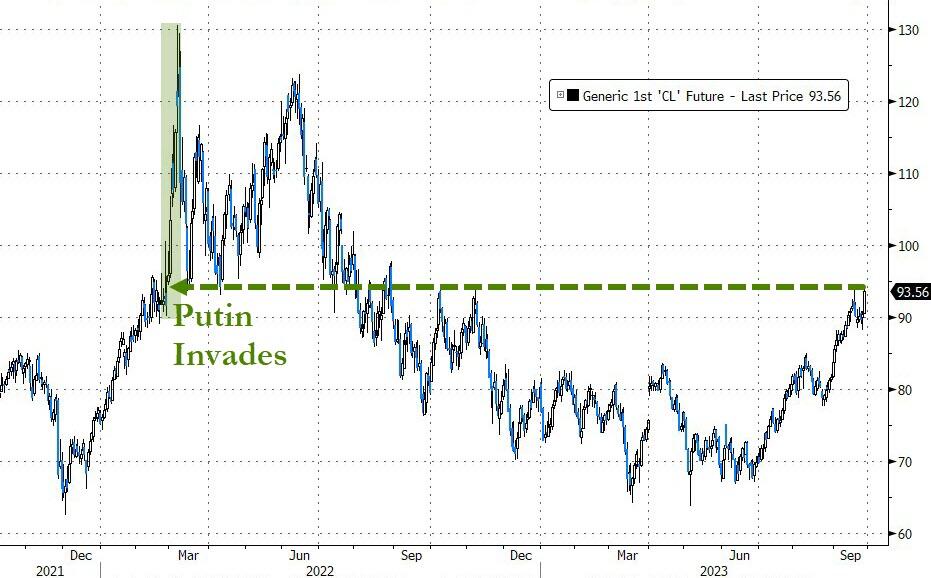
Oil prices soared after another major drawdown in stocks at Cushing (and overall crude), rallying right up to pre-Putin-Invasion levels...

Source: Bloomberg

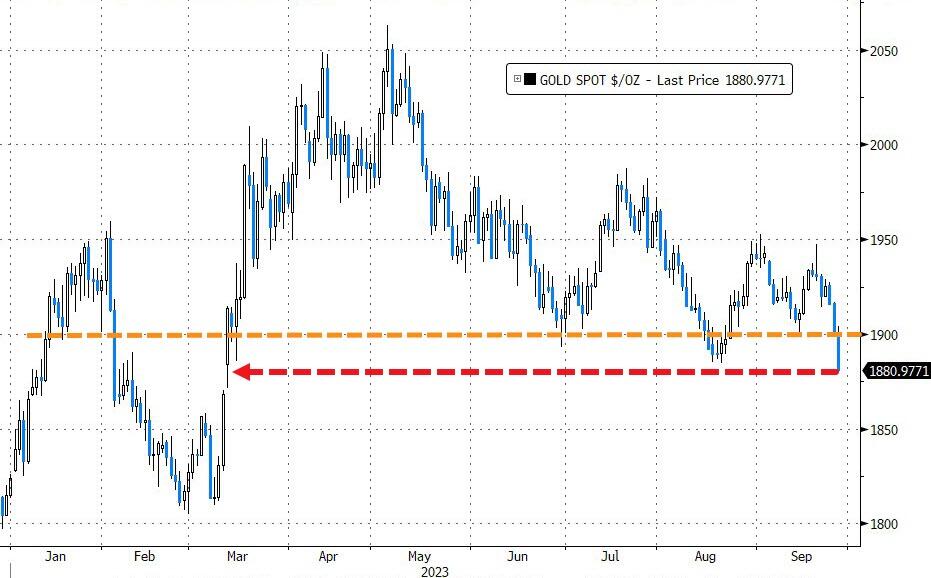
Spot gold prices extended their recent plunge below $1900, back to the lowest since March...

Source: Bloomberg

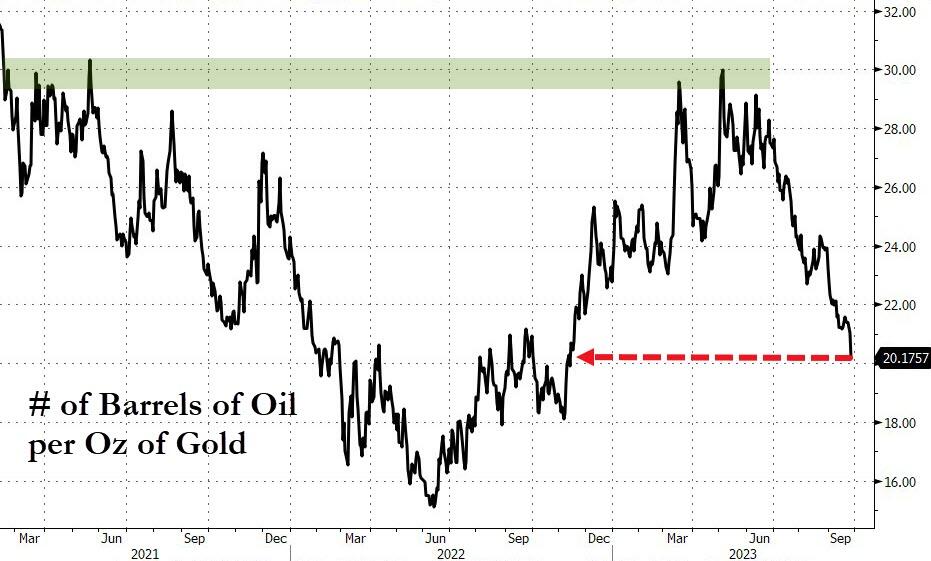
The surge in crude prices, and plunge in gold, has oil at its most expensive since Nov 2022 (at around 20 barrels/Oz)...

Source: Bloomberg

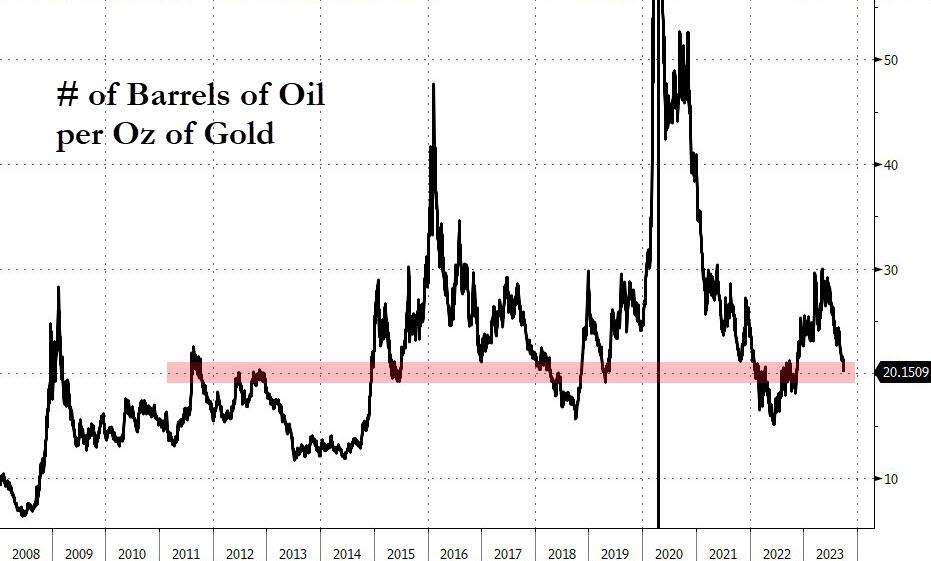
...historically that has been a level of support for the Oil/Gold ratio...

Source: Bloomberg

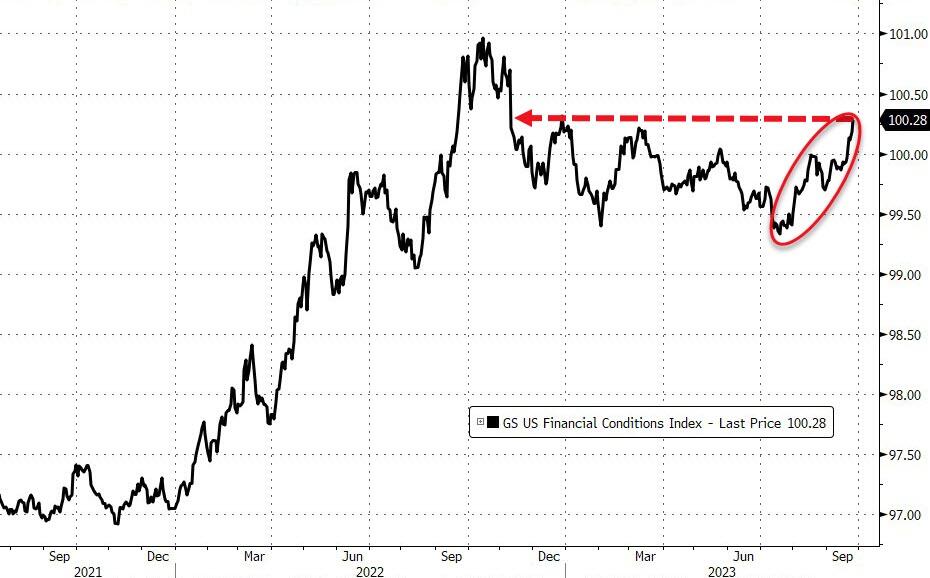
Finally, financial conditions are tightening significantly, now at the tightest since Nov 2022...

Source: Bloomberg

...which is what The Fed wants to see.

Tyler Durden Wed, 09/27/2023 - 16:00
https://ift.tt/fsFbKOR
from ZeroHedge News https://ift.tt/fsFbKOR
via IFTTT

Bonds & Bullion Purged As Crude & King-Dollar Surge Into Qtr-End SocialTwist Tell-a-Friend
| 0 comments ]

Shutdown: Toward The Brink (Or Why This Time Might Be Different)

Authored by James Rickards via DailyReckoning.com,

Should market participants be concerned about the possible government shutdown at midnight on Sept. 30?

It’s too soon to answer that question definitively, but it’s not too soon for investors to take some defensive action.

If it does happen, it’ll be different from those that have gone before. Let’s break it all down…

While most of us keep our books and records on a Dec. 31 fiscal year, the U.S. government is different. The U.S. fiscal year runs from Oct. 1 until midnight on Sept. 30.

The fiscal year is dated by the calendar year in which the last day falls.

So the fiscal year beginning on Oct. 1, 2023, is called “Fiscal Year 2024” by the Government Accounting Office (GAO) and the Office of Management and Budget (OMB). Leave it to the government to make things difficult and hard to follow, but that’s how they do it.

That means fiscal year 2023 ends at midnight on Sept. 30, 2023. We’re up against the clock and that’s why you’re hearing so much about a government shutdown right now.

It’s the job of Congress to pass appropriations bills to keep the government open. Under so-called regular order, each major department has its own appropriations bill. So there should be separate bills for Defense, the State Department, the Department of Education and so on.

Each bill should be voted on separately and each bill should pass before Sept. 30 to keep that department and the government as a whole running in the new fiscal year.

But in the real world, the “regular order” process never happens. Typically, the House and Senate and the two parties in each body can’t agree on anything by Sept. 30.

Instead, they pass a continuing resolution (CR) that basically says “everybody can keep spending the same amount of money on the same programs as they did last year and we’ll get back to you on what the new fiscal year appropriations will be.”

A CR can last for various amounts of time from, say, 30 days to six months. Sometimes the CR purposely pushes the deadline past the calendar year-end so Congress does not have to make difficult decisions prior to Election Day in November or the holiday season.

Passing a CR is basically a matter of kicking the deadline into the high grass.

Eventually Congress agrees on spending, but they don’t do it department by department as in regular order. Instead, they sweep the entire $1.6 trillion budget into a single bill called an “Omnibus Bill” that forces members to vote the entire package up or down.

This is a way to force items that many members don’t like (such as abortion spending) into the same bill with things they do like (such as military spending). If you want the goodies, you have to vote for things you may oppose.

That’s how the leadership corrals all the votes they need despite the lack of consensus on many line items.

How did we get here? And why would a potential shutdown just days from now be worse than previous shutdowns?

Read on...

This Time Might Be Different

The U.S. has had 22 gaps in funding the federal budget since the enactment of the current budget and appropriations legislation in 1976. (A gap in funding arises when the new fiscal year has begun but the Congress has not passed any appropriations bills.)

Prior to 1980, these gaps in funding did not result in government shutdowns.

But in 1980, Jimmy Carter’s Attorney General Benjamin Civiletti issued a legal opinion that required the government to shut down if a funding gap occurred. This opinion was not adhered to during the Reagan administration (1981–1989) but beginning in 1990, all funding gaps have resulted in shutdowns.

There have been 10 government shutdowns since 1980.

The shutdowns in 1980, 1981, 1984 and 1986 each lasted only one day. A shutdown in 1990 lasted three days, another in 1995 lasted five days and a more recent shutdown in 2018 lasted only three days. None of the seven shutdowns just listed was of any great economic significance despite the usual political histrionics.

That leaves three major shutdowns that lasted longer and were more disruptive.

The first of these was over year-end 1995–1996 during the Clinton administration when the government was shut down for 21 days.

This was mainly about Newt Gingrich and the Republicans trying to cut government spending at the same time that Clinton was trying to increase spending to help his 1996 reelection campaign. Republicans lost that fight.

The next major shutdown was in 2013 when the government was closed for 16 days. This fight was mainly about Republicans trying to delay funding for Obamacare to allow time to make amendments. In the end, a compromise was worked out, but Obamacare never was repealed or materially amended. Republicans lost this fight also.

The most recent major shutdown was over year-end 2018–2019 during the Trump administration. This shutdown lasted 35 days, by far the longest on record. This was mainly a battle between Donald Trump and Nancy Pelosi about funding for Trump’s border wall.

In the end, Pelosi won and the funding for the wall was never provided by Congress. (Trump later redirected some Pentagon funding to the wall on national security grounds, but only 250 miles out of 1,800 miles needed were ever built.) This was another Republican failure.

If you’re keeping score, it’s Democrats 3, Republicans 0 when it comes to policy fights that lead to major government shutdowns. The Democrats understand this dynamic well and have the media on their side.

By the way, there’s much less to these government shutdowns than the screaming headlines suggest. Critical areas of the government such as national security, defense, energy and operations at the White House continue as if nothing happened.

The Democrats love to close the national parks because they know it aggravates voters (who blame Republicans) but that’s hardly a critical function. Non-essential workers are asked to stay home but when the budget issues are resolved they always get back pay. So the whole thing amounts to a paid vacation for those furloughed and business as usual for everyone else.

With this history of Democrats prevailing on the policy fights and Republicans taking the blame for the shutdown itself, why are Republicans in the House potentially forcing another shutdown this week?

It’s clear that Democrats in the House and both parties in the Senate would sign on for a CR that would push the budget deadline out at least 90 days or even into early 2024. Speaker of the House Republican Kevin McCarthy is working with a razor-thin majority.

Republicans only have a nine-vote majority in the House. That means they can only lose four votes if they want to pass legislation.

McCarthy is facing a rebellion from about 10–15 of the most conservative members of his caucus. Some of them want separate appropriations bills (that’s not happening). Some of them refuse to vote on any CR ever; they want to hit the Sept. 30 deadline. That’s not happening either.

Others are more flexible on timing, but want some conditions on a CR that would impose specific spending caps when the Congress does finally get around to passing individual appropriations.

McCarthy has proposed a 30-day CR with some prospective spending caps. This would never be agreed to by the Senate, but at least it would move the process out of the House and put the ball in the Senate’s court.

More importantly, it satisfies most of the conservative House members who are putting up a fight about total spending and specific programs. They still want separate votes on separate bills, but they’re willing to wait 30 days to try to work things out.

McCarthy’s problem is that there are still six members who won’t agree to this 30-day compromise. Not all of the six have the same wish list. There are two or three who are “Never CR” people.

McCarthy can afford to lose them because he has a four-vote cushion. But there are a few more who want tighter promises on the spending caps. That’s enough to sink the entire process and that’s exactly what’s happening.

Over the course of Sept. 20 and 21, McCarthy lost two key procedural votes on the rules that must occur before the substantive vote on the 30-day CR. McCarthy finally gave up, sent everyone home and will pick up the process this week with just days to go before the Sept. 30 deadline.

Meanwhile, the Senate is trying to rush through its own CR to get ahead of the House. If they can do it, they’ll be able to blame the House for the overall failure if there is one. Most of the Republican leadership in the Senate are in the RINO category (McConnell, Thune, Ernst, Romney, Cornyn, etc.) so they don’t mind blaming the House conservatives one bit.

It’s possible this is just a game of chicken and that the CR will pass in some form late on Sept. 30. My view is that’s unlikely. The divisions are not only between House and Senate, and Democrats and Republicans. There are serious divides within the Republican House caucus between budget radicals and moderate get-along types.

This shutdown is different because it’s not about a specific policy issue such as Obamacare or the wall. It’s about the way the entire government finances itself and ways to cut spending to restore some fiscal sanity to Washington. Those are the biggest budget issues since the current budget process was enacted in 1976.

The radicals are dug in. The RINOS are circling. The Democrats are cheering the shutdown on because they believe it only hurts Republicans. If this shutdown occurs, it could last longer than the 35-day standoff between Trump and Pelosi in 2018. That could do serious damage to an economy that’s already on the edge of recession.

Investors should hope for the best but prepare for the worst. That means reducing equity exposure now and increasing cash allocations until some clarity is restored. That may take the month of October. It may take even longer.

Tyler Durden Wed, 09/27/2023 - 15:20
https://ift.tt/AXOe9Sg
from ZeroHedge News https://ift.tt/AXOe9Sg
via IFTTT

Shutdown: Toward The Brink (Or Why This Time Might Be Different) SocialTwist Tell-a-Friend
| 0 comments ]

OpenAI Seeks $90 Billion Valuation In Potential Sale Of Existing Shares

OpenAI has been in discussions with investors about a possible share sale which would value the AI startup behind ChatGPT at between $80 and $90 billion, nearly triple what it went for in an April share sale.

The startup, which Microsoft owns 49% of, says it plans to reach $1 billion in revenue this year, and much more next year. The company generates revenue by charging $20 per month for access to its most advanced public version, GPT-4, as well as licensing the large language models behind the bot.

The deal is expected to allow employees to sell their existing shares as opposed to the company issuing new ones to raise additional capital. OpenAI representatives have begun pitching investors on the deal, the people said, though it is possible the terms could change. 

A valuation of $80 billion or more would make OpenAI one of the most highly-valued global startups, behind Elon Musk’s SpaceX and TikTok owner ByteDance. -WSJ

In April, OpenAI closed a $300 million sale of shares which valued the company at $27 billion - $29 billion, securing funding from VC firms including Sequoia Capital, Andreessen Horowitz, Thrive and K2 Global. This was separate of Microsoft's investment which closed in January.

That said, the company is currently being sued by a group of prominent authors who have joined a class action lawsuit which alleges that products like ChatGPT illegally uses their copyrighted work to train their models.

"At the heart of these algorithms is systemic theft on a massive scale," the plaintiffs claim.

According to James Grimmelmann, professor of digital and information law at Cornell University Law School, "If anyone is going to win on the straight-up copyright infringement claims against OpenAI, this is probably the lawsuit that has the best chance of it."

Tyler Durden Tue, 09/26/2023 - 17:05
https://ift.tt/hLiR5Bc
from ZeroHedge News https://ift.tt/hLiR5Bc
via IFTTT

OpenAI Seeks $90 Billion Valuation In Potential Sale Of Existing Shares SocialTwist Tell-a-Friend