| 0 comments ]

Jeff Bezos' Superyacht Generates 447 Times The Yearly Carbon Emissions Of Average US Household

Amazon founder Jeff Bezos' triple-masted $500 million superyacht is far from climate-friendly, generating hundreds of times the annual carbon footprint of a typical American household. 

At 417 feet, "Koru" is the world's largest sailing yacht. It produces a whopping 7,154 tons of greenhouse gasses on a per-annum basis, or about 447 times the entire annual carbon footprint of the average US household, the New York Post reported, citing Indiana researchers. 

Indiana anthropology Ph.D. candidate Beatriz Barros and anthropologist Richard Wilk led the research into Koru's emissions. 

Barros said, "But because they are so rich and so powerful, they feel like they are entitled [to travel in carbon-producing superyachts], whereas you and I should drive less, should eat less meat." 

Despite Koru's "green" ability to travel via the three masts, she said plenty of greenhouse gasses are still released to provide electricity on the vessel - typically by diesel marine generators. 

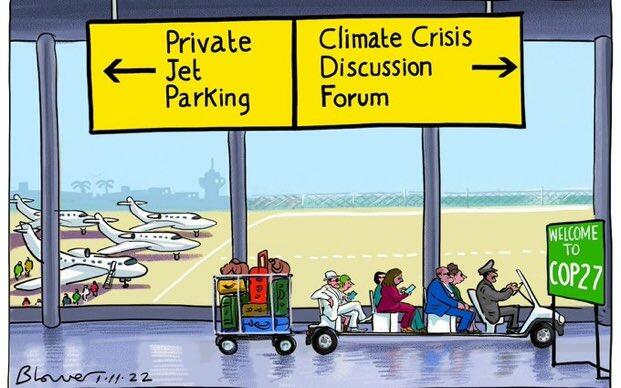
Meanwhile, the billionaires advocate for climate change while sailing around the world in luxury superyachts and jetting across continents in Gulfstream G500s that emit large amounts of carbon emissions. Then they advocate for laws to ban gas stoves, phase out petrol vehicles, ban cow farts with the eventual goal of insect burgers, and other radical structural changes to society that mirror WEF's global reset plan. 

This all comes days before Thursday's United Nations climate summit begins in Dubai. 

The two-week summit, COP28, also comes as the 'green' energy bubble is melting. 

Tyler Durden Mon, 11/27/2023 - 17:20
https://ift.tt/E6WaqSD
from ZeroHedge News https://ift.tt/E6WaqSD
via IFTTT

Jeff Bezos' Superyacht Generates 447 Times The Yearly Carbon Emissions Of Average US Household SocialTwist Tell-a-Friend
| 0 comments ]

Say Goodbye To The Middle Class: Half Of All American Workers Made Less Than $40,847.18 Last Year

Authored by Michael Snyder via TheMostImportantNews.com,

If you are wondering why so many Americans are stressed about their finances these days, just look at the numbers. 

The Social Security Administration just released national wage statistics for 2022, and the figures that they have given us do not paint a pretty picture at all.  In particular, we should all be deeply alarmed that the median wage earner brought home just $40,847.18 last year.  That breaks down to about $3,400 a month, and that is before taxes. 

Needless to say, you cannot live a middle class lifestyle in America today on just $3,400 a month before taxes.  So in most households more than one person must work, and in many cases more than one person is working multiple jobs.

During our current inflation crisis, the cost of living has been rising much faster than paychecks have, and this is squeezing American families like never before.

Right now, the national median price of renting a home is $1,978 a month, and so after paying rent on a home the average worker wouldn’t have much left over for anything else.

Meanwhile, actually owning a home is the most unaffordable that it has been since 1984

Buying and paying for a house costs Americans more now than at any point in almost four decades. Thanks to strong demand and a limited supply of new homes – even as mortgage rates have more than doubled in the past year – it now takes nearly 41% of the median household’s monthly income to afford the payments on a median-priced home, according to research from Intercontinental Exchange (ICE). The last time housing payments cost that much was in 1984.

Of course it isn’t just the cost of housing that has gone crazy.

Just about everything has soared in price over the past few years, and those at the bottom of the economic food chain are being hit the hardest

But when compared with January 2021, shortly before the inflation crisis began, prices remain up a stunning 17.62%.

Inflation has created severe financial pressures for most U.S. households, which are forced to pay more for everyday necessities like food and rent. The burden is disproportionately borne by low-income Americans, whose already-stretched paychecks are heavily impacted by price fluctuations.

If things are hard for you and your family right now, please understand that you are not alone.

Most of the country is in the exact same boat.

In a desperate attempt to maintain their middle class lifestyles, millions upon millions of Americans have been taking on debt like never before, and as a result we are now facing an unprecedented consumer debt bubble

Inflation has also impacted spending on major purchases. Balances on non-housing loans have more than doubled since 2003, totaling roughly $4.8 trillion, according to data from the New York Federal Reserve. More than $500 billion of that debt accumulated just in the past two years – a bigger jump than any other two-year period since 2003, the earliest year available.

Some of that debt comes from skyrocketing car prices, but credit card balances are growing the fastest of all – roughly 34% from the fall of 2021.

Unfortunately, the consumer debt party is coming to an end because financial institutions are starting to become significantly tighter with their money.

A credit crunch has begun, and it is only going to intensify in the months ahead.

Of course that is more bad news for our rapidly shrinking middle class.

More formerly middle class Americans are falling into poverty with each passing day, and this is causing an alarming surge in demand at food banks from coast to coast

As families across the nation prepare for the holiday season, some food banks across the United States dedicated to fighting hunger say they are experiencing an increase in demand following the end of pandemic-era SNAP benefits, an increase in inflation, and other regional factors.

Caroline De La Fuente helps care for her 16 grandchildren while their parents work to make ends meet and is one of the thousands of people who, according to data, depend on food banks. She told ABC News that without the San Antonio Food Bank, her family and others in the community wouldn’t eat.

“A lot of people would go hungry,” she said. “Kids would go hungry at night. People would not be able to celebrate Thanksgiving.”

The number of homeless Americans is spiking as well.

In fact, the Wall Street Journal has reported that homelessness in the United States has been increasing at the fastest pace ever recorded in 2023….

The U.S. has seen a record increase in homeless people this year as the Covid-19 pandemic fades, according to a Wall Street Journal review of data from around the country.

Yes, this is really happening.

The middle class really is coming apart at the seams right in front of our eyes.

And this is one of the reasons why so many people have such short fuses these days.

Even the smallest things can turn some people into raving lunatics at this point.  For example, one woman actually drove her SUV into a Popeyes restaurant because an order of biscuits was missing

A woman drove her SUV into a Georgia Popeyes building after the manager said she became angry over a missing order of biscuits Saturday, according to an incident report filed by the Richmond County Sheriff’s Office.

The manager said that prior to the crash, restaurant staff gave 50-year-old Belinda Miller biscuits to rectify the error, but she was still not happy and “…would drive her vehicle into the building.”

According to the incident report, a witness who allegedly waited in line with Miller told them to hurry and get their order “because she was coming back.”

Miller did return, according to the incident report, and allegedly drove her SUV into the chicken restaurant, narrowly missing an 18-year-old employee.

I wish that I could say that this was an isolated incident, but it isn’t.

There are so many crazy people running around out there, and you never know who will be the next one to totally lose it.

If things are this bad now, what is going to happen once the economy totally falls apart and our society descends into complete and utter chaos?

Economic conditions have deteriorated substantially in 2023, and I am entirely convinced that 2024 will be even worse…

*  *  *

Michael’s new book entitled “Chaos” is now available in paperback and for the Kindle on Amazon.com, and you can check out his new Substack newsletter right here.

Tyler Durden Mon, 11/27/2023 - 16:20
https://ift.tt/hk8HNnq
from ZeroHedge News https://ift.tt/hk8HNnq
via IFTTT

Say Goodbye To The Middle Class: Half Of All American Workers Made Less Than $40,847.18 Last Year SocialTwist Tell-a-Friend
| 0 comments ]

America's Dangerous Desire To Demonize Masculinity Must Stop

Authored by John Mac Ghlionn via The Epoch Times,

According to a recent study out of the UCSF School of Medicine, the average American female now lives 5.8 years longer than the average American male. The gap hasn’t been this big since 1996.

Speaking to The New York Times, Dr. Brandon Yan, the lead author of the study, called the findings “unsettling.”

“We need to understand which groups are particularly losing out on years of life expectancy,” he noted, “so interventions can be at least partially focused on these groups."

When discussing the causes of the life expectancy gap between men and women in the United States, Dr. Yan responded:

“All of these point to a picture of worsening mental health across the board, but particularly among men.”

Which brings us to the demonization of masculinity.

In recent years, it has become frighteningly common to hear the word "toxic" followed by the word "masculinity." According to another recent study, published in the International Journal of Health Sciences, men who view masculinity in a negative light are more likely to have lower mental well-being than men who view it in a positive light,

The aptly titled study, “The belief that masculinity has a negative influence on one’s behavior is related to reduced mental well-being," analyzed the beliefs and behaviors of 4,000 men. The findings clearly demonstrate the relationship between widespread misconceptions surrounding masculinity and how these misconceptions affect men's mental health. The findings also show that masculine attitudes are something to be preserved and promoted, not demonized.

There was a time, not that long ago, when masculine traits—strength, courage, and assertiveness—were celebrated by all Americans, regardless of their sexual orientation or political affiliations. When did things change? In the 1980s, it seems.

Commenting on the comprehensive study, Eric W. Dolan, the founder and editor of PsyPost, suggests that in the 1980s, “there was a notable shift” in how masculinity was viewed. Specifically, the lens through which it was viewed became more critical in nature. Masculinity, he notes, became synonymous “with negative traits like misogyny and homophobia, and linked to issues such as poor mental health and aggressive behavior.” This unnecessary and entirely destructive transition, adds Mr. Dolan, “was partly fueled by sociological theories, leading to what some call a 'deficit model' of masculinity—focusing primarily on its negative aspects.”

Mr. Dolan is right. However, he misses the bigger picture. The #MeToo Movement, I suggest, was the final nail in the coffin of masculinity. In 2017, the year Harvey Weinstein’s sexual misconduct became public knowledge, the social expectations of being a man changed—dramatically so. Masculinity went from being "problematic" to being "toxic," a "virus" in need of a cure. As is clear to see, males who subscribe to this virulent, deeply flawed theory are more likely to suffer than those who rightly reject it.

John Barry, the author of the abovementioned study and the co-founder of the Centre for Male Psychology, found that males who held a positive view of masculinity reported considerably higher levels of overall positivity than the naysayers. Those who dismissed the statement, “Masculinity prevents me from talking about how I feel about my problems,” had better mental health than those who embraced it.

Interestingly, Mr. Barry found that men with a positive view of masculinity were more likely to feel the need to protect women than those who viewed it more negatively.

When society demonizes masculinity, Mr. Barry told me, “it’s not just men who suffer.” He believes “that women are indirectly hurt by this in many ways.” For example, he added, “If a mother sees her son struggle to feel ok being male, his pain will impact her too. A mother might see her son's self-esteem slowly crushed as he grows older, feeling that as a man he has nothing positive to offer anyone, including potential girlfriends.”

Mr. Barry's point is a valid one. Women find masculine men attractive. This is an incontrovertible fact. There's a reason why, for decades, girls have had posters of James Dean, Paul Newman, George Clooney, Tom Cruise, and Brad Pitt on their walls. It's not rocket science. It's evolutionary science.

Men who view masculinity in a negative light may have a hard time attracting a partner. This is especially true if, as Mr. Barry noted, “they become underachievers, reclusive, and abandon any sense of being a protector of women and their community.”

Daughters, he added, “might believe the negative narrative about men and see their father in a negative light, but deeply regret this decades later when it is too late to make up for years of a soured father-daughter relationship.”

Barry’s message is clear: “If people are all connected as members of a society—and I believe that we are—then if men are being poisoned, then society is being poisoned.”

Again, he's right.

Men and women complement each other. More importantly, we need each other.

Tyler Durden Sun, 11/26/2023 - 18:40
https://ift.tt/NDa9u3H
from ZeroHedge News https://ift.tt/NDa9u3H
via IFTTT

America's Dangerous Desire To Demonize Masculinity Must Stop SocialTwist Tell-a-Friend
| 0 comments ]

Even Oliver Stone Is Starting To Question The 2020 Election

Authored by Monica Showalter via AmericanThinker.com,

Oliver Stone is a Hollywood leftist who has an odd way of being right at times.

His Academy Award-winning JFK was dismissed as a conspiracy theory.

Turns out he was likely closer to right all along -- as Tucker Carlson noted in one of this segments.

That's not the only one.

His South of the Border documentary about Latin America's wave of elected leftist dictators was initially criticized as Chavista propaganda, a glossing over of some of the region's worst rulers ... except that if you watch the thing, which I did twice, you realize he did an extraordinary job of revealing these people as the unattractive pigs that they were.

Sleazy, covetous, Imelda-like, sidelong, gangsterly ... he actually exposed them in all their glory in a way their worst critics couldn't.

That was a useful record of the era.

He's criticized government bureaucracies' demonization of ivermectin and vaccine mandates which is credibility right there.

His criticism of the way the Vietnam War was run by vested interests and swamp bureaucrats was probably spot on, too.

So now he's dropped another truth bomb, or at least is circling around it.

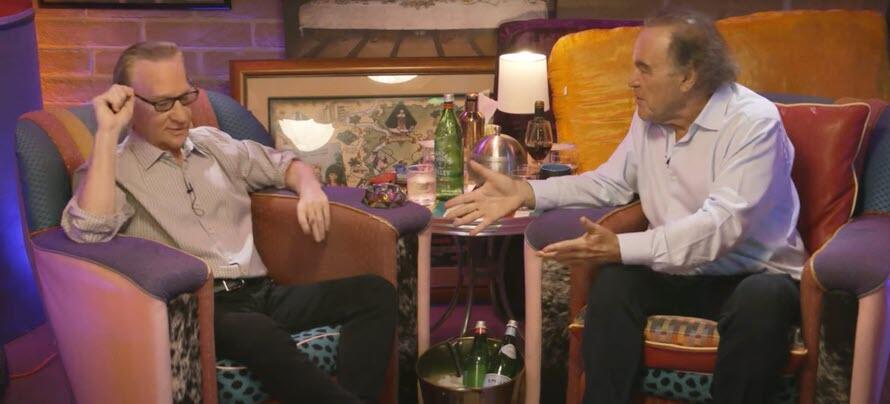
According to RealClearPolitics, which showed a segment and transcript of Stone conversing with Bill Maher:

Some of the transcript (they go off on tangents) is here, emphasis mine:

MAHER: Well, I mean, [Trump] doesn't concede elections. You know, the elections only count if we win theory of government. Okay. Well, come on. You know, Trump has he still has not conceded the election. He has not conceded. He does not honor them. Okay.

STONE: I mean, do you know for a fact that he lost? I'm just curious.

MAHER: Okay. You're going to make me --

STONE: I just don't know all of the facts.

MAHER: Well I do. Is there a conspiracy theory that you don't believe?

STONE: Come on, Bill. You know I'm intelligent.

MAHER: Intelligent? Of course you are. But look, look, I've had many people sit here and I'd say the same thing to them. Like, the key to getting along in America is not getting into these tribal things. It's understanding that you can have somebody in your life who you go for A, B, C, and D, We are so aligned and the person is so smart and they really get it.

And then E each of you thinks the other one's crazy and there's a couple of those with us, but we got A, B, C, and D, and so we just.

OLIVER STONE: We'll start with that.

MAHER: Yes, that's got to be enough. You can't make people like agree with you on these things. And you're right when you --

STONE: I'm just asking you, I'm not an expert on the election. I don't go on. I'm not a political junkie. You are. And you follow it very closely. Okay.

MAHER: All right, then I'll give you the thumbnail sketch. They tried it in like 60 courts. It was laughed out of every court, including by Republican judges. Report The people who save this democracy were Republicans. Good Republicans. In states where Trump pressured them like the guy, the one he's on trial for in Georgia. Find me 11,000 votes. It's on tape.

A guy like that saying to him, sir, we just don't do that here. I voted for you. I'm a Republican, but we just don't do that. That's what saved us. And they were Republicans. So you don't take their word for it. I mean, it would.

STONE: I don't know. I mean, you went through the 2000 election. That was horrifying to me. What happened when the Supreme Court closed that down. What happened there? You know, the popular vote was --

MAHER: What should we do? Do we just keep counting votes forever? Or should we still be counting them now?

STONE: No. Count them correctly.

MAHER: The people who have testified that this was a fair and will [sic] run election. It's a who's who of people like Bill Barr. Mitch McConnell. You're talking about Liz Cheney. You're talking about dyed in the wool, serious conservative Republicans who went with Trump really further out than a lot of us thought they would go with a guy like McCain's not a war hero.

[...]

STONE: Well, I don't know the facts. And I think I would trust the accountants more than the politicians. And I'd like to know what the accountants, the guys who vote, who know the most about votes, who do the Electoral Commission's, you know. I can't take Biden's word for it on anything.

MAHER: It's not his word. It's the Electoral Commission. It's Trump's own election security guy who said this was the most fair, well-run election that we've had ever.

STONE: Really?

MAHER: Yes.

STONE: I don't know about that. Okay. I don't know about that.

MAHER: Well, I mean, if there's nothing that can be said or argued that would convince you --

STONE: You, I think it would shock people --

MAHER: Then they called it --

STONE: -- Joe [Biden] got so many got so many votes. You know, that was what was shocking, that he did so well compared to what he was expected to do --

MAHER: Right.

STONE: -- because we believed all the East Coast media --

That's the thinking of an independent thinker, someone who asks again and again what we really know from hard knowledge and what we really know only from the press.

It's startling in its candor, not a full-blown admission of Trump support, but a person who can critically think and use his own knowledge to reason out strange things that have happened since. He cites the bad media treatment of Pete Rose as his theory on why people stick close to Trump, and his experience with the 2000 election, which he seems to think as stolen, as something that leaves the realm of stolen elections a distinct possibility since he believes it has happened before.

His views are not all that 'conspiratorial' as Maher seemed to want to dismiss them as. Polls show that a majority of Republicans believe the elections these days do have fraud -- as do a sizable minority of Democrats. They didn't get into it in the conversation, but many Democrats think our elections are compromised by cheating.

Stone stood his ground and didn't back away from the questions that Maher had no serious answers to -- claiming that the press, numerous neverTrumps and many neverTrump judges had reported the election as free and fair. Just because someone says so does not make it so, and that was why Maher kept misfiring at Stone and Stone held his ground. Stone also suggested that there were a lot of liars out there -- from the COVID shambles around vaccines and the like, to Joe Biden himself, whom he couldn't bring himself to believe a word he said.

One can only hope that Stone looks at this matter ever more closely. He's onto something. He's sniffing, he's asking questions and he might come up with a tremendous new work from it. Once again, he could be confoundingly correct.

Tyler Durden Sun, 11/26/2023 - 17:30
https://ift.tt/7r8DPbi
from ZeroHedge News https://ift.tt/7r8DPbi
via IFTTT

Even Oliver Stone Is Starting To Question The 2020 Election SocialTwist Tell-a-Friend
| 0 comments ]

We Didn't Learn A Whole Lot Last Week

By Peter Tchir of Academy Securities

We Didn’t Learn a Whole Lot Last Week

Data was mixed. Unemployment claims were lower (a sign of strength), durable goods were weak, and Global PMIs were just above 50 (Goldilocks economy). While I don’t pay much attention to CONsumer CONfidence, it is interesting that one-year inflation expectations jumped from 3.2% to 4.5% in two months. That occurred while oil (often a proxy for CONsumer CONfidence inflation expectations) dropped, some major retailers warned about deflating prices, and as far as I can tell, everyone is having some sort of a sale, which doesn’t seem inflationary to me.

The 10-year Treasury inched higher, finishing at 4.47% (up from 4.44%, and it was as low as 4.39%). Since it was illiquid/holiday-oriented trading, we can probably ignore most of those moves as noise.

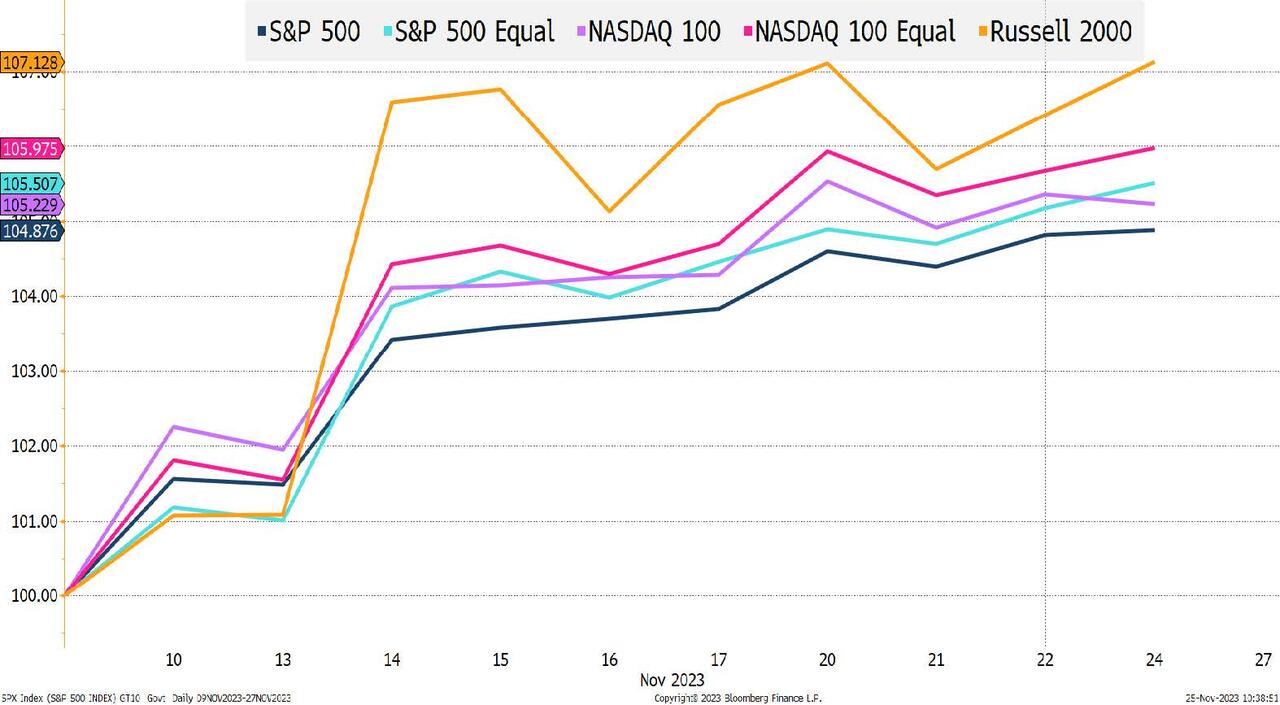
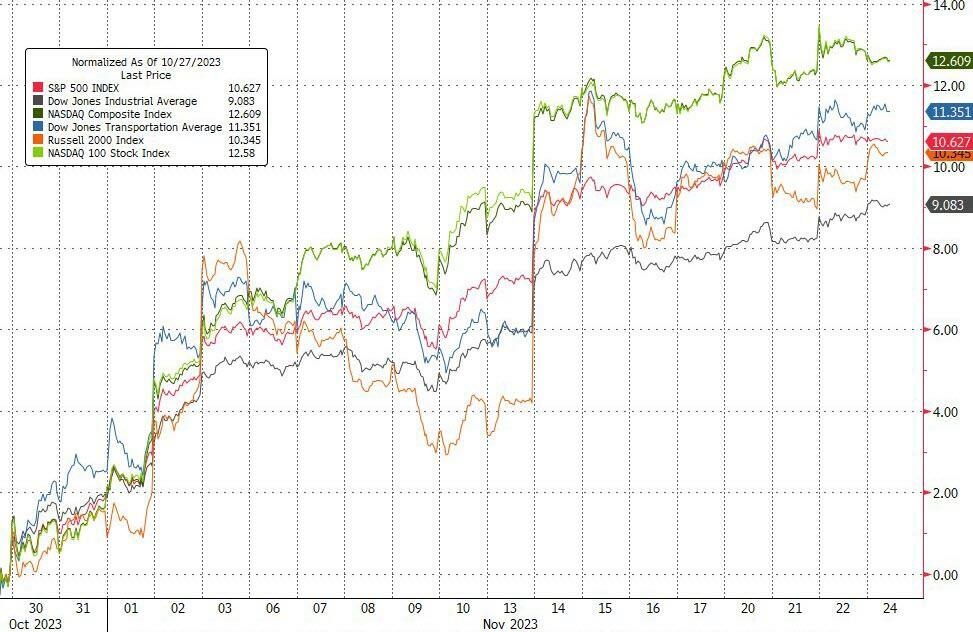
We also had NVDA earnings, which tend to serve as a “proxy” for AI. NVDA itself is down a touch since those earnings, but the markets as a whole have not suffered. That, along with the ongoing outperformance of the equal weighted indices and Russell 2000, is worth noting.

Since November 9th, the Russell 2000 has led the way, followed by the equal-weighted indices. That trend continued, and could be one of the more useful lessons of the week.

Ultimately, if AI is truly capable of generating efficiencies (today’s costs, versus today’s benefits) we should see more benefits accruing to companies that adopt and incorporate AI, thereby increasing earnings per share and multiples. So far, almost all of the AI benefits have accrued to the companies providing AI, which cannot last forever.

  • Either AI works, and the broad economy and a wide swath of companies should benefit, or the current cost/benefit doesn’t work, in which case spending on AI will decrease as we move away from “hype” spending into critical analysis.

Personally, I’m in the “tide will lift all boats” camp but cannot deny that the current up-front costs versus value (especially at today’s higher cost of capital) may slow adoption. We will learn more as we get through year-end earnings and have more time to digest the true “success” stories, rather than just looking at certain investments which seem to be more about “keeping up with the Joneses’” rather than being fully incorporated into corporate strategy (which is a necessary condition for AI to be truly effective).

China

To get more of a sustained rally into year-end, we likely need some positive developments on the Chinese economy via some new deals with the U.S., more domestic stimulus, or some combination of the two. That is a bet that I’m still making for all the reasons listed in prior reports (Rally on Garth, Dictator, and More than a Photo Op).

Credit

CDS index spreads are hovering around their tightest levels of the year (CDX IG closed at 63). Corporate bond index spreads are at the lowest levels of the year (109 bps for the Bloomberg Corporate OAS). That is a little misleading, as the average maturity has been dropping all year (far fewer long-dated bonds have been issued this year relative to short-dated bonds because rates rose and the curve became less inverted).

High yield prices, while not back to levels seen at the start of the year, have rallied nicely and are trading well.

As a “contrarian” it would be easy to be bearish, but I think that we will see spreads tighten further (largely because of the “pain trade” element, but also due to the “safety” element).

  • Enormous sums of money that have been allocated to private credit and distressed debt in anticipation of problems may need to be put to work. The “obvious” problems were the weak B credits and CCC credits in the leveraged loan universe. I can agree that this is where the “problems” arose. But if CLOs and private credit funds act like banks used to (“extend and pretend”), then the risk of default may be put off for some time. “Extend and pretend” occasionally is enough for a credit to recover, but it also tends to just delay default and result in lower recoveries. However, that won’t help those sitting on money meant for distressed investments. If the CLO market can open nicely for actual arbitrage deals (deals where non-sponsor/non-manager owned equity looks compelling), we could see a lot of buying interest in these loans that are supposed to be the problem. This could push the squeeze higher.
  • Rethinking the “safety” of Treasuries. I remain convinced that we have only seen the start of investors being significantly underweight Treasuries in favor of other asset classes. High-quality investment grade credit is one of the obvious beneficiaries, but anything floating rate, things that don’t trade on a spread to Treasuries, and products that require more work (like ABS) will do very well. Heck, you could even argue that equities and crypto may deserve some “portion” of the allocation being channeled out of Treasuries. There are several reasons why assets trade at a spread to Treasuries
    • Credit risk. Sure, but when was the last time a multinational/highly rated corporate credit haphazardly discussed not paying something on time? The U.S. government has, as recently as this summer. That is a somewhat frivolous argument, but when was the last IG default? The last time (on a quick glance) that CDX IG had a Credit Event was Series 25, launched in 2015! So, in the last 8 years we haven’t had a Credit Event in a CDX index (and my view is that the index committee is always in favor of more volatile names). So why are we getting such a big premium?
  • Liquidity risk. Sure, Treasuries are more liquid, but most insurance companies, pension funds, and index funds rarely sell, so why “pay up” (give up yield) for liquidity that they will never use? Even large IG funds that are not indexed don’t tend to manage portfolios in an “actively” traded way, so why “pay up” and “give up” yield for liquidity? Treasury liquidity seems worse than it was years ago, so what are you really getting for that lower yield? Finally, if I had to bet on which bond market was susceptible to a “flash crash” scenario (in which bonds went up for sale, triggering stop loss after stop loss), I’d bet that this would occur in Treasuries before other markets based on market structure.
  • Governance. ESG investing has had some fits and starts, but I strongly believe that one thing that has largely changed for the better is corporate governance. I generally like what I see in corporate governance and think that is beneficial to creditors. I do NOT like what I see out of D.C. in terms of debt management or fiscal responsibility.
    • The Debt Diet. While corporations are governed for the benefit of shareholders, the boards are all well aware that if you mess up the debt too badly, the creditors are first in line and can destroy shareholder wealth quickly. So even if we get a mild recession, I expect that corporate governance will demonstrate that not just the top-rated credits deserve to trade at tighter spreads to Treasuries. The case for credit across the board to trade tighter than it does remains in place.

I’m not as bullish as I sound. We are near recent “tights”, I’m bearish on the economy, and this re-allocation will be a slow/long process, but I do like credit spreads here.

Bottom Line

I’m still in the “everything rally” camp.

  • 10-year Treasury to 4.3%.
  • S&P 500 to 4,600 but expect significant outperformance by the Russell 2000 and equal weighted indices.
  • Credit spreads to grind tighter (with CDX outperforming cash and a target of 55 bps).
  • At some point if the “Wayne’s World” rally continues, I’m going to have to behave even more immaturely to support it, but we haven’t yet reached “Beavis and Butt-Head” mode (at least I hope not).

I hope that you had a great Thanksgiving and are ready for the next few weeks as we power into year-end!

Tyler Durden Sun, 11/26/2023 - 16:20
https://ift.tt/Q6ouzVg
from ZeroHedge News https://ift.tt/Q6ouzVg
via IFTTT

We Didn't Learn A Whole Lot Last Week SocialTwist Tell-a-Friend