| 0 comments ]

Work, Welfare, & The Illusion Of A New Eden

Authored by Richard Porter via RealClearPolitics.com,

The scandal among the Somali community in Minnesota highlights a question to consider as we plunge deeper into the AI Age, an age in which some futurists, such as Elon Musk, suggest work will be optional: What’s the point of working?

In the beginning, there was no work: God’s punishment for Adam’s disobedience was tossing him from the Garden of Eden and condemning mankind to suffer through labor. 

And for millennia, man suffered and labored merely to exist and reproduce, as all other living things did on earth. But whether from eating from the Tree of Knowledge, intelligent design, or the vagaries of evolution, man has the capacity to reason and imagine, create and innovate that other animals do not have. 

As a result, humans no longer labor merely to exist, but to aspire, acquire, and achieve. We trade our labor for things we cannot or do not wish to make ourselves; to provide for future needs; to enjoy plenty, luxury, and convenience. Humans are social animals too, so we work with others to build what a single person could not, and to gain status or admiration from other humans. 

And we work to help those who cannot help themselves, mindful of the Biblical exhortation “I have shewed you all things, how that so labouring ye ought to support the weak, and to remember the words of the Lord Jesus, how he said, It is more blessed to give than to receive.”

Working to achieve the blessing of giving is integral to Americanism; Americans are the most generous people on earth

Now, in this golden age of plenty and peace, we consider again: What’s the point of working? And its corollary as well: What’s the point of giving? 

Eden – or heaven on earth – a place of contentment, ease, and mindless happiness, a place where work no longer exists, shimmers like a mirage on the horizon: thirsted for but never really in reach. 

Well now, in the AI Age, perhaps a return to Eden is in reach, but is this version of Eden – abundant slothfulness – really the pinnacle of human existence? 

To Somali refugees escaping civil war, death, destruction, and a bare subsistence economy, the U.S. offered a new life in which work was no longer required to subsist. At the cost of merely filling out and filing a form – and no doubt, even that “work” was done for them as well by a well-meaning social worker – the U.S. provided for all needs and even some wants. 

Each and every Somali refugee found a better life in the U.S. without working. So, no one should be surprised that 89% of Somali families with children receive public aid

Indeed, some clever refugees figured out that the generous, inattentive welfare state the U.S. had created with good intentions over the last 60 years offered a return to Eden. 

Just by breaking a few rules that no one was enforcing, filling out and filing some more forms, vast unimaginable wealth was available – and would actually be given to you. Enough, it turns out, to live in opulence and to provide most of the needs for sprawling clans back home as well. 

If we create an environment in which wealth can be achieved so easily just by breaking a few rules that no one enforces, was it wrong for a rational person to pursue wealth just by taking it? 

We placed refugees into a new Eden and merely said: Take fruit from these trees but not from that tree. 

Somalian refugees are not the only people who have discovered this glitch – this feature – in how we give. DOGE started a process, which is ongoing, uncovering the startling extent to which government giving is gamed. 

For example, the Department of Agriculture has asked each state to provide the name, address, and Social Security number of each person receiving SNAP (Supplemental Nutrition Assistance) benefits. More than 20 states have refused to comply, but in studying the data on those that did, the government discovered over 150,000 dead people receiving benefits, hundreds of thousands more taking benefits from more than one state, and of course fake Social Security numbers. 

It turns out it’s easy to cheat the government, and most state governments are actually actively trying not to find the fraud. And it’s not just in the welfare state; it appears to be systemic in the social service grant-making world as well. 

The Somali experience is turning out to be an inadvertent social policy experiment complete with lessons, about both work and generosity. 

  • First, giving with lax, unenforced rules is akin to giving without rules, which is an invitation to live in Eden – an invitation many will accept. 

  • Second, Eden is good for animals, but it’s actually not the pinnacle of human existence so long as humans have the capacity to think, create, imagine, and aspire. 

  • Third, work may be a curse for humans focused on subsistence, but it’s a blessing for humans thinking, creating, imagining, aspiring, trading, acquiring, achieving – and giving. 

  • Fourth, giving as an output of human labor is better than receiving, because receiving discourages work and work is how one is blessed with the ability to give – so we need to beware of thoughtless, unstructured giving that discourages work. 

In our golden age, as our means to give grows, and as “work” itself becomes “optional,” we need to anticipate the paradox of working, giving, and getting. We still live in a world of scarcity, but we continue to create abundance through freely trading or selling work, and giving is a beneficial consequence of working. But getting undermines the will to work, which diminishes future giving. 

Giving and getting can never be a replacement for working and giving. If we ignore this, offering a new Eden to all without work, human will experience a painful fall from grace once again. 

Tyler Durden Wed, 12/24/2025 - 17:15
https://ift.tt/YgAeVM1
from ZeroHedge News https://ift.tt/YgAeVM1
via IFTTT

Work, Welfare, & The Illusion Of A New Eden SocialTwist Tell-a-Friend
| 0 comments ]

Canada Is Building The Wrong Army For The War That Is Coming

Authored by Andrew Latham via RealClearDefense,

The next major land war will not reward elegance, boutique modernization, or the comforting belief that advanced technology can replace mass and endurance. It will expose armies built on fragile assumptions. Concealment has largely disappeared. Attrition has returned as a central fact of combat. Sustainment shapes outcomes as decisively as firepower. Yet the Canadian Army remains organized, equipped, and intellectually anchored to a vision of warfare that belonged to yesterday’s world. The problem is not a simple modernization lag or a lack of new kit. It is a deeper conceptual failure—a refusal to absorb how radically and irreversibly the character of land warfare has changed.

That is the larger point. The key change is not this or that technology. The battlespace itself has changed. Artificial intelligence, proliferated drones, commercial satellites, autonomous strike systems, and persistent ISR have combined into a transparent, data-rich battlespace where everyone is on the move, movement is tracked instantly, concentrations are targeted rapidly, and supply lines are targeted as soon as they begin to form—an environment already documented in assessments of modern conflict. An army that cannot scatter, regenerate while under fire, and sustain itself while under persistent observation is not going to muddle through. It is going to break.

Transparency and the End of Concealment

Western armies have operated on the assumptions of concealment and intermittent detection for a generation. Those assumptions are no longer valid. The contemporary battlespace is full of aerial surveillance, open-source commercial satellite imagery, digital emissions that reveal every vehicle and headquarters location, and loitering munitions that make ground above those locations perpetually contested—patterns captured in recent operational analyses.

The issue is time: the time between being discovered and being targeted. The time between when a headquarters can command and when it becomes a targeting point. The time between declaring a movement and becoming a target.

Survival requires dispersion, deception, mobility, and an entire operating paradigm built on the idea that you are observed all the time. The Canadian Army knows about the emergence of drones, ISR, and digital exposure, but it has not yet internalized the ways that they change land warfare’s fundamentals.

Attrition Has Returned—and Canada Is Not Ready

Precision fires promised surgical, inexpensive war. In reality, they have intensified attrition: the ability to strike targets more often, more reliably, and more predictably. Ukraine has demonstrated the scale of this shift: modern war is industrial, not surgical. It consumes people, equipment, ammunition, drones, and spare parts at rates far beyond what most Western forces planned for in peacetime, as shown by studies of wartime industrial demand.

The Canadian Army is not designed for this reality. It is small and brittle. It is optimized for controlled, expeditionary contributions, not for open-ended, high-intensity conflict. Ammunition stocks are low. Maintenance capacity is thin. Replacement cycles are slow. Mobilization—across industry, reserve forces, and training pipelines—is largely theoretical, even as official modernization documents highlight the fragility of the current model.

You can have a small and lethal army if it is small and lethal through design and deliberate choice. You cannot have a small, hollow, and unprepared army if it has to fight for extended periods. In an attritional war, those features are decisive.

Sustainment as a Front-Line Fight

The rise of long-range strike, drones, and cyber means that the old rear area is no more. Supply lines are now a front-line fight from start to finish. Supply depots, railheads, ports, repair facilities, and fuel infrastructure are all high-priority targets. If an enemy cannot stop forward brigades, it will attempt to starve them. Analyses of modern logistics under fire emphasize that industrial capacity and resilient supply networks—not efficiency—determine strategic endurance.

An army for the future must be able to fight under conditions of intermittent resupply, contested and damaged infrastructure, disrupted and overloaded communications, and near-constant threats to supply lines. Planning and organization must prioritize resilience, redundancy, and regeneration rather than peacetime efficiency and timeliness.

The Canadian Army still plans as if reliable resupply were a given and rear areas could stay intact. The moment a capable adversary enters the fight, those assumptions are shattered.

Dispersion, Autonomy, and Command Under Fire

Land warfare favors armies that can fight dispersed but connected, decentralized but coordinated. Small units must be able to operate at will even when isolated or cut off. Junior leaders must be able to act without micromanagement. Commanders must know their communications will be lost and they must be able to exercise control while that loss is happening. Contemporary doctrinal analysis underscores exactly this requirement for decentralized command in contested environments.

This is a question of more than new radios or drones. It is also a cultural issue. The instinct for centralization, risk aversion, and procedural control stems from the experience of peacekeeping and counterinsurgency missions, not from the needs of a high-tech, fully contested battlespace.

The institutional habits and instincts of the Canadian Army are still oriented to a previous world. It is those habits that will be unprepared when the next world comes.

The Arctic and Continental Reality

Canada’s geography adds to the problem. The Arctic is no longer a distant, largely theoretical frontier. It is now a theatre of competition defined by opposing surveillance architectures, long-range strike systems, and critical infrastructure vulnerabilities—conditions mapped in recent assessments of Arctic security. Continental defense is no longer just about aerospace warning. It is also about protecting energy networks, ports, radar sites, satellite uplinks, and the digital infrastructure that underpins modern life, as reflected in NATO’s forward defense posture.

A land force built for small contributions overseas cannot do all that. Canada needs an army that is also oriented toward persistent continental defense, NATO high-intensity operations, and hybrid resiliency. Canada does not have that. Instead, it has something far smaller and far less capable—an assessment echoed in recent readiness evaluations.

Radical Redesign, Not Cautious Incrementalism

Add drones, experiment with AI tools, rewrite doctrine. It is the typical Ottawa response to a problem of this nature. It is also not remotely enough. This is a structural problem, not a superficial one. Canada faces a conceptual failure, not a cosmetic one. A conceptual failure cannot be solved by bolt-on solutions.

What is needed is redesign. Force structure, reserves, sustainment, mobilization, training, and even strategic purpose must be rethought. This means jettisoning some assumptions that have been bedrock in Canadian defence since the Kosovo and Afghanistan era. It also means facing political realities about cost, scale, and what it is to be a responsible nation in this new moment. Emerging analysis of “hiding vs. finding,” sensor-shooter compression, and mass-versus-quality dynamics illustrates how unforgiving the next battlespace will be.

Optimism that everything is fine is a costly illusion. The faster you are wrong, the greater the cost.

The Cost of Illusion

The transformation of land warfare is happening before our eyes, under real fire. Armies that adapt late lose deterrence, relevancy, and influence. Canada does not need the biggest army in NATO. It needs an army designed for the realities of transparent, attritional, technologically saturated land warfare where endurance—not elegance—is the definition of combat power, themes reinforced in the latest assessments of the future competitive security environment.

Steel will matter. Silicon will matter. But none of it will matter until Canada has rethought how it prepares for land war – and makes the necessary changes. Waiting until events force that remaking is asking for a much harder reckoning in far worse circumstances down the road.

Andrew Latham, Ph.D., a tenured professor at Macalester College in Saint Paul, Minnesota. He is also a Senior Washington Fellow with the Institute for Peace and Diplomacy in Ottawa and a non-resident fellow with Defense Priorities, a think tank in Washington, D.C.

Tyler Durden Wed, 12/24/2025 - 16:05
https://ift.tt/fIA2MpY
from ZeroHedge News https://ift.tt/fIA2MpY
via IFTTT

Canada Is Building The Wrong Army For The War That Is Coming SocialTwist Tell-a-Friend
| 0 comments ]

A Christmas Gift To The War Machine

Authored by Ron Paul

Late last week, Congress passed and President Trump signed the 2026 National Defense Authorization Act (NDAA). The bill marks the first time the US military budget officially passed the one trillion dollar mark. Of course, when you add in other military-related spending such as interest on the debt, veterans’ affairs, and military components of other government agencies, the true number is at least one and a half times that amount.

To paraphrase the famous 1953 President Eisenhower speech, "The Chance for Peace," each of these dollars spent on military offense and the maintenance of the US global empire rather than on defense of our own nation is taken from the mouths of the hungry and off the backs of hardworking American families.

Congress is so addicted to military spending that they appropriated even more money than President Trump requested, including an unconscionable $800 million for thoroughly corrupt Ukraine. Will Washington ever be called to answer for why Americans, who are seeing their standard of living eaten away by inflation and a declining economy, should continue to subsidize a criminal regime overseas whose ruling class enjoys the comfort of golden toilets?

The Ukraine money also undermines President Trump’s claim to be a neutral mediator in the conflict. How can you be a peacemaker when you are sending nearly a billion dollars in weapons to one side to help kill the other side? It makes no sense.

Congress even included measures in the bill that would prevent President Trump from bringing any US troops home from real “forever wars” in Korea and Europe. For how many more decades must the American worker continue to subsidize a US military presence in countries completely unrelated to our own security? World War II ended 80 years ago and the Korean war some ten years later. Yet the American military empire remains, at an incalculable cost to Americans.

Some fellow critics will say this is all about welfare for rich countries overseas, and that’s partly right. But more than that, it is welfare for the politically-connected US military-industrial complex at home. Imagine how many retired US military officers and former US officials-turned-lobbyists might be financially inconvenienced if we finally "just marched home"?

This week Western Christians will celebrate the coming of the Prince of Peace, with the Orthodox celebrating a few days later. It is disheartening that so many Americans who call themselves Christians also hold fast to a view that we must bankrupt our country and impoverish our people by playing policeman to the world and arbiter of whose regime must be changed by Washington.

Christians are among the biggest victims in these overseas operations, including in Syria, Lebanon, and Gaza. Yet many American Christians turn a blind eye to the suffering and misery produced by neocon-led militarism overseas. They don't care that unquestioning support for Israel, for example, has nearly erased Christianity from where it was born.

Imagine if Jesus were born in the Holy Land today.

"Blessed are the peacemakers: for they shall be called the children of God." That is the message of the Savior whose birth we Christians celebrate this week. Continuing to bankrupt our country and export misery overseas in the futile pursuit of a global military empire places us in opposition to this worthwhile advice. Let us all join together and work for a real peace in the New Year!

Tyler Durden Tue, 12/23/2025 - 17:00
https://ift.tt/PtTpx5h
from ZeroHedge News https://ift.tt/PtTpx5h
via IFTTT

A Christmas Gift To The War Machine SocialTwist Tell-a-Friend
| 0 comments ]

"Winter Isn't Over": NatGas Soars As Another Cold Blast Targets US East

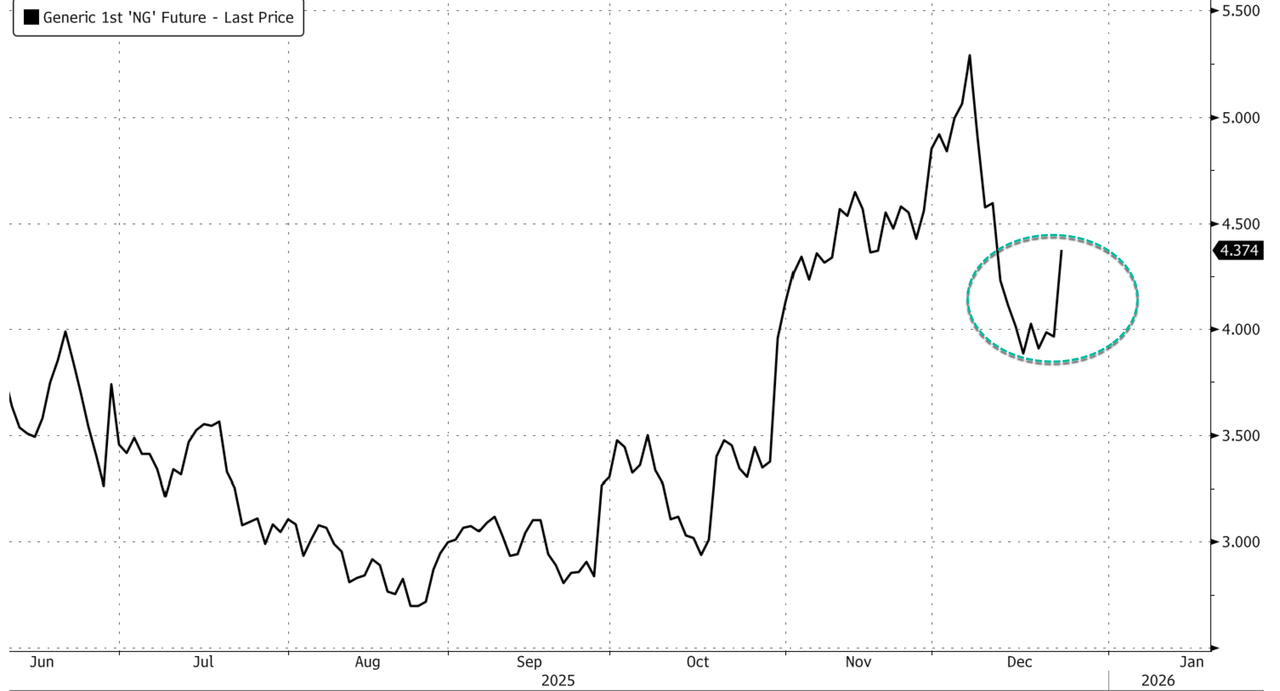
U.S. natural gas futures surged the most since late October as one energy trader warned that "winter isn't over," with another wave of cold air set to spill into the eastern half of the Lower 48 early next week. The upcoming cold blast arrives even as much of the U.S. enjoys a brief warm-up following an early-month polar vortex that plunged large parts of the U.S. East into Arctic-like conditions.

"Winter isn't over yet. Here are forecast anomalies for this time next week showing a large area of unseasonably chilly temperatures across the major population centers of the Eastern US," energy trader Celsius Energy wrote on X.

Celsius Energy noted, "Near-term #natgas demand will be quite volatile with very bearish daily storage withdrawals under +5 BCF/d through this weekend surging to nearly -30 BCF/d by this time next week, more than double the 5-yr avg. In general, these projections have improved considerably."

By late afternoon Tuesday, NatGas futures are up nearly 10%, the largest intraday jump since October 30's 17% price spike. Prices are trading around $4.365 per MMBtu.

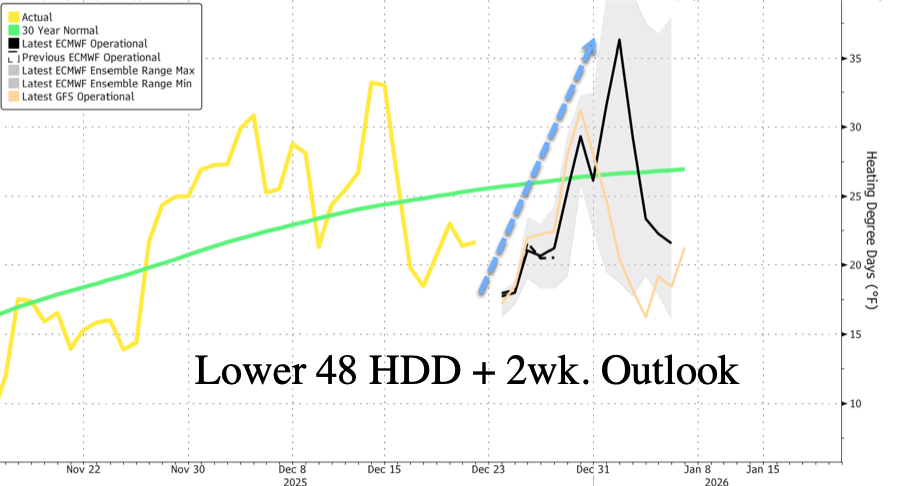
Looking at Heating Degree Days for the Lower 48 - the weather-based measure of US heating demand -the index is projected to surge well above the 30-year average early next week and remain elevated through year-end.

Cold is returning to the eastern half of the Lower 48. Time to stack the firewood and get the gas-powered snowblower ready.

Tyler Durden Tue, 12/23/2025 - 15:45
https://ift.tt/8hHjVXT
from ZeroHedge News https://ift.tt/8hHjVXT
via IFTTT

"Winter Isn't Over": NatGas Soars As Another Cold Blast Targets US East SocialTwist Tell-a-Friend
| 0 comments ]

Mapping The Chances Of A White Christmas

A white Christmas is one of those holiday experiences that feels universal—until you look at the weather history and actual odds of snowfall on Christmas Day across the United States.

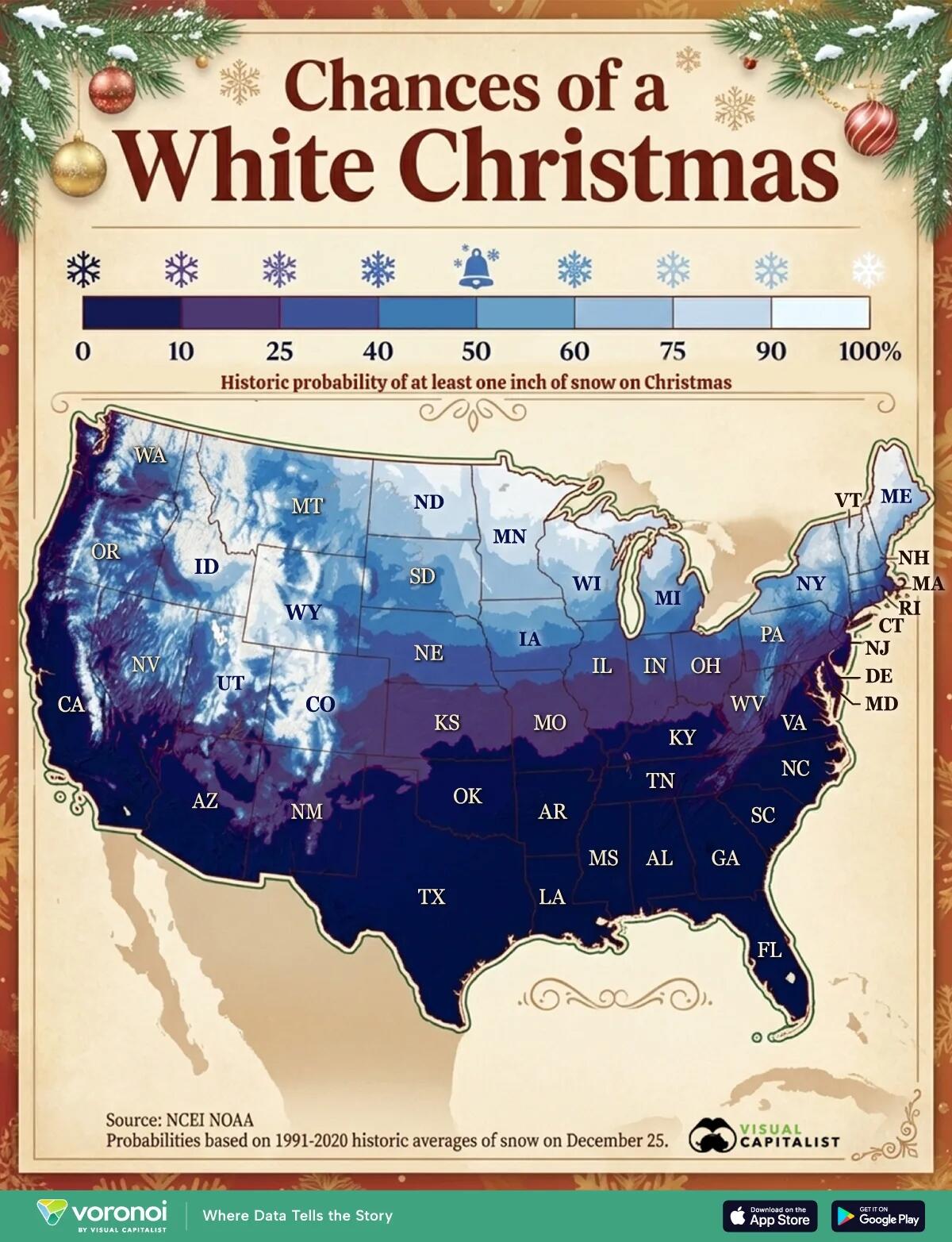
This map, via Visual Capitalist's Niccolo Conte, shows the historic probability across the U.S. of seeing at least one inch of snow on the ground on December 25, using data from the NOAA National Centers for Environmental Information (NCEI) is based on the latest U.S. Climate Normals (1991–2020).

These “normals” are three-decade averages built from observations at nearly 15,000 stations, offering a consistent baseline for what’s typical in different parts of the country.

Latitude Matters Most For a Snow on Christmas Day

If you want the simplest rule of thumb for a white Christmas, head north. The northern Plains, Upper Midwest, and large stretches of the interior Northeast generally sit in higher probability bands than the rest of the country.

The data table below features state averages of NOAA’s full 5,000+ row dataset of specific station probabilities of at least one inch of snow:

State Average probability of at least one inch of snow on Christmas day
Alabama 0.1%
Alaska 84.3%
Arizona 4.1%
Arkansas 1.3%
California 4.4%
Colorado 48.7%
Connecticut 35.2%
Delaware 6.5%
Florida 0.0%
Georgia 0.4%
Hawaii 0.0%
Idaho 62.1%
Illinois 27.2%
Indiana 26.0%
Iowa 46.9%
Kansas 15.0%
Kentucky 6.6%
Louisiana 0.1%
Maine 74.4%
Maryland 11.2%
Massachusetts 35.8%
Michigan 64.8%
Minnesota 75.2%
Mississippi 0.2%
Missouri 13.7%
Montana 56.7%
Nebraska 35.1%
Nevada 17.8%
New Hampshire 70.1%
New Jersey 13.7%
New Mexico 11.3%
New York 55.9%
North Carolina 3.1%
North Dakota 77.3%
Ohio 26.8%
Oklahoma 3.1%
Oregon 14.4%
Pennsylvania 34.2%
Rhode Island 26.9%
South Carolina 0.6%
South Dakota 55.5%
Tennessee 2.8%
Texas 0.8%
Utah 46.2%
Vermont 76.9%
Virginia 8.6%
Washington 26.9%
West Virginia 26.8%
Wisconsin 66.3%
Wyoming 56.0%

Areas around the Great Lakes can also improve their odds thanks to lake-effect snow, which can build persistent snowpack when cold air is in place.

Meanwhile, the further south you go, the more quickly the map shifts into darker shades—signaling that a white Christmas is historically uncommon.

Mountains Upgrade White Christmas Probabilities

Elevation can change the forecast more than any state line. The Rockies and the Sierra Nevada stand out as some of the most reliable places for holiday snow cover, with many high-altitude areas reaching the upper probabilities of Christmas Day snowfall.

The Cascades and ranges across Idaho also show strong odds, reinforcing how quickly temperatures drop with height.

Even in the East, the Appalachians make a visible difference—higher terrain can hold onto snow that the surrounding lowlands doesn’t.

Why the South and Coasts Often Miss White Christmas

Across the Gulf Coast, Deep South, and much of the Sun Belt, the map largely sits in the 0–10% range. Warmer winter temperatures mean snow is rarer to begin with—and even when it does fall, it’s less likely to stick around long enough to still be on the ground by Christmas morning.

Coastal climates often tilt milder as well, especially where ocean air moderates winter cold.

And for non-contiguous states, the story is mixed: Alaska’s station network is too sparse to confidently fill in the entire map, while Hawaii’s odds remain firmly at zero.

In other words, the classic “white Christmas” is real—but it’s also highly regional. If snow is the goal, history suggests two reliable strategies: chase colder latitudes, or climb into the mountains.

For more Christmas-related visualizations, check out this graphic which ranks Spotify’s most streamed Christmas songs on Voronoi.

Tyler Durden Mon, 12/22/2025 - 16:40
https://ift.tt/xAdoFQ1
from ZeroHedge News https://ift.tt/xAdoFQ1
via IFTTT

Mapping The Chances Of A White Christmas SocialTwist Tell-a-Friend