| 0 comments ]

Ukrainian Drone With Huge Explosive Payload Hits Bulgaria Near Vital Gas Pipeline

A major border and aerial incident has occurred between Ukraine and Bulgaria, and Bulgarian officials are outraged and demanding answers - ironically on the heels of a political shift regarding the Ukraine war wherein Sofia has stopped giving weaponry, citing its own stockpile shortages.

A Ukrainian drone on Saturday breached Bulgaria's airspace and directly endangered vital energy infrastructure upon exploding in Bulgarian territory, regional media reports. These types of breaches of neighboring states' territories and spillover from the Ukraine war has been happening with increased regularity of late.

File image via Reuters

Bulgaria's defense ministry quickly pointed the finger at Kiev, saying the destroyed drone debris points to a weapon "widely used by the Ukrainian military."

Despite the two countries by and large being 'friendly' - Bulgaria has summoned the Ukrainian ambassador for a meeting scheduled for Monday in response, AFP reports.

The Ukrainian government is seeking to defuse the situation, saying it remains "in close contact with the Bulgarian side to clarify the circumstances" of the incident. "We can say with certainty that the Ukrainian Armed Forces did not intentionally direct any assets toward Bulgaria," Ukraine's foreign ministry spokesman Georgiy Tykhyi said, noting that these incidents ultimately arise from the Russian invasion.

Thankfully there were no casualties, however...

According to Bulgarian Prime Minister Rumen Radev, the drone entered Bulgarian airspace from Romania before exploding 1,000 metres from a compressor station of the Trans-Balkan gas pipeline, near the former Kardam border checkpoint between the two countries.

"Noise made by the drone was detected by Romanian border police, and a loud explosion was subsequently heard by the 'General Toshevo' border police patrol," he told a press conference.

Bulgarian Prime Minister Rumen Radev has expressed the main concern, saying the explosive payload the UAV carried was "significant". But so far, Bulgarian officials have agreed that the incident does not look intentional.

Indeed, Ukraine insists it did not 'intentionally' target Bulgaria, an Eastern European NATO-member country, which Kiev has long sought to curry favor with.

Russian drones have also on numerous occasions breached European airspace. In prior recent instances of drones entering neighboring airspace, particularly in Baltic countries and also Poland, NATO jets were scrambled - and in some cases drones are safely brought down via electronic intercept means.

Russia has more frequently been accused of sending drones into EU airspace, after which threats & accusations fly from NATO 'eastern flank' leaders:

Each instance creates new tensions between Russia and NATO, and the typical accusations and threats then fly. The Kremlin has of late been especially alarmed at the Trump administration transferring 5,000 US troops from Germany to Poland, near Russia's doorstep. But again, some of these drones in recent instances were found to be Ukrainian.

Tyler Durden Sat, 08/08/2026 - 16:55
https://ift.tt/2Qg90n8
from ZeroHedge News https://ift.tt/2Qg90n8
via IFTTT

Ukrainian Drone With Huge Explosive Payload Hits Bulgaria Near Vital Gas Pipeline SocialTwist Tell-a-Friend
| 0 comments ]

How The UAE Has Kept Its Oil Flowing Through Hormuz

By Tsvetana Paraskova of OilPrice.com

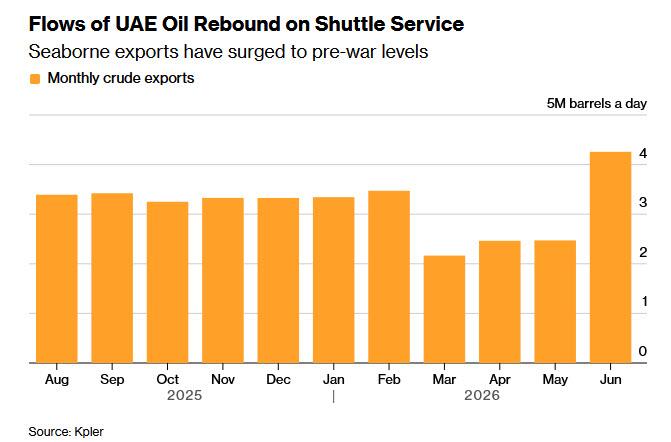
The United Arab Emirates has managed to boost its oil exports to pre-crisis levels as early as June, as it has kept pushing crude through the Strait of Hormuz and outside it.  

The UAE, which left OPEC on May 1, has found workarounds to the blockage at the Strait of Hormuz. It has been shuttling crude through the chokepoint to load it on larger vessels outside the Strait, maximizing the use of its onshore pipeline to ship crude from the west to the east of the country, bypassing Hormuz, and shipping tankers through the Strait in dark mode.  

The UAE has managed to ship over June and July the most crude oil out of the Strait of Hormuz than any other Gulf producer, according to vessel-tracking data compiled by Bloomberg.

The UAE has also issued an unprecedented number of tenders to sell cargoes of millions of barrels of crude oil in recent weeks.

At the end of July, Abu Dhabi National Oil Company ADNOC issued its seventh tender offering crude from the United Arab Emirates since the beginning of June, expecting to sell millions of barrels of oil between August and October, both from within and outside the Persian Gulf.

ADNOC was offering cargo loadings from the UAE ports Zirku and Das Island inside the Persian Gulf, as well as the port of Fujairah outside the Gulf, or via ship-to-ship transfers offshore Fujairah or Malaysia.

The UAE is estimated to have produced 4.1 million barrels per day (bpd) of crude oil in June, its highest output ever.

The UAE’s crude oil production jumped from 3.3 million bpd in May to 4.1 million bpd in June after the country left OPEC effective May 1, started raising output, and managed to sneak a lot of exports out of the Middle East even as the Strait of Hormuz was mostly blockaded for the first half of June, according to estimates by the International Energy Agency (IEA).

The UAE has sought to adapt to the closure of the Strait of Hormuz by sneaking tankers in dark mode through the Strait and increasingly offering to sell many of its crude grades for loading offshore Fujairah and at Sohar in Oman, outside the Strait.

Tyler Durden Sat, 08/08/2026 - 15:10
https://ift.tt/HvuoQFP
from ZeroHedge News https://ift.tt/HvuoQFP
via IFTTT

How The UAE Has Kept Its Oil Flowing Through Hormuz SocialTwist Tell-a-Friend
| 0 comments ]

Uncertainty Rules!

By Elwin de Groot, head of macro strategy at Rabobank

US Treasury yields drifted higher yesterday after the Financial Times reported, citing people close to Fed Chair Kevin Warsh, that he would be prepared to raise rates as early as September if incoming inflation data surprise to the upside and markets themselves begin pricing a more hawkish path. Yet the market reaction was not confined to the front end suggesting investors were not interpreting the story in a straightforwardly hawkish manner.

That ambiguity is understandable. If markets push yields higher on expectations of tighter policy, the Fed may feel less need to deliver that tightening. Note also that Warsh himself was not speaking, and one of his recurring themes has been a dislike of explicit forward guidance. Moreover, September remains some distance away in market time, particularly in an environment where geopolitical developments can overturn macro narratives overnight.

Indeed, whilst oil prices had come down in the early part of this week on the back of renewed signs that the Strait of Hormuz could gradually reopen, those same prices rose again overnight as a convincing agreement remains elusive as it offers no permanent solutions for the key sticking points. Instead, it offers another 60-day window of free transits through Hormuz while further negotiations resume. Reports suggest Iran is looking to restrict US and Israeli ships from the Strait and it’s been ear-deafening silent on the ‘nuclear’ issue, for example. If a deal is agreed, it could be a matter of time until either party expresses frustration with the negotiations again and markets are forced to price in another few weeks of geopolitical tension.

Meanwhile, refined products are feeling the pinch of impending shortages, leading us to revise up sharply our forecasts for diesel, gasoil and marine fuels, as our senior energy analyst Joe DeLaura writes. In Europe, it is the winter-demand pressure that hangs over the market. The underpriced risk is that Europe’s own weather stress raises gas burn through the power sector just as LNG supply risks remain elevated, our senior energy analyst Florence Schmitt writes.

European macro data offered little inspiration yesterday. German factory orders surprised to the upside in June, though largely thanks to volatile big-ticket orders. This morning saw industrial production tick 0.2% m/m higher that month, but this was offset by lower growth in the previous month. Elsewhere, the picture was even less encouraging. Industrial production fell in both Spain and Italy, raising the possibility that the eurozone's preliminary 0.4% q/q GDP growth estimate may yet be revised lower. Eurozone retail sales also disappointed, falling 0.3% m/m in June and largely offsetting May's upwardly revised increase. The broader message is that growth concerns are unlikely to disappear simply because oil prices have eased from their recent highs.

In fact, what increasingly defines the global economy is not any single shock, but the relentless arrival of new ones. Businesses and households are being bombarded (in some regions rather literally) by an overlapping set of disruptions: trade disputes, geopolitical conflict, policy uncertainty, financial market volatility, technological disruption and natural disasters. The first eight months of 2026 have already provided a year's worth of such events.

The obvious example is the Middle East conflict and the disruption of shipping through Hormuz. But it is far from the only one. Investors continue to grapple with uncertainty surrounding the US tariff regime, while questions persist over the sustainability of the AI investment boom and the valuations attached to it. A rising string of hacking reports and AI models behaving unexpectedly has raised concerns over AI’s controllability.

In Europe, concerns are mounting over intensifying Chinese competition and the growing economic costs of climate change. Scorching temperatures, drying rivers and devastating wildfires have already become defining features of this summer. Looking ahead, forecasters are increasingly focused on the emergence of a potential "super El Niño" event, which could amplify weather-related disruptions across a wide range of emerging and developed economies.

Yet uncertainty is more than merely a transmission channel for shocks. It is an economic force in its own right.

Franklin D. Roosevelt famously captured this during the depths of the Great Depression when he declared in his first inaugural address that "the only thing we have to fear is fear itself". Nearly a century later, the insight remains remarkably relevant. Uncertainty can paralyze decision-making, delay investment, encourage precautionary saving and ultimately amplify the effects of whatever shock triggered it in the first place.

An interesting ECB study published in its latest Economic Bulletin broadly confirms the point. Looking at the eurozone, the analysis finds that uncertainty shocks tend to reduce investment, particularly spending on tangible capital, as well as consumer purchases of durable goods. The effects are most visible during the first two to four quarters following the shock. Importantly, however, the impact appears largely transitory. After an initial decline, activity tends to recover and the long-run effect on output is limited.

Part of that result may reflect modelling choices. But there is also an intuitive economic explanation: people learn. Households, businesses and investors gradually adapt to recurring shocks. The unfamiliar becomes familiar. What initially causes panic eventually becomes incorporated into decision-making. That observation brings us back to a theme from our Monthly Outlook, Groundhog Day Economics: markets seem to become more accustomed to geopolitical disruptions, yet every recurring script carries the risk of a very different ending.

Interestingly, the same logic may apply in reverse. As our colleague Stefan Koopman argues here, UK Prime Minister Andy Burnham may seek to replace "securonomics" with a form of "vibonomics": generating a series of positive confidence shocks before embarking on more politically difficult structural reforms. The idea is simple enough. If uncertainty depresses activity, improved confidence can temporarily support it.

The key word, however, is temporarily. The lesson from both the ECB's research and recent market experience is that confidence effects can move demand forward in time, but they do not permanently raise an economy's growth potential. Lower precautionary savings may provide a one-off boost to spending. Positive sentiment may temporarily lift GDP. But neither changes the underlying supply capacity of an economy.

Ultimately, uncertainty may rule the headlines, and confidence may shape the near-term cycle. But lasting prosperity still depends on a far less fashionable ingredient: stronger supply-side growth.

Tyler Durden Fri, 08/07/2026 - 14:40
https://ift.tt/tZfgzdx
from ZeroHedge News https://ift.tt/tZfgzdx
via IFTTT

Uncertainty Rules! SocialTwist Tell-a-Friend
| 0 comments ]

Judge Rules Trump Admin Can End Temporary Protected Status For Haitians

Authored by Jack Phillips via The Epoch Times,

A federal judge on Aug. 5 allowed the Trump administration to end temporary protected status (TPS) for an estimated 350,000 Haitian nationals following a Supreme Court ruling.

U.S. District Judge Ana Reyes ruled that a previous court order that “had stayed the effective date of Department of Homeland Security Secretary Kristi Noem’s Termination of the Designation of Haiti for Temporary Protected Status pending judicial review … is no longer in effect.”

But Reyes also denied the government’s request to halt discovery in the lawsuit that was filed over TPS in Haiti. She told the plaintiffs and the government to provide a new schedule in the order.

The Department of Homeland Security (DHS) last year said that around 350,000 Haitian nationals were living in the United States when Noem, who left the administration earlier this year, issued an order ending TPS for the country.

Multiple courts paused enforcement of the order before the Supreme Court in June ruled that the Trump administration could go ahead with rescinding the rule.

Before the judge’s Wednesday ruling at the U.S. District Court for the District of Columbia, Department of Homeland Security (DHS) Secretary Markwayne Mullin warned in an interview that Haitians under the program should leave the United States.

“We’re going after them right now … these individuals can either self-deport or we’ll arrest you and send you back. It’s that simple,” he said.

Under the Biden administration, TPS policies were expanded, allowing hundreds of thousands of people from Ukraine, Afghanistan, Venezuela, Haiti, and other countries to remain in the United States. The Trump administration has moved to revoke TPS for a number of countries, saying that the program was meant to be temporary.

Homeland Security officials said that the TPS program, which was set up under the Immigration Act of 1990, has become a magnet for illegal immigrants in recent years.

“Using TPS to grant temporary status to successive waves of new arrivals from a designated country may generate a significant pull factor for illegal immigration and act in tension with the congressional design,” the agency said in a Federal Register notice.

Meanwhile, DHS said in the Federal Register notice and in court papers that conditions in Haiti no longer justify the designation.

Illegal immigration from Haiti turned into a flashpoint during the 2024 election when vice presidential candidate JD Vance and presidential candidate Donald Trump referred to thousands of Haitian nationals who were living in Springfield, Ohio, generating complaints from residents.

During arguments before the Supreme Court, Geoffrey Pipoly, a lawyer for the plaintiffs, claimed that the TPS termination was due to President Donald Trump’s “racial animus towards non-white immigrants and bare dislike of Haitians, in particular.”

In the high court ruling, a 6–3 majority ruled that the president has the right to start deporting people from Haiti and Syria and that federal law usually bars judicial review of future TPS terminations or designations.

TPS was designated for Haiti in January 2010 following a major earthquake and was extended multiple times.

Tyler Durden Thu, 08/06/2026 - 15:45
https://ift.tt/j2WQc51
from ZeroHedge News https://ift.tt/j2WQc51
via IFTTT

Judge Rules Trump Admin Can End Temporary Protected Status For Haitians SocialTwist Tell-a-Friend
| 0 comments ]

DHS Confirms Over 3 Million Total Deportations, Highlights Arrests Of Five More "Worst Of The Worst" Criminal Illegals

Authored by Debra Heine via American Greatness,

US Immigration and Customs Enforcement (ICE) on Monday arrested five more “worst of the worst” criminal illegal aliens convicted for heinous crimes, including voluntary manslaughter, criminal indecent exposure, aggravated assault, and fentanyl trafficking.

According to the Department of Homeland Security (DHS), more than three million illegal aliens have left the United States due to the Trump administration’s immigration crackdown: 2.2 million self-deportations, and over 985,000 deported by DHS.

Each of the five violent criminals highlighted by DHS Tuesday were arrested in deep blue sanctuary cities where anti-ICE agitators continue to harass immigration officers.

  • Fernando Ruiz-Maldonado, a criminal illegal alien from Mexico, convicted for voluntary manslaughter in Los Angeles, California.

  • Sergio Loya-Lozano, a criminal illegal alien from Mexico, convicted for criminal indecent exposure, hit-and-run, and TWO counts of driving under the influence in San Jose, California.

  • Olman Josue Pineda-Jimenez, a criminal illegal alien from Honduras, convicted for aggravated assault and harassing communications in Charlotte, North Carolina.

  • Heriberto Hernandez-Sosa, a criminal illegal alien from the Dominican Republic, convicted for fentanyl trafficking in Worcester, Massachusetts.

  • Jose Manuel Pertuz-Pena, a criminal illegal alien from Venezuela, convicted for aggravated unlawful use of a weapon in Cook County, Illinois.

Immigration agents continue to carry out their law enforcement duties in blue sanctuary enclaves despite the left’s relentless coordinated campaigns of violence against them.

According to DHS, immigration officers have experienced a 1,300+ percent increase in assaults against them, a 3,300 percent increase in vehicular attacks, and an 8,000 percent increase in death threats.

“Every single day, we are REMOVING criminals from American communities. Just yesterday, ICE arrested murderers, sexual predators, violent assailants, drug traffickers, and other dangerous criminal illegal aliens,” said DHS Secretary Markwayne Mullin.

“Under the Trump Administration, the Department of Homeland Security is enforcing the law, deporting criminal illegal aliens, and defending the homeland. It’s no wonder crime rates have reached historic lows.”

DHS has listed over 40,000 illegal alien criminals on their Worst of the Worst (WOW) website which tracks ICE arrests of murderers, rapists, pedophiles, violent gangbangers and arsonists.

A DHS spokesperson told American Greatness Tuesday that over 985,000 illegal aliens have been deported since President Trump took office. An additional 2.2 million have self-deported.

“In President Trump’s first year back in office, more than 3 million illegal aliens have left the U.S. because of the Trump administration’s crackdown on illegal immigration including an estimated 2.2 million self-deportations,” the spokesman said via email.

“As of July 12, we have now deported over 985,000 illegal aliens and arrested over 1 million illegal aliens.”

Tyler Durden Wed, 08/05/2026 - 17:00
https://ift.tt/NxaHC7Q
from ZeroHedge News https://ift.tt/NxaHC7Q
via IFTTT

DHS Confirms Over 3 Million Total Deportations, Highlights Arrests Of Five More "Worst Of The Worst" Criminal Illegals SocialTwist Tell-a-Friend