| 0 comments ]

Worker Fired Over Refusal To Receive COVID-19 Vaccine Wins Job Back

Authored by Zachary Stieber via The Epoch Times (emphasis ours),

The University of Virginia wrongly fired an employee who refused to receive a COVID-19 vaccine, according to a new ruling.

The university "acted in an arbitrary and capricious manner" when it fired Kaycee McCoy, a cytotechnologist, in 2021, Virginia District Court Judge Claude Worrell Jr. said in a July 27 ruling.

Ms. McCoy had asked for a religious exemption to the university's COVID-19 vaccine mandate, with support from her pastor.

But her employer denied the request and terminated Ms. McCoy in November 2021.

Ms. McCoy quickly took her case to the courts, saying that the refusal to grant an exemption violated Virginia's Constitution, which states in part that all citizens are "entitled to the free exercise of religion" and that no citizen "shall be enforced, restrained, molested, or burthened in his body or goods, nor shall otherwise suffer on account of his religious opinions or belief."

The university defended its decision, arguing that the plaintiff's "personal opinions" and "personal preferences" did not make her entitled to a religious exemption. They also said they did not have to grant her an exemption even if her objection was based on sincere beliefs.

Judge Worrell disagreed, finding in favor of the plaintiff.

Virginia courts uphold governmental actions unless the actions are "arbitrary and capricious" or those taken "without a determining principle," according to previous court decisions.

The university wrongly applied a test aimed at determining the sincerity of belief, the judge said, which "is violative of the separation of church and state doctrine enshrined in both the Virginia and federal constitutions."

He reversed the termination, ordered the university not to fire Ms. McCoy again, provided she met the exemption requirements, and awarded the plaintiff damages equal to the salary she would have received since being fired, plus interest.

The university did not respond to a request for comment.

Lawyers for Ms. McCoy said the court "handed a victory" to the plaintiff.

Requests Exemption After Mandate Announced

Ms. McCoy started working for the University of Virginia in 2011. She is a cytotechnologist or a laboratory worker who analyzes cells.

The university imposed the COVID-19 vaccine mandate on Aug. 25, 2021, but said it would consider medical and religious exemption requests. The university cited guidance by Virginia Attorney General Mark Herring, a Democrat who said that universities could require COVID-19 vaccination but that they should "be prepared to provide reasonable accommodation for medical conditions and/or religious objections."

Ms. McCoy filed her exemption request on Sept. 12, 2021, before the deadline for such requests.

Ms. McCoy's objection was partly based on how fetal cells were used in testing or developing all the COVID-19 vaccines.

"The presence of and use of immortalized human cell lines taken against the will of the person aborted, having been used in the development of vaccinations, violates my sincere and firm beliefs that participation in the vaccination mandate is an indirect engagement and participation in abortion," Ms. McCoy told the university.

She also sent a letter from her pastor confirming the sincerity of Ms. McCoy's beliefs.

"I fully support Kaycee's right to this objection based on the exercise of her own personal and faithful convictions," the pastor wrote.

Denial

Several weeks later, the university denied the request, with no rationale provided.

Ms. McCoy asked for a reason for the denial, but the university said all decisions made by a body described as the "Health System Vaccine Religious Exemption Committee" were final, and no appeals were allowed. Additional information supporting the request could be provided, according to the message, from human resources.

The email said employees not in compliance with the mandate as of Nov. 1, 2021, would be subject to punitive action, including possible termination.

Ms. McCoy was on vacation during the first week of November 2021. When she went to work on the first day after returning from vacation, she met with a supervisor who told her she was suspended and would be fired in five days.

Later that day, an email confirming that the university would not change its denial decision arrived in Ms. McCoy's inbox.

Mandate Kept in Place

Virginia Gov. Glenn Youngkin, a Republican, issued an executive order upon taking office in 2022 that said any "requirement of state employees to receive the COVID-19 vaccination and disclose their vaccination status or engage in mandatory testing is harmful to their individual freedoms and privacy."

Mr. Youngkin ordered a halt to such mandates at state institutions, including state universities.

The University of Virginia suspended its mandate for some employees but not workers in its health system.

The university cited a federal rule that forced health care institutions to require COVID-19 vaccination if they receive Medicare or Medicaid funding.

President Joe Biden's administration ended that rule, and many other mandates, in May. Mr. Biden said the decline in COVID-19 cases, hospitalizations, and deaths led to the change.

Tyler Durden Wed, 08/02/2023 - 17:40
https://ift.tt/FIM5bht
from ZeroHedge News https://ift.tt/FIM5bht
via IFTTT

Worker Fired Over Refusal To Receive COVID-19 Vaccine Wins Job Back SocialTwist Tell-a-Friend
| 0 comments ]

Trump Suggests GOP Primary Debate Could Decide His 2024 Running Mate

Authored by Ryan Morgan via The Epoch Times (emphasis ours),

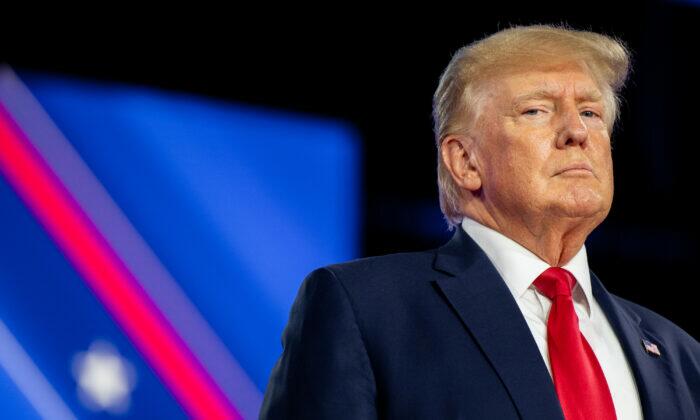
Former President Donald Trump has cast the upcoming Republican party's presidential debates as a contest for second place in the party primary, with the winner potentially getting to be his 2024 running mate.

Mr. Trump, who has opened up a wide lead in the RealClearPolitics Republican presidential primary polling average, has repeatedly suggested he sees no need to debate the other Republican candidates in the primary field. Mr. Trump still hasn't said whether he will attend the first Republican presidential debate in Milwaukee, Wisconsin, on Aug. 23, but encouraged the rest of the field to duke it out in a Monday post on his Truth social media account.

"Let them debate so I can see who I MIGHT consider for Vice President!" Mr. Trump wrote on Monday.

The former Republican president holds the support of 54 percent of Republican primary voters in the latest RCP polling average. Republican Florida Gov. Ron DeSantis holds the second place spot in the polling average, still trailing by more than 35 points on average. Businessman Vivek Ramaswamy has taken the third place position at 4.9 percent in the RCP average, overtaking Mr. Trump's 2016 and 2020 running mate, former Vice President Mike Pence.

At a campaign rally in Erie, Pennsylvania, on Saturday, July 29, Mr. Trump suggested he stands little to gain even if he performs well at the debate. He said he mostly stands to be "abused" with "terrible questions" from the other candidates and from Fox News, which is set to host the first debate and which Mr. Trump has said has been a "hostile network" toward him.

"If I agree to do the debates I get hit by a hostile network, but I also get hit by all these guys—and they are professional politicians, I mean they're not stupid people, they just happen to be at zero—and they say, 'What about this, President Trump? What about this?' And I look at the guy and say, 'You're at zero, you're asking me these questions,'" Mr. Trump said.

The former president eventually put the debate question to his rallygoers, many of whom shouted "no" when he asked if he should attend.

While Mr. Trump leads in the polls, he's facing several criminal charges that could upend his campaign, including federal charges for mishandling classified documents. Mr. Trump has characterized the classified documents case as an act of election interference by President Joe Biden and his Department of Justice. Mr. Trump's trial in the classified documents case is set to begin in May of next year, well into the primary election process.

Debate Requirements

In order to qualify for the first debate, the Republican National Committee is requiring candidates to poll at least 1 percent in three national polls, or poll at least 1 percent in two national polls and at least 1 percent in two of the four early voting states: Iowa, New Hampshire, Nevada, or South Carolina. Candidates must also have at least 40,000 unique donors, with at least 200 donors per state in 20 states or territories. Lastly, candidates must sign a pledge to support the eventual Republican presidential nominee if they do not win the primary contest.

As of Sunday, Mr. DeSantis and Mr. Ramaswamy have qualified for the first debate, as has Sen. Tim Scott (R-S.C.), former Republican South Carolina Gov. Nikki Haley, former Republican New Jersey Gov. Chris Christie, and Republican South Dakota Gov. Doug Burgum.

Mr. Pence has met the polling criteria but has yet to reach the donor criteria. Former Republican Arkansas Gov. Asa Hutchinson has also met the polling requirement, but not the donor requirement. Republican Miami Mayor Francis Saurez, businessman Perry Johnson, conservative talk radio host Larry Elder, and former Rep. Will Hurd (R-Texas) are also still working to qualify for the first debate.

DeSantis, Ramaswamy Not Interested in VP Job

Even if Mr. Trump's comments about using the Republican debate to pick a running mate were taken at face value, Mr. DeSantis and Mr. Ramaswamy have already indicated they're not interested in the opportunity.

“I don’t think I’m a No. 2 guy. I think I’m a leader, governor of Florida. I’ve accomplished a lot,” Mr. DeSantis said in an interview with the Wisconsin Right Now podcast earlier this month. “I think I could do more staying there than being VP, which doesn’t really have any authority.”

Mr. Trump has repeatedly jabbed at Mr. DeSantis so far in the primary cycle, calling him "DeSanctus" and "DeSanctimonous." The former president has also taken credit for Mr. DeSantis gaining his governorship in Florida and has described Mr. DeSantis as "disloyal." Mr. DeSantis has, in turn, claimed Mr. Trump has moved to the left on issues like federal spending, abortion, and crime and now only gives lip service to his “America First” agenda.

Mr. Ramaswamy has also indicated he's not interested in holding out for a job in a future Trump administration

“I will be helpful to this country in whatever way I can, but I would not be No. 2 or member of an administration," Mr. Ramaswamy said in a July 13 interview on the Clay & Buck Show podcast. "I just don’t think that’s the right way for me to make the maximal positive impact on this country."

Mr. Trump has indicated he's amenable to bringing on Mr. Scott in some form in a future administration.

"Tim is very good,” Mr. Trump said in a July 16 interview with Fox News. “I mean, I could see Tim doing something with the administration, but he’s right now campaigning, and I’m sure Tim and everybody else would say I’m only interested in one [position], but Tim is a very talented guy and you have other very talented people.”

Tyler Durden Wed, 08/02/2023 - 17:00
https://ift.tt/mK9gbpz
from ZeroHedge News https://ift.tt/mK9gbpz
via IFTTT

Trump Suggests GOP Primary Debate Could Decide His 2024 Running Mate SocialTwist Tell-a-Friend
| 0 comments ]

The 'Outrage' Burned Out Long Ago... Even Aliens Are Boring Now

Authored by Charles Hugh Smith via OfTwoMinds blog,

Everything is boring, even the aliens.

Sometimes truth is best revealed tongue-in-cheek, that is, in semi-serious banter rather than supposedly serious analysis.

Consider the recent flood-tide of "news" about extraterrestrial vehicles, a.k.a. UFOs and UAPs--(formerly Unidentified Aerial Phenomena, now Unidentified Anomalous Phenomena, to include underwater phenomena.

Prolific podcaster (1,314 podcasts and counting) Tommy Corrigan and I tackled the UAP mystery--why are UAPs now an officially sanctioned "thing"?--in a free-form conversation, Aliens Are Boring (1:08 hrs).

As you can tell from the title of our podcast, the truth is the Powers That Be have managed to make the aliens boring. Rather than the "revelations" being "stunning" or "shocking," the entire exercise was as boring as everything else the PTB manage.

Transforming what could be the biggest story in history into a boring committee meeting devoid of any real evidence is quite an accomplishment. As Tommy opined, what would qualify as "interesting" would be Presidents Xi, Putin and Biden appearing on stage together to announce a global consortium to deal with the alien presence, and video of recovered alien bodies and spacecraft wreckage.

Instead, we got a boring committee meeting with sworn testimony, i.e. a nothing-burger of rehashed pilot accounts from the New York Time's 2017 report. 

2 Navy Airmen and an Object That 'Accelerated Like Nothing I've Ever Seen'

In a word, boring. Tic-Tacs, saucers, hovering lights, blah-blah-blah.

The only interesting aspect of the the whole charade is the question, why now? The question, cui bono, to whose benefit?, remains unanswered. Who benefits from the distraction or the narrative?

OK, we get the PR cover story. The American public deserves to know,National Security is at stake, and so on. But what's the real motivation? Who benefits from this stage-managed emergence of weird stuff that's been ridiculed and dismissed by the Powers That Be for 75 years?

The most likely answer to many is this is just a larger-scale rollout of the usual False Flag template: a threat has emerged which we must counter. The template is worn at the edges because it's been used so many times. For example, North Vietnamese gunboats fired on US Navy vessels, so we really had no choice but to launch a multi-year bombing campaign involving thousands of aircraft and military personnel that cost many their lives and squandered countless billions of dollars.

Never mind the "attack" was fabricated for PR purposes. It worked great, as it always does. The public rallies around vastly increased "defense" spending and skeptical inquiries are derided as "unpatriotic" / dangerous to National Security.

Due to its over-use, the public is finally wise to the template, and so how much traction this rollout of the alien threat to National Security will have is not yet visible.

Until the public gets to see the alien corpses on ice and the shattered spacecraft bits, it's a non-starter.

Further down the "truthiness" chain, we ask: why are the aliens as boring as everything else? Tommy and I discuss the possibility--again, tongue-in-cheek--that the Powers That Be are themselves so bored by their control of all the machinery of the modern world that they decided to unleash the alien wild-card as a rare "what the heck" moment of freedom from the demands of controlling everything, just to see where it goes.

Humans habituate rather quickly to ceaseless hysterical crises. The crises pile up and we tune out. Those generating the crises for the benefit of various players start realizing the endless crises are slipping inexorably into the same boring trough as entertainment, "news", AI (LLMs, blah-blah-blah), economics, politics and the rest of the tightly controlled narratives.

Where's the outrage"? It burned out long ago. There's nothing left but the mind-dulling, hyper-boring derangement of channel-surfing and the social-media / TikTok / Only Fans scroll of repetitive rubbish. Crises, shmises, give me something new.

Sorry, there isn't anything that's actually new--it's just the same old tired frenzy of crisis, over-acting, existential threats, secret cabals, terrorists who hate our freedoms, tricked-up statistics, phony exposes, celebrity apologies, blah-blah-blah, all intended to spin the money-maker, our attention, the polite word for addiction.

We habituate to stimulus of any kind, even the addictive variety. Just as the Ibogaine dosage has to be constantly increased to get the same effect, until there's no effect at all, the Powers That Be have to constantly increase the dosage of crisis, frenzy, drama, threats, thrills, fake exposes, etc. to keep the narratives functioning as intended: distracting, deranging and fragmenting the increasingly burned-out, bored audience.

In other words, maybe, just maybe, the UAP / aliens story being released into the wild is the result of the Powers That Be's own immense boredom. Running the machinery is so tedious and predictable that how can it not be boring?

Or, as some anticipate, the "UAPs are now a thing" story is the cover for the unveiling of the weaponization of space that's already well underway. That would be mildly interesting, but to the degree it's already been anticipated, it too would quickly slide into the boring bin.

The problem may well be terminal boredom with the whole shebang. Everything has been so relentlessly hyped to grab "attention" that the dosage now exceeds the event horizon of any possible effect: the screaming, shouting cacophony of "news", crises, threats, revelations, scandals, cover-ups, PR, marketing, narrative-control, gambling, gaming, threadbare outrage, bogus statistics, etc. no longer move the needle. Everything is boring, even the aliens.

If you want to listen to another hour of "experts" discussing the bogus inflation data / cover-up / conspiracy-theory du jour, this isn't it. This is pure free-form fun, at least for Tommy and I. Aliens Are Boring (1:09 hrs). (Occasional free-form profanity.)

*  *  *

My new book is now available at a 10% discount ($8.95 ebook, $18 print): Self-Reliance in the 21st Century. Read the first chapter for free (PDF)

Become a $1/month patron of my work via patreon.com.

Subscribe to my Substack for free

Tyler Durden Wed, 08/02/2023 - 15:45
https://ift.tt/cuESeWC
from ZeroHedge News https://ift.tt/cuESeWC
via IFTTT

The 'Outrage' Burned Out Long Ago... Even Aliens Are Boring Now SocialTwist Tell-a-Friend
| 0 comments ]

Mom Accuses FBI Of Entrapping Her 'Neurodiverse' Teenager In Terrorism Scheme

Authored by Ken Silva via Headline USA,

In June 2022, Colorado woman Deanna Meyer contacted her local sheriff’s office about violent and terroristic statements that her mentally ill 17-year-old son, Davin Meyer, was making at the time.

The Federal Bureau of Investigation building headquarters is seen in Washington. / PHOTO: AP

The local sheriff, in turn, contacted the FBI, which then began communicating with the teenager online. Months later, the FBI arrested Davin as he was about to board an airplane, ostensibly to travel to the Middle East to join ISIS.

But Davin’s mother says he is no ISIS fighter. Instead, he’s an 18-year-old with no friends, who suffers from numerous mental health issues, including autism, depression and anxiety, according to the mom.

At a detention hearing on Friday, Deanna reportedly expressed remorse that she ever sought help from law enforcement, blaming the FBI for ensnaring her son in a phony terrorism plot.

“I bet my life he would never do that without that encouragement [from FBI informants],” she said Friday, describing how her son communicated with at least two FBI informants in chat rooms from last November until he was arrested.

U.S. Magistrate Judge Reid Neureiter disregarded Deanna’s pleas on Friday and ordered Davin to remain in custody. Neureiter pointed to the fact that Davin allegedly threatened his mother’s life when he was still a juvenile—even though the mother said he hasn’t threatened her since he turned 18.

The judge did acknowledge the mother’s arguments in his five-page order.

“The mother testified at the detention hearing that she never believed he would likely move ahead with his expressed intentions, and the defendant only took steps to travel to the Middle East after finding a ‘community’ online, which included confidential FBI sources,” Judge Neureiter said.

“According to the defendant’s mother, he has ‘never had a friend’ and finding this community that appeared to be supportive of his plans is what likely caused him to act by buying the ticket to fly to Turkey.”

Neureiter also acknowledged Davin’s mental health problems.

“The defendant is ‘neurodiverse’ and was diagnosed at the age of nine of being on the autism spectrum, and he has also been diagnosed with having a low processing speed and massive depression. The defendant may also have obsessive compulsive disorder,” the judge said.

“The defendant has received diagnoses of autism spectrum disorder; attention-deficit hyperactivity disorder; adjustment disorder with mixed anxiety and depressed mood; specific learning disorder with impairment in mathematics; and major depressive disorder, recurrent episode, moderate.”

However, Judge Neureiter said it’s in the public interest to keep Davin incarcerated.

This is a difficult situation, and must be extremely heart-wrenching for the defendant’s family, in particular his mother, who has long believed the defendant needs help and therapy,” he said.

“Putting a defendant with his disabilities in jail, pending trial, will not address his condition nor provide the therapy that he apparently needs. It will, however, ensure that he cannot do violence to anyone.”

The judge concluded by saying he’d reconsider his order if the Meyer family can find a suitable mental health facility to house Davin.

Other bizarre details about the Meyer case can be found in the arrest affidavit of FBI task force officer Joni Tangeman.

For instance, Tangeman said Davin followed “white supremacist ideology” when he was 15-years-old, before he began practicing Islam in late 2020. Tangeman further said that Davin said when he was 17 that if he didn’t go to the Middle East, he would build a fertilizer bomb in the United States—the same bomb used in the Oklahoma City bombing.

Additionally, the FBI officer admitted she knew about Davin’s mental health issues when investigating him.

“I am aware that MEYER has previously received mental health treatment, including residential treatment programs,” she said, adding that Davin apparently refused to take his medication when he converted to Islam.

“MEYER refused to take any prescription medication prescribed by the psychiatrist because it would be against his Islamic religion, and he also refused to go to school or participate in online school programs,” Tangeman said.

“Records show that MEYER has received diagnoses of autism spectrum disorder; attention-deficit hyperactivity disorder; adjustment disorder with mixed anxiety and depressed mood; specific learning disorder with impairment in mathematics; and major depressive disorder, recurrent episode, moderate.”

The Meyer case follows the FBI arresting another mentally challenged 18-year-old, Mateo Ventura, for allegedly intending to help ISIS. Last month, The Intercept published an interview with Ventura’s father, who also accused FBI informants of entrapping his son.

“He was born prematurely, he had brain development issues. I had the school do a neurosurgery evaluation on him and they said his brain was underdeveloped,” Ventura’s father, Paul Ventura, told The Intercept. “He was suffering endless bullying at school with other kids taking food off his plate, tripping him in the hallway, humiliating him, laughing at him.”

Ventura is currently in a private mental health facility as his case proceeds. Meyer’s preliminary hearing is set for July 31.

Ken Silva is a staff writer at Headline USA. Follow him at twitter.com/jd_cashless.

Tyler Durden Tue, 08/01/2023 - 18:40
https://ift.tt/L5JYNu8
from ZeroHedge News https://ift.tt/L5JYNu8
via IFTTT

Mom Accuses FBI Of Entrapping Her 'Neurodiverse' Teenager In Terrorism Scheme SocialTwist Tell-a-Friend
| 0 comments ]

Lessons From The Unraveling Of The Roman Empire: Simplification, Localization

Authored by Charles Hugh Smith via OfTwoMinds blog,

The fragmentation, simplification and localization of the post-Imperial era offers us lessons we ignore at our peril.

There is an entire industry devoted to "why the Roman Empire collapsed," but the post-collapse era may be offer us higher value lessons. The post-collapse era, long written off as The Dark Ages, is better understood as a period of adaptation to changing conditions, specifically, the relocalization and simplification of the economy and governance.

As historian Chris Wickham has explained in his books Medieval Europe and The Inheritance of Rome: Illuminating the Dark Ages 400-1000the medieval era is best understood as a complex process of social, political and economic natural selection: while the Western Roman Empire unraveled, the Eastern Roman Empire (Byzantium) continued on for almost 1,000 years after the fall of the Western Roman Empire, and the social and political structures of the Western Roman Empire influenced Europe for hundreds of years.

In broad-brush, the Roman Empire was a highly centralized, tightly bound system that was remarkably adaptive despite its enormous size and the slow pace of transport and communication. Roman society was both highly hierarchical--the elites claimed superiority and worked hard to master the necessary tools of authority-- slaves were integral to the building and maintenance of Rome's vast infrastructure--and open to meritocracy, as the Roman Army and other classes were open to advancement by anyone in the sprawling empire: every free person became a Roman Citizen once their territory was absorbed into the Empire.

When the Empire fell apart, the model of centralized control/power continued on in the reigns of the so-called Barbarian kingdoms (Goths, Vandals, etc.) and Charlemagne (768-814), over 300 years after the fall of Rome. (When the Ottomans finally conquered Constantinople in 1453, they also adopted many of the bureaucratic structures of the Byzantine Empire.)

Over time, however, the feudal model of localized fiefdoms nominally loyal to a weak central monarchy replaced the centralized model of governance. This adaptation fit the highly fragmented nature of European societies in this era.

But centralized influence never went away. The Christian churches based in Rome and Constantinople continued to exert centralized influence in politically fragmented regions, and monarchies continued to exist, in various states of strength and weakness. The Holy Roman Empire--as Voltaire is reputed to have observed, "neither Holy, Roman or an Empire"--had an enormously complex history in Germany and the rest of Europe. The monarchies in England and France remained in place, and the city-states of northern Italy wielded influence via trade and shifting alliances.

In other words, the Medieval era was ultimately a complex competition between overlapping models of governance and sharing resources, a competition between centralized and localized (what Wickham calls "cellular") nodes of power and the various ways that rulers and those they ruled dealt with each other.

Throughout the era, the legitimacy of rulers ultimately flowed from public assemblies, a tradition inherited from Rome that manifested in aristocratic courts and the church's leadership (bishops, etc.) and eventually, in parliaments. This tension played out in the sharing of costs and resources and the general direction of the state.

As a general rule, when monarchs consolidated too much power, they engaged in catastrophically costly and doomed wars (The Hundred Years War) because they were able to override or ignore the cautious counsel of elite assemblies.

Understood as a selective process of adapting to changing circumstances, this history offers us valuable lessons and templates for our future.

Once the centralized power of Rome fragmented, economic, social and political power simplified and relocalized. Trade volume shrank and trade routes vanished. Once the bureaucratic and military structures dictated by Rome collapsed, regions and localities were on their own.

Elites naturally sought out the best means to consolidate and expand their power, and residents (as a general rule, the peasantry and town-dwellers) sought to improve their own lives by reducing costs and securing access to resources.

The immense geographic, cultural, social and economic diversity of Europe was in effect freed to play out. This diversity is still evident; the European Union may have unified the European financial system, but cultural and social divisions have not dissolved.

Wickham distinguishes between two primary sources of income and wealth accessible to elites and governments: land and taxes. Collecting taxes requires an immense bureaucracy to identify and assess property owners, tenant farmers, merchants, collect duties on trade flows, etc. Taxes are the only reliable way to fund professional armies and the stupendous bureaucracy required to manage a complex centralized empire. The Byzantine Empire survived multiple rivals, invasions, etc. largely due to its competent tax collection bureaucracy, and European monarchies could only fund long, costly wars once they established tax collection bureaucracies.

Wealth from land--surplus skimmed from the labor of peasants--was adequate to fund highly localized nobility (many of which had one or two castles and a small fiefdom), but it wasn't reliable enough or large enough to support professional armies or vast centralized states.

How does this history offer a template for the next 20 years?

I have long held that the dominant global forces binding the global economy are globalization and financialization. Both have greatly increased the income and wealth that nation-states can tax to fund their vast structures: military, social welfare, and bureaucracies of management, regulation and control.

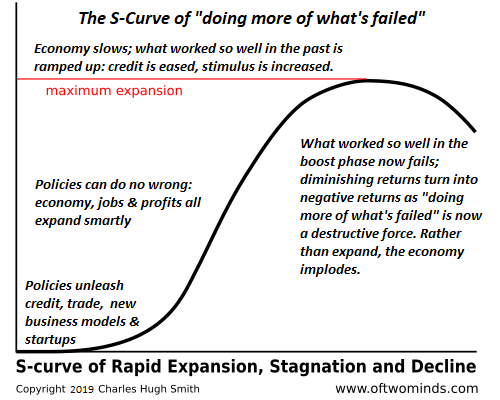
I have also held that globalization and financialization became hyper-structures prone to over-extension and the diminishing returns of the S-Curve. (see chart below) Both have reversed and are now in decline, a decline that I anticipate will accelerate unpredictably and rapidly as each dynamic is centralized and tightly bound, meaning each subsystem is highly interconnected with other subsystems. Should one break, the entire system unravels.
Globalization may appear to be decentralized, but the vast majority of global trade and capital flows through a few centralized nodes, and many aspects of trade depend on a very small number of routes and suppliers. This makes global trade exquisitely sensitive to disruption should any critical supplier or node fail.

Financialization is equally centralized and tightly bound, to the absurd degree that obscure financial structures (reverse repos, etc.) can trigger cascading crises in the real-world economy.

I anticipate a global simplification of trade and finance as fragile hyper-structures collapse as the failure of subsystems cascade through the entire system.

These systems have greatly accelerated extremes of wealth-income inequality by their very nature, and these vast distortions and imbalances are unsustainable. Also unsustainable is the immense expansion of the plundering of the planet's remaining resources via globalization and financialization. These dynamics will collapse under their own weight.

What will be left? Once the income and wealth that supported enormously costly nation-state governments contracts, central governments will no longer be able to fund their gargantuan systems. (States that attempt to fund their activities by printing money will only speed the collapse of their finances and thus their coherence.)

As in the post-Roman era, central authority may well continue, but its actual power and influence will be greatly reduced. Without expanding income and wealth to tax, the central state may attempt to extract most of the nation's surplus, but this stripmining of elites and commoners alike will trigger pushback and revolt.

A more sustainable response would be to offload most of the central government's financial burdens onto states, provinces, counties, etc., in effect pushing the impossible task of maintaining entitlements and promised spending on local entities.

Given the diversity of cultures, social values and economic dynamics in large nations and regions, we can anticipate a flowering of adaptations to these greatly reduced means. Some localities will favor increasing authoritarian controls, others will favor reducing authoritarian controls and ceding authority to the smallest units of public assembly.

Locales (shall we call them fiefdoms?) will divide naturally along geographic boundaries, just as fiefdoms in medieval Europe fell into natural boundaries shaped by rivers, valleys, mountain ranges, etc., and along economic and cultural borders.

This relocalization may manifest in the well-known forecasts of the US breaking into multiple regional states, or it might manifest as I suggest in a much-weakened but still influential central government ceding power to local political structures which may themselves fragment or form alliances with nearby entities with whom they share cultural and economic ties.

In other words, a churn of evolutionary adaptations can be expected. Just as there was no one post-Roman adaptation that worked equally well everywhere, we can expect there to be some adaptations of roughly equal success and many that are unsuccessful.

As individuals and households, we want to be located in successful adaptations that share our values and offer us agency, i.e. a say in public assemblies and the freedom to move and work as we see fit.

As I have outlined many times in the blog and in my books, locales that are highly dependent on long global supply chains and distant capital for their essentials will fare very poorly once those supply chains break and the capital dries up. Regions and locales that generate their own essentials (food, energy, metals, concrete, electronics, etc.), talent and capital are much more likely to generate enough resources to satisfy both local elites and the public.

As I explain in my book Self-Reliance, we who have lived in the past 75 years of expanding production and consumption of Everything have lost touch with both the natural world that sustains us and the social and practical skills needed to endure and prosper in an era in which the engines of centralized power and wealth (globalization and financialization) decay and collapse.

Some locales will choose to foster relocalization and individual agency. Others will cling on to failing models of authoritarian control and globalization / financialization.

Ironically, perhaps, the most successful regions will be prone to indulging in hubris and denial, just as the Roman elites, basking in their centuries of dominance, dismissed the "Barbarians" and clung to their delusions of grandeur even as their world fragmented around them.

Those locales left behind by globalization and financialization may well offer much better opportunities for successful adaptation, relocalization and individual / household agency.

It is human nature to find reasons to dismiss the storm clouds on the horizon. We look around and find solace in the apparent strength of our institutions and economy, while ignoring their sobering dependence on unsustainable hyper-globalization and hyper-financialization.

The fragmentation, simplification and localization of the post-Imperial era offers us lessons we ignore at our peril. It's important to view these lessons not just as an academic abstraction but as a guide to your own decisions about what places are most conducive to your security and well-being. Not every locale will do equally well, and the culture of many places may not be a great match for your own values and goals. If you decide to move, sooner is better than later.

*  *  *

This essay was drawn from my Weekly Musings Reports sent exclusively to subscriberspatrons and Substack subscribers. Thank you very much for supporting my work.

My new book is now available at a 10% discount ($8.95 ebook, $18 print): Self-Reliance in the 21st Century. Read the first chapter for free (PDF)

Become a $1/month patron of my work via patreon.com.

Subscribe to my Substack for free

Tyler Durden Tue, 08/01/2023 - 16:20
https://ift.tt/26iMXrt
from ZeroHedge News https://ift.tt/26iMXrt
via IFTTT

Lessons From The Unraveling Of The Roman Empire: Simplification, Localization SocialTwist Tell-a-Friend