| 0 comments ]

Navy Gets The Nod: President Biden Acknowledges The Existence Of His Fifth Granddaughter

Authored by Jonathan Turley,

For her entire life, Navy Joan Roberts has been “she who must not be named.”

There is no evidence that her father has ever visited her, let alone held her. 

Her grandparents repeatedly denied her existence and said that they had only “four granddaughters.”

They even gave their dogs stockings at Christmas rather than Navy, who never even bit one let alone a score of Secret Service agents.

As even Democrats began to voice their own shock at the cruelty of the First Couple shunning this child, the Bidens finally relented and recognized her existence, but only barely so.

Pressed by Fox News, the White House issued this statement:

“Our son Hunter and Navy’s mother, Lunden, are working together to foster a relationship that is in the best interests of their daughter, preserving her privacy as much as possible going forward. This is not a political issue, it’s a family matter. Jill and I only want what is best for all of our grandchildren, including Navy.”

Even for those of us who merely followed this saga from the beginning, the statement was maddening and frankly insulting. It suggested that there was some reason, until now, that prevented the Bidens from acknowledging the existence of their fifth granddaughter. That is false. There was no legal, or even tactical, reason for the refusal of the First Couple to acknowledge Navy for four years.

Navy and her mother sought that recognition and the Bidens refused. How was that in the “best interests” of this child? Were they fostering a relationship when they gave the German Shepherds stockings at Christmas but not their grandchild?

Moreover, Hunter has not been “working together” with Lunden for the best interests of his daughter. He has been a callous cad throughout this process, consistently putting his own interests ahead of his child.

Hunter refused to admit that he was Navy’s father for years until forced to accept the results of a court-ordered DNA test.

He then fought child support and even her use of the name Biden. He was threatened repeatedly with contempt of court over his obstruction in the litigation in Arkansas. The statement that he has been working together with Lunden is insulting to anyone who has followed these court proceedings, let alone their granddaughter.

In June, Hunter settled the Arkansas child support case on the condition that Lunden agreed to withdraw her request to change their child’s last name to “Biden.”

Washington is a hard town. I have lived and worked here for decades and I am still amazed by the cold calculations of many in this city. Long-standing values and associations are routinely jettisoned for personal advantage. Here the moral strictures of the rest of the nation are flipped; vice is a virtue and integrity is a weakness.

Yet, even in this place of utter personal corruption, the Bidens shocked the local population. It was not their millions in influence peddling. The Bidens are standouts but hardly unique in that form of corruption. It is not the President’s obvious lies about his knowledge and ties to his son’s foreign dealings. Truth is as relative in Washington as loyalty in this city. However, few have the stomach for how the Bidens treated this little girl. The Bidens spent more time fretting over the “pressure” of the White House on Major and Commander than they did the emotional impact on a four-year-old child who was prevented from even calling herself a Biden.

So what changed after four years to compel this passing recognition in a press statement? It was not the litigation. There was never any legal reason not to recognize their granddaughter since it was confirmed by DNA and court order. It was not any sudden request of the child or her mother. They have been asking for years for such recognition.

It was more likely the disgust expressed even by Democrats that this is simply wrong. The President is about to head out on the campaign trail and had no answer to that objection. In other words, for the First Couple, it is a political not a family matter. If it were the latter, they would have done the decent thing years ago.

Of course, the President cannot go into his loving account of how his granddaughter is “a talker” and playful (like his German Shepherd) because he has never bothered to meet her.

That is now a matter for this little girl to contemplate as she gets older.

However, whatever the impetus of the sudden recognition of Navy’s existence, it was not any legal cause.

The First Couple was free to do the decent thing at any time over the last four years. They simply did not find it in their “best interest” to do so.

Tyler Durden Sat, 07/29/2023 - 17:30
https://ift.tt/ZnLG4lz
from ZeroHedge News https://ift.tt/ZnLG4lz
via IFTTT

Navy Gets The Nod: President Biden Acknowledges The Existence Of His Fifth Granddaughter SocialTwist Tell-a-Friend
| 0 comments ]

Gasoline: The Price Rally That Nobody Saw Coming

Authored by Charles Kennedy via OilPrice.com,

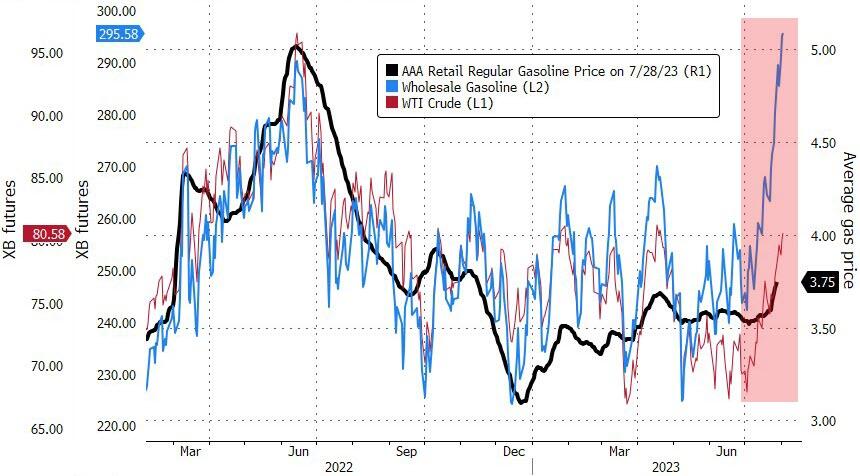
  • Gasoline prices have gained around 20% year-to-date.

  • This week, gasoline topped $2.90 per gallon and may yet reach $3.

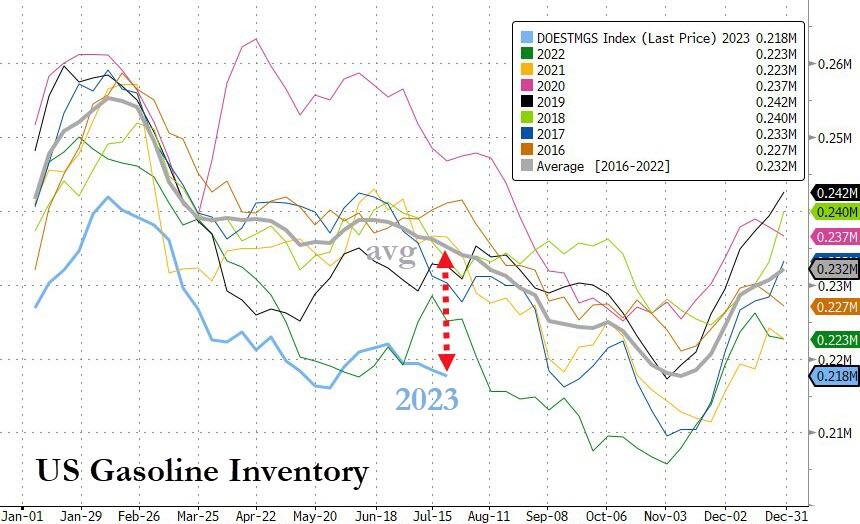
  • In the United States, gasoline inventories are lower than the five-year average both because of the gap between demand and production rates but also because of unplanned refinery outages.

The direction of oil prices is top news material. Everyone follows oil prices. Many also follow the prices of the most traded oil derivatives, and some may have noticed something rather alarming in the trend of one of these derivatives.

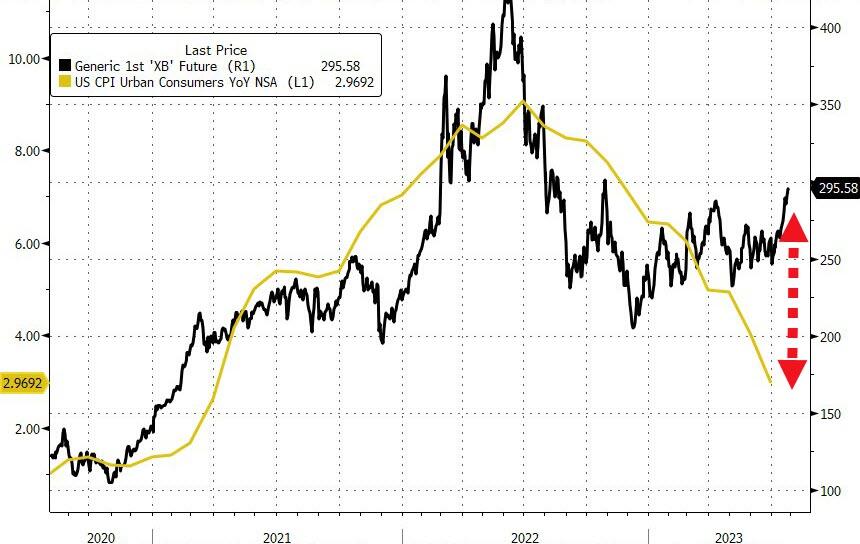
Gasoline, one of the six most traded petroleum contracts on the global futures market, has gained over 20% in the year to date, according to a recent Bloomberg report. This is more than what crude oil has gained—a lot more.

At the start of this year, Brent crude was trading around $78 per barrel. This week, the international benchmark, which now also includes a U.S. crude grade, touched $83 per barrel.

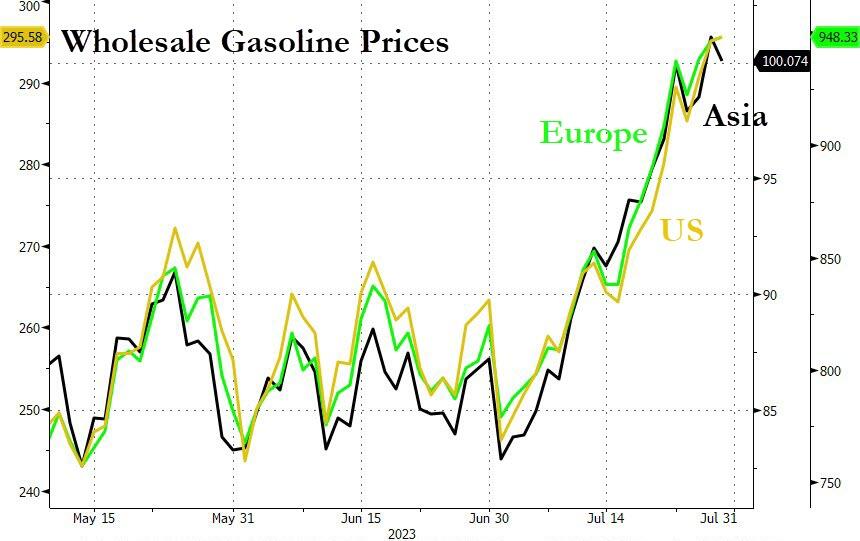
Gasoline, meanwhile, started the year at less than $2.50 per gallon. This week, gasoline topped $2.90 per gallon and may yet reach $3.

This is a cause for worry for governments around the world because gasoline, along with diesel, plays a lead role when it comes to inflation. When the price of fuels rises, the prices of everything else rises, too, because everything else is being moved from one place to another—from producer to consumer—on vehicles using either diesel or gasoline.

Yet while diesel is a lot more common for goods transportation, gasoline is a lot more popular among regular drivers. Gasoline demand is a closely watched economic indicator that analysts use to gain insight into the state of the economy, among many others.

Right now, the data suggests that gasoline demand is quite healthy, which could be cause for optimism about the global economy were it not for the fact that supply is falling short of expectations. This is fueling concern about more inflation pain despite the efforts of central banks in Europe and North America to tame it with a series of rate hikes.

In the United States, the Federal Reserve announced yet another hike of 25 percentage points for the benchmark interest rate this week. In the same week, gasoline prices moved higher, with the national average adding 4% in a single day. According to the EIA, gasoline stocks are some 7% below the five-year average for this time of the year. And oil drillers are not drilling more. They are drilling less.

In Europe, governments had to step in last year and subsidize fuels amid the energy crunch and the following embargo on Russian crude and fuels. The move drew a lot of criticism from transition advocates who argued the EU is essentially selling out to the oil and gas industry by encouraging the use of its products.

Yet those governments that implemented the subsidies knew very well what they were doing: they were avoiding riots by millions of drivers whose living standard depends quite a lot on affordable fuels.

Meanwhile, the European Central Bank just hiked interest rates to the highest in more than two decades. And gasoline is not going down anytime soon. Because there is simply not enough supply, at least not everywhere.

In the United States, gasoline inventories are lower than the five-year average both because of the gap between demand and production rates but also because of unplanned refinery outages, Bloomberg noted in its report, such as the one at Exxon’s Baton Rouge facility from earlier this week. In fact, for this time of year, gasoline inventories are the lowest since 2015...

Media reported that a gasoline production unit was down at the Baton Rouge refinery earlier this week. The reports noted that the unit, a catalytic converter, could be down for several weeks. Needless to say, gasoline prices jumped lively at the news.

In Europe, refining and gasoline production has been disrupted by protests in France and then, last month, Shell’s Pernis refinery in the Netherlands shut down a unit due to a leak.

That and the shutdown of refineries in the past few years on both sides of the Atlantic have combined to create a tight supply picture even as governments consider bans for gasoline-powered cars.

While they consider these bans and even vote on them, consumption is on the increase. Bloomberg reports that gasoline consumption in France, Germany, Spain, and Italy is on the rise. At the same time, because of the embargo on Russian fuels, feedstocks needed to produce gasoline are in short supply on the continent.

Meanwhile, Chinese refiners are producing millions of barrels of gasoline and diesel. They are, in fact, producing so much that there were recently pressuring refining margins for the whole region. But most of the gasoline and diesel that Chinese refiners produce gets consumed locally. Because although it’s the world’s biggest EV market, China is also a giant non-EV market. And fuel demand is on the rise.

The picture that gasoline supply and demand trends paint is one of prolonged tight supply and high prices.

This, in turn, will likely keep inflation untamed despite the best efforts of central banks—efforts, which also unfortunately make life more expensive.

The silver lining: inflation leads to lower consumption of everything. The risk is slipping into a recession.

Tyler Durden Sat, 07/29/2023 - 16:30
https://ift.tt/3QnJC9m
from ZeroHedge News https://ift.tt/3QnJC9m
via IFTTT

Gasoline: The Price Rally That Nobody Saw Coming SocialTwist Tell-a-Friend
| 0 comments ]

Teammates Of Trans Swimmer Lia Thomas Voiced Complaints - University Offered To "Re-Educate" Them

It was perhaps unfair that the teammates of trans swimmer Lia Thomas (originally William Thomas) were accused of being complicit in the destruction of women's sports because they "refused" to speak out.  Their initial silence in the public eye was treated by some as an endorsement of biological men posing as women participating in women's sports.  At the time, Lia Thomas was being held up by the corporate media as a hero (or heroine), the very model of the new trans-ification of sports; a rush by trans competitors into the women's arena soon followed.  

However, the team members were trying to fight back.  And according to their recent testimony, Lia Thomas was made a priority by the University of Pennsylvania and they were given an ultimatum - Fall into line or risk being ostracized as "bigots."  Furthermore, the women were told that they would have to share a locker room, changing facilities and bathrooms with the man, regularly forced to undress in front of him and be forced to watch him undress.  When they expressed concerns over this privacy issue, UPenn offered psychological services to "re-educate" Lia's teammates so that they would feel more comfortable with the changing arrangements.   

The trans movement has proven time and time again to be a vehicle for censorship and thought control in the name of "protecting the feelings of marginalized people." In reality, trans activists use a classic Marxist methodology: The exploitation of false victim status as a means to gain power over others.  And while intersectional feminism was the gateway drug to the trans movement we see today, it is now ironically women who face erasure as their entire biological reality is denied.  Hopefully the tide is turning as women speak out against dangers of trans ideology, no longer content to be used by the political left as pawns while their spaces are slowly diminished.  

Tyler Durden Fri, 07/28/2023 - 17:20
https://ift.tt/ZJnHb6T
from ZeroHedge News https://ift.tt/ZJnHb6T
via IFTTT

Teammates Of Trans Swimmer Lia Thomas Voiced Complaints - University Offered To "Re-Educate" Them SocialTwist Tell-a-Friend
| 0 comments ]

As Twitter X Hits New High In Monthly Users, Zuck Admits Threads Failing In Leaked Audio

Twitter, now rebranded as X, reached a new record high in monthly users as per a new tweet via Elon Musk. On the other hand, Meta's Threads, which is basically a Twitter clone, has lost more than half of its users who downloaded the new app earlier this month, according to Meta CEO Mark Zuckerberg. 

Zuckerberg told employees, "Obviously, if you have more than 100 million people sign up, ideally, it would be awesome if all of them or even half of them stuck around. We're not there yet." 

Reuters obtained a copy of the company's internal town hall with employees. Zuckerberg considered the exodus of users a "normal" drop-off and expected retention would soon increase with the expansion of new features. 

Chief Product Officer Chris Cox said Meta is adding more "retention-driving hooks" to lure users back to the text-based social media platform to stop the hemorrhaging. 

Since the July 5 launch, data firm Sensor Tower has shown daily active users on the app have plunged to 13 million, a drop of around 70%. We've detailed the 'unthreading' of Threads in a series of notes:

Thread's launch came days after Elon Musk announced a series of temporary limits on viewing tweets to avoid extreme manipulation and data scraping. 

Meanwhile, data privacy and censorship concerns have emerged, with former Twitter owner Jack Dorsey highlighting the vast amount of data collected by Threads.

Yet this could be another venture Zuckerberg struggles at, just like Meta's virtual reality unit has lost as much as $21.3 billion since the start of last year. 

Twitter was rebranded to "X" on Monday. 

Musk has said it will be an "everything app."  

Musk tweeted Friday that the platform has achieved a new milestone with 541.5 million monthly users.

Tyler Durden Fri, 07/28/2023 - 15:05
https://ift.tt/HepVUls
from ZeroHedge News https://ift.tt/HepVUls
via IFTTT

As Twitter X Hits New High In Monthly Users, Zuck Admits Threads Failing In Leaked Audio SocialTwist Tell-a-Friend
| 0 comments ]

These Will Be The Fastest Growing (And Declining) Industries In The US Over The Next Decade

The labor force is always shifting, responding to technological or societal changes.

For that reason, keeping an eye on the fastest growing industries can help workers and businesses stay on top of the crucial trends driving employment.

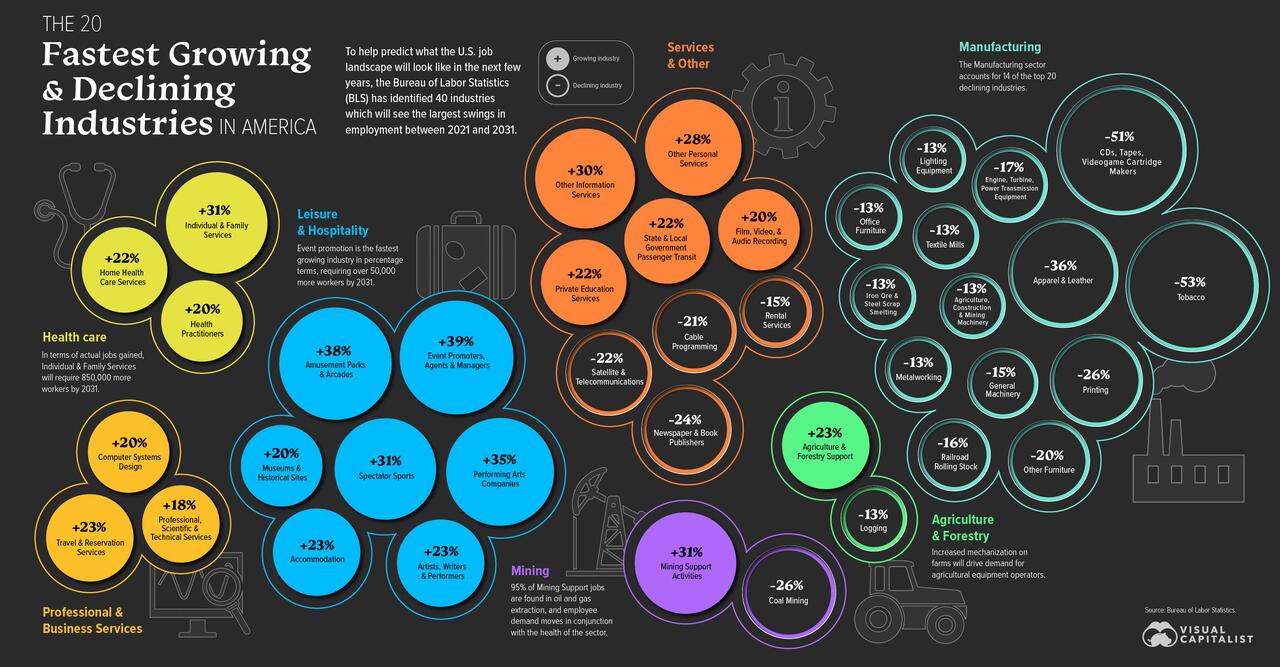
Today, Visual Capitalist's Pallavi Rao looks through projections from the U.S. Bureau of Labor Statistics (BLS) on the fastest growing industries, as well as those that are the fastest declining, by percentage employment change between 2021 and 2031.

Ranked: Fastest Growing Industries By Employment Change

Event Promoters, Agents, and Managers top the list of fastest growing industries, with an impressive predicted growth of 39%, employing over 180,000 workers by 2031.

Amusement Parks and Arcades follows close behind, with an expected 38% increase—adding over 60,000 new employees—in the same time period. Ranked third, the Performing Arts industry will start the next decade with around a 100,000-strong workforce, up 35% from 2021.

Below is the full list of BLS’ projected fastest growing industries, ranked by percent change in employment, between 2021–2031.

Rank Industry Sector Change
(2021-2031)
% Change
(2021-2031)
1 Event Promoters,
Agents & Managers
Leisure &
Hospitality
50,800 +39%
2 Amusement Parks
& Arcades
Leisure &
Hospitality
60,500 +38%
3 Performing
Arts Companies
Leisure &
Hospitality
28,400 +35%
4 Individual &
Family services
Health Care 850,000 +31%
5 Mining Support
Activities
Mining 69,700 +31%
6 Spectator Sports Leisure &
Hospitality
36,500 +31%
7 Other Information
Services
Services
& Other
112,900 +30%
8 Other Personal
Services
Services
& Other
87,200 +28%
9 Travel &
Reservation
Services
Professional &
Business Services
32,300 +23%
10 Agriculture &
Forestry Support
Agriculture
& Forestry
26,200 +23%
11 Artists, Writers
& Performers
Leisure &
Hospitality
11,500 +23%
12 Accommodation Leisure &
Hospitality
333,700 +23%
13 Private Education
Services
Services
& Other
169,200 +22%
14 Government Transit Services
& Other
61,200 +22%
15 Home Health
Care Services
Health Care 330,100 +22%
16 Health Practitioners Health Care 205,500 +20%
17 Film, Video, &
Audio Recording
Services
& Other
75,300 +20%
18 Museums &
Historical Sites
Leisure &
Hospitality
27,600 +20%
19 Computer
Systems Design
Professional &
Business Services
455,200 +20%
20 Professional,
Scientific &
Technical Services
Professional &
Business Services
144,100 +18%

Note: Services & Other sector includes Information, Education and State & Local Government industries.

All of the top three industries belong to the Leisure and Hospitality sector, which accounts for seven of the 20 fastest growing industries. This outsized performance reflects recovery more than pure growth, as the BLS notes that the Leisure and Hospitality sector was unduly affected by the COVID-19 pandemic, giving it a lower-than-usual baseline in 2021.

Ranked fourth by employment change percentage is Individual and Family Services, though it is actually expected to see the largest growth in total employment terms, adding 850,000 new workers by the end of the decade. It is one of three industries in the Health Care and Social Assistance sector with large projected growth, thanks to an increased need for care service due to an aging American population.

Not to be missed is Computer Systems Design, projected to grow by 20% in employment thanks to growing demand for computing infrastructure and IT security. Due the industry’s sheer size in employment force with 2.3 million workers in 2021, that’s close to half a million additional workers over the next decade.

Ranked: Fastest Declining Industries By Employment Change

Tobacco Manufacturing leads the group of industries expected to register employment declines by 2031, with a projected decrease of 53% in employment, bringing its already small workforce down to only 5,000 employees by the end of the decade. This stark decline is not necessarily driven by waning smoking habits, as cigarette sales in the U.S. went up during the pandemic. Instead, further automation of the industry may replace tobacco manufacturing employees.

Another industry facing a similar situation is CDs & Tapes Manufacturing, which is expected to witness a 51% reduction in employees by 2031.

Below is the full list of BLS’ projected fastest declining industries, ranked by percent change in employment, between 2021–2031.

Rank Industry Sector Change
(2021-31)
% Change
(2021-2031)
1 Tobacco
Manufacturing
Manufacturing -5,700 -53%
2 CDs & Tapes
Manufacturing
Manufacturing -5,800 -51%
3 Apparel & Leather
Manufacturing
Manufacturing -41,800 -36%
4 Printing Manufacturing -96,800 -26%
5 Coal Mining Mining -9,500 -26%
6 Newspaper &
Book Publishers
Services
& Other
-60,000 -24%
7 Satellite &
Telecommunications
Services
& Other
-19,300 -22%
8 Cable Programming Services
& Other
-9,700 -21%
9 Other Furniture
Manufacturing
Manufacturing -7,600 -20%
10 Engine & Power
Transmission
Equipment
Manufacturing
Manufacturing -14,800 -17%
11 Railroad Rolling
Stock Manufacturing
Manufacturing -3,100 -16%
12 Rental Services Services &
Other
-22,200 -15%
13 General Machinery
Manufacturing
Manufacturing -39,800 -15%
14 Iron Ore & Steel
Scrap Smelting
Manufacturing -10,600 -13%
15 Lighting Equipment
Manufacturing
Manufacturing -5,600 -13%
16 Metalworking
Manufacturing
Manufacturing -21,100 -13%
17 Logging Agriculture
& Forestry
-6,000 -13%
18 Textile Mills Manufacturing -26,100 -13%
19 Agriculture,
Construction &
Mining Machinery
Manufacturing
Manufacturing -25,500 -13%
20 Office Furniture
Manufacturing
Manufacturing -12,600 -13%

Most of the industries facing large total employment contraction belong to the Manufacturing sector. The troubles of American manufacturing aren’t new, but the variety of industries presented suggests a mix of factors causing slumps across the sector.

Some industries like Printing, Cable Programming, and Newspaper and Book Publishers face shifting consumption habits.

Meanwhile, others like Textiles, Apparel, and Furniture Manufacturing are expected to suffer from further automation and shifted production abroad.

Factors Shaping Future Employment Trends in the U.S.

It’s important to note that these projections by the BLS were released in September 2022. That means they do not reflect the rapid rise of generative AI like ChatGPT and how they have begun to affect the economy.

A recent Goldman Sachs report, for example, stated that AI could replace 300 million jobs—almost the size of the U.S. population—around the world in the next 10 years.

That makes it an open and important question as to whether AI or powerful demographic trends, such as slower population growth and an aging workforce, will be the most impactful in terms of determining the future employment landscape.

Tyler Durden Thu, 07/27/2023 - 18:20
https://ift.tt/e1OofW0
from ZeroHedge News https://ift.tt/e1OofW0
via IFTTT

These Will Be The Fastest Growing (And Declining) Industries In The US Over The Next Decade SocialTwist Tell-a-Friend