And The Winner For Poorest Big City In America Is...
Philadelphia has once again been named the poorest major city in the United States, reclaiming an unwanted title after briefly losing last year.
A whopping 20.4% of Philadelphia residents lived below the poverty line in 2025, according to newly released U.S. Census Bureau data, marking the city's first increase in poverty since 2011.
The figures, first reported by The Philadelphia Inquirer, put Philadelphia ahead of Houston and New York City, which both recorded poverty rates of 17.7%.
The reversal comes after Philadelphia briefly surrendered its unwanted title to Houston in 2024, when its poverty rate dropped to 19.7%, its lowest level since at least 1979.
The latest figures also revealed that Philadelphia's median household income stood at just $67,400 in 2025. A family of four earning approximately $32,750 annually was considered to be living in poverty, according to federal guidelines.
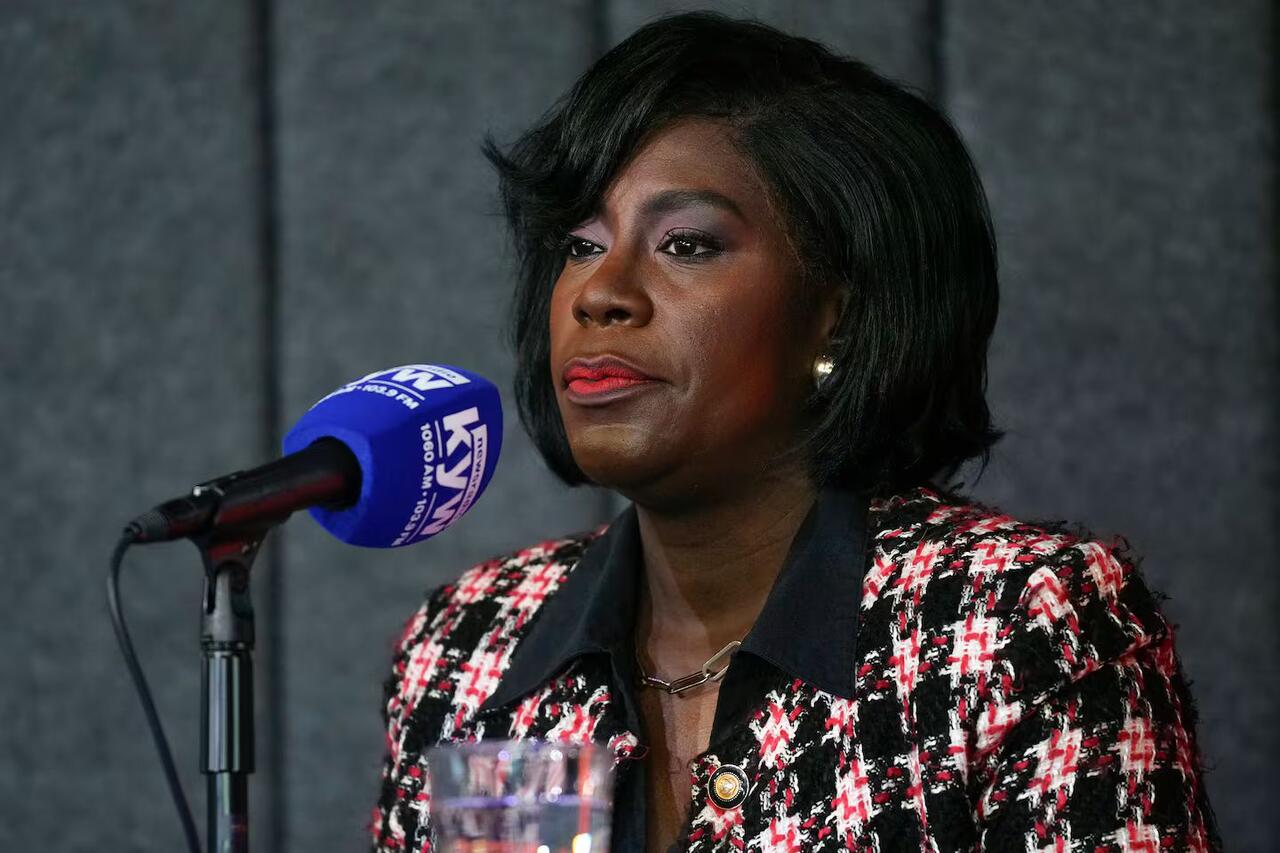
In a statement to the Inquirer, Philadelphia Mayor Cherelle Parker (D) conceded that city's poverty rate unacceptable.
"A rate of 20.4 percent is too high and unacceptable to me as mayor," the mayor said, pointing to the rising cost of everyday necessities as a major burden on struggling families.
"Affordability is a very real issue, and basic staples like food, fuel and clothing cost too much for too many Philadelphians," she added.
Philadelphia's poverty rate peaked at 28.4% in 2011 before gradually declining over the following decade.
Philadelphia's poverty figures come as city officials push a risky new housing scheme that bears troubling echoes of the 2008 financial crisis.
As we reported earlier Friday, Philadelphia plans to roll out a taxpayer-subsidized mortgage program allowing first-time homebuyers to put down as little as 3% and avoid private mortgage insurance, with public funds covering part of the interest costs.
The program, dubbed One Philly Mortgage, is part of Parker's H.O.M.E. housing initiative, which earmarks $25 million for low-interest mortgages and down-payment assistance.
However, questions remain about who will shoulder the financial risks.
Private mortgage insurance typically costs between $30 and $70 per month for every $100,000 borrowed, according to Freddie Mac. Homeowners could end up paying nearly $3,000 a year on a $350,000 mortgage.
The insurance protects lenders if borrowers with little equity default on their loans. Under Philadelphia's program, buyers would not be required to pay it, although publicly available city materials do not specify who would assume that risk instead.
With the median listing price in the Philadelphia metro area hovering around $375,000, a buyer putting down just 3% would have only $11,250 in initial equity.
A 3% decline in the property's value would wipe out that initial equity, assuming no mortgage principal had been repaid, even before accounting for selling costs.
Translation: This could be a slow-moving train wreck. But don't tell the Democrats running Philadelphia that.
Iran Issues Nov 1st Blanket Ban On South Korean Tanker Giant Moving One-Third Of Persian Gulf Oil Exports
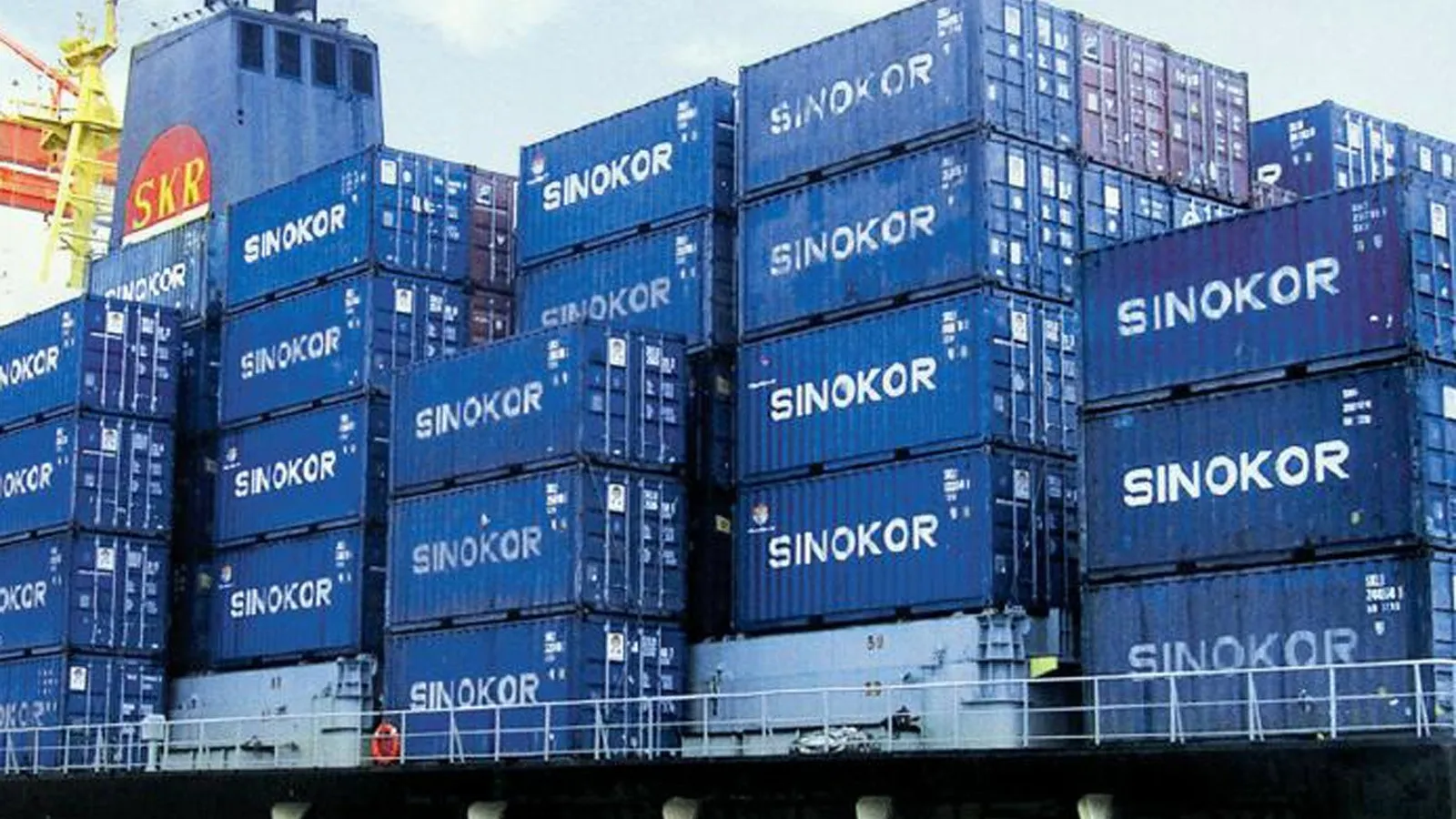
South Korean tanker giant Sinokor is the world's dominant VLCC owner (Very Large Crude Carrier) and has in recent weeks found itself front and center in the crosshairs of Iranian retaliation in the Strait of Hormuz and regional waters.
This past week, Iran's Persian Gulf Strait Authority (PGSA) has put the major South Korean maritime shipping and logistics group on notice, saying Sinokor will suffer sweeping action against its fleet starting November 1st if it keeps violating Tehran's protocol for shipping through the strait.
This has marked the first time the Islamic Republic issued a blanket warning covering a shipowner's entire fleet, but this is perhaps because Sinokor alone accounted for about 37% of Hormuz oil transits in September and more than 50% of VLCC traffic in the first 10 days of October, according to Lloyd’s List Intelligence data.
Despite regional passage being fraught with obvious ultra high risks, Sinokor has risen to dominance in the Gulf's shipping market, moving to capitalize on extraordinary freight rates.
However, this has come at a steep physical cost, with at least seven Sinokor-linked tankers having been attacked and struck by Iranian missiles or drones recently and during the conflict.
New VLCC's contracted from shipyards can run from $125 million to $135 million to build - but a prompt delivery resale can run much, much highter - especially now.
Also, war risk insurance has been exploding in price. One industry watcher has put together a brief primer:
Standard hull and machinery insurance excludes war risks, so owners buy separate hull war cover and pay an additional premium (AP) each time a ship enters a Joint War Committee listed area.
Before the war that began on February 28, 2026, Hormuz war-risk cover typically cost 0.15% to 0.25% of hull value; brokers quoted 6% to 10% in early October 2026, according to the Financial Times.
On a $100 million tanker, that swing turns a roughly $250,000 premium into $6 million to $10 million for one transit, before cargo cover, which is bought separately.
Quoted rates are not an official index: they vary by ship, flag, ownership links, route and date, and underwriters can reprice or withdraw cover at short notice.
WarBrief Live has provided the following brief timeline and outline of soaring rates:
Pre-war rate: 0.15% to 0.25% of hull value (Lloyd’s List, March 11, 2026)
Early October 2026 quote: 6% to 10% of hull value per voyage (brokers via the Financial Times, reported October 7)
Worked example: $100 million tanker: about $250,000 before the war, $6 million to $10 million at early-October quotes
Trigger: entry into a Joint War Committee listed area, usually priced for a seven-day period
Days ago, Bloomberg highlighted the outsized role this single South Korean company has played in shipping contract pricing amid the global energy crisis:
The messages from the world’s biggest supertanker owner often begin with pleasantries: “Dear Ladies and Gentlemen.” Within minutes, the WhatsApps are the talk of the oil-tanker industry, a multibillion-dollar corner of the energy market that’s been plunged into chaos by the Iran war this year, and where word of mouth is the main way information spreads. The details vary, but the messages to shipbrokers from Sinokor Group, the South Korean company controlled by tycoon Ga-Hyun Chung, mostly boil down to the same thing — one of its vessels has just been hired at a new sky-high rate to ferry oil out of the Persian Gulf.
Some messages detail a new contract, listing the ship, counterparty and eyewatering price. Others just refer loosely to negotiations underway. The format fluctuates from terse strings of numbers and names to full sentences and florid signoffs: “Very respectfully. Thank you very much and best regards,” concludes one message sent to brokers in August, and seen by Bloomberg. Usually, in the days that follow, the global benchmark price set by London’s Baltic Exchange takes another leap higher.
What would simply be fodder for gossip in most industries, brokers say that Sinokor’s WhatsApp messages have for months played an outsized role in setting the cost of transporting oil around the world. Rates for very-large crude carriers (VLCC) — the biggest kind of oil tanker — have soared more than 1,600% this year amid disruptions caused by the war, creating an unprecedented boom for the industry, but throwing a spotlight on the arcane system used to price the world’s shipping contracts, and the centuries-old institution that manages it.
As for the threat against the company coming from Iran, it remains to be seen what unspecified "legal action" will be taken going forward or in what form, or how to interprete "appropriate enforcement measures" - which has so far involved full-on military attacks.
SINOKOR Fleet update - Given the direct threat to their fleet by the IRGC from 1 Nov onwards. The fleet seems very interestingly poised.
The statement PGSA released on October 27 said Sinokor vessels "have committed the highest number of crossing violations over the past 3 months" and that "appropriate enforcement actions have been taken against at least 7 of them."
A top Washington state official said on Oct. 29 that the state has no way to confirm whether people are U.S. citizens when registering them to vote.
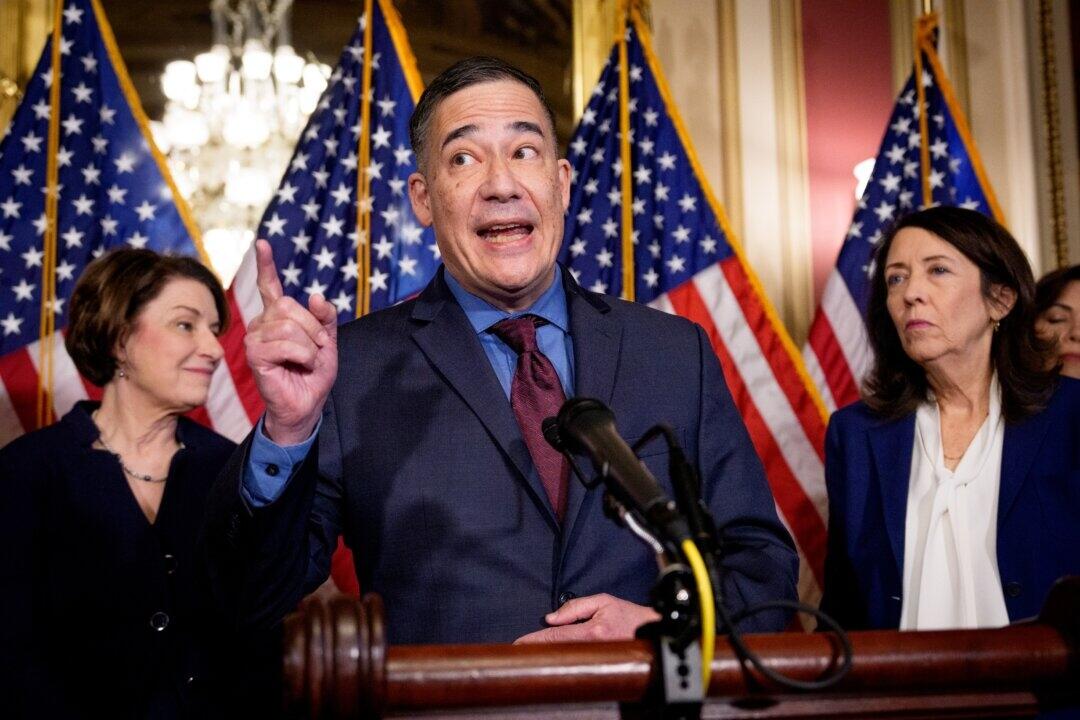
"We don't have a system that can identify whether someone is an actual noncitizen," Washington Secretary of State Steve Hobbs said during a press conference in King County.
Hobbs also said that "it's not unusual for noncitizens to actually be on voter rolls" and that "we never said that there are none on there."
Federal officials recently saidthey identified more than 400 people registered to vote in Washington state who are suspected of being noncitizens.
They said they would send Hobbs's office a list of the people and ask him to set aside ballots from those individuals until their citizenship status could be confirmed.
Hobbs, responding in a letter on Wednesday, said a preliminary analysis showed that some of the people on the list are not currently registered to vote and that others are U.S. citizens, "based on information of which Washington is aware." Hobbs asked the federal government for "individualized proof that certain registered voters in Washington are ineligible."
Washington state has automatic voter registration. That means people who present proof of citizenship to state agencies are automatically registered to vote.
To meet the requirements, a person must sign a statement saying they're a U.S. citizen and provide identification.
Hobbs told the briefing, after saying the state lacks a system to verify citizenship, "That's why when people go up to get their registration done at a [government facility], they are asked if they are a noncitizen, they are asked to sign the form; they're attesting whether or not they're a U.S. citizen."
Hobbs's comments show that the state "does nothing to confirm citizenship" and is "knowingly sending out ballots to noncitizens and trusting that the noncitizens will not fill out the ballot," Charles Neil Floyd, acting U.S. attorney for the Western District of Washington, said in a statement to news outlets on Oct. 29.
"Registering noncitizens to vote with or without their knowledge could jeopardize their ability to become citizens. The noncitizens we have interviewed tell us that they assumed they could vote because the state sent them a ballot."
Hobbs said registering noncitizens to vote could happen because a noncitizen wasn't listening to what a government worker said or because a government worker clicked the wrong box.
He said that there have been 15 cases of noncitizen voting between 1982 and 2025 in the state.
Hobbs and King County Elections Director Julie Wise, who has expressed concerns in the past about noncitizens being registered to vote, told the briefing that noncitizens who are registered to vote have in the past called authorities to have their names removed.
"It is not a crime to be accidentally put on the voter roll, because sometimes it's not their fault," Hobbs said.
Officials noted that voting as a noncitizen is a crime, with prison time among the penalties upon conviction.
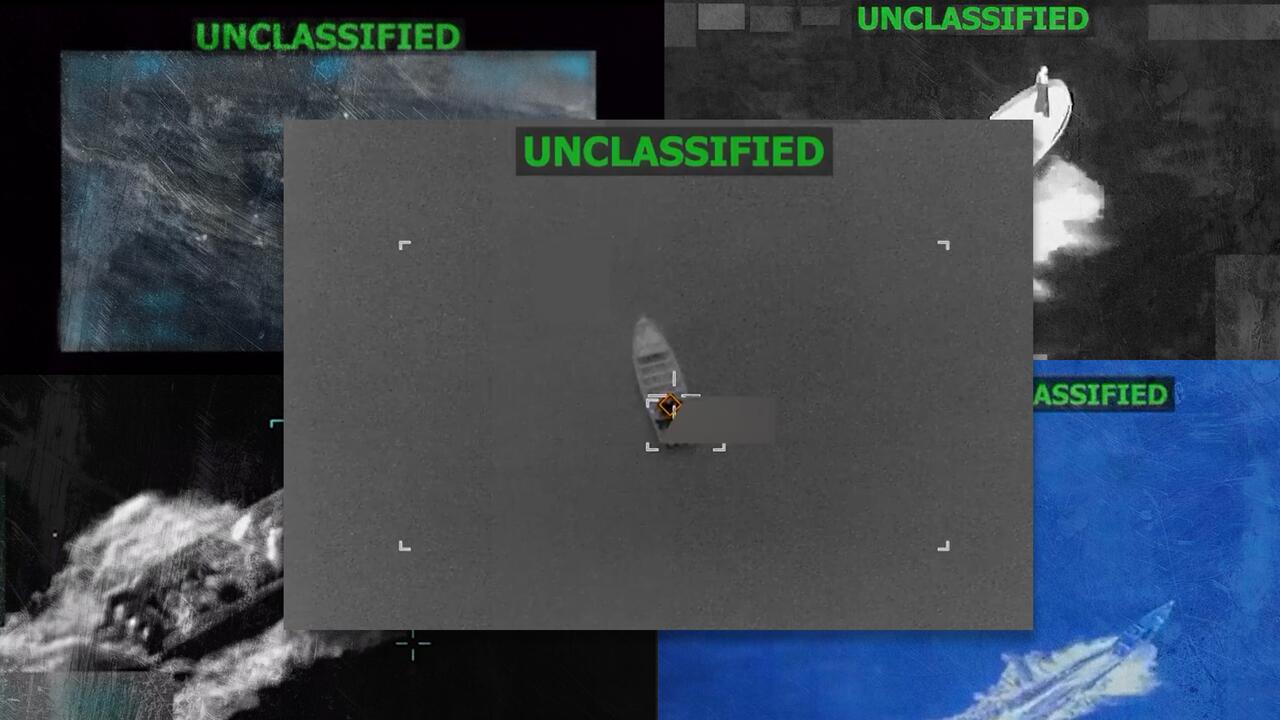
The U.S. military killed five people Tuesday aboard what Southern Command described as a "go-fast vessel" associated with "narco-terrorists" in the eastern Pacific Ocean, bringing the death toll from its campaign against suspected drug traffickers to at least 240 since September 2025.
U.S. Southern Command said Joint Task Force Western Hemisphere carried out the Oct. 27 strike against a speedboat traveling along known drug-trafficking routes.
The command said intelligence confirmed the vessel's involvement in narcotics trafficking but did not publicly provide evidence supporting that assessment, with the majority of these killings occurring at sea.
Video released by U.S. Southern Command on X appears to show the vessel sitting nearly motionless in the water before a large explosion engulfs it. The footage does not establish whether the vessel was anchored or disabled.
On October 27, under the direction of #SOUTHCOM, Joint Task Force Western Hemisphere executed a lethal, kinetic strike on a go-fast vessel operating along established narco-trafficking routes in the Eastern Pacific. Confirmed intelligence revealed the vessel's active involvement... pic.twitter.com/egwWVgoypi
The families of two men killed in an October 2025 strike have also sued the U.S. government, alleging wrongful death and extrajudicial killing. The lawsuit, filed with assistance from the American Civil Liberties Union and Center for Constitutional Rights, concerns Chad Joseph, 26, and Rishi Samaroo, 41, both from Trinidad and Tobago.
Their families say the men had been fishing and working in Venezuela and were returning home when the military struck their boat. The lawsuit seeks damages and a finding that their deaths were unlawful.
The Trump administration has maintained that the strikes are lawful. SOUTHCOM previously told Task & Purpose that all military operations had complied with the law of armed conflict and that every person killed was a confirmed member of a designated terrorist organization.
Google Plunges After Ugly Top And Bottom Line Miss, As AI Cannibalizes Search And Ads
Today, ahead of the doubleheader of Mag 7 reports when both Microsoft and Google parent Alphabet report, we wrote in our preview that Microsoft has become the consensus long, while Alphabet "still feels like the consensus funding short across megacaps." And both have to convince a market that, as Goldman's Rich Privorotsky put it this morning, now has "eye watering expectations":
"These really matter. Eye watering expectations… buyside probably closer to Azure growth around high 40s%, Google Cloud around mid 90s%. The question isn't whether those are good numbers, but whether they can surpass already high expectations... Azure probably needs a guidance raise to be properly supportive. The nuance is capacity… if they miss elevated expectations simply because they cannot bring enough compute online. That's disappointing for near term revenue but potentially even more bullish for the scarcity premium and future spending. Watch customer concentration, how broad the demand really is and, crucially, the relationship between revenue growth, capex and margins. The market wants evidence that the incremental economics work."
In other words, a cloud beat is just the price of admission, and the debate tonight is what all that cloud costs, and who pays for it.
Within the Mag 7, Microsoft and Alphabet sit at opposite ends. Goldman's derivatives desk has Microsoft at 8/10 on its positioning score (the same score Meta carried into its print last week, and we all know how that went). Alphabet, meanwhile, keeps getting sold to pay for everything else. JPMorgan's TMT trader Brian Heavey wrote this morning that "we continue to see GOOG being used as a source of funds (note there was another negative 3P check ahead of earnings - all pointing to a Search miss)." The stock dropped 10% from its October 13 high into Monday.
There are some signs of a thaw. Goldman's US desk saw "a buyer of 50k GOOGL 15Jan 360 calls" on Tuesday, and Privorotsky notes that "people have barely begun to re-risk. What we've really seen so far is the abatement of supply, rather than meaningful fresh demand."
Away from Goldman, and focusing on Alphabet, the whole debate fits in one line from JPMorgan's Mark Schilsky, whose Tech Sketch "Earnings Preview Bonanza" (available to pro subs) frames it as "Street (Consensus) Fighter II: Search vs. Cloud":
"On the one hand, Google Cloud Revenues are likely to crush this quarter, thanks to TPU sales. On the other hand, Search Revenue growth is expected to miss the Street because the alt data (which is always right!) suggests so... GOOGL is also on a path to where Google Cloud Revenues could be equal to Search Revenues by late 2028. That's massive! Who thought that was possible 1 year ago? And now we're debating whether or not Search is going to miss by like -50 bps this quarter. Who cares?!?"
Plenty of people care, apparently. Schilsky gives Alphabet a 5 out of 10 on his investor expectations gauge, vs. a 9 for Meta last week:
Here is the buyside bar, combining Schilsky and the UBS bogeys:
Search: investors expect ~14% growth, FXN and reported, vs. the Street's ~15%. UBS has the bogey at 14-14.5%. Goldman's analysts are 1% below consensus. Per Schilsky, "everyone 'knows' that Search is likely to miss by about -100 bps because that's where the alt data is," so "if this beats, the stock is almost assuredly going higher T+1." Watch paid clicks too (+13% in Q2), where "the comps get 3 points harder this print."
YouTube: ~11-12%. "Honestly, no one really cares about YouTube. As long as growth doesn't dip below +10% Y/Y, investors will continue to ignore it."
Google Cloud: this is where the buyside is way above the sellside. Schilsky hears +105% to +115%, UBS +100-115%, Goldman's analysts ~+100%, and Privorotsky's desk "mid 90s," all vs. the Street at roughly +90-96%. Implied TPU sales in the quarter: "most are in the $5B to $7B range."
Operating income: ~$45 billion vs. the Street's ~$43 billion (UBS says $44-45 billion).
Note just how wide the range is on Google Cloud in Bloomberg's consensus: the median is $29.1 billion, but individual estimates run from $24.3 billion to $36.7 billion, roughly 60% to 140% growth. Elsewhere, Search is expected at $64.9 billion, YouTube at $11.4 billion, and total operating income at $43.2 billion. And look at the bottom line: consensus has Alphabet generating negative free cash flow of $3.5 billion this quarter, as $55.8 billion of capex swallows $53.9 billion of operating cash flow.
For Schilsky, the sneaky most important number is the Google Cloud margin: "given that this is the first quarter in which TPU sales are likely to be truly meaningful, any beat to the Street's ~33% EBIT Margin estimate will be rightfully viewed by investors as modest validation that TPU margins are close to – or possibly higher than – core Google Cloud Margins." Goldman's TMT specialists add the other side of that ledger: "Watch cloud margin commentary as they have flagged modest pressure... Search still funds the build. Any softness in search monetization or YouTube would compound the spend narrative."
Then there's the consumer agent. UBS says investors want two things before sentiment can inflect: "a credible AI agent that helps ease Muse/Search concerns, and a broader Gemini 4 rollout." Perceptions of Alphabet as a direct competitor to the leading frontier labs "have faded" after the latest Gemini delay (and after Gemini 4 Argon proved to be, well, benchmaxxed). Goldman's Eric Sheridan sees "an eventual consumer agent launch, possibly aligned with Gemini 4 ahead of the holiday season," and Schilsky expects "a 'real' competitor to META Muse in the coming months."
The $350 Billion Question
As always, the number that moves the stock may not even be in the quarter. Alphabet's 2026 capex guide sits at $195-205 billion, and UBS says the focus tonight is simply a reiteration. 2027 is another story:
2027 capex: Street ~$305 billion, per Schilsky. The buyside is at "$330B to $350B" (JPM) or "$350-375 bn" (UBS). Goldman's own estimate is $350 billion.
2028 capex: "Trust me, I've been asking investors for weeks for this number, but the most common answer I've received is a combination of 'Higher' and 'If anyone tells you with any certainty what their estimate for Google's 2028 is, they are b*#!$#!ing you.'"
2027 EPS: $14.50-16.00 per JPM, $15-16 per UBS, vs. the Street at ~$15. 2028 EPS is anyone's guess, with the "modal outcome" in the low $20s vs. the Street at ~$18.
2027 Google Cloud growth: the Street is at +68%, while "most investors are >+100% Y/Y."
So, a 70%-plus jump in capex to $350 billion or more is now the bull case. Recall what Sundar told us in July when the market balked at the last increase:
*ALPHABET CEO: NEXT GEN FRONTIER MODELS WILL BE MUCH LARGER
With all that in mind (and it's quite a lot), here is what GOOGL reported moments ago, which judging by the negative stock reaction to the revenue and EPS miss a sign that the company is failing to generate enough return to justify its massive investments in AI, is a mirror image of the meltup after the stellar 2nd quarter, may explain why as noted above, GOOGL has been the funding short across the Mag 7 space:
Google advertising revenue $82.01 billion, +11% y/y, missing estimate $83.57 billion as AI is starting to aggressively cannibalize search and ad revenue
Google Search & Other Revenue $63.35 billion, +12% y/y, missing estimate $64.85 billion
Google Subscriptions, Platforms and Devices Revenue $14.29 billion, +11% y/y, missing estimate $14.78 billion
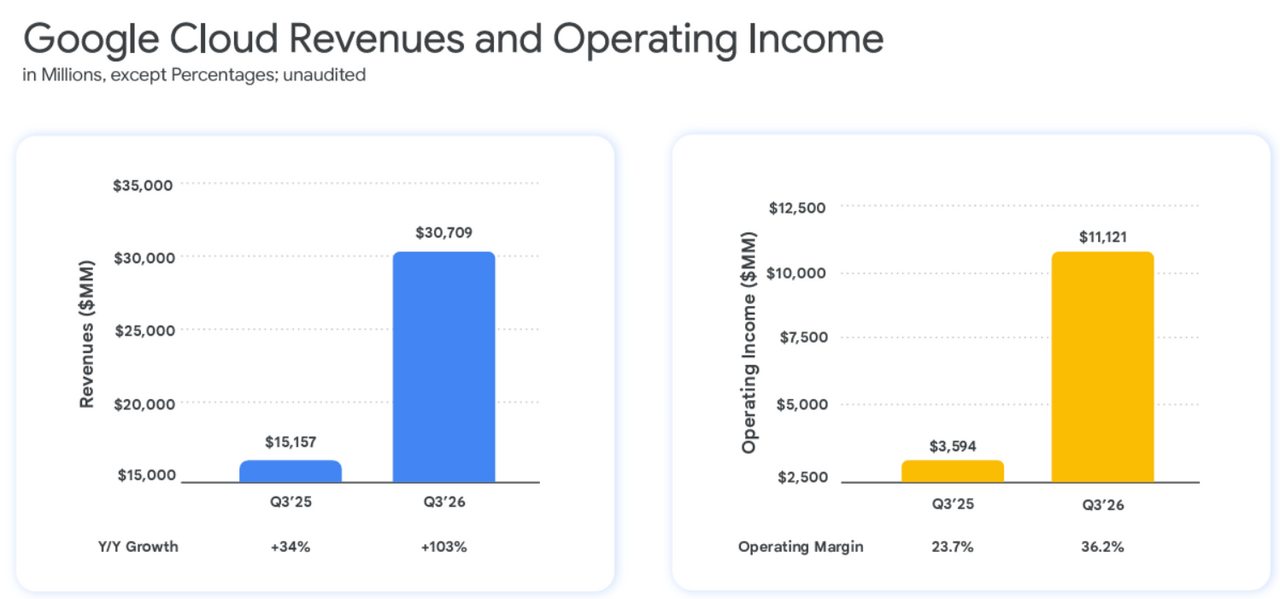
Google Cloud revenue $30.71 billion vs. $15.16 billion y/y, beating estimate $29.1 billion
Other Bets revenue $372 million, +8.1% y/y, missing estimate $387.8 million
Other items:
Hedging gains $194 million, estimate $21.1 million
Total TAC $16.37 billion, +10% y/y, estimate $16.53 billion
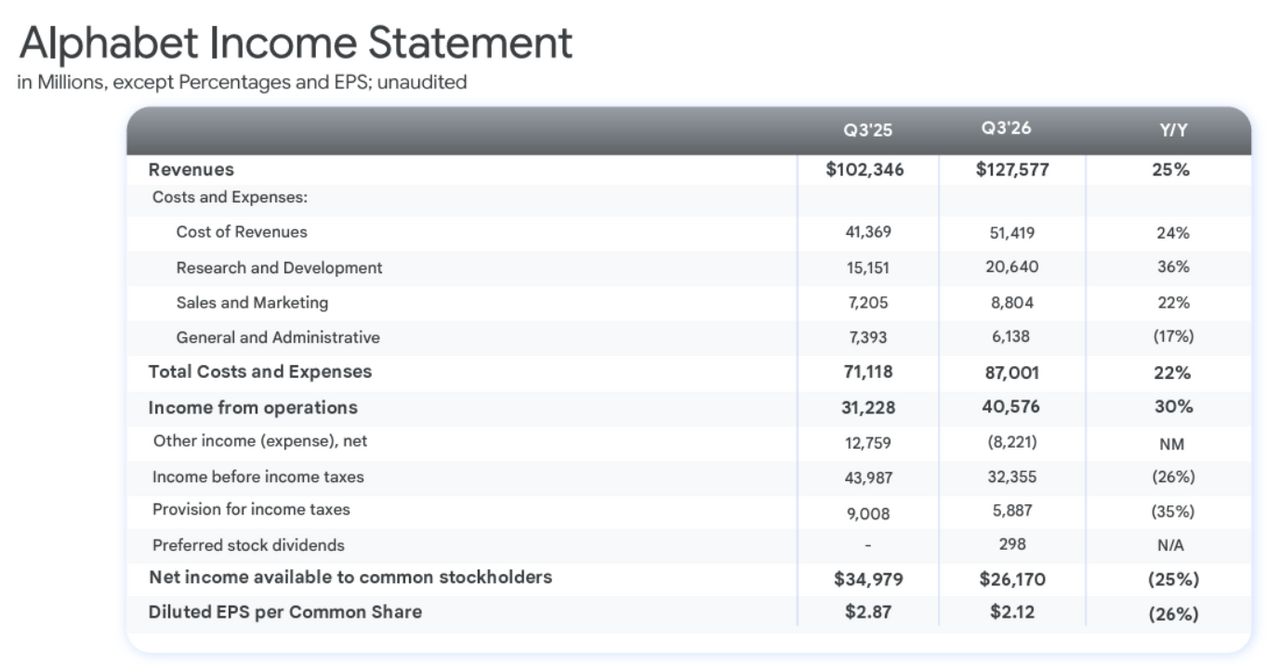
Operating income $40.58 billion, +30% y/y, estimate $43.16 billion
Operating margin 32% vs. 31% y/y, estimate 33.7%
Google Services operating income $39.16 billion, +17% y/y, estimate $40.53 billion
Other Bets operating loss $2.05 billion vs. loss $1.43 billion y/y, estimate loss $1.72 billion
Alphabet-level activities operating loss $7.66 billion vs. loss $4.47 billion y/y, estimate loss $5.49 billion
Number of employees 204,757, +7.7% y/y, estimate 200,614
Last but not least, Capex:
Capital expenditure $51.36 billion vs. $23.95 billion y/y, estimate $55.78 billion
Oops.
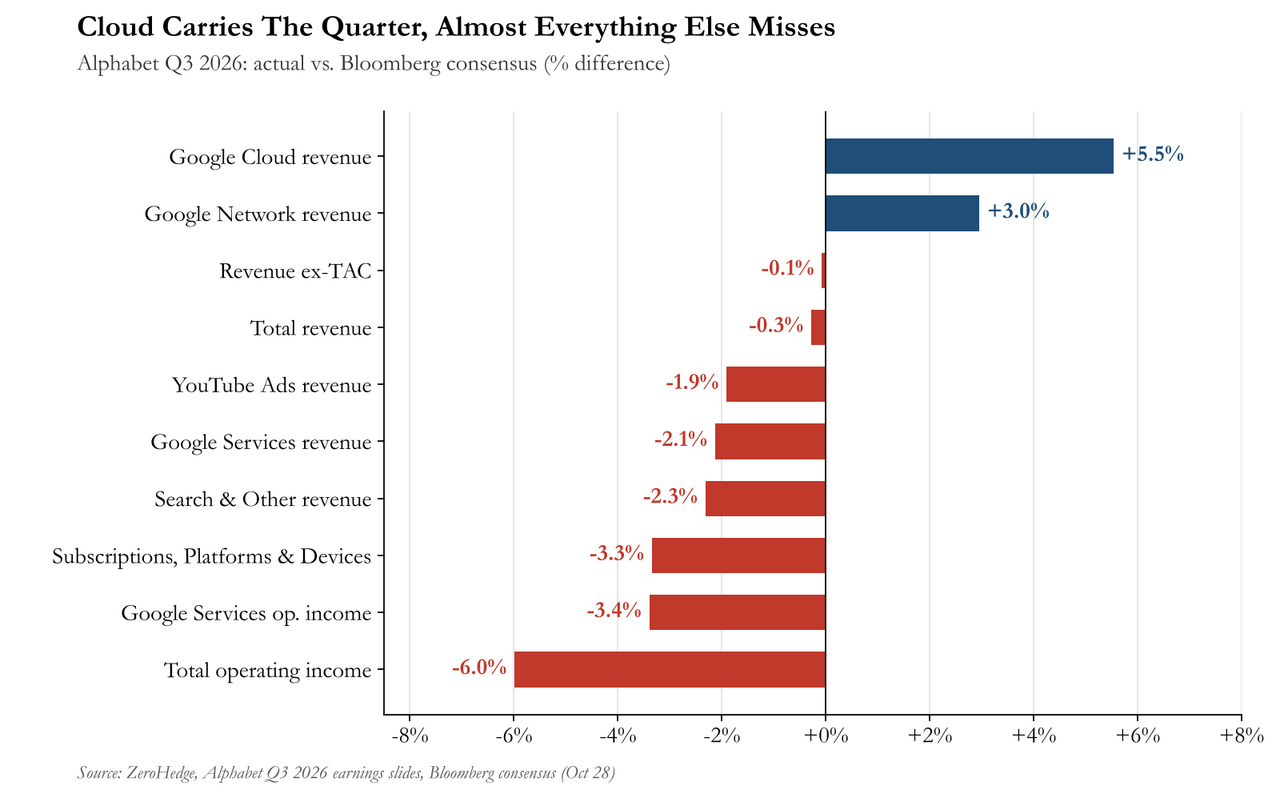
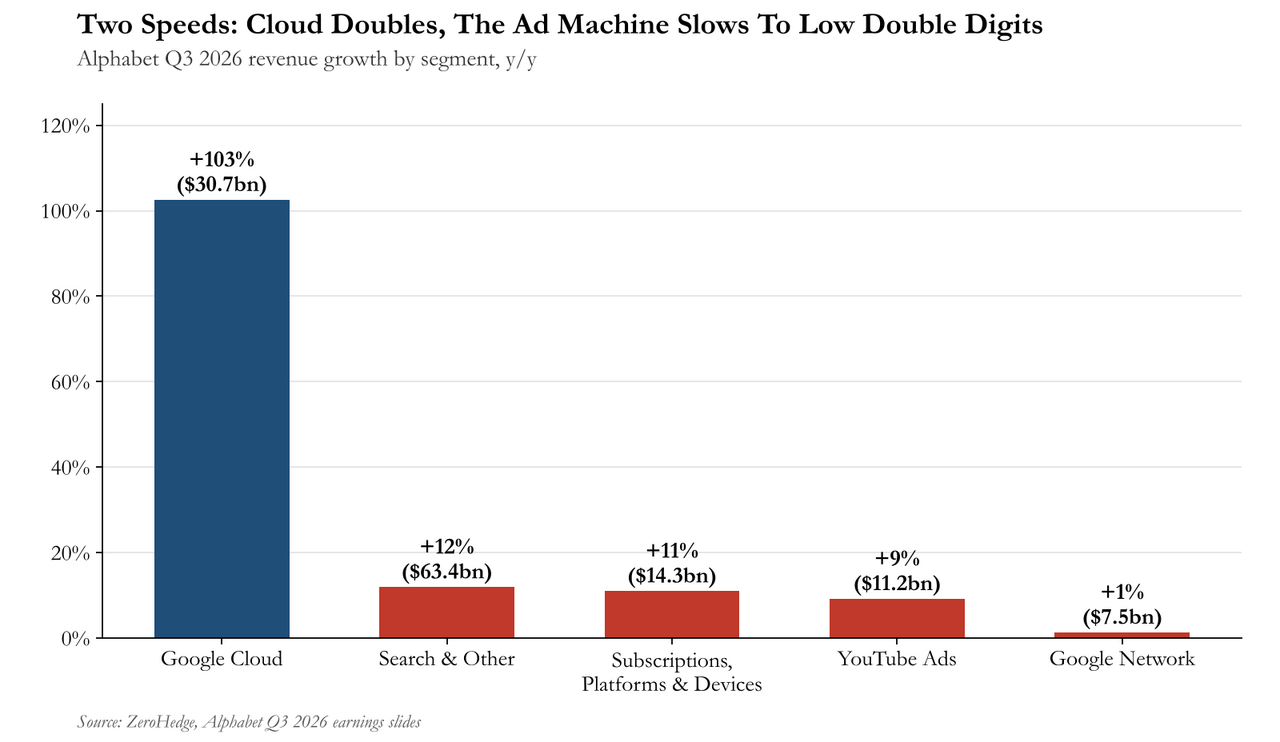
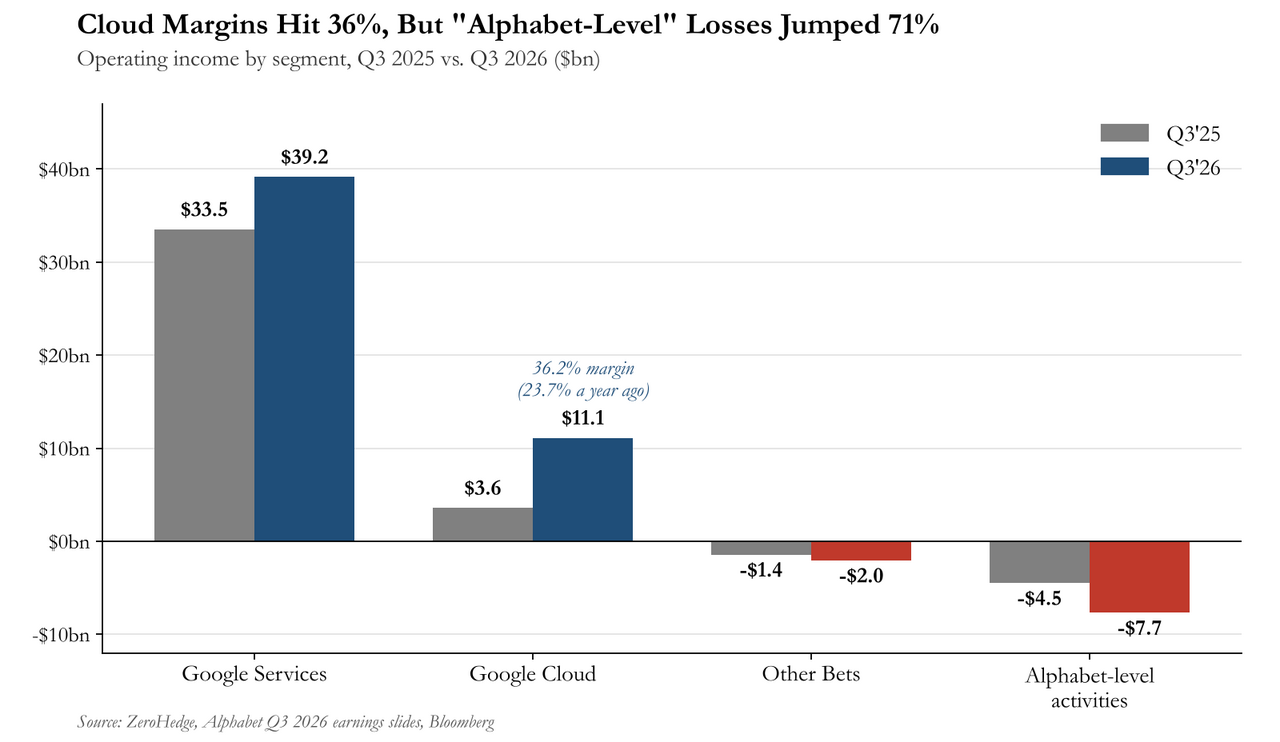
Here are the results visually:
Cloud was the only big beat. Google Cloud came in at $30.7bn vs $29.1bn expected (+103% y/y), but Search, YouTube, Subscriptions and Services all missed. Operating income of $40.6bn was 6% light.
Two speeds. Cloud doubled; Search grew 12% (vs the ~14% buyside bogey and ~15% Street), YouTube 9% (below the 10% line Schilsky said investors would tolerate), and Network just 1%.
Cloud margin jumped to 36.2% from 23.7%, well above the ~33% Street figure Schilsky flagged. But Alphabet-level losses rose 71% to $7.7bn and Other Bets lost $2.0bn, so about half of Cloud's $7.5bn profit gain went straight back out.
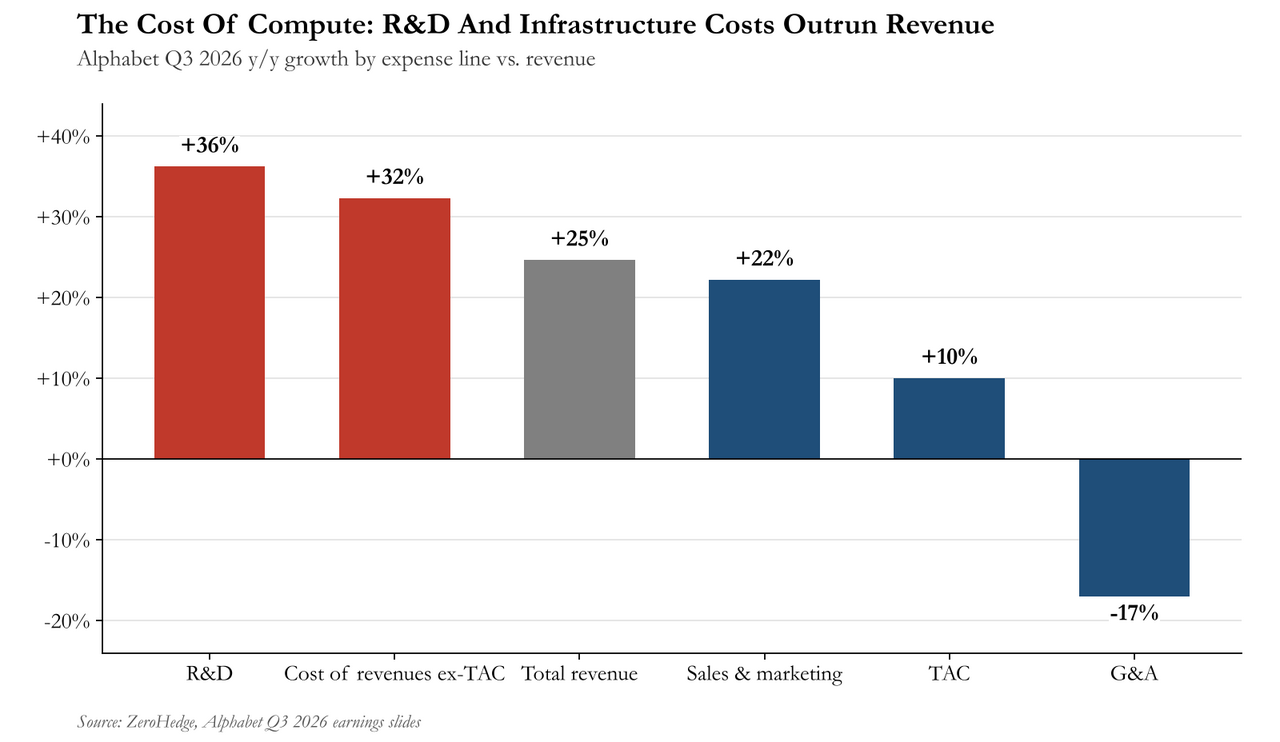
The cost of compute. R&D (+36%) and cost of revenues ex-TAC (+32%, where depreciation sits) both grew faster than revenue (+25%). G&A fell 17%, and headcount was still up 7.7% to 204,757.
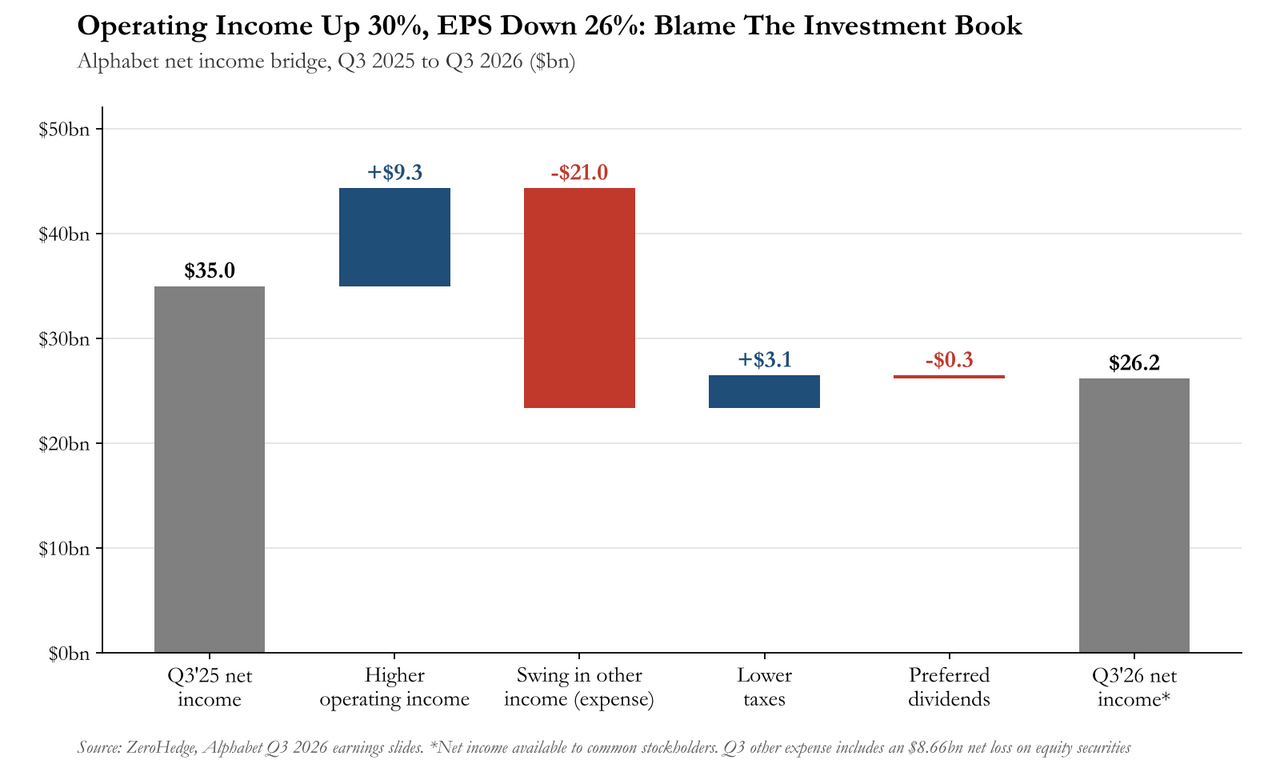
Operating income was up 30%, but EPS fell 26% to $2.12. A $21bn swing in other income, including an $8.66bn net loss on equity securities, wiped out the operating gain. There was also a new $298mm preferred dividend line.
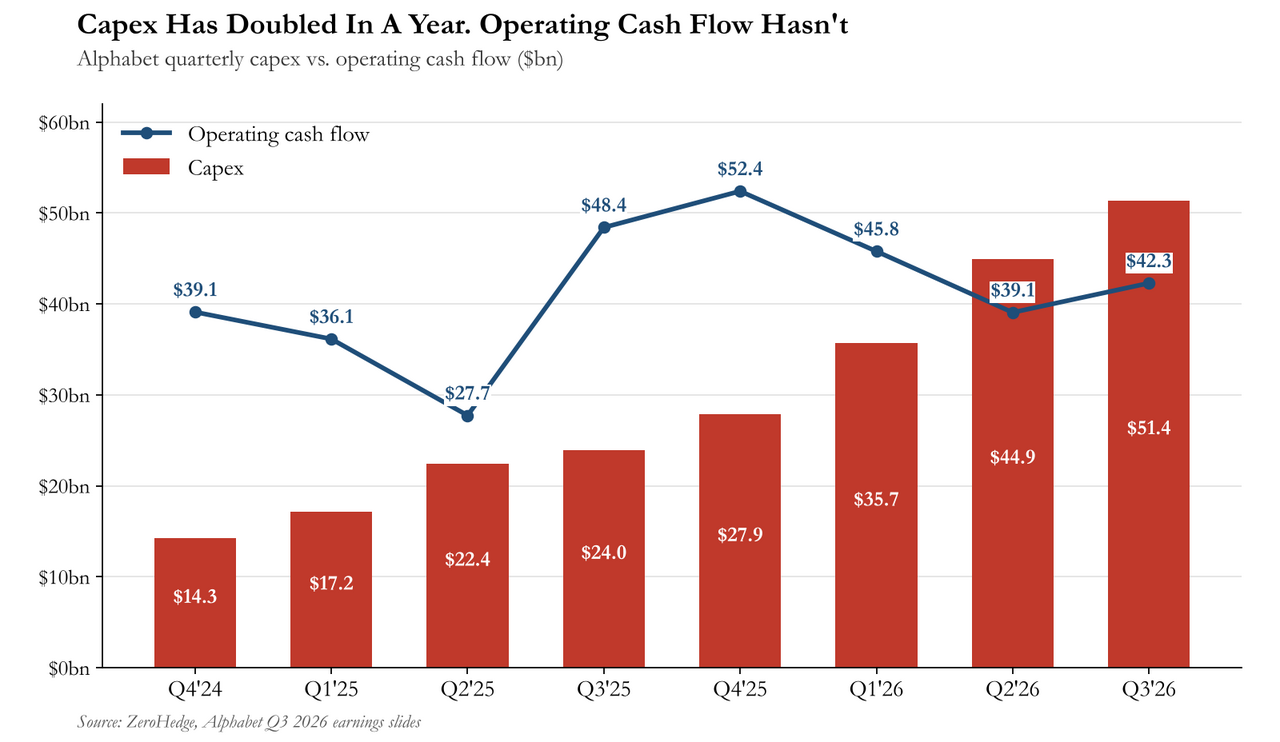
Capex rose 114% y/y to $51.4bn (below the $55.8bn consensus). Operating cash flow fell 13% y/y to $42.3bn, far short of the $53.9bn consensus, so the capex 'miss' did not help free cash flow.
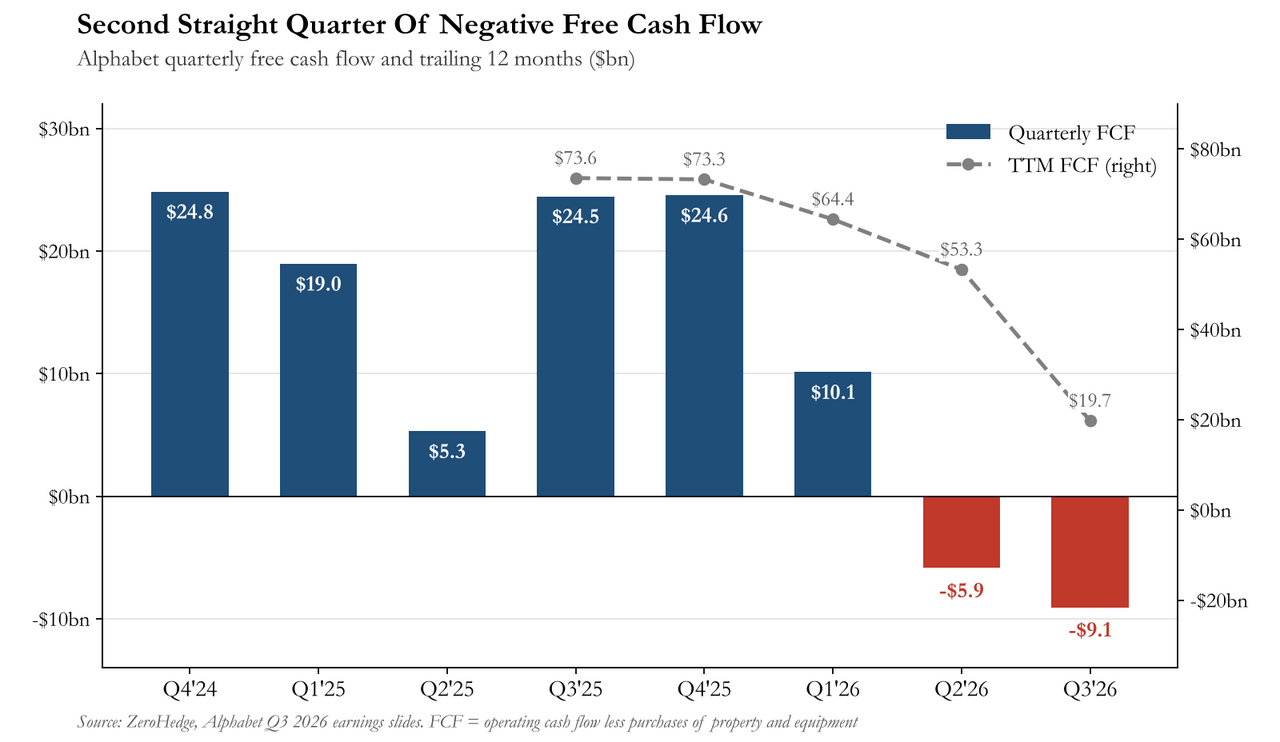
Free cash flow was negative for a second straight quarter: -$9.1bn vs -$3.5bn consensus. Trailing-12-month FCF collapsed 73% to $19.7bn, from $73.6bn a year ago.
The funniest part is just how dramatic the Y-axis rigging was in the company's presentation to make the YoY growth better:
Some more comments from the press release:
Model Apis Now Processing About 32B Tokens Per Minute
Gemini App Has Reached 1 Billion Users
Gemini App Has Reached Oneb Users—making
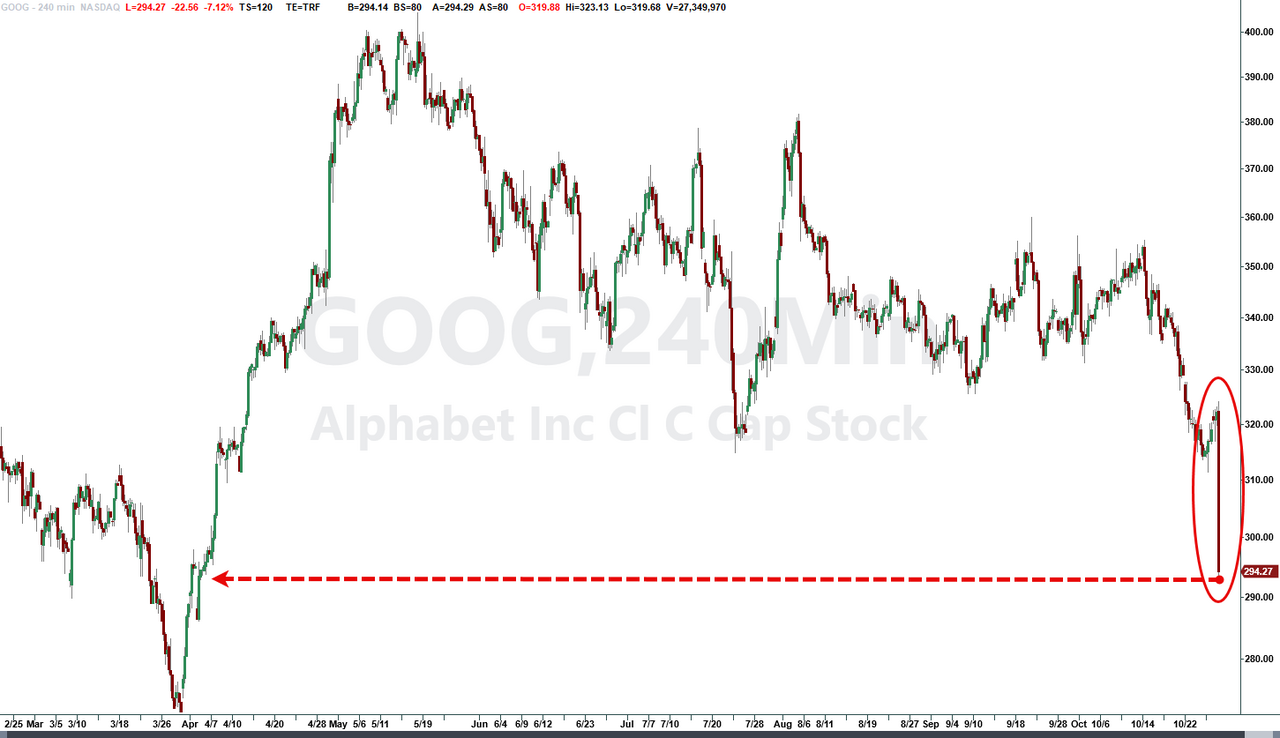
Shares Drop 7% After 3Q Earnings Report
Surpassed 150M Youtube Music & Premium Subs
Gemini 4 Argon & Carbon Are Now Leading at Frontier
3Q Net Loss on Equity Securities $8.66B
Google Cloud Rev. Grew 103%
Surpassed 150M Youtube Music & Premium Subs Globally
We expect to hear much more on the call, including capex guidance: as a reminder, Google’s race to build AI infrastructure for both itself and its customers has sent its capital expenditures soaring to record levels. At the same time, the investments have helped Google evolve into a top supplier of computing power to AI companies including Anthropic PBC and Meta. The problem is that AI is now too successful, and is clearly cannibalizing from the company's core "bread and butter" advertising and search business, which missed badly across the board.
The company is also working to develop AI models itself and integrate them into consumer products such as the search engine, YouTube and Gmail - though those efforts have yet to pay off relative to the level of Google’s spending.
In response to the dramatic top and bottom line miss, GOOGL stock plunged 8%, not only reversing the July surge, but dragging the stock back to levels last seen in April as some 6 months of gains have been unwound.
An Illinois man was charged Monday with mailing letters containing a white granular substance to four members of Congress, telling investigators he used salt because it looked like anthrax, according to a federal criminal complaint.
The complaint says the letters were postmarked Oct. 19 in Springfield, Illinois, and arrived at district offices between Oct. 21 and Oct. 23.
Three contained the handwritten note "HA HA", while one to a senator's office read "HAH enjoy the gift," according to the filing. Preliminary testing found no chemical or biological toxins in the letters.
An anonymous tip reached the FBI's National Threat Operations Center on Oct. 16, with the tipster saying he overheard Matthew G. Unglesbee in a restaurant discussing the mailings. The tipster provided Unglesbee's name, address, and date of birth, the filing said.
According to the complaint, the envelopes also included Unglesbee's name and his return home address.
FBI agents interviewed Unglesbee at his Quincy home on Oct. 25, and he admitted mailing the four letters.
Unglesbee told agents the substance in the letters was salt because it "kind of looks like" anthrax. He acknowledged he knew recipients "took it serious" and would have "hazmat come in white suits" because "anthrax is dangerous," according to the complaint.
He said he was joking but recognized the recipients would not know that and could perceive it as a threat, the filing said.
A search of his residence turned up a fifth, unmailed envelope addressed to one congressperson's Washington office.
Unglesbee said he sent the letters after hearing someone mention a news story about other suspicious white powder mailed to officials. He denied any role in those mailings.
Unglesbee was charged with mailing threatening communications, false information, and hoaxes to at least four members of Congress, and with claiming that those letters contained a white granular substance. An attorney for Unglesbee could not be identified.
Election Offices Targeted
Unglesbee's case comes amid similar incidents in October, ahead of the November midterm elections.
On Oct. 15, the FBI confirmed to The Epoch Times that "a series of suspicious mailings" had been sent to election offices across the country. As part of this, four Republican election officials reported they were the intended recipients of the suspicious mail. A spokesperson said the agency was not confirming the number of mailings intercepted at the time.
Ohio Secretary of State Frank LaRose confirmed that his office was an intended recipient of one of the mailings, but federal investigators intercepted the letter. Mississippi Secretary of State Michael Watson's office was also an intended target, according to his spokeswoman, Liz Jonson. The Wisconsin Elections Commission said it received an envelope with white powder, according to a statement, and that tests concluded it was not hazardous.
In an alert on Oct. 23, the FBI also said it found suspicious substances in mail sent to media organizations, public and private polling companies, secretaries of state and related election offices, and other election-related entities. No hazardous material had been identified.
In a similar incident before the 2024 general elections, election officials in six states reported receiving envelopes with powdery substances. Investigators tested the substances and found no hazardous materials.
U.S. Secretary of State Marco Rubio made a direct appeal to Cubans on Friday, encouraging them to partner with the CIA if they want to see change in the communist country.
"To those who seek to create positive change in Cuba - now is the time," Rubio said in an Oct. 23 post on X. "The disappointment of failed promises, corruption, and the privileged lives of only a few; seize this opportunity to create the change you desire through a discrete partnership with the CIA."
The CIA followed up Rubio's post on the same platform with the same message in Spanish and included instructions on how to contact the agency. It urged Cubans to use non-personal devices and VPNs.
Cuban leader Miguel Diaz-Canel attends a rally in Havana on May 22, 2026. Norlys Perez/Reuters
Cuban-born Rep. Carlos A. Gimenez (R-Fla.) said in a post on X that the Cuban regime must be "relegated to the ash heap of history."
U.S. President Donald Trump hinted at a new American intervention in Cuba, potentially with military force, as he addressed supporters at a midterm campaign rally in Florida on Oct. 23.
He made the comments about Cuba after touting investments in the U.S. military and in military operations this year in Venezuela and Cuba.
"The Islamic Republic of Iran will tell you that we have the best equipment," Trump said, before appearing to respond to comments about Cuba from someone in the crowd. "He wants to know 'what about Cuba?' Give me a break. Give me a break. Don't worry. We'll take care of Cuba on our way back from Iran."
Cuban Deputy FM Carlos Fernández de Cossío mocked Rubio's direct bid to the island.
"Now the U.S. is resorting to public recruitment campaigns for the CIA," he said in an Oct. 23 post on X. "There must be a lot of desperation or a serious lack of resources within the agency if it has to market its offers like toothpaste."
Florida Attorney General James Uthmeier announced earlier this month that state authorities had secured an arrest warrant for former Cuban leader Raúl Castro Ruz.
Castro was charged with conspiracy to commit first-degree murder in connection with the 1996 shootdown of two civilian aircraft operated by Brothers to the Rescue over international waters.
"The Castro regime's spies operated in our communities, fed intelligence to Havana, and helped put civilian pilots in the crosshairs of Cuban MiGs," Uthmeier said. "Thirty years later, we are still fighting for justice for Carlos Costa, Pablo Morales, Mario de la Peña, and Armando Alejandre Jr."
Castro, then minister of the Cuban armed forces and first vice president of Cuba, was a final decision-maker in the chain of command that authorized the shootdown, according to the affidavit.
The affidavit stated that Castro gave senior military leaders standing orders that said, "Fine, shoot them down at sea when they show up, and those who have the authority are not to consult anyone."
Cuban Foreign Minister Bruno Rodríguez described the arrest warrant against Castro as a "disgraceful act" with no legal, ethical, or practical value, during a press conference on Oct. 21, Spanish news agency EFE reported.
Trump issued an executive order in January that said the government of Cuba had "taken extraordinary actions that harm and threaten the United States."
It said that the regime aligns itself with, and provides support for, numerous hostile countries and organizations, including Russia, China, Iran, Hamas, and Hezbollah.
It noted that Cuba hosts Russia's largest overseas signals intelligence facility and also continues to build deep intelligence and defense cooperation with the Chinese communist regime.
In a packed courtroom in Leeuwarden, the official COVID story is being put on trial as Dutch plaintiffs demand personal liability from Bill Gates, Pfizer CEO Albert Bourla, former Prime Minister Mark Rutte and others for what their lawyer calls a coordinated global deception.
The civil case, filed in 2023, alleges the mRNA injections functioned as lethal biological weapons rolled out through unlawful public deception tied to the World Economic Forum's Great Reset.
Two of the original seven plaintiffs have already died. Defendants' lawyers rejected every claim, repeating that the shots were safe and effective and developed through normal science.
?BILL GATES/BOURLA TRIAL: "These injections are a BIOLOGICAL WEAPON." "COVID-19 injections are LETHAL." "The global deployment of this biological weapon can only take place through the UNLAWFUL deception of the public on a global scale." "The defendants [including Bill Gates and Albert Bourla] are implementers of the 'COVID-19: The Great Reset' project and are GUILTY of this deception; they are therefore being sued individually in these proceedings."
The substantive hearing on the merits took place on October 22, 2026 before three judges at the District Court of Northern Netherlands. Lawyer Peter Stassen told the court the injections were not ordinary medical products.
"These injections are a biological weapon," Stassen declared. "Global deployment of this biological weapon can only take place through the unlawful deception of the public on a global scale."
He added that "COVID-19 injections are lethal, or at least highly harmful to human health and fertility" and that "the defendants are implementers of the 'COVID-19: The Great Reset' project and are GUILTY of this deception."
Outside the courthouse Stassen told supporters, "COVID-19 was not a disease; It was a project." He said the plaintiffs had crucial evidence showing the official narrative was false.
Supporters gathered with banners while critics outside and in mainstream outlets called the arguments extreme conspiracy theories.
The judge noted the case was highly unusual, with the two sides diametrically opposed: one side arguing there was no virus, that the injections were a bioweapon and that genocide had occurred; the other side insisting the opposite.
Justice is coming for the COVID Vaccine Injured... two of the original plaintiffs against Bill Gates, Pfizer CEO Albert Bourla, and PM Mark Rutte have already died. The Netherlands Case moves FORWARD as Lawyer Peter Strassen receives a monumental welcome. Peter Stassen walks out of the District Court of Northern Netherlands after a substantive hearing in the civil case brought by Dutch plaintiffs who say they were injured by COVID-19 injections and policies. Defendants include Bill Gates, Pfizer CEO Albert Bourla, former PM Mark Rutte, and the Dutch State. The plaintiffs are seeking personal liability for what they call coordinated deception and coercion. Outside, Stassen and expert witnesses (including Sasha Latypova) addressed supporters and laid out their core claim: the official COVID narrative is false, and the court must decide which side it stands on. The case has already survived jurisdiction challenges and is now being heard on the merits. Two of the original seven plaintiffs have since died.
Expert witness material submitted by the plaintiffs included statements from Sasha Latypova, former Pfizer scientist Mike Yeadon, Catherine Austin Fitts and others.
Latypova has described the response as a coordinated government effort originating in changes to U.S. law over roughly 25 years that enabled the global program, rather than originating solely in pharmaceutical companies. She has spoken of dark practices, including the slow killing of disabled children to maximize profits, and of people who appeared to enjoy the process.
Sasha Latypova, an expert witness in the lawsuit against Bill Gates et al. in the Netherlands, on the Covid crimes as a "government effort" + doctors "getting off" on killing "they... killed disabled children... slowly to maximize their profits... they were getting off on it" "we actually got to depose one of these people... they were enjoying doing this" "I can tell you it's dark. It's like, as dark as you can think of" "I came out first and I said this is, first of all, a coordinated effort by global governments" "a lot of so-called health freedom advocates still today insist that this is just pharma. We just have to blame pharma here" "[but] it's not just pharma, and [the crimes don't] even originate necessarily in pharma. [They originate] in the U.S. government that changed the laws... [over the course of] about 25 years of lawmaking to enable this global crime" @sasha_latypova @PaulChek
Defendants' representatives denied all allegations. Gates's lawyer stated that his client denies every accusation and that the claims rest on incorrect premises, with nothing in the large dossier attributing liability to him.
Bourla's side repeated that the vaccines are proven safe and effective, with only rare side effects as with any vaccine. The State's lawyer warned against unfounded personal accusations that could deter scientists and officials from acting in future crises, asking which scientist would still stick their neck out. Some defendants' lawyers noted that their clients had received hate messages and death threats.
A ruling is not expected before December 9, 2026 and could come as late as the end of February 2027. The case survived earlier jurisdiction challenges, including Gates's attempt to argue the Dutch court lacked authority over him.
The plaintiffs' dossier runs to thousands of pages plus video evidence. Stassen has said the parties stand opposed and only one side can be telling the truth, with the court tasked to seek that truth.
The timing coincides with fresh public comments from Gates. He has stated that the COVID pandemic "didn't work out the way I expected" and warned that over the next several years there will be "attacks" different in scale from anything seen before.
Bill Gates:- "Covid didn't work out the way I expected" This basically implies that there was a pre-orchestrated plan for Covid - which there obviously was So what did Bill Gates expect? He wanted a Deadly Virus that required full compliance from EVERYONE in getting fully Vaccinated with the mRNA Jabs & use of Covid Passports to access every day life 'They' will try again
Critics interpret the first remark as implying an expected outcome of higher lethality, fuller compliance, universal mRNA uptake and permanent digital passports for daily life.
?BILL GATES: The COVID pandemic "didn't work the way I expected." "Over the next several years... you will see a lot of ATTACKS different in terms of scale than anything we've seen in the past." That literally sounds like a threat...
These remarks sit against Gates's longer pattern of pandemic preparedness and funding. Through the Gates Foundation he co-founded CEPI, which has sought billions more for next-pandemic vaccines while the WHO and World Bank deploy large sums across dozens of nations.
CEPI has directed tens of millions to Moderna for mRNA platforms, including work on an Ebola jab using the same technology as the COVID product.
Gates has recently separately predicted that AI combined with ill-intent actors could drive events causing a billion deaths, describing AI as an evolutionary event more dangerous than previous technologies, and has warned of grim cyberattack surprises and bioterror risks now far higher than natural pandemics.
The Dutch proceedings remain a civil damages action, not a criminal trial. Plaintiffs seek compensation for physical and psychological injuries they attribute to the injections and the policies that pushed them.
Whether the court accepts the bioweapon and Great Reset framing, or accepts the defense that the shots were ordinary safe-and-effective vaccines, will be decided on the written record and the arguments heard in Leeuwarden.
The case places the official preferred narrative under formal judicial scrutiny for the first time at this level. Supporters outside the court have framed it as a rare chance for accountability.
Good news, everyone. The war is over, at least in the United Arab Emirates. That is the only conclusion you could draw from this month’s headlines. On October 14, Bloomberg reported the International Energy Agency’s estimate that UAE oil supply hit a record 5.3 million barrels a day in September. Fujairah, the port the Emirates built so they would never have to worry about the Strait of Hormuz, loaded a record 2.62 million barrels a day. The giant Ruwais refinery was declared back at full capacity at the end of August. Pop the (non-alcoholic) champagne.
Then Karl Miller sent me his October 22 assessment of the UAE’s oil and gas system, and spoiled the party. The Emirates have indeed recovered their crude exports. What they have not recovered is everything else. The gas business is still limping, the petrochemical plants are starving for feedstock, and the fuel reserves that are supposed to carry the country through the next attack have been drained to about a third of their prewar level. The UAE is setting production records with its gas light on.
The safe haven that wasn't
For years the UAE sold itself as the Switzerland of the Gulf: stable, diversified, insulated from the region’s chaos, a place where hedge funds and oil majors could sleep soundly. Then came 2026. According to the U.S. Energy Information Administration, UAE crude and condensate production fell from about 4.0 million barrels a day at the start of the year to an average of 2.4 million in March through May. A 40 percent collapse. Switzerland, it turns out, is within drone range of Iran.
The damage list reads like a sightseeing tour of Emirati industry. The Ruwais refining complex caught fire on March 10 and shut down. The Shah sour-gas plant, built to process 1.28 billion cubic feet a day, burned on March 16. The Habshan gas complex, the beating heart of the UAE’s gas system, was hit on April 3 and, in case anyone missed it, again on April 8. Borouge’s petrochemical plant was damaged on April 5. The Emirates Global Aluminium smelter went dark on March 28. And on May 17, a drone hit an electrical installation supporting the Barakah nuclear power plant, which is the sort of sentence nobody in Abu Dhabi ever wanted to read in a Security Council transcript.
Then there is Fujairah, the bypass port, the whole point of which was to keep UAE oil flowing no matter what happened at Hormuz. Reuters counts at least 19 attacks on it since the war began. In the week of March 16, loadings fell to 440,000 barrels a day. After a strike on May 4, refined-product exports essentially stopped for a month, with exactly one product tanker leaving between then and June 1. One. The insurance policy turned out to need insurance.
Available, just not working
Crude came back. Gas did not. ADNOC Gas’s second-quarter numbers compared with a year earlier: domestic gas production down 32.5 percent, export liquids such as LPG and naphtha down 54.5 percent, the company’s share of LNG down 63 percent. Export liquids sales fell from 252 to 117 trillion British thermal units. LNG sales fell about 71 percent. Revenue fell 39 percent, EBITDA 47 percent, net income 52 percent. That is $2.3 billion of revenue that evaporated in one quarter, at one company.
But my favorite statistic in Miller’s entire deck is this one. ADNOC Gas proudly reported that its assets were 99.9 percent available in the second quarter, better than the year before. Its actual asset utilization, meanwhile, fell from 80 percent to 54 percent. The plants were ready, willing and able. They just could not run, because the feedstock, the storage and the export routes they depend on had been knocked out. It is the corporate equivalent of announcing that your car is in perfect condition while it sits on blocks without wheels.
The recovery since then has been real but partial. Habshan’s gas supply was 85 percent restored as of August 10. Borouge had fixed its plant by the end of June, then discovered it had nothing to feed it, and ran at 60 percent utilization. The aluminium smelter had restarted a quarter of its pots by late August and now expects to finish the job sometime in early 2027. Repairs, as it happens, are faster than recoveries.
Running on fumes
Here is the number that should ruin a European energy minister’s weekend. On October 19, Fujairah held 7.25 million barrels of refined products. Before the war it held about 20.7 million. That is a 65 percent drop. Gasoline and naphtha stocks are down 87 percent. Fuel oil is down 53 percent. Diesel and jet fuel are down 23 percent, and fell 18 percent in a single week this month, just in time for winter.
Fujairah is not a corner gas station. It is one of the world’s great bunkering and product-trading hubs, the place where ships refuel and traders park cargoes between Asia and Europe. With a third of its normal stocks, it has about a third of its normal ability to absorb a shock. Miller’s arithmetic is unforgiving: lose a million barrels a day of export outlets with 10 million barrels of usable storage to fill, and you have roughly ten days before the oil fields have to shut in. Ten days. That is not a strategic reserve. That is a long weekend.
A bypass for a third of the traffic
The UAE’s answer to a closed Strait of Hormuz is the ADCOP pipeline from Habshan to Fujairah. It is designed to carry 1.5 million barrels a day, maybe 1.8 on a good day. ADNOC claims 4.85 million barrels a day of production capacity. So the escape hatch fits about a third of the passengers. A second pipeline is planned, for 2027, which will be a great comfort to anyone planning to hold this war in 2028.
And that record September? Some of it reflects genuine repairs. Some of it reflects the UAE’s exit from OPEC, which conveniently ended its production quotas in May. And some of it, by the IEA’s own account, came from drawing down inventories that were already at a record low. Selling your savings is a fine way to post record income for a month. It is not a business model. Meanwhile, across the region, refined-product shipments in September were 1.9 million barrels a day against 4.7 million before the war, and LPG shipments were 670,000 barrels a day against 1.5 million. The recovery is real for crude tankers. For everything else, it is a press release.
One more round, anyone?
To be fair, and Miller insists on being fair, nobody can prove that 30 to 40 percent of the UAE’s energy system is still destroyed. There is no complete public register of damage and repairs, and he gives full credit to the recoveries at Ruwais and in crude output. But the shape of the problem is plain. The UAE has rebuilt its ability to ship crude. Its gas business, its petrochemical feedstock and above all its fuel reserves remain badly depleted.
Which brings us to Washington’s latest bright idea: another round of strikes on Iran. Iran has already demonstrated, at least 19 times at Fujairah alone, that it can reach the UAE’s export system. The last time the Emirates absorbed a blow, they had 20 million barrels of products in Fujairah to soften it. Next time they will have about seven. Record output and empty tanks is not resilience. It is a country standing on the edge of a cliff and posting about the view.
JetBlue Creditors Call In Restructuring Advisers As Stock, Bonds Crater
A federal judge blocked JetBlue Airways' $3.8 billion takeover of Spirit Airlines during the Biden administration to protect consumers. That supposedly brilliant decision is now looking increasingly disastrous for both airlines and the passengers it was meant to protect.
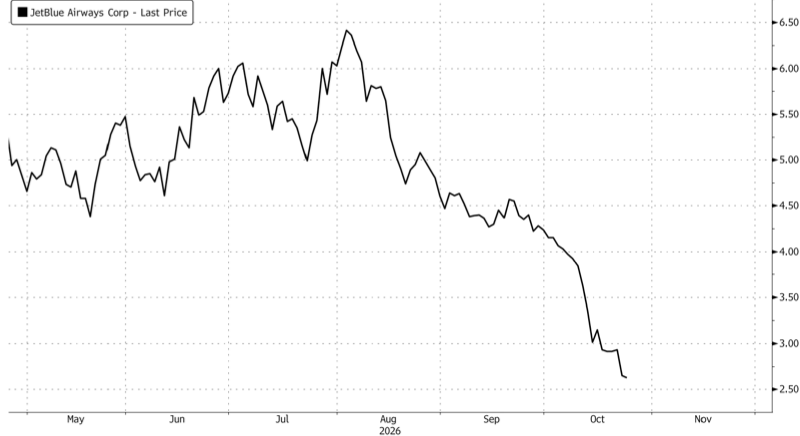
First, Spirit Aviation shuttered all operations earlier this year, stunning travelers with the abrupt move after 34 years of offering some of the most deeply discounted fares. Now, JetBlue could be on a similar trajectory, as the carrier's shares and junk bonds have cratered over the last several months.
Bloomberg News reported late Friday that JetBlue's creditors are organizing with restructuring advisers as the budget airline grapples with cash burn and high jet fuel prices.
The report centers on a group of creditors, including holders of $2 billion in bonds due in 2031 and a $742 million first-lien loan, who are working with PJT Partners and Akin Gump Strauss Hauer & Feld.
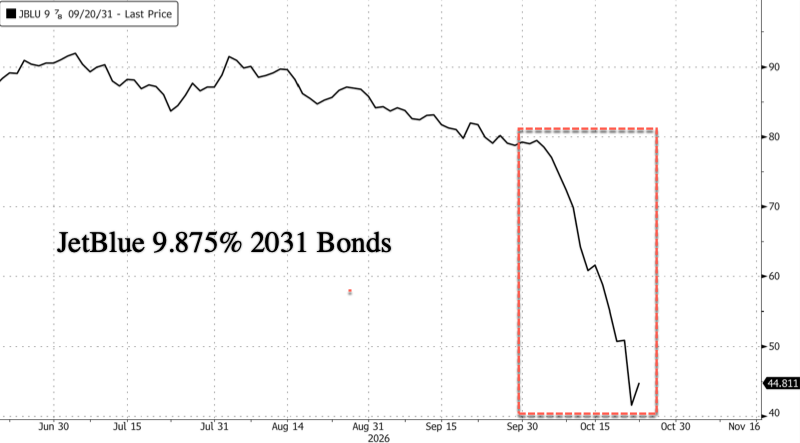
JetBlue's 9.875% 2031 bonds traded near 80 cents on the dollar at the start of October but, just three weeks into the month, had fallen to distressed levels around 44 cents by Friday's close.
The stock has followed a similar trajectory, falling from $4.50 to $2.62 over the same period.
JetBlue reported about $2 billion in cash and $6 billion in unencumbered assets in the second quarter, as well as $8.5 billion in total debt. S&P stated that the budget airline had sufficient liquidity and borrowing capacity but warned about mounting debt-service costs.
Creditors of junk-rated airlines were worried this past week as larger airlines slashed guidance and warned of margin erosion from soaring jet fuel costs.
Latest guidance updates from airlines:
Southwest Airlines
Southwest lowered its full-year adjusted EPS guidance to $2.60-$2.85, down from a prior range of $3.25-$4.25. For Q4, it now expects adjusted EPS of $0.55-$0.80, below the $0.81 analyst consensus. The cuts came despite better-than-expected Q3 results and continued strong demand.
American Airlines
American cut its full-year outlook to an adjusted loss of $1.00-$1.60 per share, a significant deterioration from prior guidance of a $0.65 loss to $0.65 in earnings. For Q4, it guided to an adjusted loss of $0.50-$1.10 per share vs. the $0.49 consensus loss. CEO Robert Isom said fuel prices are expected to remain "higher, longer."
United Airlines
United guided Q4 adjusted EPS to $0.50-$1.50, well below the $1.88 analyst consensus, after fuel expenses surged 61.6% to $4.84 billion in Q3. Shares fell ~2% in after-hours trading on October 20.
For context, the Biden administration's DoJ sued to block JetBlue's $3.8 billion takeover of Spirit in March 2023, claiming the deal would reduce competition and raise fares. Then, in early 2024, U.S. District Judge William Young sided with the Biden administration. Notably, Young was appointed by Ronald Reagan in 1985.
A reasonable argument can be made that government intervention backfired and is now hurting the very consumers it sought to protect, as Spirit's shutdown has reduced competition in the budget airline market. Now the odds are increasing that JetBlue could face a similar fate.
"The Left has always preferred the ashes of its own making to the inheritance of better men." - Celina101 on X
By now, everybody and his uncle interested in public matters has probably read that a claque of current-and-former agency officials, ex-USAID busybodies, military officers, activist academics, Democratic Party paladins, and freelance communist jihadis has been exposed plotting the overthrow of the US government. The plot was reported by the diligent "X" blogger Jennica Pounds under her nom-de-plume "Data Republican," who lately received an enormous document-and-recording dump courtesy of careless color revolutionaries who recorded themselves and saved doc files against orders, the dumb bunnies.
Erica Chenoweth of Harvard (They / Them?) Master Color Revolutionary
Ms. Pounds, an experienced software engineer turned political detective, came to public attention early in 2025 when she assisted Elon Musk's DOGE operation in building a database of NGO money trails emanating from the colossal USAID grant matrix - after which her identity was "doxed" by Rolling Stone and she underwent a harassment campaign.
Of course, USAID was abolished early in the Trump 2.0 admin, and a lot of the "activists" defenestrated from it moved into scores of NGOs, with their salaries switched from taxpayer funding to the bank accounts of George Soros-connected orgs and sundry other shady characters like Shanghai-based Neville Roy Singham. These are the NGOs forever puling about "our democracy," meaning their drive to punish, persecute, and push around Americans who demur from a communist future. Data Republican says her reporting so far is "only the beginning" of much more detailed and alarming disclosures.
Coincidentally this week, their cover was also blown by Senator Elissa Slotkin (D-MI and former CIA analyst), who told an audience at the U. of Chicago that the Democrats intend to go after and wreck any young person who might think about working in the current administration. Ms. Slotkin, you might recall, was in that video put out a year ago - with five other US lawmakers - telling military officers they should-and-must refuse "illegal" orders. Sedition-lite, it looked like at the time.
Before we get into the meat of their playbook for us, and what might happen in response, let's just dox a few of the characters involved. You should know who they are (and maybe the DOJ should, too). They are not necessarily the usual suspects you've read about before like the omnipresent lawfare ninjas, Norm Eisen, Marc Elias, Mary McCord, et al., so busy filing frivolous lawsuits in the federal courts.
For instance (as reported by one Eric Schwalm on "X"), there's Erica Chenoweth, the transvestite professor at Harvard's Kennedy School of government who acts as chief strategist and hub for the "color revolution" planned by the United Democracy Alliance cabal she is associated with. Ms. (or Mr.?) Chenoweth's big contribution to Jacobin thought is "the 3.5 rule" which says that if you can get that percentage of people out on the streets making a ruckus, you can successfully overthrow a government.
Then there's Danielle Reiff, former USAID, now co-founder of the Democracy Renewal Group, Renew American Democracy, and Renew to Thrive orgs. . . very verbal on video laying out the exact procedures for the US color revolution. And there's Rear Admiral Michael E. Smith (Ret.) who runs a network of over a thousand retired military officers called National Security Leaders for America. He's in charge of "role-playing" exercises in preparation for post-election hijinks. Then there's Julia Roig, founder of the Horizons Project who is responsible for "building relational infrastructure so that disparate groups can act in concert without a single hierarchical command." Then there's Maria Stephan, co-author, with Erica Chenoweth, of the sedition tract Why Civil Resistance Works. Then there's Brenden Halloran, former USAID, now with the Renew to Thrive org, responsible for "accountability ecosystems, overcoming fragmentation among groups, and long-term sequencing of reforms." Then there's Walt Roberts, also on the Renew to Thrive team, plus the Mediators Foundation and the Inter-Movement Impact Project. Then there's Laura Adams, also former USAID, now in Renew to Thrive and PACT, whose mission is to turn strategy papers into operational plans. Then there's Zoe Marks, also in Harvard's Kennedy School, a "scenario-planner" for Horizons and United Democracy Alliance. Then there's "cohesion" strategist Paul Zeitz, co-founder of UnifyUSA, partner with Danielle Reiff on Renew to Thrive, and active in NGOs Renew to Thrive and National Security Leaders for America. There's the bunch. Now you know.
Top row: Reiff, Smith, Roig; Center row: Roberts, Halloran, Adams; Bottom Row: Stephan, Slotkin, Chenoweth
As to the coup playbook, here goes: The idea is to turn out massive street actions (protests and riots) in the blue cities, based on rumors that President Trump has somehow "interfered" in the election, and create enough chaos so that Mr. Trump would be tempted to invoke the Insurrection Act or some-such national emergency measure. The coupsters mentioned above, and their cohorts and underlings, have been quietly confabbing with blue state attorneys general and governors. These officials would unite to declare that Mr. Trump's actions make him illegitimate, and would set in-motion procedures for said governors to declare the president a tyrant and an outlaw and themselves as the "new governing authority." They would move from that to a new constitutional convention and bring about all the heralded revolutionary changes chattered about for months such as abolishing the electoral college and Senate, changing-up the Supreme Court, etc. Voila! Trump and his government are out! The Democratic Party (and their new DSA commissars) would take over and the punishments would begin. . . .
But. . . what if President Trump doesn't play along? What if he insists that the blue state governors must ask (or beg) for federal troops to be sent in to control the street violence in their cities before he commits to anything? Then the onus would be theirs, wouldn't it? They will have asked for help? Mr. Trump will have obliged. How does that make him a tyrant? (It doesn't, of course.) Or. . . the blue state governors might not ask for federal help and Mr. Trump could just watch their cities burn down. That would kind of be on the blue governors, too, wouldn't it - hey, they didn't ask for federal troops and their own feckless police couldn't get the job done because: previous "de-funding" and all that nonsense.
Then, how about Mr. Trump moves to arrest said blue state governors for sedition and treason (especially if they entertained any collusion with foreign operators, such as CCP-connected Neville Roy Singham's NGO network or any of Soros's overseas outfits)? And how about arresting and likewise charging many of those aforementioned NGO strategists, along with the governors? (And while you're at it, throw in the lawfare ninjas who have assisted in all this mischief.) And how about after accomplishing that, the president then and only then declares the Insurrection Act, sends in federal troops to quell the street chaos, and moves to indict and try said seditionists and traitors in the military tribunal apparatus? There it is! Just some suggestions. . . .