Tesla "Drastically Accelerating" Model Y Delivery Timeline As Demand Appears To CollapseTyler DurdenMon, 06/01/2020 - 05:30
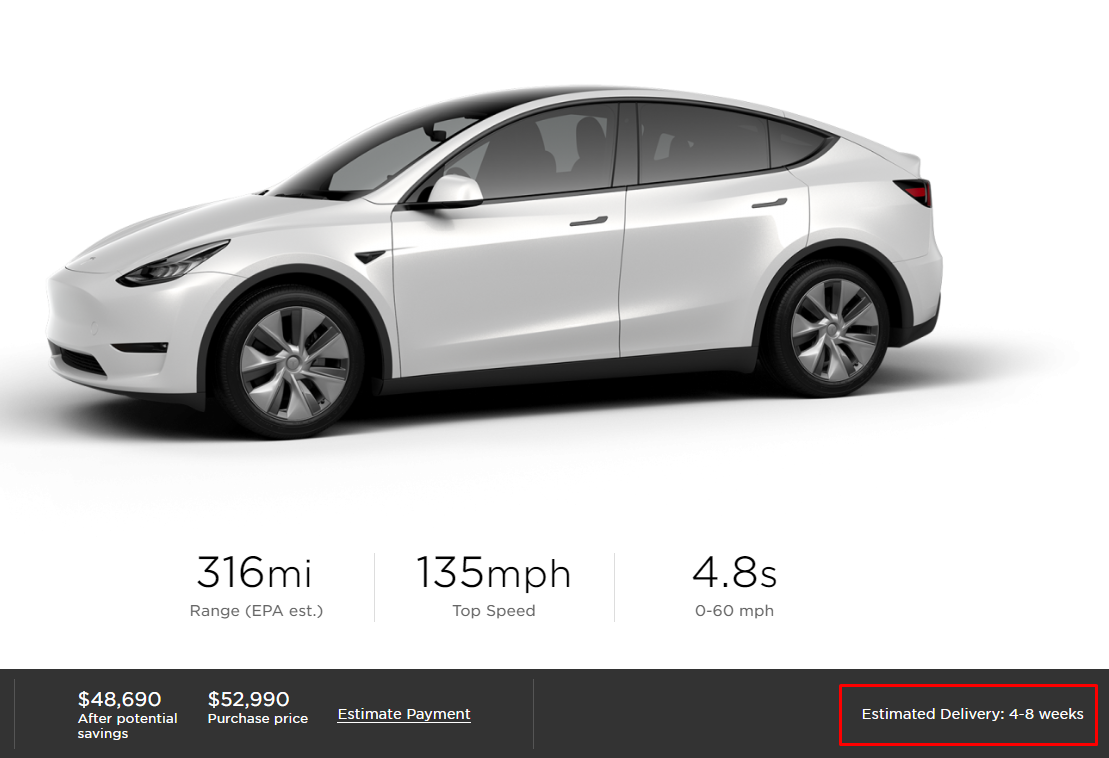
As always happens when you have an enormous backlog of reservations for a brand new vehicle you barely just started manufacturing, Tesla has "drastically" accelerated its timeline for delivering its Model Y after restarting its Fremont factory earlier this month.
The Model Y delivery timeline has moved from 8-12 weeks for new orders earlier this month to now 4-8 weeks for delivery of new orders in the United States. It marks a relatively meaningful bump up in delivery time for a Tesla model that should have amassed a significant amount of reservations.
Even the pro-Tesla lot at electrek was befuddled by the quick change in delivery timing.
"This is a significant reduction in delivery delay for a brand new model for which Tesla had been accumulating reservations for over a year," they noted before stating "...it’s definitely not normal for a new Tesla model to have new orders available within 4 to 8 weeks after only what adds up to barely a month of deliveries."
Then, editor Frederic Lambert finally got to the obvious conclusion of a demand issue: "What I think is happening is that Tesla had its smoothest production ramp of any new vehicle to date on top of having a demand issue with the global pandemic."
We're going to bet its more of the latter, Fred.
Lambert then begrudgingly expounds on his analysis:
"I’ve heard from dozens of owners who decided to cancel or delay their Model Y orders due to the economic downturn and some were also disappointed by how Tesla and Elon Musk handled the shutdown order.
I think demand problems have also led to Tesla’s price cuts last week for every vehicle except Model Y."
But it wouldn't be electrek if the blog didn't immediately start making excuses for Tesla:
"Of course, Tesla is not alone having important issues selling cars currently. Virtually every automaker is seeing a massive downturn in demand.
There’s no doubt that Tesla still has an important backlog of orders for Model Y in other markets, but with Model Y deliveries only happening in the US right now, Tesla is limited in demand and it is working through its backlog of people still willing to take delivery a lot quicker."
The Model 3 delivery timeline has remained mostly unchanged, at 5-7 weeks from its prior 4-8 weeks.
If Lambert continues to have difficulty figuring out why the timeline has moved up, one well known Tesla skeptic on Twitter had an eloquent way of conveying a theory that we think even he could understand...
The window to act before the next market break is likely very, very short...
As the market continues to seek out its maximum stupid price limit, it’s now decision time for investors.
If you’re still long stocks and bonds at this point: Do you now sell to protect your gains?
If you’re skeptical of today’s prices and sitting in cash: Is now the right time to start shorting the market?
If you’ve recently been laid off: Do any of the new options offered by the CARES Act that enable you to access retirement funds without penalty make sense for you?
With markets this overextended, your window of time to take action will likely be quite brief. An end to the currently rally could happen extremely quickly and brutally.
What make us say this?
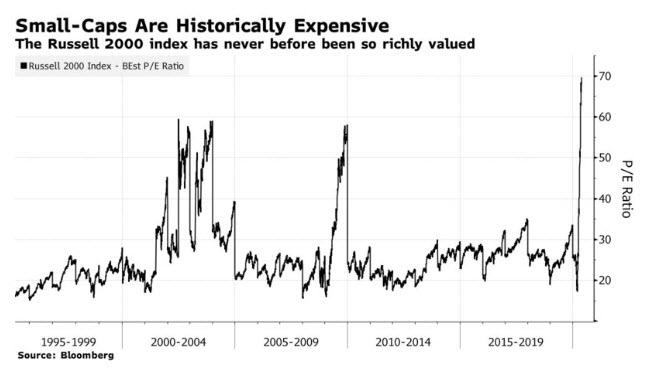
Because here’s an example of the level of overvaluation we’re dealing with:
The Russell 2000 index — at a P/E ratio of 70x(!!) — has never been so richly valued. Remember: these are the smaller, weaker publicly traded companies, a material number of which will likely be going bankrupt later this year.
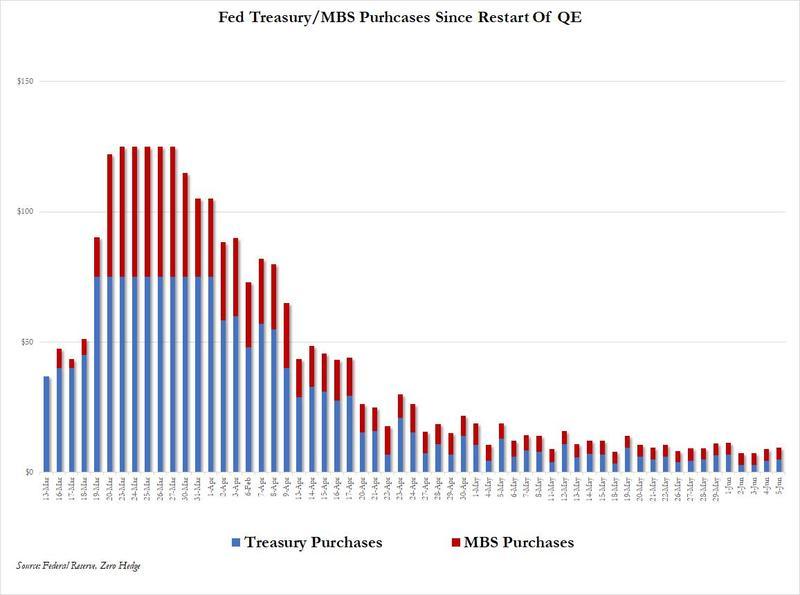
And if you believe that fundamentals don’t matter, that only Fed liquidity does; note that the Fed’s buying spree has been tapering off for a month now:
Without sufficient liquidity, how long can the market remain at these ridiculous prices?
Not long, we predict. Which is why time is now of the essence.
As we do each week, we’ve once again asked the lead partners at New Harbor Financial, Peak Prosperity’s endorsed financial advisor, to share their latest insights into the road ahead for investors.
In the below video, we address the risks and rewards offered by shorting the market, retirement fund tapping/rollover strategies, and how the Fed is inflaming societal instability as it continues to dangerously deform prices:
* * *
Anyone interested in scheduling a free consultation and portfolio review with Mike and John can do so by clicking here. And if you’re one of the many readers brand new to Peak Prosperity over the past few months, we strongly urge you get your financial situation in order in parallel with your ongoing physical coronavirus preparations. We recommend you do so in partnership with a professional financial advisor who understands the macro risks to the market that we discuss on this website. If you’ve already got one, great. But if not, consider talking to the team at New Harbor. We’ve set up this ‘free consultation’ relationship with them to help folks exactly like you.
Quibi Is Running Out Of Time To Turn Around Its "Mobile-Only" PlatformTyler DurdenMon, 06/01/2020 - 04:15
From the first time we heard Meg Whitman give her Quibi elevator pitch on CNBC last year, we had a feeling the digital media project, which boasts an impressive list of bold-faced names topped by Whitman and former Disney studio chief Jeffrey Katzenberg, was destined for the "dustbin of history," as Trotsky would call it. bMany have compared the product to a more expensive, less useful b-version of YouTube. When the concept was first introduced to the public back in 2018, it was met with widespread befuddlement. And its launch has mostly been overshadowed by Disney+ and the handful of other new streaming products.
Despite being launched in the middle of a pandemic that left billions of people - and hundreds of millions of Americans - marooned inside their homes, desperate to be entertained, Quibi has managed to rack up just 1.3 million active users and 3.5 million downloads, less than 1% of Netflix's total, and far short of where the company had hoped to be. What's worse: none of those users are paying: the company is offering three-month free trials to all comers.
The discrepancy between active users and downloands means roughly 2/3rds of those who tried the product didn't view it as "an essential entertainment product", a designation that Quibi's management views as essential for the company's survival.
Though they've already approved some of the app's more-popular series for a second season, and in the past few days the app has added new features enabling support for streaming on television, in contravention of Quibi's initial mission. Whitman and others had originally envisioned Quibi as the perfect app for subway commuters, but the app's narrow design meant that it was really only convenient to watch while commuting to work on mass transit. Unfortunately, the number of commuters is way down. And here's the most hilarious part: By focusing so intently on the mobile experience and an alphabet soup of VC buzzwords, Whitmen & Co. designed a mobile streaming experience that could only be enjoyed on smartphones. Who wants to watch a video on your smartphone when you have your TV or laptop handy? Almost nobody.
In that spirit, Quibi finally enabled upport for Apple's Airplay this past week. Now, the company's future depends on whether Katzenberg can pull off this pivot to a more home-friendly product. And he's quickly running out of time, one analyst told the New York Observers.
“Because the 90-day free trials that Quibi offered when it launched in April will start expiring in July, the company urgently needs to remedy missteps made in its initial mobile-only streaming service introduction – the main one being a lack of casting from phones to TVs for content viewing on bigger screens,” Tammy Parker, senior analyst at leading data and analytics company GlobalData, said. “Providing support for Apple’s AirPlay in Quibi 1.3 is a significant improvement, as iPhone users can now cast Quibi videos to their Apple TV and compatible smart TVs.”
But while analysts praised the company for listening to its critics, the company simply doesn't have the wherewithal to stand up to competitors like Disney+, which is offering a massive lineup of Disney content for $7.99 a month. That's the same price as Quibi's ad-free tier.
“It is commendable that Quibi has heard the critiques of its platform and is moving aggressively to make changes,” Parker said. “Unfortunately, the company’s early oversights were compounded by COVID-19 lockdowns that kept people at home. Reprioritizing casting as an essential feature in light of COVID-19’s impact on daily routines is essential to Quibi’s immediate and future prospects as it becomes a mobile-first, rather than mobile-only, service.”
If nothing else, Quibi is a cautionary tale of what happens when VC firms fixate too much on trends and buzzwords. People like Whitman became so entranced by our increasingly "mobile" world, that they forgot that most people have little use for a platform that can't be enjoyed on a lazy Sunday in bed.
Germany’s federal government and mainstream media are engaged in damage control after a report that challenges the established Corona narrative leaked from the interior ministry.
Some of the report key passages are:
The dangerousness of Covid-19 was overestimated: probably at no point did the danger posed by the new virus go beyond the normal level.
The people who die from Corona are essentially those who would statistically die this year, because they have reached the end of their lives and their weakened bodies can no longer cope with any random everyday stress (including the approximately 150 viruses currently in circulation).
Worldwide, within a quarter of a year, there has been no more than 250,000 deaths from Covid-19, compared to 1.5 million deaths [25,100 in Germany] during the influenza wave 2017/18.
The danger is obviously no greater than that of many other viruses. There is no evidence that this was more than a false alarm.
A reproach could go along these lines:
During the Corona crisis the State has proved itself as one of the biggest producers of Fake News.
So far, so bad. But it gets worse.
The report focuses on the “manifold and heavy consequences of the Corona measures” and warns that these are “grave”.
More people are dying because of state-imposed Corona-measures than they are being killed by the virus.
The reason is a scandal in the making:
A Corona-focused German healthcare system is postponing life-saving surgery and delaying or reducing treatment for non-Corona patients.
Berlin in Denial Mode. The scientists fight back.
Initially, the government tried to dismiss the report as “the work of one employee”, and its contents as “his own opinion” – while the journalists closed ranks, no questions asked, with the politicians.
But the 93-pages report titled “Analysis of the Crisis Management” has been drafted by a scientific panel appointed by the interior ministry and composed by external medical experts from several German universities.
The report was the initiative of a department of the interior ministry called Unit KM4 and in charge with the “Protection of critical infrastructures”.
This is also where the German official turned whistleblower, Stephen Kohn, work(ed), and from where he leaked it to the media.
The authors of the report issued a joint press release already on Mai 11th, berating the government for ignoring expert advise, and asking for the interior minister to officially comment upon the experts joint statement:
“Therapeutic and preventive measures should never bring more harm than the illness itself. Their aim should be to protect the risk groups, without endangering the availabilty of medical care and the health of the whole population, as it is unfortunately occurring”
“We in the scientific and medical praxis are experiencing the secondary damages of the Corona-measures on our patients on a daily basis.”
“We therefore ask the Federal Ministry of the Interior, to comment upon our press release, and we hope for a pertinent discussion regarding the [Corona] measures, one that leads to the best possible solution for the whole population”
At the time of writing, the German government had yet to react.
But the facts are – sadly – vindicating the medical experts’ worries.
On May 23 the German newspaper Das Bild titled: “Dramatic consequences of the Corona-Measures: 52,000 Cancer Ops delayed.”
Inside, a leading medical doctor warns that “we will feel the side-effects of the Corona crisis for years”.
Shooting the Whistleblower. Ignoring the Message.
As Der Spiegel reported on Mai 15th: “Stephen Kohn [the whistleblower] has since been suspended from duty. He was advised to obtain a lawyer and his work laptop was confiscated.”
Kohn had originally leaked the report on May 9th to the liberal-conservative magazine Tichys Einblick one of Germany’s most popular alternative media outlets.
News of the report went mainstream in Germany during the second week of Mai – but already in the third week media and politicians alike stopped discussing the issue by refusing to comment upon it.
Emblematic was the approach taken by Günter Krings, the representative for Interior Minister Horst Seehofer – the whistleblower’s boss:
Asked it he would treat the document seriously, Krings replied:
“If you start analyzing papers like that, then pretty soon you’ll be inviting the guys with the tin foil hats to parliamentary hearings.”
Men in tin foil hats – Aluhut in German – is a term used to describe people who believe in conspiracy theories.
Indeed one article by Der Spiegel adressing the Corona protest movement and the consequences of the leaked report contained the word “conspiracy” no fewer than 17 times!
And no discussions of the issues raised by the report itself.
Outside Germany the news has virtually gone unreported.
The Protest Movement – or “Corona-Rebellen”.
Germans begun demonstrating against Lockdowns as early as April.
And thousands of citizens keep showing up at demos every week-end, even as the government is easing the restrictions.
The demos are not merely against restrictions, which have actually been comparatively mild compared to many other Western countries.
The demos question the entire Corona Narrative, and even more its principals, especially the role Bill Gates is playing, as the WHO second biggest donor (the first one since Trump suspended U.S. contribution).
Indeed the biggest such demos took place in Stuttgart on May 9th, where tens of thousands people assempled to say no – to the NWO.
Germans are saying no to any orwellian solution the government might one day impose out of a questionable “emergency status”, from mass surveillance Apps to mandatory vaccinations.
The leaked report has proved their fears to be well founded.
At least as far as the fake nature of the “Corona pandemic” is concerned.
Luxury Good? Where The "Tampon Tax" Is Highest (& Lowest) In EuropeTyler DurdenMon, 06/01/2020 - 02:45
Around the world, women pay high tax rates on period supplies like pads and tampons. These items are included in high sales tax brackets in many countries, ignoring possible reductions permissible for essential items or even declaring them luxuries before the law.
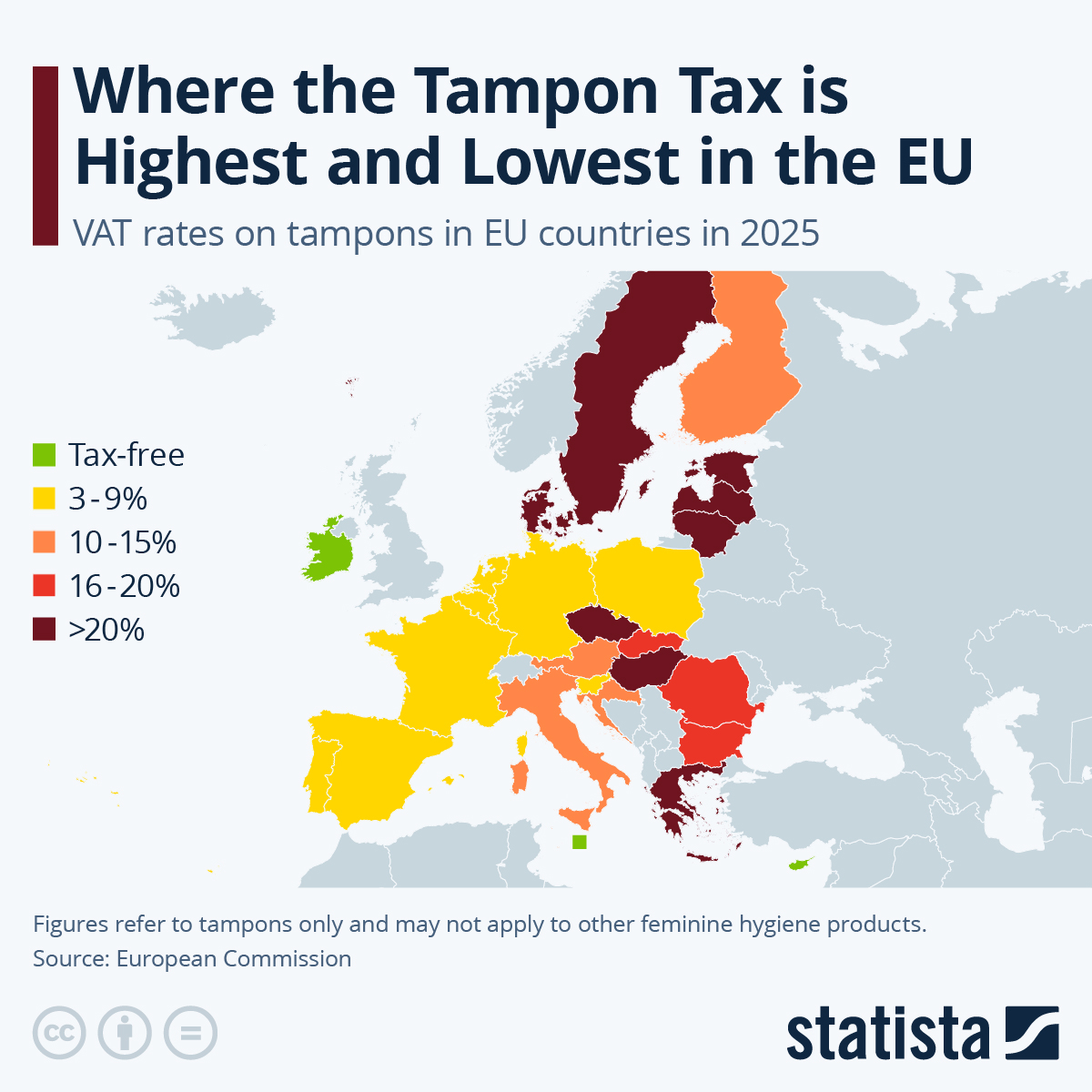
In the EU for example, countries have been free to depart from standard sales tax rates since 2007 and apply super discounted tax rates to feminine sanitary products. Still, as Statista's Katharina Buchholz notes, many countries haven’t lowered their tax rates, with Hungary exhibiting the highest rate at 27 percent. Several Scandinavian countries, whether they are EU-members or not, tax at around 25 percent and Greece even raised the so-called "tampon tax" to 23 percent as part of the country's austerity measures, according to Eurostat and media reports.
In the past 12 months, three Eastern and Central European countries - Poland, the Czech Republic and Lithuania - have lowered the "tampon tax" to 5 percent. Germany has also slashed taxes on feminine hygiene products to 7 percent from a high of 19 percent and Luxembourg has even gone as low as a 3 percent tax.
The UK and Cyprus already had their rate as low as 5 percent by 2018, similar to France, which charges 5.5 percent. Switzerland currently charges 7.7 percent but is looking to reduce that to 2.5 percent. Equally, Spain has been discussing changing the current 10 percent rate to 4 percent. The only country with no sales tax on period supplies in Europe is Ireland.