| 0 comments ]

"An Absolute Shocker": Core CPI To Hit 4% In Two Weeks?

While pundits debate whether the record usage on the Fed's reverse repo facility, which last week hit a record $485BN before easing back modestly...
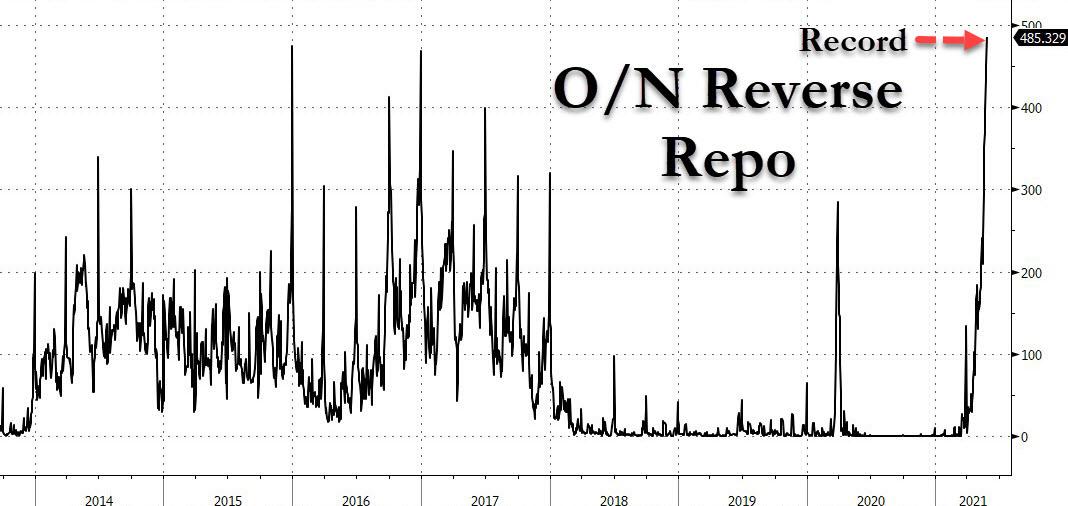
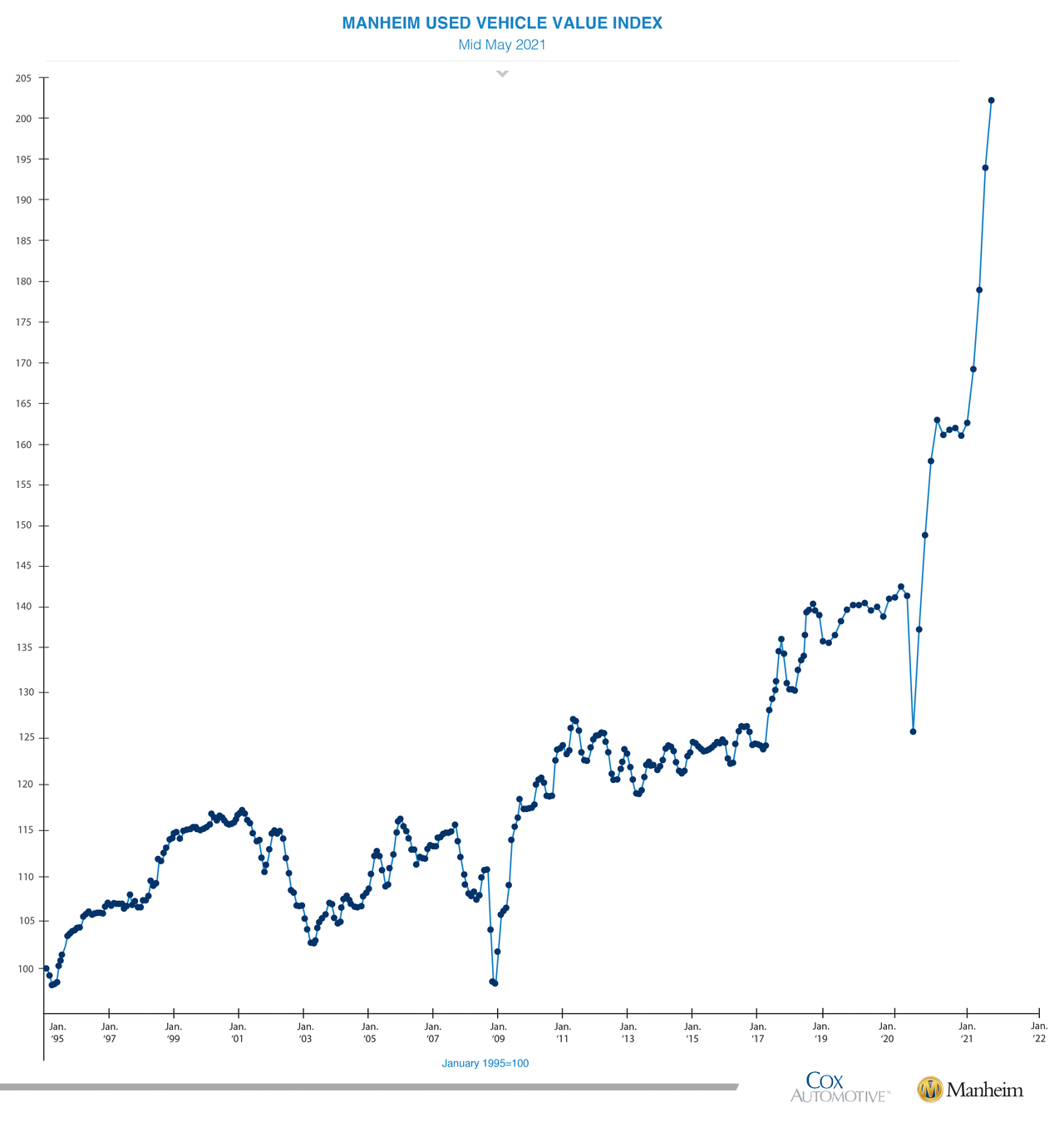
... will be the technical catalyst that forces the Fed to finally hike the IOER by 5bps at the June meeting (a move which Powell will repeat several hundred times is not indicative of the Fed's broader monetary policy to avoid a panic puke), a bigger threat to the Fed's overall (and overly dovish) monetary posture is that as Nordea wrote last week, there is a clear risk that the May inflation report published on June 10, "will prove to be an absolute shocker with used cars and trucks up by 50% year over year, and a potential further increase in the yearly increase in the rent of shelter component."

For those who haven't seen what is going on in the used car space, here is a chart of the Mannheim used car index:
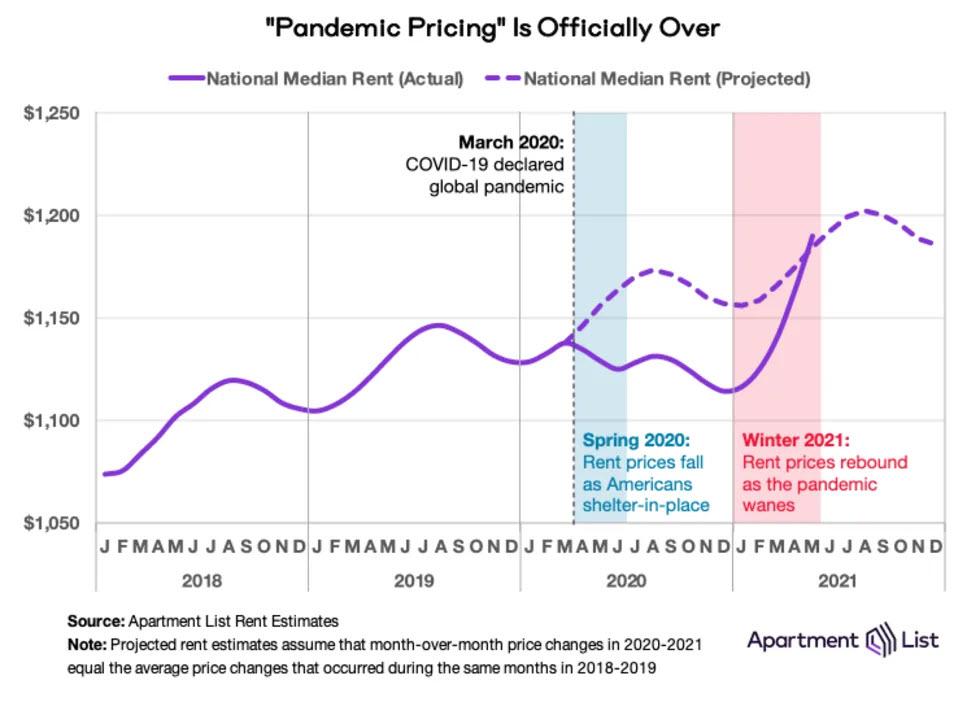
... and according to Apartment List, after a period of decline, nationwide median rents just surged by the most on record as this key component of the CPI and PCE basket suddenly explodes higher.
And here is the chart which prompts Nordea "not to rule out >4% core CPI inflation" in May, which will see the Fed's "transitory inflation" world cave in as even Democrats politicians demand the Fed to start tapering.

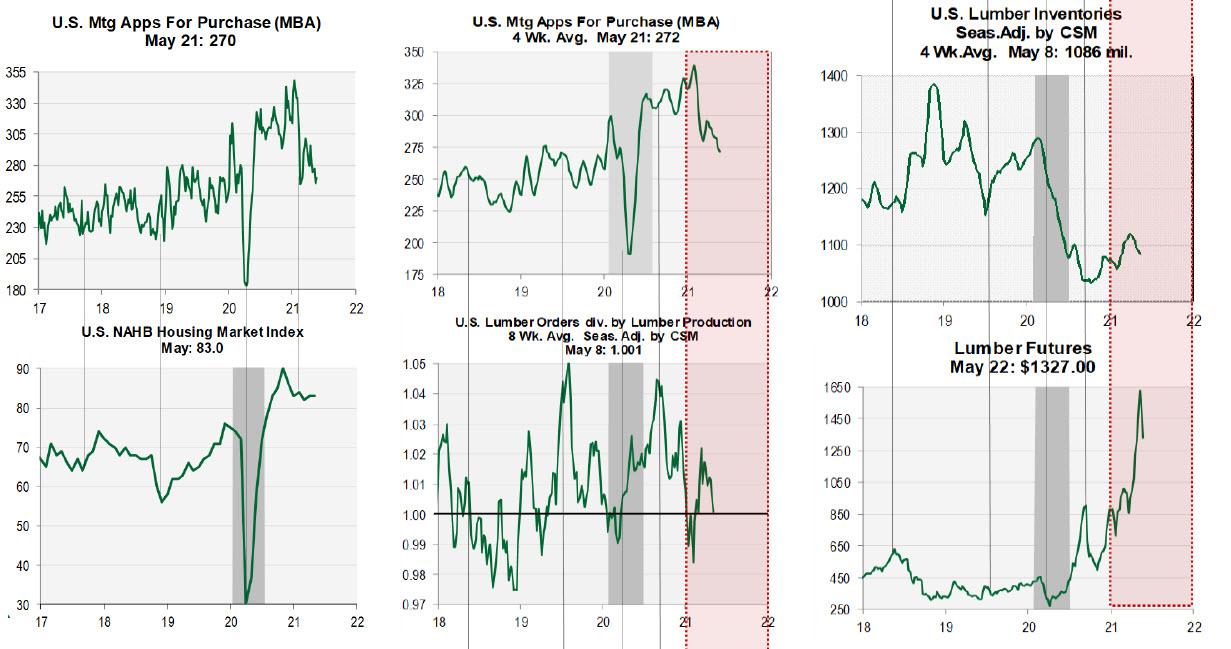
Or maybe not, because while by now it is all too clear that we will have at least several months of residual surges in most prices which according to the Fed are "transitory", some are already focusing on the next leg lower in prices which has manifested itself in certain commodity prices as well as the broader housing sector, with analysts pointing to early signs that demand is moderating, and supply is starting to catch up, helping explain some cooling commodity prices, followed by a similar sequence in goods inflation. Two frequently cited example of the above include US mortgage apps/lumber, and China’s recent direct intervention impacting soaring prices in iron ore and copper.

Take lumber and housing for example: housing led the way in the broad virus-demand boom/virus-supply constraint pattern the economy experienced over the past year. This was confirmed by the data: lumber new orders surged above production, collapsing inventories and igniting a price surge reflecting lumber new orders increasing faster than supply. But now, production has caught up with orders, and lumber inventories have stabilized. Many economists - and certainly the Fed - expect this pattern to repeat elsewhere in the economy, as supply catches up with demand, and price spikes roll over.
Meanwhile, as discussed over the past two weeks, commodities have been under sharp pressure from Beijing’s heavy hand - particularly iron ore, and also copper - with Beijing repeatedly warning that commodity prices are too frothy. Indeed, China's banking regulator has asked lenders to stop selling commodity-linked investment products to mom-and-pop buyers

It's not just commodities, however: Beijing is also making it increasingly clear that it demands the Fed end its dovish ways (which are leading to soaring commodity price inflation in China) by the recent surge in the yuan. Indeed, while Beijing is publicly pretending to jawbone the yuan lower, the Chinese currency rose to a new cycle high, and on Friday the official Shanghai Securities News said the CNY “may gain past 6.2,” supported by the weakening dollar, and China’s strong domestic economic recovery, citing analysts.
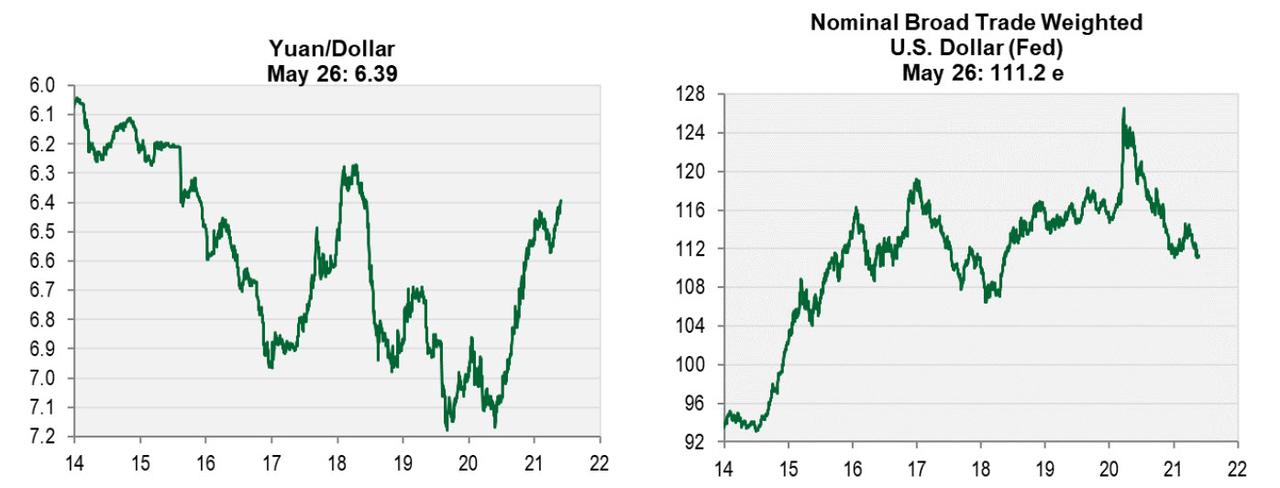
So while the Fed is pretending that inflation is transitory, China - where commodity inflation has sparked widespread and very much non-transitory public anger in recent months - is taking matters into its own hands and is strenghtening the CNY to make imports cheaper, helping cool inflation, while making exports less competitive. Yet paradoxically, this action will also weigh on the USD, as China adds to its own price pressures.

Ultimately, the current untenable situation will necessitate another Shanghai Accord-type agreement between the world's biggest economies, or the growing divergence in policy responses will end in chaos.

Tyler Durden Tue, 06/01/2021 - 05:45
https://ift.tt/3i4OqmP
from ZeroHedge News https://ift.tt/3i4OqmP
via IFTTT

"An Absolute Shocker": Core CPI To Hit 4% In Two Weeks? SocialTwist Tell-a-Friend
| 0 comments ]

Turkey Prepares A Syrian Diversion For Its Internal Strife

By South Front,

A Turkish operation in northeastern Syria may be brewing, if recent developments are an indication. On May 28th, the Turkish-backed Syrian National Army (SNA) announced that it had eliminated the mastermind behind ISIS assassinations in the region, in a joint operation with the “Free Syrian Police.”

The SNA said that a joint force had raided a hideout in the town of al-Bab where the ISIS assassination commander was taking shelter. There were heavy clashes.

In a typical Turkish-esque reporting manner, the pro-Ankara forces achieved victory, despite the odds. Two days later, ISIS’ response came, when al-Bab was subjected to two attacks. On May 30th, in the morning, an improvised explosive device blew up the SUV of Tala ‘Abu, the General Judge of al-Bab, who survived the attack.

Later on the same day, unidentified gunmen on a motorcycle shot and killed two personnel of the Free Syrian Police, a law reinforcement body backed by Turkey, in al-Bab. Eyewitnesses who were at the scene of the second attack said that the gunmen shouted “the Islamic State is remaining”.

ISIS remains as a strong presence in Turkish-occupied areas in northern and northeastern Syria. Some of the Turkish-backed militants present there are former fighters and commanders of the terrorist group. Furthermore, Turkey’s forces and the factions it backs fight against the Kurdish groups in northeastern Syria.

On May 30th, Turkish forces shelled the town of Maraanaz which is located in northern Aleppo and is jointly held by Kurdish forces and the Syrian Arab Army (SAA).

The Turkish shelling appears to be a response to a recent infiltration attempt by the Afrin Liberation Forces (ALF) on Maraanaz front. On May 28th, a group of ALF fighters attempted to infiltrate the defenses of Turkish forces to the north of the town. The attempt failed because the fighters came across a minefield and two of them died.

In Greater Idlib and northeastern Syria, Ankara fights against ISIS, also against every Kurdish faction. It’s only “allies” appear to be the factions it backs, and mostly the al-Qaeda-affiliated al-Nusra Front (Hay’at Tahrir al-Sham). On May 30th, Turkish mob boss Sedat Peker has opened up in a new video explaining the Turkish government involvement in illicit trade with Syria and the transfer of weapons to the al-Nusra Front.

Peker was considered an ultra-nationalist and an ally to the ruling AK Party of Recep Tayyip Erdogan. He began revealing information about the corruption of senior Turkish officials and their involvement in illicit activities after a fallout with the authorities.

As a result of these revelations, Turkey’s leadership is feeling a sense of urgency. There were allegations of high-level phone tapping and more, alongside the illicit weapon and drug trade. As such, the focus needs to be shifted quickly outside of Turkey and what better way than to organize a sort of crisis in the north of Syria?

Tyler Durden Tue, 06/01/2021 - 05:00
https://ift.tt/3yVYTr0
from ZeroHedge News https://ift.tt/3yVYTr0
via IFTTT

Turkey Prepares A Syrian Diversion For Its Internal Strife SocialTwist Tell-a-Friend
| 0 comments ]

The Global Race Towards Full Vaccination

Scientists initially estimated that 60 to 70 percent of a population would have to acquire resistance to Covid-19 in order for herd immunity to take effect, a threshold that has been revised upwards since the start of the year with 80 to 85 percent quoted in some cases.

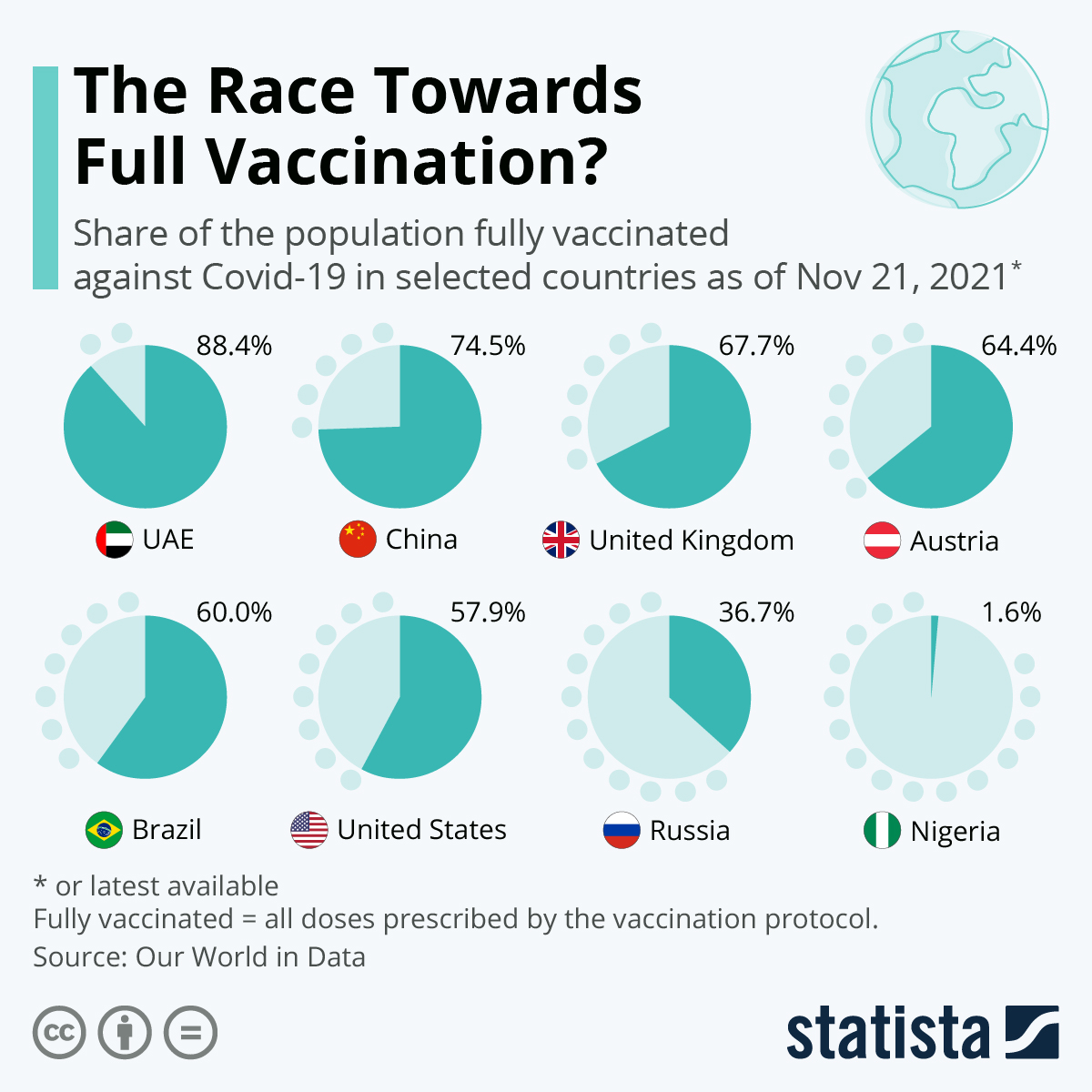
As Statista's Niall McCarthy notes, the race towards full vaccination is well underway and Israel has the highest share of its population fully jabbed, according to Our World in Data.

Infographic: The Race Towards Full Vaccination | Statista

You will find more infographics at Statista

Despite the ever-higher immunity threshold discussed by scientists, Israel's Covid-19 case count started to tumble when 40 percent of its population received at least one jab and now 59.3 percent of its inhabitants are fully vaccinated. The country's reproduction rate has been around 0.5 in recent weeks and it appears to be on track to emerge from the pandemic, suggesting that initial herd immunity estimates carried some accuracy.

With 45.4 percent of its inhabitants fully vaccinated, Bahrain comes second on the list.

In the United States, 40.2 percent of people have been fully vaccinated (though do not forget that almost half of unvaccinated Americans have natural immunity from prior infection).

In this case, full vaccination refers to all doses prescribed by the vaccination protocol with data only available for countries reporting the breakdown of their doses.

As Scott Morefield wrote recently, Blue-state lockdown-lovers drunk on their own power like Democratic Michigan Gov. Gretchen Whitmer who insist on a 70 percent vaccination rate in order to ease up on mandates and restrictions are ignoring the science completely in order to hold their people hostage to an unobtainable, unnecessary goal.

Dr. Marty Makary, a surgeon at Johns Hopkins Hospital debunked the desire among some health officials, sometimes referred to as "zero COVID," that COVID-19 can be eradicated completely.

Well, unfortunately, we have this perception now that's being created by some public health leaders that we need to reach total eradication. We're not gonna get to total absolute risk elimination. That is a false goal and quite honestly it’s being used now to manipulate the public. We heard today again from our public health leaders that if we get to 70% vaccination, then we can start seeing restrictions removed. That’s dishonest. Most of the country is at herd immunity. Other parts will get there later this month. San Francisco had 12 cases yesterday, most asymptomatic. What do you call that? I call that herd immunity. And I think what's happening is our public health leaders are dismissing natural immunity from prior infection, which changes the path to get to more population immunity. It invokes mandates, it means kids may have to get it and it demonizes those that are hesitant rather than respecting their decision.

Indeed, you don't have to have a medical degree to know that the formula for herd immunity has always been vaccinated plus natural immunity, but then again, when have Democrats ever been good at math?

Tyler Durden Tue, 06/01/2021 - 04:15
https://ift.tt/3i6wBE0
from ZeroHedge News https://ift.tt/3i6wBE0
via IFTTT

The Global Race Towards Full Vaccination SocialTwist Tell-a-Friend
| 0 comments ]

Did The Greens Peak Too Soon In Germany?

Authored by Tom Luongo via Gold, Goats, 'n Guns blog,

For the past year the Green Party has surged in popularity, riding from what I can gather, a kind of anti-government wave coming from the left thanks to Angela Merkel’s continued mishandling of the COVID vaccination program and the exhaustion from multiple rounds of lockdowns.

Protests across Germany, under-reported in the news, have proliferated and the rise of the Greens can be seen as a kind of simple protest vote against the existing government, another of Merkel’s Grand Coalitions between her nominally center-right Christian Democratic Union (CDU) and the Social Democrats (SPD).

The SPD has lost considerable support over the term of this government and the Greens have been the beneficiary. I’ve talked about this previously and how Merkel uses the Greens as her whip hand in the Upper House, the Bundesrat, to push German policy along the vector set by her masters in Davos.

That’s resulted in both a loss of support for the CDU and the SPD nationally as the Greens have gained such that the electoral map in Germany is now functionally no better than the mess in Spain or Italy.

And from where I’m sitting this has always looked to be the plan.

The problem, however, is that after peaking nationally at nearly 28% earlier this year, Green support is coming back down to earth as people being listening sincerely to what they actually stand for.

They’ve become increasingly bellicose, supporting war in Ukraine to counter Russia as well as their silence recently over the conflict between Hamas and Israel. They’re led by interventionist and increasingly neoconservative people internally while trading on their pacifist roots. And that dichotomy is beginning to catch up with them apparently among German voters.

This is because the Greens, just like Merkel, are a wholly-owned subsidiary of The Davos Crowd’s agenda to make the world safe for communism and the Green New Deal, itself a 593-page piece of EU legislation that is bogged down in ideological infighting within the European Parliament as members there fight over typical things like the definitions of words and what is or is not ideologically pure enough.

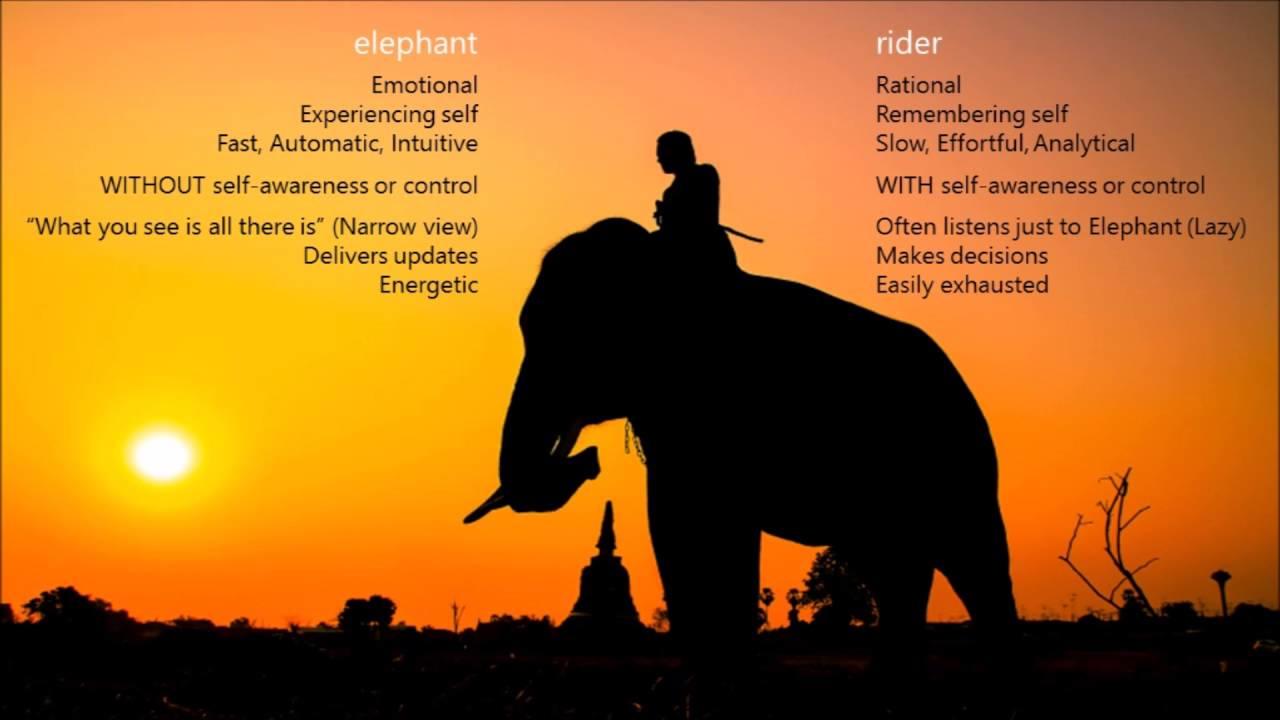
It’s Jonathan Haidt’s “Elephant and the Rider” problem playing out at a policy level.

In a post for my Patrons back on March 23rd I said then that the biggest enemy of the Green New Deal is the Greens.

So much of the ‘culture war’ which is now turning into a Hobbesian “War of All Against All” is due to the spiraling of logic built on false premises, like man-made global warming, and amplifying from there.

W.B. Yeats called it a ‘widening gyre’ but that’s why the EU will never get its Green investment rules set in place and certainly not in time for the 2030 time frame. Remember, I think of the EU as the Western Oligarchs’ last attempt to colonize the world through regulatory dominance a la California.

The relentless talk of expanding the EU is all about bringing more countries under its regulatory rubric forcing more people to adhere to its standards which then increases the pressure on trade partners to do the same.

It’s California on Leninist Steroids.

And I still fear not the Green New Deal itself but the haphazard way it gets implemented once the lobbyists get a hold of it. It will be a horrifically bloated piece of rotting pork which the average, fiscally-conservative German voter knows they will ultimately have to pay for.

So, with that in mind and the Greens peaking in the polls four months out from the Bundestag elections, itself a zombie institution thanks to the Greens’ veto power in the Burdesrat thanks to Merkel, it is possible that we see a sharp U-turn in the polls by the time the election actually happens.

Why? State-level elections.

Next week state elections happen in the German State of Saxony-Anhalt. And the closer we get to this election, for the first time in months, German polling is interesting. Because the heretofore incompetent Alternate for Germany (AfD) has successfully placed themselves in the position to win that election making it very difficult for Merkel, the very definition of lame duck, to keep them out of the government there through backroom dealings.

It’s one thing when the CDU is the dominant vote-getter, but it’s another thing when after two election cycles in Saxony, AfD is denied a seat at the table when they have a stable 23-25% level of support which is surging as we get to election day.

In this way if AfD wins this election it will be a black eye to all the other parties if they again pull the same stunt as in the last round of elections, refusing to even talk with them. And this could be the thing that catalyzes real movement in the polls come October.

I still maintain that AfD has squandered its many chances this far to become the center-right standard bearer for the average German. They are still mired below the critical 16% Chasm nationally while the SPD have fallen into irrelevance. Recent polls have the national number rising off of post-Coronapocalypse lows. And the question now is whether they see this opportunity in front of them to put Davos’ agenda on its back foot at a critical juncture in European history and position themselves as the true anti-war, pro-German middle class party.

I’m not sanguine about this given its leadership’s history, but it bears watching as the split between the former East and West Germany politically widens. Davos is always pushing events to ensure weak leadership in key countries. And it looks to me that the situation in Germany is fluid in a way that could see their best plans compromised.

*  *  *

Join my Patreon if your Elephant needs a new Rider

Donate via

BTC: 3GSkAe8PhENyMWQb7orjtnJK9VX8mMf7Zf
BCH: qq9pvwq26d8fjfk0f6k5mmnn09vzkmeh3sffxd6ryt
DCR: DsV2x4kJ4gWCPSpHmS4czbLz2fJNqms78oE
LTC: MWWdCHbMmn1yuyMSZX55ENJnQo8DXCFg5k
DASH: XjWQKXJuxYzaNV6WMC4zhuQ43uBw8mN4Va
WAVES: 3PF58yzAghxPJad5rM44ZpH5fUZJug4kBSa
ETH: 0x1dd2e6cddb02e3839700b33e9dd45859344c9edc

Tyler Durden Tue, 06/01/2021 - 03:30
https://ift.tt/3wNJyqA
from ZeroHedge News https://ift.tt/3wNJyqA
via IFTTT

Did The Greens Peak Too Soon In Germany? SocialTwist Tell-a-Friend
| 0 comments ]

Turkey Cracks Down On Alcohol As Erdogan Pushes Islamist Agenda

Turkey, which Ataturk's reforms dragged kicking and screaming from the confines of medieval Islam into the modern world, is fast regressing to its original state under its despotic ruler Recep Tayyip Erdogan who is seeking to place Islam at the heart of national politics to deflect away from his catastrophic rule, and steer the overwhelmingly Muslim country toward the Middle East and away from the West. He is doing so by restricting the use of alcohol, to start.

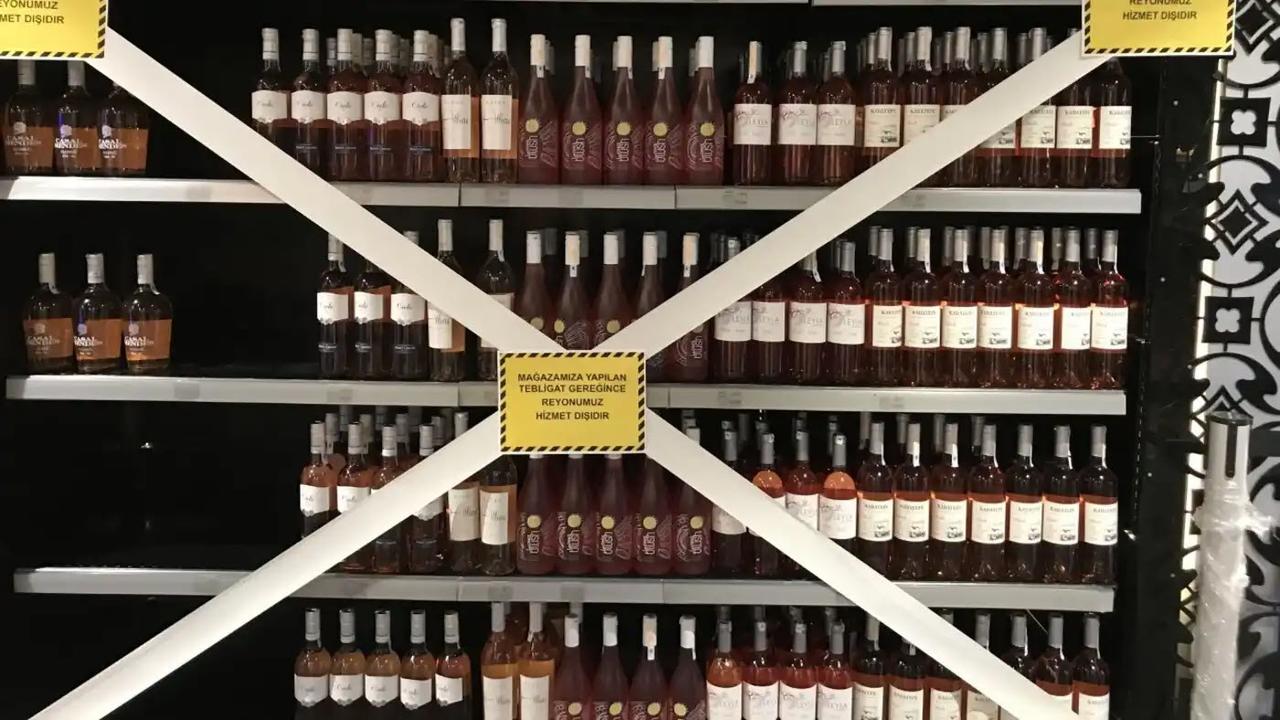
On April 29, the Turkish government imposed a nearly three-week nationwide lockdown and ban on alcohol sales through the end of Ramadan. Even at grocery stores allowed to operate during the period, liquor sections were sealed off with tape notifying customers that the corner has been temporarily closed by government order.

The liquor section of an Istanbul grocery store is cordoned off during a recent three-week lockdown.

As the Nikkei details, many people rushed to buy liquor before the lockdown. An employee at a midsize winery in the western region of Thrace said it had received telephone inquiries about delivery from about 30 customers. "I guess we have never sold so much alcohol during Ramadan," she said.

The lockdown ended May 17, but the government would keep the weekend curfews and alcohol ban through the end of the month. It may extend it beyond. Many Turks question the effectiveness of the ban on drinking at home as an antivirus measure and criticize the move as undue meddling in private lives.

Since taking power in 2002, the Islamist ruling Justice and Development Party has clamped down on alcohol. The government has increased related taxes over the years and in 2013 passed a law banning alcohol ads and sales at liquor stores after 10 p.m. It also prohibits makers and sellers of alcohol from sponsoring sports events.

And these are only the visible measures. Although more than 150,000 stores, including supermarkets, sell alcohol in Turkey, over the past few years it has become increasingly difficult to obtain permission to open new stores to sell liquor, said Ozgur Aybas, head of a liquor store association that opposes government restrictions. In some conservative regions, local authorities turn down stores' applications, saying alcohol is a sin.

Erdogan is a pious Muslim known for his dislike of alcohol. "The president may be trying to turn Turkey into a place like Dubai, United Arab Emirates, which allows alcohol consumption only among non-Muslim foreigners," said Aybas, echoing similar views in the industry.

Although Turkey is a Muslim-majority country, it has a rich drinking culture and produces a wide variety of alcoholic beverages, including beer, wine and raki, the country's signature spirit. Drinking became legal soon after the Republic of Turkey was established in 1923. Mustafa Kemal Ataturk, the founder of modern Turkey and a hard drinker, helped establish a state-owned winery.

Ataturk - who regarded Islamic politics and society as the primary obstacle - pushed for Westernization with a focus on the separation of state and religion. While some see Turkey as a Middle Eastern country, international organizations and Western media often regard it as part of Europe. Turkey is a member of NATO and was named as a candidate for EU accession in 1999.

Erdogan has been trying to reverse the country's secularization. Last year, the government converted Istanbul's Hagia Sophia, a World Heritage site secularized by Ataturk in 1934, into a mosque, and this past March it announced a withdrawal from the Istanbul Convention, an international accord designed to protect women from violence.

Diplomatically, Turkey has actively engaged in the Palestinian issue as a Muslim country, and its EU accession has been practically put on hold.

The current move to tighten alcohol regulations is part of Erdogan's effort to promote Islam and traditional values. When the tougher law was introduced in 2013, Erdogan implicitly criticized Ataturk and his longtime ally Ismet Inonu by saying, "Given that a law made by the two drunkards is respected, why should a law that is commanded by religion be rejected by your side?"

Turkish President Recep Tayyip Erdogan speaks beside a portrait of Mustafa Kemal Ataturk, the founder of modern Turkey.

Erdogan is trying to appeal to the country's conservatives, who make up a majority of the population but often feel neglected by secular elites, who did not even allow women to wear headscarves in public at times.

According to several private-sector surveys, only around 20% of Turks drink alcohol regularly, while the state-run Turkish Statistical Institute - which is more Erdogan's personal propaganda arm than anything data-driven - reported that more than 70% of those age 15 or older have never had alcohol.

Yet people seem weary of the government's move to limit their freedom to choose their favorite drink. In a recent survey conducted by Istanbul Economics Research, 56% of respondents saw the recent alcohol ban as inappropriate, while 44% voiced their support. The poll shows that many in the nondrinking segment have reservations about the ban.

Soner Cagaptay, director of the Turkish Research Program at the Washington Institute for Near East Policy, said that Erdogan and Ataturk are very similar in that both try to transform the country based on their own vision -- but their visions are completely opposite.

Tyler Durden Tue, 06/01/2021 - 02:45
https://ift.tt/3geNQAH
from ZeroHedge News https://ift.tt/3geNQAH
via IFTTT

Turkey Cracks Down On Alcohol As Erdogan Pushes Islamist Agenda SocialTwist Tell-a-Friend