| 0 comments ]

China's Productive Capacity Is Starting To Slip Away To India And Southeast Asia

Continued lockdowns in China aren't helping the country's ongoing, decade-long, production exodus, a new report from Caixin notes.

The accelerating exodus from Asian production powerhouse has been helped along by Covid policy disruptions, rising labor costs and worsening trade tensions between the U.S. and China, the report notes. 

Southeast Asia and India are looking to take China's place thanks to low labor costs and rising domestic demand. This falls in line with India's political objectives, where Prime Minister Narendra Modi is pushing a “Made in India” campaign. 

As an example, Apple said earlier this year that it had started making its iPhone 13 at a factory in India instead of Taiwanese contract manufacturer Foxconn. Like other smartphone makers, it has an incentive not only for exports, but for domestic sales, the report notes:

In India, Chinese smartphone makers set up factories aiming at the huge domestic market. With 1.4 billion people — almost as many as in China — and a high proportion of young people, India has attracted Chinese brands including Xiaomi, Meizu, Vivo and Oppo to build factories. Many Chinese phone part makers have also set up factories there. Now Chinese brands account for nearly two-thirds of India’s smartphone market.

But that doesn't mean China doesn't have advantages: it has an enormous domestic market and decades of manufacturing infrastructure and experience, the Caixin report notes. And while no major aftershocks have been felt in China's economy, the trend is heading in the wrong direction for the country. 

Li Xingqian, director general of the Ministry of Commerce's Foreign Trade Department said the exodus from China was  “in line with the law of economics.”

Exports in the country were up 16.9% in May, the report says, accelerating from April's 3.9%. The country's trade surplus was $78.76 billion in May. 

However, thanks to weak demand in developed countries, "export orders for delivery in June and July, usually the peak season for booking goods for the back-to-school and holiday seasons, didn’t come in as expected," the report said. This weak demand was seen in falling shipping rates. 

Americans may take until the end of this year to work through inventories that were pulled forward over the last year. 

At the same time, President Joe Biden has said that he is considering lifting tariffs on $350 billion a year in Chinese goods. His administration, however, still seems to be divided on the matter and no decision is expected quickly. 

The report noted clearly that, to this day, China remains "the world's factory", which is unlikely to change anytime soon:

Neither Southeast Asia nor India can replace China as the global manufacturing hub in the near future as they are mainly engaged in labor-intensive and low value-added manufacturing, several foreign trade participants told Caixin. They also face problems such as incomplete industrial chains and low labor efficiency to varying degrees, experts said.

To foreign companies, China is not only a manufacturing base but also a huge market, said He Xiaoqing, president of consulting firm Kearney Greater China. In 2020, global companies had $1.4 trillion of domestic sales, far more than their exports of $900 billion, showing the attractiveness of China’s local market, He said.

In addition to India, Vietnam has also been a beneficiary of factories leaving China. Imports for the country were up 16.7% for the first five months of this year, data shows.

Most of the production moving to Southeast Asia involves textiles, furniture and low-end assembly of consumer electronics, the report said. 

Tyler Durden Wed, 06/29/2022 - 18:00
https://ift.tt/1O0JhAF
from ZeroHedge News https://ift.tt/1O0JhAF
via IFTTT

China's Productive Capacity Is Starting To Slip Away To India And Southeast Asia SocialTwist Tell-a-Friend
| 0 comments ]

Crisis Of Faith: Politicians & Press Escalate Attacks On Legitimacy Of Supreme Court

Authored by Jonathan Turley,

Below is my column on the growing attacks on the legitimacy of the Supreme Court after the decision to overturn Roe v. Wade. As the Court ends its term, Democratic leaders are calling for removing justices, packing the Court, and other extreme reactions to the decision in Dobbs v. Jackson Women’s Health Organization.

Here is the column:

For justices, the end of a Supreme Court term usually brings welcomed vacations and speaking engagements out of town. This week it seemed more like the justices were fleeing the jurisdiction with a mob at their heels. Six justices (and their homes) are targeted because they dared to interpret the Constitution in a way that is opposed by many in the political, media, and academic establishment. After the overturning of Roe v. Wade, many called for impeachments, court packing, and “disciplining” justices. What is chilling, however, is that these calls have not come from extremist groups but political and media figures who are challenging the very  “legitimacy” of the Supreme Court.

The Madisonian democracy is based on the premise that, despite our factional divisions, the Constitution creates an interest in all groups in preserving the system. While the Constitution does not guarantee that your views will prevail in Congress or the courts, it has proven the most stable and successful democratic system in history.  We are all invested in that system which has achieved transformative changes over time in our laws and our society.

The Constitution is neither poetic nor pretentious in its language. It was written by the ultimate wonk in Madison. It has only one thing to recommend it: we are still here.  We have survived periods of war, economic collapse, and social discord that broke other systems.

Politicians and the press have thrived under this system and have historically defended its legitimacy even when demanding major changes in our laws. We are now witnessing a crisis of faith with the political and media establishment declaring the highest court to be illegitimate. All because they disagree with a constitutional interpretation adopted by the majority of its members.

Sen. Elizabeth Warren, D-Mass, has declared the Supreme Court illegitimate and has called to pack the Court for rending opinions against “widely held public opinion.”

Rep. Alexandria Ocasio-Cortez, D-N.Y., even questioned the institution’s value: “How much does the current structure benefit us? And I don’t think it does.” She has now demanded the impeachment of Justices Kavanaugh and Gorsuch based on the entirely false claim that they lied under oath in their confirmation hearings. After the Dobbs decision, Ocasio-Cortez demanded “there must be consequences” for the Court.

Other leaders like Sen. Jeanne Shaheen, D-N.H., issued a warning to the Supreme Court: Reaffirm Roe v. Wade or face a “revolution.”

The media has amplified these extreme calls. In the New York Times, columnist Jamelle Bouie wrote an outline of how Democrats could rein in the high court in a piece titled, “How to Discipline a Rogue Supreme Court.” He wrote that the Supreme Court does not exist above the constitutional system and added that the “rogue” court “cannot shield itself from the power of other branches.” Bouie’s discipline includes impeaching or removing justices as well as packing the court.

Notably, like many others demanding radical changes to the Court, Bouie previously advocated the change that is most responsible for creating the Court’s current composition. Like many liberals, Bouie demanded that the Senate kill the filibuster rule for Supreme Court nominees.

At the time, some of us warned the Democrats that the move was uniquely short-sighted and that they would rue the day that they took such a moronic step. As predicted, the Democrats soon found themselves in the minority without the protection of the filibuster rule and could not block nominees. They gained comparably little from the change given what they lost, including ultimately Roe v. Wade.

Rather than admit that their prior attack on the filibuster backfired, liberals are now demanding even more radical moves like a bad gambler at Vegas who just keeps doubling down in the hopes of winning a hand.

It does not matter that the Court is not as rigidly ideological or dysfunctionally divided as widely claimed. If anything, it has shown fewer divisions in most cases. Before the opinion, ABC admitted that “67% of the court’s opinions in cases argued during the term that ends this month have been unanimous or near-unanimous with just one justice dissenting.That compares to just 46% of unanimous or near-unanimous decisions during the 2019 term and the 48% average unanimous decision rate of the past decade.” Yet, after the decision, ABC’s legal analyst Terry Moran described the term as a “new era” of the “activist court.”

This crisis of faith is evident in other key constituencies in our system, including in our law schools. Law professors like Berkeley Dean Erwin Chemerinksy have called the justices “partisan hacks” while others have supported targeting the individual justices at their home. Georgetown Law Professor Josh Chafetz declared that “when the mob is right, some (but not all!) more aggressive tactics are justified.” Most recently, the dean and chancellor of University of California Hastings College of the Law David Faigman questioned the legitimacy of the Court after the ruling in Dobbs v. Jackson Women’s Health Organization.  

Writing in his official capacity, Faigman went as far as to claim that “this decision turns back the clock not just to 1973, but to a century when women did not have the right to vote and were, largely, treated as property . .  . the world today is so much less generous and inclusive than it was just yesterday. I tremble for my granddaughters.” Faigman declared that the “the Court itself, which is a product of political gerrymandering—raises basic questions regarding the legitimacy of the Court itself.”

From Congress to the press to academia, the very foundation of the Court is being challenged. What is notable is that these are also the voices of some of the most powerful figures in our society. Rather than seek to moderate the mob, they are fueling the rage with such reckless rhetoric. There are good-faith objections to this decision but those objections challenge the legitimacy of the holding, not the institution itself. As Benjamin Franklin noted “The U. S. Constitution doesn’t guarantee happiness, only the pursuit of it. You have to catch up with it yourself.”

Tyler Durden Wed, 06/29/2022 - 17:40
https://ift.tt/MXV4uQH
from ZeroHedge News https://ift.tt/MXV4uQH
via IFTTT

Crisis Of Faith: Politicians & Press Escalate Attacks On Legitimacy Of Supreme Court SocialTwist Tell-a-Friend
| 0 comments ]

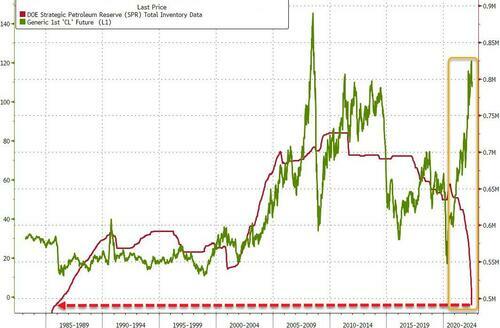
US Emergency Oil Reserves Tumble To Record Low 27 Days Worth Of Supply

As we detailed earlier in the week, the latest weekly release has pushed the SPR below the 500 million barrels mark for the first time since 1986...

And as the chart above shows, the plummeting SPR is not having the impact on prices that President Biden hoped (which explains why he is blaming everyone and everything else for the rise in gas prices - as it becomes clear it's a refining capacity issue as much as anything else).

While that is ominous by itself, we note that in the context of US demand, it is even more of a concern as based on the latest Department of Energy estimate of Implied Crude Demand, there is just 27 days of supply left in the emergency oil reserve... a record low...

"Congress has been irresponsibly selling the SPR down," said Bob McNally, who in the early 2000s oversaw the Energy Department's efforts to replenish the SPR under former President George W. Bush, adding that "draining the reserve leaves the country and the world more vulnerable to geopolitical shocks."

Finally, we note that in response to growing concerns about the depleted reserve, the Department of Energy revealed plans to replenish emergency stocks.

This fall, it will launch a buyback process to repurchase 60 million barrels of oil, or one-third of the six-month 180-million-barrel emergency release.

As Andrew Moran writes at The Epoch Times, although the White House is exploring multiple avenues, such as urging OPEC to open the taps and pushing gasoline stations to diminish the pain at the pump, the best solution is greater North American output, says Tortoise Senior Portfolio Manager Rob Thummel.

“The best solution remains increasing oil and natural gas production from reliable supply sources like U.S. and Canada that will assist in balancing the global energy markets and reduce the geopolitical risk premium embedded in global oil and natural gas prices resulting in lower prices at the pump,” Thummel stated during a recent TortoiseEcofin QuickTake podcast.

Biden announced last week that he is encouraging Congress to lift the 18-cent federal gas tax for three months...

Tyler Durden Wed, 06/29/2022 - 17:20
https://ift.tt/KNzOAI5
from ZeroHedge News https://ift.tt/KNzOAI5
via IFTTT

US Emergency Oil Reserves Tumble To Record Low 27 Days Worth Of Supply SocialTwist Tell-a-Friend
| 0 comments ]

Daily Briefing: When Rates Rise, Growth Slows

U.S. gross domestic product contracted by 1.6% on an annualized basis during the first quarter, according to the Bureau of Economic Analysis’s final estimate, as consumer spending was weaker than originally forecast. The sense we’re heading for recession was heightened when Federal Reserve Chair Jerome Powell said today at a European Central Bank forum that policymakers won’t let the economy slip into a "higher inflation regime" even if it means raising interest rates to levels that put growth at risk. He maintains U.S. household finances remain strong. “The Fed needs you to capitulate on summer travel in order for inflation to get under control,” says 42 Macro founder and CEO Darius Dale. Darius joins Real Vision's Andreas Steno Larsen to talk about receding inflation fear and rising recession risk. We also hear from Francis Gannon about how higher interest rates are driving a shift in market focus. And we share a segment from today’s Crypto Unwrapped episode on continuing upheaval in the crypto market. Want to submit questions? Drop them right here on the Exchange: https://rvtv.io/3Ntyqa7. Watch the full conversation featuring Francis Gannon here: https://rvtv.io/3QUWOnV. Watch the full Crypto Unwrapped episode featuring Tascha Che, Katie Talati, and Ash Bennington here: https://rvtv.io/3NufQyO.

Tyler Durden Wed, 06/29/2022 - 14:20
https://ift.tt/RzC2qH5
from ZeroHedge News https://ift.tt/RzC2qH5
via IFTTT

Daily Briefing: When Rates Rise, Growth Slows SocialTwist Tell-a-Friend
| 0 comments ]

Americans Become More Pessimistic About The Future Of The Country

Authored by Tom Ozimek via The Epoch Times (emphasis ours),

The share of American adults who say they’re optimistic about the future of the country has dropped to a new tracking low, according to a poll by Morning Consult, which comes on the heels of a closely-watched consumer confidence gauge that fell to its lowest level on record.

Consumers shop for meat at a grocery store in Annapolis, Md., on May 16, 2022. (Jim Watson/AFP)

The Morning Consult survey, carried out on a representative sample of 2,210 U.S. adults between June 16–20, shows that 45 percent of respondents said they were “very optimistic” or “somewhat optimistic” about the future of the United States.

This is a record low as far as this particular data series is concerned, which goes back to October 2020. By comparison, a series high was reached in March 2021, when 65 percent of U.S. adults expressed optimism about the future of the country.

Consumer Confidence Plummets

While the Morning Consult’s data series goes back only two years, a separate measure of U.S. consumer confidence from the University of Michigan, which goes back to the mid-1970s, has plunged to a record low.

The Michigan consumer sentiment index fell from a reading of 58.4 in May to just 50.0 in June, an all-time low, with soaring inflation a key factor behind the surge in pessimism.

“While consumers still appear relatively optimistic about the stability of their incomes, their perceptions of the economy are much more strongly influenced by concerns over inflation,” according to University of Michigan economist Joanne Hsu, director of the consumer confidence survey.

All components of the University of Michigan sentiment index declined in June, but the sharpest drop was in the year-ahead outlook for the U.S. economy, which fell 24 percent between May and June, according to Hsu.

Inflation Expectations Ease a Little

One bright spot in the University of Michigan survey was that longer-term inflation expectations among U.S. consumers eased slightly to 3.1 percent over the next five to ten years, down from an earlier preliminary reading of 3.3 percent.

Hsu told Bloomberg that the downward revision in longer-run inflation expectations was driven by a jump in the share of respondents who said they expect “extremely low inflation in the years ahead,” with around half of those expressing “bleak views about the risks of recession or unemployment.”

Growing concern about the prospect of a recession as the Fed tightens monetary conditions could be a factor in the easing of the University of Michigan inflation expectations, as price pressures tend to ease during economic contractions.

A number of Wall Street analysts recently raised their forecasts for the odds of a U.S. recession, with Goldman Sachs predicting a 30 percent chance of the U.S. economy contracting over the next year, up from 15 percent in an earlier projection.

‘Quite Eye-Catching’

Still, U.S. inflation expectations as reflected in the 10-year breakeven inflation rate per the St. Louis Federal Reserve data jumped on Friday to 2.56 percent following a three-day downtrend that touched a multi-month low of 2.50 percent.

Policymakers fret over future inflation expectations—not just actual price growth—as they are a barometer of potential pressure building in the wage-price spiral. A de-anchoring of inflation expectations could fuel stronger demand for wages, driving a feedback loop that sees inflation pushing higher.

The dreaded wage-price dynamic was at play during the economic upheaval of the 1970s, which led then-Fed chief Paul Volcker to raise interest rates sharply, taming inflation but also sparking a recession.

Current Fed Chair Jerome Powell recently noted the University of Michigan’s preliminary inflation expectations reading—which he called “quite eye-catching”—as one of the factors that drove policymakers to hike rates by 75 basis points on June 15, the biggest jump since 1994.

‘Unimaginable Fed Pivot’

While an early signal, the slight easing of inflation expectations takes some pressure off the Fed to keep hiking rates aggressively, some analysts say.

Last week’s rally in stocks and other risk assets could reflect a shift in investors’ view of the Fed’s future path in light of inflation expectations.

“The market is telling us it is salivating at the prospect of a currently unimaginable Fed pivot,” analyst Sven Henrich wrote in a series of tweets, referring to a potential reversal of the Fed’s current monetary tightening cycle.

“Perversely, we may enter a period where bad news is good news as ever slowing growth will raise recession expectations and cause yields to drop (bullish stocks),” he added.

Henrich argued that any type of rollover in inflation data over the summer would “be massively positive” for equities, though the risk of a full-blown recession remains with the risk for new lows in stock markets remaining “extremely high.”

Tyler Durden Wed, 06/29/2022 - 17:00
https://ift.tt/DkBLQC0
from ZeroHedge News https://ift.tt/DkBLQC0
via IFTTT

Americans Become More Pessimistic About The Future Of The Country SocialTwist Tell-a-Friend