
| 0 comments ]

On The Jobs Report And Recession

Submitted by Eric Hickman of Lantern Capital

The strong jobs report today (+254k) caused the dam to break on what I’ve been writing about for weeks with Treasury yields. The 2-year yield is higher by 22 basis points today. With the 2-year now at 3.93%, the bond market is priced for the Fed to cut rates to 3.25% by March of 2026. This would be a 25-basis point cut at 7.5 of the 12 meetings in between now and then. This seems like fair pricing for the conditions given the Fed’s desire to slowly get rates back to neutral.

But I’ve never seen a big pop like this be limited to just one day. I expect yields to continue rising for a while (particularly at the front-end of the yield curve) until negative economic data reasserts itself. The narrative from Austan Goolsbee, president of the Chicago Fed, and Jerome Powell is that the Fed is going to cut rates back to neutral (somewhere around 3%) with or without economic weakness. But Fed hawks are going to quickly worry about inflation after today and try to un-do the favorable financial conditions (low Treasury yields). For instance, Larry Summers said today that cutting 50 basis-points was a mistake. It wasn’t given the regularity of the business cycle, but he is a good barometer for the hawkish side of the Fed. I expect for some member of the FOMC to say a version of “don’t count on us cutting back to neutral.” If this is said, the 2-year will become un-moored. The jobs number today represents a narrative change, and it is a process to work through before rates fall again in this Treasury bull market.

But today’s economic data doesn’t change my expectation of a recession one bit; it just suggests it is further away until more negative economic data comes along. The preconditions are set and make economic sense. The inverted yield curve, the unemployment rate rising, and Leading Economic Index have all signaled a recession is coming. Historically, if two of these signal, a recession occurs. In this cycle, all three have signaled. See this image for further detail. Soft-landings have one or none of these conditions and are pretty evident in the charts below.
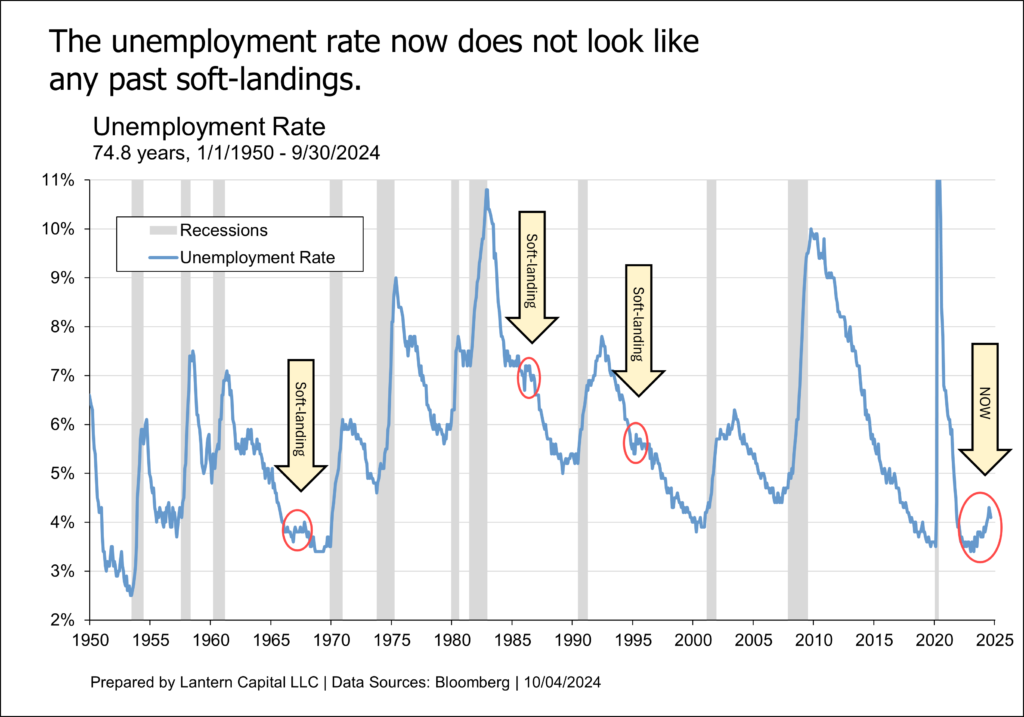
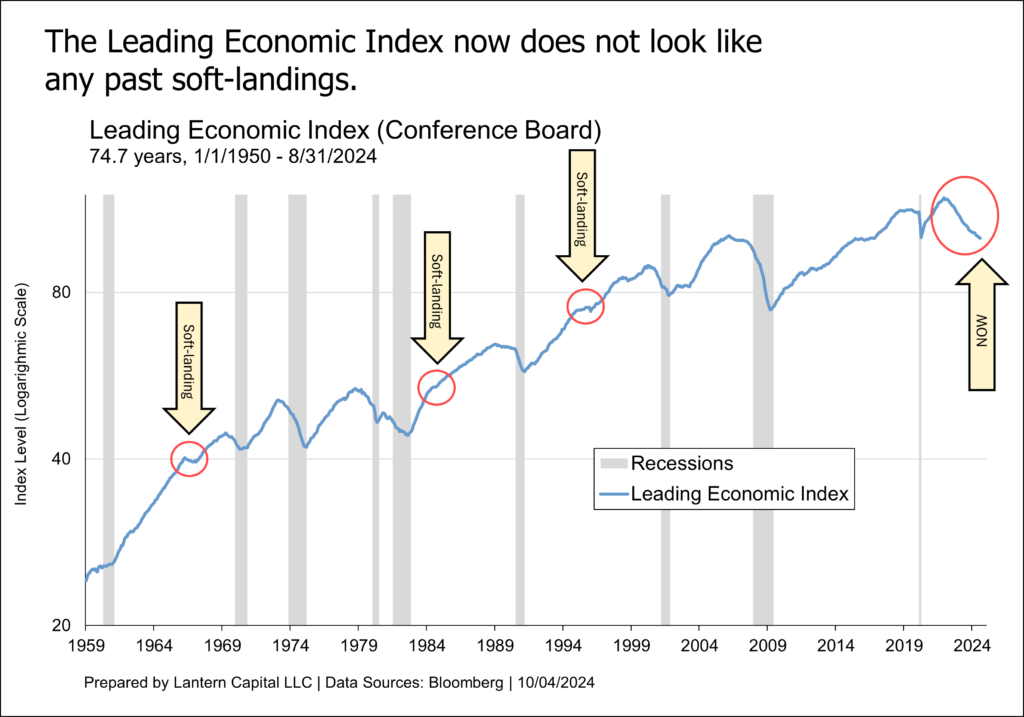
The arguments against this are that a recession hasn’t come yet, the Fed is going to lower rates before one comes, and that there are no economic imbalances to correct. Responding to the first, a recession has likely been delayed because of large fiscal deficits. The U.S. deficit to GDP in 2023 was 6.3%. The European Union, that began to cut rates the earliest of the G-7 in June, had a much-lower deficit to GDP of 3.6% in 2023. The UK, that began to cut rates in August, had a deficit of 4.4% of GDP in 2023. This correlation is too simplistic, but the point is that deficit spending buys temporary GDP growth and the U.S. has spent the most among the G-7, likely delaying the business cycle.

Second, the Fed is not going to be able to cut blindly down to neutral (around 3%). Inflation is a concern every step of the way and the reason why the Fed can never get ahead of the business cycle. Today is a good example with Larry Summers’ comments. The Fed needs to see escalating economic weakness as they cut to make them feel comfortable about inflation. I wrote more about this here.

In response to the third, risk-markets (i.e., the stock market) are the imbalance. The S&P 500 has returned 16.9% annualized (total return, dividends re-invested) since the Great Financial Crisis low on March 6th, 2009. It isn’t unusual for the stock market to go through 9-18 year periods with high returns like this, but it has been 15.5 years so far and with the labor market deteriorating, I think a recession is going to start a long period of mean reversion. See chart here.

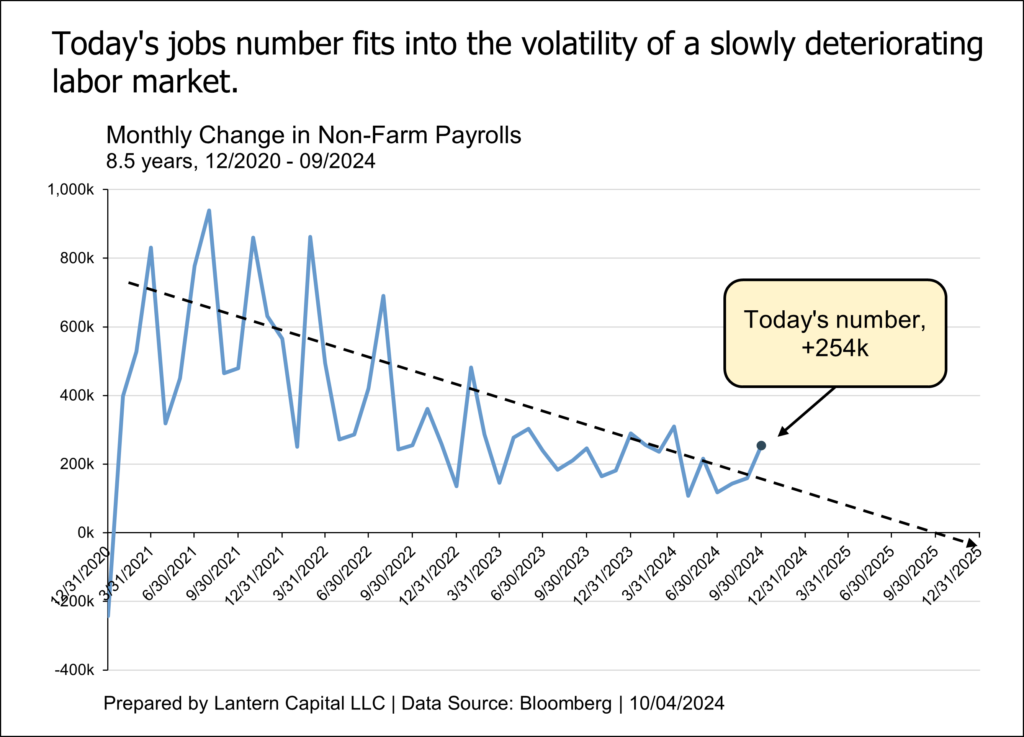
Today’s jobs number fits into the volatility of a slowly deteriorating labor market and there are plenty of examples of big jobs numbers before recessions. Looking at initially reported data (not revised), non-farm payrolls were +372k in February 1990, six-months before that recession began. Payrolls were +268k in January 2001, two months before that recession began. And payrolls were +166k in October of 2007, two months before the Great Recession began. See chart below.
It is hard to find someone that doesn’t think this cycle will result in a soft-landing, but the time-tested signals are very clear about the opposite and the incentives to be optimistic among nearly everyone build-up the soft-landing theme into a bigger thing than it is. In a telling part of Jerome Powell’s interview with the President of the NABE (National Association of Business Economics), Ellen Zentner on Monday, Jerome Powell wouldn’t acknowledge a soft-landing,

ZENTNER: Do you think that the 50 basis points you delivered in September. That cut, you described as a strong start. Did that cut give you more confidence in a soft landing?

POWELL: [4-second pause] I would put it this way. It is a reflection of our confidence that inflation is moving sustainably down. Or, our growing confidence that it is moving sustainably down to 2%. You know, as I mentioned, our design overall is to achieve disinflation down to 2% without the kind of painful increase in unemployment that is often associated with disinflation processes. That’s been our goal all along. We’ve made progress towards it. We haven’t completed that task. I think you’ll see us using our tools in a way that shows our commitment to achieving that. I don’t want to make a judgement about its likelihood, I just want you to know that we are committed to using our tools to do everything we can to achieve that outcome.

ZENTNER : Well you know economists everyday are asked for a probability of a soft-landing. I try very artfully to avoid it, but I just have high hopes.

Think of how easy it would’ve been for him to say “yes” if he felt that way. Ellen Zentner’s response is a perfect encapsulation of how business economists feel, they try to be optimistic despite what they may see. Not only do I see a recession coming, but I’ve yet to see a credible reason why it wouldn’t. Today’s jobs number has nothing to do with it.

Tyler Durden Sun, 10/06/2024 - 17:30
https://ift.tt/zrwEmW0
from ZeroHedge News https://ift.tt/zrwEmW0
via IFTTT

On The Jobs Report And Recession SocialTwist Tell-a-Friend
| 0 comments ]

"Hunger Games $hit": DHS Head Mayorkas Shops In Georgetown While Katrina-Like Disaster Unfolds In North Carolina 

A massive shitstorm has erupted for Department of Homeland Security Secretary Alejandro Mayorkas after he told reporters last week that FEMA "does not have the funds" for the remainder of the Atlantic hurricane season. Meanwhile, reports suggest the agency's resources were depleted to address Biden-Harris' open southern border policies that facilitated the greatest migrant invasion this nation has ever seen. 

On Sunday morning, the latest power data for the US Southeast region showed that across North Carolina, South Carolina, and Georiga, more than 400,000 customers are without power.

Rescue operations in western North Carolina are continuing amid reports that FEMA hindered private citizens from flying aircraft and other ground-based operations to bring in supplies or conduct rescue operations. It's just been an epic mess by the federal government. 

There are at least 227 deaths across six states after Hurricane Helene wiped entire towns off the face of the map in western North Carolina...

... DHS Mayorkas, impeached once for sparking the southern border crisis, ... 

... was spotted at a luxury clothing shop in Georgetown on Saturday afternoon by one journo from Washington Free Beacon. 

"... the Washington Free Beacon strolling through the mens section of Sid Mashburn, a high-end menswear store, surrounded by security. He appeared to purchase some items at the store, where suit jackets go for as much as three thousand dollars." 

It appears Mayorkas wasn't in the emergency control room on Saturday, directing staff to address the twin crises unfolding across the nation. If that's weather-related disasters (and a looming one for next week) or migrant crisis blowing up for the Biden-Harris team, Mayorkas was out shopping for luxury clothes.

Read more about the incoming storm... 

"He's shopping for fancy clothes while people are suffering from hurricane damage. This is some Hunger Games shit," Elon Musk wrote on X while commenting on Washington Free Beacon's Joe Gabriel Simonson's X post, who first published the image of the DHS head walking around the luxury shop with a bag of high-end designer shirts. 

The Katrina-like disaster unfolding for Democrats exposed a stark reality, just 29 days before the presidential elections, how Biden-Harris prioritized non-citizens over citizens.

Tyler Durden Sun, 10/06/2024 - 16:55
https://ift.tt/MIUKsvo
from ZeroHedge News https://ift.tt/MIUKsvo
via IFTTT

"Hunger Games $hit": DHS Head Mayorkas Shops In Georgetown While Katrina-Like Disaster Unfolds In North Carolina  SocialTwist Tell-a-Friend
| 0 comments ]

Want To Win An Election? Run On Cheap Energy

Authored by Michael O'Sullivan via RealClearEnergy,

Ah, election season. That festive time when politicians suddenly have new ideas about how to make our lives better. This year the limelight shines brightly on our revered American economy, which is presently either good or bad, depending on whom you ask. But it’s election season, so voters rule and the experts can take a powder. And that’s why today we have both presidential candidates proposing economic policies that make economists wince and voters cheer.

The remarkable gap between experts and ordinary people is nicely illustrated in a recent Wall Street Journal poll targeting economic policy ideas from both campaigns. The Journal asked 750 registered voters what they think. Then they commissioned the University of Chicago’s Clark Center to get a reading from 39 “top academic experts.” The policies in question include things like tax-free tips and Social Security income, tariffs on imported goods, penalties for price gouging, free money for first-time homebuyers or parents of newborns, and caps on various drug prices.

The experts hate much of this because it runs counter to their preferred economic theories. But regular folks, whose frame of reference comes mainly from the realities of daily living, gave an average 63% thumbs-up. The starkest contrast comes with tax elimination, where voters are nearly 80% for and economists are about 90% against. Makes you wonder if we’re not living in parallel universes.

At this point much could be said about economic philosophy and lessons from history. But instead let’s think about this: roughly half of this country votes conservative, which means they typically don’t like big government. But according to this survey, around three quarters of all voters favor economic policies that involve more government spending. That means something like one half of conservative voters are willing to suspend their principles in the interest of helping people get through tough times.

I realize I’m playing fast and loose with the numbers, but it does indeed look like a society in economic distress — where relatively small numbers become meaningful to many households. Perhaps that’s why nearly 8 of 10 American adults live paycheck to paycheck and more than 20 million households are behind on their utility bills. This is where even the staunchest Jeffersonian is tempted to look to Uncle Sam for help.

And yet we have that pesky free lunch myth. Milton Friedman described it as “the belief that somehow or other government can spend money at no one’s expense.” It doesn’t require higher math to know that more government spending brings relief only at the expense of more problems. The piper always gets paid.

But what if there were a way to help people without more government spending? What if we could give something to some people without first taking money from other people? Surely that would bring tears of joy to both the ill-informed voters and the enlightened experts.

If 20 million households are in arrears on their utility bills, and so many are living paycheck to paycheck, then there must be many more who are not behind but still struggling to pay. And we know the average cost of electricity in the U.S. has been rising steadily, up nearly 30% since just 2019. In a society where a few dollars mean a lot, many people each month must decide between the light bill, the rent, and food.

So, here’s an idea: what if we simply bring down the cost of electricity? It helps everyone and it doesn’t require more government (i.e., taxpayer) money. It only requires the government stop forcing a premature “transition” that has only served to make energy more expensive and less reliable.

If we want to get crazy, then Uncle Sam could take some of the big money he throws at wind and solar (which come up short) and invest in something with a better pay-off, like responsibly sourced natural gas, which is cheap, reliable, and reasonably clean. Or maybe put a few chips on nuclear, which is safer and cleaner than you might think. If Uncle Sam were really concerned about return on investment, he’d realign his portfolio. At least that wouldn’t be new spending — and it would bring down energy costs more quickly.

Imagine if a presidential candidate stood up and said, “Listen folks — here’s what we’re going to do. We’re going to put a couple hundred bucks in everyone’s pocket. Every month. Forever.”

Point me to the nearest voting booth.

Michael O'Sullivan is Program Director and COO for Blue Energy Nation, a non-profit committed to educating young people on energy realities. He is also a popular podcast host and an advocate for smart energy choices.

Tyler Durden Sun, 10/06/2024 - 15:10
https://ift.tt/1hjBbgD
from ZeroHedge News https://ift.tt/1hjBbgD
via IFTTT

Want To Win An Election? Run On Cheap Energy SocialTwist Tell-a-Friend
| 0 comments ]

Watch Live: Trump Returns To Butler With Special Guest Elon Musk

Donald Trump is returning to Butler, Pennsylvania - where he was nearly killed on July 13, holding a high-profile rally in what the former president described as unfinished business.

"I said that day when I was shot, I said, ‘We’re coming back. We’re going to come back.’ And I’m fulfilling a promise," Trump told NewsNation this week. "I’m fulfilling, really, an obligation."

In attendance will be his running mate, Ohio Sen. JD Vance, as well as Tesla and SpaceX founder, Elon Musk. Trump is scheduled to speak at 5PM ET.

Watch Live:

Secret Service Figures Out Sloped Roofs

In an amazing display of agility, the US Secret Service has beefed up security - and even managed to set up shop on a sloped rooftop - which former Secret Service Director Kimberly Cheatle assured us was the reason nobody was stationed on the roof used by shooter Thomas Crooks during the July attempt on Trump.

According to reports, unlike July 13, the Secret Service and local law enforcement will operate as one unit through a unified command center in order to quickly communicate any threats.

They're also using a counter-drone system which wasn't placed online until nearly an hour after Crooks flew one over the rally site. Law enforcement is also flying their own drones today.

As the Epoch Times notes further;

At the July 13 rally, an estimated 15,000 people waited in scorching heat for hours. Trump had only spoken for a few minutes before the shots rang out, bringing the rally to an abrupt end.

The U.S. Secret Service has faced criticism for security lapses surrounding the shooting and another gunman’s foiled plan to kill Trump as he golfed in West Palm Beach, Florida, on Sept. 15. Most concerns have centered on on-site planning failures; Trump and others have praised agents for acting swiftly after threats became obvious in both instances.

Ahead of the Oct. 5 rally, local and federal officials expressed confidence that necessary adjustments have been made to protect Trump and the public.

James Ott, sheriff in Pennsylvania’s Blair County, about 100 miles southeast of Butler, told The Epoch Times: “After seeing what took place the last time, I would certainly think that they’re going to have a lot of provisions in place ... to alleviate any type of threat like that this time.”

Ott is among about a dozen Pennsylvania sheriffs who are expected to attend Saturday’s rally at the Butler Farm Show. He pointed out that he and his fellow sheriffs have taken a public position that, “no matter where you stand in this election ... nobody should resort to violence.”

Anthony Guglielmi, Secret Service spokesman, said Trump “is receiving heightened levels of U.S. Secret Service protection.” In a statement provided to news outlets, Guglielmi said, “Our top priority is mitigating risks to ensure his continued safety at all times.”

Stay tuned for updates...

Tyler Durden Sat, 10/05/2024 - 16:55
https://ift.tt/vhrbm7N
from ZeroHedge News https://ift.tt/vhrbm7N
via IFTTT

Watch Live: Trump Returns To Butler With Special Guest Elon Musk SocialTwist Tell-a-Friend
| 0 comments ]

Study Confirms The Truth About Masks And Children

Authored by Ian Miller via The Brownstone Institute,

It’s late 2024, and masking has managed to remain a contentious issue. Years of misinformation from supposed “experts” like Anthony Fauci and Deborah Birx and organizations like the CDC have convinced millions of Very Smart People to believe that masks are an effective tool to reduce the transmission of respiratory viruses. This applies also to the flu, despite those same experts and organizations somehow neglecting to recommend masks for the decades of flu seasons pre-2020.

Forcing anyone to mask, given the substantial and robust evidence base showing conclusively that masks don’t work, was an indefensible policy decision. But specifically forcing children to mask was decidedly much, much worse.

And not just because it was a pointless exercise in pandemic theater, with zero evidence of efficacy.

But because it was actively causing harm too, as a new study shows.

New Study Confirms Harms of Masking Children

A new study co-authored by Tracy Beth Høeg delves into the side effects of masking, a subject completely ignored by experts and politicians desperate to exert control over individual behavior.

And in their discussion, it’s immediately obvious why their research and conclusions will be completely ignored by the mainstream media.

“There is a lack of robust evidence of benefit from masking children to reduce transmission of SARS-CoV-2 or other respiratory viruses,” they explain.

Couldn’t have said it better myself.

The highest quality evidence available for masking children for COVID-19 or other viral respiratory infections has failed to find a beneficial impact against transmission. Mechanistic studies showing reduced viral transmission from use of face masks and respirators have not translated to real world effectiveness.

Identified harms of masking include negative effects on communication and components of speech and language, ability to learn and comprehend, emotional and trust development, physical discomfort, and reduction in time and intensity of exercise.

It’s a masterpiece. No notes.

As the Cochrane Library review explained, as the data shows, as decades of accumulated evidence confirmed: Masks Don’t Work. For anyone, but especially for children, who could not wear or use masks properly, even if they were shown to have worked. Which they did not.

Experts demanded and politicians mandated that they wear them anyway, based on speculation, hope, and mechanistic studies that were conclusively disproven. And the harms were remarkable.

“Negative effects on communication and components of speech and language.”

“Ability to learn and comprehend.”

“Emotional and trust development, physical discomfort, and reduction in time and intensity of exercise.”

Just, you know, the basic building blocks of human development that children need to grow as well-adjusted, physically and mentally healthy teenagers and adults.

As Høeg and the other authors explain, this necessarily means that forcing children to mask fails any objective standard of harms and benefits.

Effectiveness of child masking has not been demonstrated, while documented harms of masking in children are diverse and non-negligible and should prompt careful reflection. Recommendations for masking children fail basic harm-benefit analyses.

Their next section is a complete dismantling of the CDC and the US public health bureaucracy, how they handled Covid, and how poor an example this sets for future pandemics.

In many locations in North America, children as young as two years of age were required to wear face masks daily for multiple consecutive hours, both indoors and outdoors, in school and childcare settings [1], [2]. This stood in stark contrast to European countries where masking was never recommended for children under the age of six and, in many countries, never under age twelve [3]. The United States Centers for Disease Control and Prevention (CDC)’s child masking recommendations deviated substantially from international guidelines [3], [4], [5]. The CDC continues to recommend masks for children down to age two in certain settings [1], [6], and this is in the absence of strategies for exiting these restrictions. In the event of a future public health threat, clear and consistent communication from public health officials about the criteria that will be used to withdraw temporary public health recommendations while data are gathered could serve to ease public anxiety, lessen distrust, and facilitate a return to a more normal life wherein ineffective recommendations are promptly discarded.

It’s a calm, thorough demolition of the incompetence and authoritarianism of the US public health establishment.

They repeat that there is no evidence to support masking children and explain that there is no real-world evidence showing the effectiveness of child mask mandates, with zero randomized controlled trials conducted to determine whether masking kids would prevent the spread of Covid. It’s inexcusable to mandate a policy with no evidence, but even worse considering the demonstrable harms.

“Speech, language, and learning: Humans rely on visual information provided by a speaker’s face to decode speech. Seeing mouth movements and facial gestures accelerates recognition of words and enhances speech comprehension [12], [19], [20], [21]. The integration of audio and facial information is crucial to speech perception and development. Visually impaired children often have delays in speech and language development [22], which may be due, at least in part, to reduced ability to perceive,” they write.

Masks prevent children from learning, from seeing mouth movements to facial gestures. They fundamentally detract from a child’s ability to develop speech and language. Among many other problems covered in the full study.

These harms were well-known before Covid. This isn’t new information, and it’s obvious common sense. So why did public health authorities ignore it, in favor of promoting evidence-free policies and mandates?

There are few reasonable explanations: panic, fear, or incompetence. Likely some combination of all three.

Forcing their absurd, fatalistic, hyper-safetyism on adults was and is one thing. Imposing it on children is another. And their refusal to admit they were wrong meant the growth and development of kids were most certainly harmed and stunted for years, while ensuring that there would be terrified, misinformed parents who would continue to force their kids to wear masks indefinitely.

When you consider those consequences, rationality fades, and a disturbing likelihood of malicious intent becomes a lot more realistic.

Republished from the author’s Substack

Tyler Durden Sat, 10/05/2024 - 14:35
https://ift.tt/SZLxQ6j
from ZeroHedge News https://ift.tt/SZLxQ6j
via IFTTT

Study Confirms The Truth About Masks And Children SocialTwist Tell-a-Friend
