| 0 comments ]

Google Agrees To Buy Nuclear Power From Small Modular Reactors To Be Built By Kairos Power

First it was Amazon, then Microsoft, now Google telegraphs why the "next AI trade" will generate obnoxious amounts of alpha in the coming years by sending the same message: i) it's all about how all those data centers will be powered, and ii) in the future a growing number of data centers will be powered by small modular nuclear reactors.

On Monday, Google - picking up on what we discussed last week in "Google Turns To Nuclear To Power Its Data Centers" - announced plans to buy power from Kairos Power’s small modular reactors (SMRs) as part of a growing industry shift toward nuclear energy to meet rising data center demands. By purchasing energy from multiple SMRs, Google aims to send a strong market signal while supporting long-term commercialization.

According to CNBC, senior director for energy and climate at Google, Michael Terrell, said on a call with reporters that "we believe that nuclear energy has a critical role to play in supporting our clean growth and helping to deliver on the progress of AI."

"The grid needs these kinds of clean, reliable sources of energy that can support the build out of these technologies. … We feel like nuclear can play an important role in helping to meet our demand, and helping meet our demand cleanly, in a way that's more around the clock."

Only three SMRs are operational worldwide currently, none in the U.S.... but that's going to change.

SMRs offer a cheaper, faster alternative to traditional reactors. Kairos Power, backed by the Department of Energy, is building a demonstration reactor in Tennessee. Google expects the first reactor online by 2030, adding 500 megawatts by 2035.

"It is an incredibly promising bet, and one that, you know, if we can get these projects to scale and then scale globally, will deliver enormous benefits to communities and power grids around the world," Terrell said of backing nuclear power companies. 

The news came just hours after we pointed out the short interest in one of our favorite SMR names, Sam Altman-backed Oklo, on the rise. Oklo has targeted its first SMRs to be online by 2027, three years ahead of Kairos' proposed timeline.  

Today's news should not come as a surprise: less than a week ago we quoted Amanda Peterson Corio, global head of data center energy at Google, who said that “in the US, in highly regulated markets where we don’t have the opportunity to directly purchase power, we are working with our utility partners and the generators to come together to figure out how we can bring these new technologies — nuclear may be one of them — to the grid."

Separately, we ALSO wrote at the beginning of this month that the U.S. had closed on a $1.5 billion loan to resurrect Holtec's Palisades Nuclear Plant. The report at the time said that the Biden administration aims to triple U.S. nuclear power capacity as demand rises and climate concerns grow.

Meanwhile, we recently wrote that Oklo announced it had finalized an agreement with the Department of Energy to advance the next phase of sitting at the Idaho National Lab. 

Pennsylvania Governor Josh Shapiro has also been urging for Three Mile Island to reopen as quickly as possible. Following Microsoft's agreement to purchase power from the dormant nuclear plant, Shapiro urged regulators to prioritize the reactor's connection to the electrical grid, according to Barron’s.

The latest news out of Google provides substantial tail wind for our "Next AI Trade" which we laid out in April as our favorite long-term trade, and where we outlined various investment opportunities for powering up America, playing out.

The stellar returns of the trade in 2024 so far are just the start: as more capital is allocated to "those who provide the electricity to those who sell the picks and shovels for the next gold rush", the basket will blow away every other segment of the market, and the biggest winners will be not those who bet on the revolutionary technology that is AI, but those who backed something much more primitive: the electricity needed to power it.

Tyler Durden Mon, 10/14/2024 - 15:40
https://ift.tt/dvkHgo4
from ZeroHedge News https://ift.tt/dvkHgo4
via IFTTT

Google Agrees To Buy Nuclear Power From Small Modular Reactors To Be Built By Kairos Power SocialTwist Tell-a-Friend
| 0 comments ]

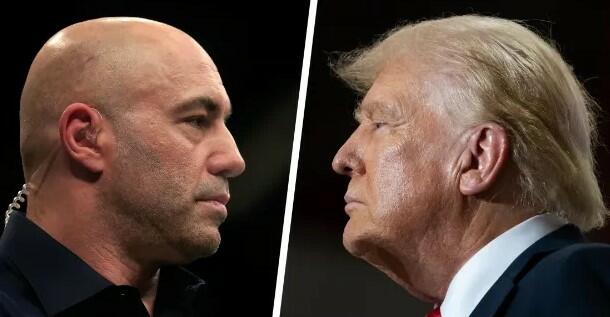
Donald Trump Says He's Doing The Joe Rogan Podcast

During an interview on the Nelk Boys' Full Send Podcast, Donald Trump said he plans to appear on the Joe Rogan Experience, according to the Washington Examiner. 

When asked by host Kyle Forgeard if he would consider going on Rogan’s podcast, Trump responded last week: “Oh sure, I think I’m doing it actually." He later confirmed, "Yeah, I am."

Rogan has yet to confirm the booking, the Examiner noted. The discussion seemed to start last week after this article noting Rogan was running out of time to interview Trump. Elon Musk sent the discussion to the stratosphere when he said last week: "It will happen". 

Musk made the post responding to our article, "Joe Rogan Has 25 Days To Interview Donald Trump", submitted by Zero Hedge contributor Quoth the Raven, who wrote on Tuesday: "I can't listen to another 4 years of Rogan bitch about how bad things have gotten if he won't talk to Trump."

Rogan has been notoriously uninterested in the interview, which he has been asked about multiple times over the last half decade. Back in June 2023, when asked about the idea, Rogan said to Lex Fridman:

"I have had the opportunity to have him on my show, more than once, and I have said no every time. I don't want to help him, I'm not interested in helping him."

By August 2023, it looked like Rogan might be changing his tune, as he told Valuetainment's Patrick Bet-David:

"I don't know. Maybe. At a certain point in time. Just like, it would be interesting to hear his perspective on a lot of things.”

Since then, Rogan has stated his admiration for RFK, Jr., who is now supporting Trump. He has also given a platform to Tulsi Gabbard, who is campaigning with, and for, Trump. The idea that Rogan wouldn't interview Trump, who has recently done podcasts with Theo Von and Andrew Schultz, to name a few, seems bizarre. 

QTR wrote on his blog last Tuesday night that "If anything, an interview would give Rogan an opportunity to push Trump on the things that he disagrees with him on. Bring him on and give him hell if you want, Joe. Rogan could even extend an invitation to the Harris campaign and invite her on for a separate appearance if she wants."

"I don’t want to pretend to understand what the problem is that Rogan has with Trump, but all I know is that it’s not bigger than the potential consequences of this election," he wrote.

"After listening to Rogan’s podcast for nearly 2,000 episodes, I’m confident in my assessment that he’s a person of integrity and a man of character. The truth is, whether he likes it or not, putting his personal animus aside and getting Trump on the largest media platform in the world can only make an impact for the next month or so."

He concluded: "After the November election, especially if Trump loses, there will be no point — and it’ll be impossible to listen to Rogan crow about the lunatics on the left any further, knowing he didn’t talk to Trump when he had the chance. So let’s get real, Joe: what the hell are you waiting for?"

We may have our answer soon...

Tyler Durden Sun, 10/13/2024 - 16:55
https://ift.tt/j02ShkM
from ZeroHedge News https://ift.tt/j02ShkM
via IFTTT

Donald Trump Says He's Doing The Joe Rogan Podcast SocialTwist Tell-a-Friend
| 0 comments ]

A Hard Rain Is Going To Fall

Authored by Charles Hugh Smith via OfTwoMinds blog,

The core skill going forward - frugality - is largely a forgotten skillset. Time to get busy while we still have time.

There are core systemic dynamics that are impervious to technological or financial gimmicks, and as they play out, a hard rain is going to fall:

1) The credit-business cycle. The credit-business cycle has been pushed forward for the past 15 years, and arguably for the past 24 years. The last "real recession"--the organic contraction of credit and risk-taking that drains the excesses from the economy and financial system over the course of several years--occurred 43 years ago in 1981-82.

The mechanism for pushing this essential cleansing is moral hazard, the disconnection of risk from consequence by unprecedented central bank monetary stimulus and central state fiscal stimulus. The net result of moral hazard is the excesses of risk and debt are rewarded and expand to even more precarious heights, ensuring the eventual downturn will be far more destructive than had the system been allowed to fully re-set in 2000-02 and again in 2008-09.

2) The reversal of financialization and the collapse of the Everything Bubble and the wealth effect. The commoditization of credit, leverage and speculation is a boon when first introduced to a credit-starved economy, but once the productive investments have been made, financialization continues expanding into extremes of debt, leverage and speculation.

Central banks have used one trick to keep the expansion going: they dropped interest rates to zero, enabling borrowers and speculators to borrow / leverage more with the same income. This expansion of credit boosted assets to extreme valuations as all this new "money" chased a limited quantity of assets. The credit-asset bubble increases the value of the collateral--the house, the stock portfolio, etc.--which then supports additional borrowing / leverage.

The payoff was not just putting off the credit cycle--the credit-asset bubble generated a massive wealth effect for those who owned the assets before the bubble multiplied their value. The top 10% who own 93% of all stocks have seen their net worth expand by tens of trillions of dollars, enabling their spending to account for roughly half of all consumption.

The resulting extreme of wealth-income inequality has social repercussions that are not yet fully realized, but the pressure on those left behind is mounting.

Interest rate cycles are multi-year affairs, generally running between 15 and 40 years. The current cycle--from 1981 to the present--is extremely long in tooth, reflecting the financial repression of interest rates over the past 15 years.

Nothing lasts forever, regardless of what policy is applied. Interest rates are rising and will continue to rise.

This means that central banks' favorite trick to put off the credit cycle--lowering interest rates to zero--is slipping out of reach. This means that central banks will no longer be able to keep the credit-asset bubble inflated. It will deflate as interest rates rise, unpayable debt is defaulted and risk emerges in force.

Once the credit-asset bubble deflates, the wealth effect reverses, and consumption plummets as all those who rode the bubble higher are now poorer. The net result is the economy slides into recession.

Central states have piled up such a mountain of obligations and debt that their ability to stimulate the economy out of a much-needed cleansing of bad debt and speculative excess is limited.

So neither central banks and central states have the capacity to push the credit cycle forward any longer. The games have all been played and now the bill is due and payable.

3) The reversal of globalization. central banks were given the one-time luxury of lowering interest rates to zero by one dynamic: the emergence of China as the global exporter of deflation and a new "credit impulse." As the developed economies shifted production to China, costs declined and profits soared, fueling the stock market bubble and offsetting the inflationary pressures generated by expanding credit and fiscal stimulus.

China has now matured to the point that it no longer exports either deflation or the credit impulse. Now the inflationary pressures of expanding credit and fiscal stimulus are not being offset, so they're finally manifesting globally. There is no replacement of China's one-time gift of deflation and credit expansion, and so inflation and interest rates will rise.

Throwing more money into the system will only accelerate inflation and interest rates. That game is over: checkmate.

4) The limits of scale. The latest technological advance on the lab bench rarely scales up: vaporizing plastic waste is nice, but the cost and inherent limitations of this "advance" mean it will remain a curiosity, not a global solution that magically eliminates the 400+ million tons of plastic waste that isn't recycled, out of the 450 million tons of plastic produced annually.

Even when a new technology may make financial and practical sense, the time and money required to scale it up t useful levels are significant. Consider the "next big thing" in nuclear power, Small Modular Reactors. The first one is slated to come online in 2030, but such projects are typically plagued by cost and time over-runs in the early stages of development.

If the goal is to build 100 such reactors, how log will that take, and how much capital will it consume?

Will it take a decade? or two decades?

The point here is we're entering a credit cycle recession with the infrastructure we have, and improvements will be incremental, time-consuming and expensive, draining capital from consumption, in effect deepening the recession. This is the dynamic I endeavor to illuminate in the 1970s, when vast sums of capital were invested in pollution mitigation and the upgrading of the nation's industrial base, with only modest payback in the near-term. The real benefits only accrued decades later.

A similar upgrading of the nation's industrial base is starting, but it will be a drain on consumption for decades to come.

5) The downsides of centralization. Optimizing profits has relentlessly driven centralization on every scale: a handful of corporations dominate every sector, and facilities--from slaughterhouses to chemical storage--are geographically centralized, inherently increasing the risk of "normal accidents" triggering catastrophic losses. This reality was explained by Charles Perrow in his book The Next Catastrophe: Reducing Our Vulnerabilities to Natural, Industrial, and Terrorist Disasters.

Decentralizing the economy increases costs, reducing profitability and pushing prices higher. This is the cost of resilience and redundancy. The cost of centralization is invisible until it's too late.

6) Climate extremes. Setting aside the debate about causal factors, that extremes of weather are increasing in number and intensity globally is placing agriculture and infrastructure at greater risk of cascading, non-linear avalanches of consequences. Centralization adds to these risks.

Add all this up and we have a recipe for global recession in which inflation and interest rates rise, The Everything Bubble pops, possibly violently, the wealth effect vanishes into thin air, consumption plummets and job losses soar. Central banks and central states will not be able to push the credit cycle (i.e. recession) forward any longer, and if they try to do so, they will only make the decline more severe and painful.

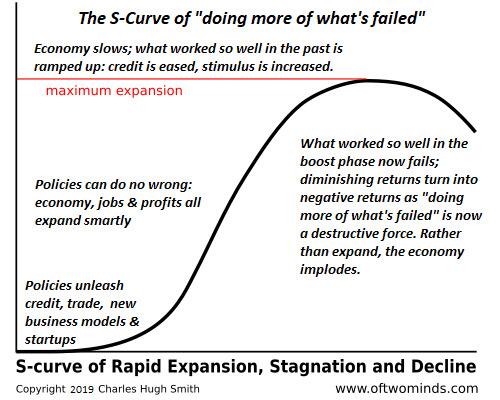
I often post this chart of the S-Curve to emphasize that cycles are organic and cannot be reversed or pushed forward forever. Pushing them forward has only increased the bill that must now be paid.

Our hubristic faith in the god-like powers of technology and central banks / states creates an illusion that the credit cycle turning is the result of a "policy error," when in fact it's just the way systems function. We've created extremely fragile, centralized systems optimized for profit, and operated on the false premise that all systems are infinitely controllable given the right technology or policy.

The result of our hubris is that the turning of systemic cycles will be more disruptive and painful than was necessary, as a direct result of our attempt to manipulate / rig the system to suit our expedient, short-term desires.

A hard rain is going to fall, and we serve our best interests by preparing for the coming storm.

The core skill going forward--frugality--is largely a forgotten skillset. Time to get busy while we still have time.

*  *  *

Become a $3/month patron of my work via patreon.com.

Subscribe to my Substack for free

Tyler Durden Sun, 10/13/2024 - 15:10
https://ift.tt/6DQKNxq
from ZeroHedge News https://ift.tt/6DQKNxq
via IFTTT

A Hard Rain Is Going To Fall SocialTwist Tell-a-Friend
| 0 comments ]

The US Government Is Dramatically Expanding The Use Of Facial Recognition Technology

Authored by Michael Snyder via The Economic Collapse blog,

Do you want to live in a society where you are required to have your face scanned wherever you go?  If not, you may want to speak up now while you still can.  As you will see below, the U.S. government is aggressively expanding the use of facial recognition technology for identification verification purposes.  For now, the use of facial recognition technology will be optional.  But as we have seen before, once a voluntary option is adopted by enough people our leaders have a way of making it mandatory.  Of course it isn’t just our government that is pushing facial recognition technology.  It is popping up throughout our society, and given enough time it would literally be everywhere.

Login.gov is billed as “a single sign-on solution for US government websites”, and now users of Login.gov will be given the option to use facial recognition technology to verify their identities…

An online hub for Americans to access benefits and services across the federal government is giving its users a new option to sign on.

The General Services Administration will begin offering facial recognition technology as an option for users of Login.gov, a one-stop for government-provided public services, to verify their identities.

GSA’s Technology Transformation Services announced Wednesday it will allow Login.gov users to verify their identity online through facial technology that meets standards set by the National Institute of Standards and Technology’s 800-63-3 Identity Assurance Level 2 (IAL2) guidelines.

We are being told that this will help reduce identity theft and fraud, and I don’t know anyone that likes identity theft and fraud.

But do we really want to live in a dystopian world where our faces are constantly being scanned all the time?

I certainly don’t.

We are being told that this new facial recognition system will rely on “best-in-class facial matching algorithms”…

After months of testing and a delay in 2023, users will now be able to verify their identity using a ‘proven facial matching technology’ approved by the General Services Administration, which will follow the National Institute of Standards and Technology (NIST) and will rely on ‘best-in-class facial matching algorithms’

All of this sounds really creepy to me.

And this is certainly a way for the government to start getting all of our faces into a giant database.

Login.gov already has more than 100 million users, and lots of them will inevitably choose the “convenience” and “security” of facial recognition…

Federal agencies use Login.gov for people to verify their identities when logging in to access government benefits and services. The offering has over 100 million users already across over 50 federal and state agencies, and this news could affect how future users have to verify their identity to access information and benefits.

“Proving your identity is a critical step in receiving many government benefits and services, and we want to ensure we are making that as easy and secure as possible for members of the public, while protecting against identity theft and fraud,” said GSA Administrator Robin Carnahan in a statement.

For now, you will still be able to use other identification verification options.

But once most people start using facial recognition, those other options could easily be taken away.

Sadly, it isn’t just the government that we need to be concerned about.

AI programs such as ChatGPT have turned out to be quite adept at identifying faces…

Using “a crafted prompt designed to bypass the safeguard mechanisms of ChatGPT,” the researchers were able to test the program’s biometric capabilities – which they found to be significant.

“Our study reveals that ChatGPT recognizes facial identities and differentiates between two facial images with considerable accuracy,” says their summary. “Additionally, experimental results demonstrate remarkable performance in gender detection and reasonable accuracy for the age estimation tasks.”

Even more alarming is what a couple of Harvard students have been able to accomplish.

They integrated PimEyes facial recognition software into a pair of Meta’s smart glasses, and they were able to instantly pull up the personal information of strangers by scanning their faces…

Meta’s Ray-Ban glasses offer an iconic wearable packed with some smart features that allow users to engage in a hands-free experience. Two Harvard students have integrated smart glasses with a facial recognition system that helps automatically dox strangers and access their information in public.

According to 404media, the facial recognition system called I-XRAY can be used to retrieve information such as phone numbers, addresses, or even social security numbers of strangers. All the user needs to do is look at the person. While software capabilities have been making the rounds, it is the hardware running the software that has been the talk of the town, which is Ray-Ban Meta Smart Glasses.

Nguyen and Ardayfio created I-XRAY using Meta’s smart glasses along with PimEyes facial recognition software, which is currently the largest search engine. The entire system of fetching information on the individual is automatic, and the smart glasses start digging the data as soon as the face is in the frame.

If we stay on the current trajectory that we are on, it would likely only be a matter of time before this sort of technology is everywhere.

Can you imagine what criminals could do with this?

A predator would not even need to follow you home.  He could just scan your face without you even realizing it, and by scanning your face he could get your address, your phone number, and a whole host of other private details about your life.

A lot of people out there just don’t get it.

In a society without any privacy, the bad guys can always find you.

Of course in a society without any privacy, there would be no hiding from tyranny either.

When facial recognition technology is literally everywhere, there will be nowhere to run and nowhere to hide.

Every time your face is scanned, your location will be known.

Needless to say, most people already carry around phones that constantly monitor where they are anyway.

But as the Big Brother surveillance grid that is being constructed all around us becomes even more pervasive, it won’t be too long before there is literally no opting out.

I have been a very vocal advocate for privacy for over a decade, but during that time our privacy rights have been greatly eroded.

Now is the time to take a stand, because once our privacy rights are completely gone it will be nearly impossible to get them back.

*  *  *

Michael’s new book entitled “Why” is available in paperback and for the Kindle on Amazon.com, and you can subscribe to his Substack newsletter at michaeltsnyder.substack.com.

Tyler Durden Sat, 10/12/2024 - 17:30
https://ift.tt/Xwj0C6d
from ZeroHedge News https://ift.tt/Xwj0C6d
via IFTTT

The US Government Is Dramatically Expanding The Use Of Facial Recognition Technology SocialTwist Tell-a-Friend
| 0 comments ]

How The Biden/Harris Admin Helped Iran Get To The Brink Of A Nuclear Bomb

Authored by Fred Fleitz via American Greatness,

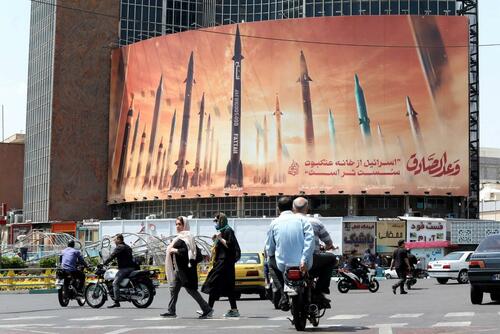
Iran has made enormous progress in its nuclear weapons program during the Biden/Harris administration and reportedly can now enrich enough weapons-grade uranium to fuel nine nuclear bombs in one month. Although Iran may be nine months to a year away from having an operational nuclear weapon, recent attacks by Iran and Israel against each other’s territory have raised concerns that Iran’s rapidly advancing nuclear program could lead to a nuclear war in the Middle East.
Biden/Harris administration officials have tried to blame President Trump for the advances in Iran’s nuclear program because he withdrew from the 2015 nuclear deal with Iran, the JCPOA. Democratic Governor Tim Walz made this claim during the October 1 vice presidential debate when he said, “There had been a coalition of nations that had boxed Iran’s nuclear program in . . . Donald Trump pulled that program and put nothing else in its place.”

This is absolutely false. The huge advances in Iran’s nuclear weapons program are the result of major flaws in the JCPOA and a series of terrible national security policy decisions, including repeated attempts to appease Iran, by the Obama and Biden administrations.

The first of these bad policy decisions was when the Obama administration conceded to Iran the “right” to enrich uranium for peaceful purposes, such as nuclear medicine and nuclear reactor fuel.

This decision reversed the positions of prior Republican and Democratic administrations who believed Iran could not be trusted to enrich uranium for peaceful purposes because of covert Iranian efforts to establish a nuclear weapons program and because it is easy to reconfigure uranium centrifuges supposedly constructed for peaceful purposes to produce weapons-grade nuclear fuel.

Allowing Iran to enrich its own uranium for peaceful purposes has never made economic sense due to a glut of reactor fuel and nuclear medicine on the world market. Iran also does not need nuclear power due to its vast oil and natural gas reserves.  Israeli Prime Minister Benjamin Netanyahu explained this to MSNBC’s Andrea Mitchell in an October 2014 interview when he said Iran’s centrifuges “are only good for one thing: to make bomb-grade material.”

The JCPOA Was a Dangerous Fraud

The Obama administration’s dangerous uranium enrichment concession to Iran was enshrined in the flawed 2015 JCPOA agreement which, allowed Iran to enrich uranium to reactor-grade and develop advanced centrifuges. In effect, this gave Iran the world’s blessing to continue to develop a uranium enrichment program whose only practical purpose was to make nuclear weapons fuel.

But it gets worse. The JCPOA lifted sanctions on Iran and provided it with $150 billion in sanctions relief. This included $1.7 billion in “pallets of cash” that the U.S. secretly flew to Iran in small planes as ransom to release five innocent Americans being held in Iranian prisons. A related UN resolution imposed limited, short-lived sanctions against Iranian conventional arms transfers, which expired in 2020, and missile transfers, which expired in 2023.

The JCPOA has a weak inspection regime that Iran did not cooperate with. This inspection regime was further weakened by secret side deals, discovered by then-Rep. Mike Pompeo and Senator Tom Cotton, that allowed Iran to evade inspections by the International Atomic Energy Agency (IAEA). Obama officials reportedly wrote the secret side deals and refused to share them with Congress.

And to top off this all off, there was substantial cheating on the JCPOA by Iran.  This included clandestine efforts to acquire illicit nuclear technology and equipment, violating JCPOA restrictions on advanced centrifuge development, and excess production of heavy water.

In 2018, a huge cache of documents on Iran’s nuclear weapons program stolen by Israel provided evidence of massive Iranian cheating on the JCPOA, including several undeclared sites where nuclear weapons work had been conducted since 2015. IAEA inspection of two of these sites found evidence of enriched uranium particles, which proved covert nuclear weapons work had occurred at these locations.

In addition, Iran quietly worked to develop advanced centrifuge designs and parts in violation of the JCPOA between 2015 and 2020. This allowed Iran to start deploying advanced centrifuges in 2021. This included completing a factory in July 2018 to make carbon fiber rotors for advanced centrifuge machines.

These and other extremely serious weaknesses of the JCPOA are why Donald Trump justifiably called it “the worst deal ever” and why he withdrew the United States from this agreement in 2018.

Iran said it would no longer honor its JCPOA commitments after Trump withdrew from the agreement and began to slowly back out of JCPOA limits in 2019 and 2020. However, Iran did little to ramp up its uranium enrichment program until January 2021—weeks before Joe Biden’s inauguration.

The reason why there was not a surge in Iran’s nuclear weapons program during President Trump’s term after he withdrew from the JCPOA was because Iranian leaders were afraid of how Trump would respond. The global American deterrence Trump established helped keep Iran and other U.S. adversaries in check during his presidency.

Iranian Nuclear Weapons Program Takes Off Under Biden/Harris Administration

It is clear that Iran’s leaders were not afraid of Joe Biden. They saw a new American president desperate to revive the JCPOA and who would resume the Obama administration’s appeasement policies. The results have been a catastrophe for global security, with huge advances in Iran’s nuclear weapons program. Iran also gained at least $100 billion in additional revenue during the Biden administration because it refused to enforce U.S. oil sanctions. Most of this oil has been sold to China. Iran spent this windfall on its military, nuclear, and missile programs as well as to fund its terrorist proxy groups: Hamas, Hezbollah, the Houthis, and Shiite militias in Syria and Iraq.

The Biden administration took office in January 2021 determined to renegotiate the JCPOA to make it “longer and stronger.” Iranian officials repeatedly said they would not agree to changes to the JCPOA, but they participated in fruitless talks in Vienna to restore the JCPOA until March 2022. Not only did Iran refuse to negotiate in good faith in these talks, a Russian ambassador, with the assistance of a Chinese ambassador, ran the Vienna talks because Iranian diplomats refused to meet in the same room with their U.S. counterparts.

Iran significantly stepped up its nuclear weapons program while multilateral talks to revive the JCPOA were underway between April 2021 and March 2022.  This included deploying advanced centrifuges in February and April 2021 and producing uranium metal in February 2021.

The most serious development was when Iran announced in November 2021 that it had enriched uranium to the 60% U-235 level for the first time. 60%-enriched uranium can be further enriched to 90% (weapons-grade) in about a week.

Biden officials worked hard to convince Iran to agree to a new nuclear deal by offering a series of dangerous concessions. This included proposing to take Iran’s Revolutionary Guard Corps off the U.S. list of terrorist organizations. Several members of the U.S. negotiating team resigned in late 2021 because they believed the concessions being offered to Iran were excessive and would lead to a bad nuclear agreement.

Multilateral talks with Iran to revive the JCPOA broke down in March 2022 after Russia threatened to block a new nuclear deal unless its trade with Iran was exempted from U.S. and European sanctions imposed on Russia due to its February 2022 invasion of Ukraine.

After the multilateral talks broke down, the Biden/Harris administration used Oman as an intermediary to negotiate a secret, oral, and unwritten agreement with Iran. Biden Administration critics claimed this was done to evade Congress’s oversight of this agreement.

The secret deal was described as an interim agreement with major U.S. concessions. These reportedly included freezing Iran’s enrichment of uranium to 60%. This concession meant the Biden/Harris administration agreed to accept Iran enriching to the dangerous 60% level. Iran was also allowed to keep its nuclear infrastructure, including advanced uranium centrifuges, and permitted to continue to develop this technology.

Iran reportedly agreed under the deal to stop its proxy groups from attacking U.S. forces in Syria and Iraq and to cooperate with IAEA investigations of its nuclear program. Iran never abided by either of these provisions.

In exchange for agreeing to the above requirements, Iran was to receive over $20 billion in sanctions relief. The U.S. also reportedly agreed not to impose new sanctions on Iran.

In addition, this agreement included a U.S.-Iran prisoner exchange and a U.S. ransom payment to Iran of $5 billion. This payment was frozen in October 2023 after the October 7 Hamas terrorist attack against Israel.

Meanwhile, Iran engaged in other malign activities during the Biden/Harris administration, such as selling attack drones and missiles to Russia for its use in the Ukraine War and working with Russia, China, and North Korea to form a new anti-West “axis.”

There also were significant advances in Iran’s missile program, including a possible hypersonic missile launch, advanced cruise missiles, space launches (which were believed to be ICBM test launches), and new missiles designed to evade missile defenses.  It is unclear whether Iran fired its newest missiles during two missile attacks on Israel this year.

The Biden/Harris Administration’s Appeasement of Iran Caused the Middle East to Explode

The breakdown in security and stability in the Middle East since the October 7, 2023, massacre of Israelis by Hamas is a consequence of the Biden/Harris administration’s incompetent Iran policies. Their appeasement of Iran emboldened Iran and its terrorist proxies to attack Israel and U.S. troops in Iraq and Syria. Iran also attacked Israel twice in 2024 with missiles and drones.

There have been conflicting press reports of Iran’s involvement in the October 7 Hamas terrorist attack. The Wall Street Journal reported on October 8, 2023, that Iran helped develop and fund the Hamas attack and gave Hamas the green light to launch it. A Hamas spokesman told the BBC on October 8 that Hamas had direct support from Iran. However, although Iranian leaders praised the attack, they claimed that Iran was uninvolved in it. A senior Hamas official backed up this claim on October 9 by saying that Iran and Hezbollah were not involved in the Hamas terrorist attack.

Although Iran’s exact role in the horrendous October 7 Hamas terrorist attack is unclear, I also believe it will at least be proved that Hamas could not have conducted the attack without arms and funding from Iran.

Iran is Much Closer to Becoming a Nuclear Weapons State Because of the Biden/Harris Administration’s Incompetent Iran Policies

This article provides a summary of the profoundly incompetent and naïve Iran policies by the Biden/Harris administration that did enormous damage to Middle East and global security. Because of these deeply flawed policies, Iran today is enriching uranium at the 60% level, just below weapons-grade.  It can enrich enough uranium to fuel nine nuclear weapons a month. Iran has installed advanced centrifuges that will significantly increase the amount and speed of the production of weapons-grade uranium if Iran’s leaders decide to do so.

Iran is at least $100 billion richer today than it was when President Trump left office because of unwise concessions by the Biden administration, especially its failure to enforce U.S. oil sanctions. Iran used this additional revenue to fund its military, nuclear, and missile programs, terrorist proxies, and meddle in regional conflicts.

There is no question that the Biden/Harris administration’s Iran policies have been a spectacular failure.

Obviously, attempts by Biden/Harris officials and their allies to blame the surge in Iran’s nuclear program and its belligerent behavior on President Trump are absurd.  The greatly increased threat from Iran occurred during the Biden/Harris administration due to their weakness and incompetence. The JCPOA has also been proven to be a deeply flawed agreement that actually facilitated Iran’s pursuit of nuclear weapons. President Trump made the right decision to withdraw from this terrible deal and kept Iran in check with enhanced American deterrence and his maximum pressure policy, which almost bankrupted Iran.

America and the world desperately need a strong and decisive U.S. president to undo the enormous damage done to American and global security by the Biden/Harris administration’s disastrous Iran policies. Although there is a lot of damage to repair, I am confident that if Donald Trump wins the 2024 U.S.  presidential election, he will quickly do this with a capable and experienced national security team that will halt Iran’s belligerence by restoring American deterrence and peace through strength.

Tyler Durden Sat, 10/12/2024 - 16:20
https://ift.tt/AnioVGU
from ZeroHedge News https://ift.tt/AnioVGU
via IFTTT

How The Biden/Harris Admin Helped Iran Get To The Brink Of A Nuclear Bomb SocialTwist Tell-a-Friend