| 0 comments ]

No Central Bank Wants To Stop Price Inflation

Authored by Daniel Lacalle via The Mises Institute,

Many citizens want more government control of the economy to curb rising prices. It is the worst strategy imaginable. Interventionist governments never reduce consumer prices because they benefit from inflation, dissolving their political spending commitments in a constantly depreciated currency. Inflation is the perfect hidden tax. The government makes the currency less valuable by issuing more units of fiat money, partially dissolves its debt in real terms, collects more taxes, and presents itself as the solution to rising prices with subsidies in an increasingly worthless currency.

That is why socialism and hyperinflation go hand in hand.

Socialism rejects human action and economic calculation and sells a false image of a government that can create wealth at will by issuing more units of fiat currency. Obviously, when inflation arrives, the socialist government will use its two favorite tools: propaganda and repression. Propaganda, which accuses stores and businesses of driving up prices, and repression, which occurs when social unrest intensifies and citizens legitimately hold governments accountable for scarcity and high prices, are the two main strategies.

If you want lower prices, you need to give less economic power to the government, not more. Only free markets, competition, and open economies help decrease consumer prices. Many readers might think that we currently have a free market with competitive and open economies, but the reality is that we live in increasingly intervened and overregulated nations where central banks and governments work to perpetuate unsustainable public deficits and debt. Therefore, they continue to print more money, leading many to question why it is getting harder for families to make ends meet, buy a home, or for small businesses to prosper. The government is slowly eating away the currency it issues. They call it “social use of money.”

What is “social use of money”? In essence, it means abandoning one of the main characteristics of money, the reserve of value, to give the government preferential access to credit to finance its commitments. Therefore, the state can announce larger entitlement programs and increase the size of the public sector relative to the economy, creating a self-fulfilling prophecy. The state issues more currency, which makes people’s money less valuable. Citizens become more dependent on the state, and they will demand more subsidies paid in the currency the state issues. It is, in essence, a process of control through debt and currency depreciation.

When governments and central banks talk about price stability, it means a two percent annual depreciation of the currency. Aggregate prices rising an average of two percent is hardly price stability because it is measured by the consumer price index, which is a carefully crafted basket of goods and services weighted by the same people who print the money. That is why governments love CPI as a measure of inflation. It fails to fully reflect the erosion of the currency’s purchasing power. This is why the CPI’s basket calculation fluctuates so frequently. Even if it accurately measures, it will underestimate the rise in prices of non-replaceable goods and services by adding them to a basket of things we consume maybe once or twice a year at best. When you put together shelter, food, health, and energy with technology and entertainment, there will always be distortions.

Thus, governments and central banks are never going to defend price stability. If aggregate prices fell, competition soared, and citizens saw their real wages rise and their deposit savings increase in real value, their jobs would disappear.

When a central bank like the Fed cuts rates and increases the money supply after an accumulated 20.4% inflation in four years, it is not defending price stability; it is defending price increases. This strategy serves to conceal the government’s financial insolvency. A currency with a declining value.

Governments are the ones that create inflation by spending a currency that is constantly losing purchasing power because the state issues more than what the private sector demands. No corporation or allegedly evil oil producer can make aggregate prices rise and continue increasing annually at a lower pace. Only the one that prints the money, and central banks don’t print money because they want to; they increase the money supply to absorb rising public deficit spending.

Inflation is a hidden tax, a slow process of nationalization of the economy, and the perfect way to increase taxes without angering voters and blaming private businesses in the meantime. The consumer will likely blame the store or business for higher prices, not the issuer of a currency that loses purchasing power.

Why would governments want higher prices? Because it gives them more power. Destroying the currency they issue is a perfect form of control. That is why they need more debt and higher taxes. High taxes are not a tool to reduce debt, but rather to justify rising public indebtedness.

You may have read numerous times that the government has unlimited borrowing power and can manage inflation to allow you to live comfortably. It is false. The government cannot issue all the debt it wants. It has an inflationary, economic, and fiscal limit.

Inflation is a warning sign of declining currency confidence and a loss of purchasing power. The economic limit is evidenced by lower growth, lower employment, weaker real wages, secular stagnation, and declining foreign demand for public debt.

The fiscal limit is evidenced by soaring interest expenses even with low rates, weaker receipts every time they hike taxes, and citizens and businesses leaving the country to more friendly tax systems, all of which add to the poor or negative multiplier effect of government spending.

If you want lower prices, you should give less economic power to governments, not more.

A government that tells you it will borrow $2 trillion per annum in a growth and record receipt economy and will continue to increase debt and borrow well into 2033 with the most optimistic assumptions of GDP and receipt is telling you it will make you poorer.

When a politician promises that he or she will cut prices, they are always lying. A weaker currency is a tool to increase government power in the economy. By the time you find out, it may be too late.

Money is credit, and government debt is fiat currency. Currency depreciation is inflation, and inflation is equivalent to an implicit default. No interventionist government or central bank wants lower prices because inflation allows the government to increase its power while slowly breaching its monetary commitments.

Tyler Durden Sat, 10/19/2024 - 16:20
https://ift.tt/dh1sZUQ
from ZeroHedge News https://ift.tt/dh1sZUQ
via IFTTT

No Central Bank Wants To Stop Price Inflation SocialTwist Tell-a-Friend
| 0 comments ]

A Radical Plan To Save America's Economy In One Year

Authored by Brandon Smith via Alt-Market.us,

Alternative economists have been predicting a long list of instabilities in the US economy and for some time. We’ve been proven right in the last few years on most of those predictions and, as usual, corporate media economists are now scrambling to pretend as if they “saw the danger coming” all along. They now suddenly have their own ideas on how to fix the very problems they used to call “conspiracy theory.” The vital question is, who do you trust?

You can’t trust someone to offer you a valid solution if they’re too dense to understand the source of the crisis. You also can’t trust someone to give you valid solutions on the economy if their job is to lie to you about how great things are.

The alternative media’s accuracy about our nation’s dire circumstances has put us in a position to be right which should at least win us some trust points, but being right is only the first step. There will always be government shills that seek to undermine truth-tellers by claiming we serve no purpose because we aren’t actively fixing the problems that they warn about.

Frankly, that’s not our job. However, it’s true that our movement has a tendency to focus on diagnosis of a problem rather than prevention or treatment.

There are a few reasons why this is the case. I’ve noticed that whenever I write about solutions I get far less article traffic. Is it because people just don’t care? Or, is it because solutions are hard and require vast coordination of people and resources to ever be possible?

National solutions require millions of Americans get off their couches, go outside, and take extensive risks. This is why human beings in general tend to adapt to the worst conditions until things are so bad society snaps. We wait until we can’t stand it any longer, and then finally, we take action.

Another road block is that liberty movements are made up of people who all have their own ideas on what should be done. Most of us agree on the causes of the chaos, very few of us agree on what exactly to do about them. It’s funny because black-pill critics often accuse conservatives and patriots of falling into the echo chamber trap. The reality is quite the opposite; we can’t seem to ever shake hands on anything and it’s holding us back.

The thing is, time is running out and debate is a luxury. I believe Americans today are close to the breaking point economically with stagflation continuing to crush the middle class and those already in poverty. The future is bleak; housing costs have spiked to levels beyond what the vast majority of people can afford. All necessities including food and utilities have seen a 30%-50% minimal price increase since 2020, and inflation continues to rise.

Wages are stagnant and profit margins for employers are shrinking, which means the jobs market will be next to see cuts. By the end of 2025 and under current policies, I suspect we will be witnessing a combination of serious deflationary and inflationary crisis events simultaneously. A crash in employment and GDP combined with incessant price jumps on goods and services.  This crash has been decades in the making and might be unavoidable. That said, I do believe there is a way out, but it requires dramatic changes in the way our government and society operates.

The policy measures I suggest are a kind of fiscal time machine – A way to turn back the clock on collapse. Some might consider them “radical” but they are only policies that America USED TO value and that we have been pressured to forget. Can the modern American brain with its steady exposure to big government and socialist programs handle such a shift? It’s hard to say.

I think if people are desperate enough they’ll accept any solution that they feel works. And for now the elites that created the crisis are the only group offering a way out (a false way out). If I could snap my fingers (or if I was king for year), this is the list of actions I would undertake to save the American economy before the end of 2025 (or at least set it on the the path to resurrection).

End Income Tax For The 99%

My very first step would be to end income taxes for individuals and small business owners outside of the top 1% of earners (those who make more than $800,000 per year). The permanent income tax was never supposed to exist. It started in 1913 as a tiny 1% rate on net personal incomes over $3,000, and a 6% surtax on incomes over $500,000 (the super rich at that time).

In the past century it has ballooned into a 15%-20% monstrosity that is crushing middle class buying power. It also feeds bigger government which wastes money and leads to less and less freedom. There is no reason for the tax to exist for average citizens other than to act as a slave tribute to the Federal Reserve Bank. Shutting it down would immediately alleviate financial pressures on middle class families and getting rid of the IRS would certainly help shrink government spending.

How would the government pay for services and national security? Well, right now they print most of that money from thin air anyway, but tariffs on foreign trade used to be the main source of income for the federal government. Why not go back to that model? Because some biased Keynesian economists claim it can’t work? It already has worked.

End Property Taxes On Single Family Homes

Property taxes are supposed to act as a fiscal buffer for local infrastructure and services. They are also meant to dissuade major buyers from hoarding homes and cornering regional markets. The problem is, the taxes are doing the opposite of that. With high property taxes most US families can’t afford to own even one home, while corporate buyers snatch up distressed mortgages and drive up rents.

This scenarios is going to create mass homelessness, mark my words. It’s already starting in some areas of the country. Inflation in housing is bad enough but the high interest rates on mortgages and the high property taxes on top of that is enough to break most middle class buyers.

Fixing rates and inflation is complicated, but property taxes could be ended tomorrow. By extension, high property taxes on corporate buyers like Blackstone might force them to release some of their holdings back onto the market and help lessen the ongoing housing shortage.

How else can communities pay for local infrastructure and services?  A fair sales tax should be more than sufficient to fill the gap, or, a tourism tax.

Remove All Illegal Immigrants From The US

The illegals need to go, there’s no way around it. All the data shows they are a drain on national resources and welfare programs, but worst of all, they receive subsidies from the government that allow them to snap up housing and eat into welfare programs. In some cases, landlords are enticed to rent to illegals over native born citizens because they get more money (or tax breaks) for renting to migrants instead.

Estimates from 2023 indicate there are at least 16.8 million illegal immigrants in the US today with a net fiscal drain of over $150 billion per year. That’s also millions of homes taken off the market by people who should not be in this country. US housing availability is currently in the negative by 5 million to 7 million homes (officially). Removing most illegals could be accomplished in a single year and would immediately solve housing shortages while bringing prices down by adding more supply.

Beyond housing, the money that goes to welfare spending on migrants could be better utilized for American citizens, including  a better emergency response for those that lose their homes during natural disasters.

Incentives For Married Couples With Children

The western world has a population decline problem that is likely to hit us hard in the next decade. The elites claim that’s why we need mass immigration, but fixing our population problem with cultural replacement from the third-world is not the answer.

A major factor is the decline in stable relationships and nuclear families (marriage between men and women). This same lack of family stability is causing unprecedented social issues. Single mother homes are statistically more likely to produce children with criminal behavior and mental health problems. Children from fatherless homes are 20 times more likely to end up incarcerated. This is an insidious drain on our culture and our nation’s wealth.

Many men point out that marriage is a huge financial risk under current divorce laws and this has made the practice untenable. But even removing unfair divorce laws would probably not solve the greater conundrum. Eliminating feminism from our society would be a good start, but that’s an elusive goal requiring many years of social healing.

One thing that could be done in a single year is to create incentives for married couples that want to have children. Easy access to home loan programs would be a start, along with educational subsidies for viable careers in STEM or technical fields so they can get higher paying jobs that actually serve national needs. Eventually, a return to financially stable single income families could be possible.

Business And Technical Apprenticeships

America’s economy used to thrive due to the old standards of apprenticeship. This was a way for those that could not afford a higher education to still learn and obtain a valuable trade. George Washington, Benjamin Franklin and Paul Revere were ALL apprentices at one point in their lives. We need to bring this tradition back.

Specifically, we need apprenticeships in business operations, medical, manufacturing, engineering, the sciences, technical (repair and fabrication), construction, as well as computer and software fields. The US has a self sufficiency problem when it comes to production that needs to be solved immediately.

Revitalizing America’s worker base and small business base is the key to stopping our exponential slide into oblivion. We need to show people there’s a light at the end of the tunnel or they might give up completely. In particular, the trend of young western men dropping out of the workforce is worrying. Most of them want assurances that they’ll be able to one day do a job that actually means something.

Yes, some of them are spoiled overgrown children that have delusions of becoming YouTube stars and there’s no way to help those people. But, many others are good men that are willing to work hard as long as they’ll get a fair chance for something better in return. They have no direction because all the doors have been shut. Men make the world go around, and when a society abandons their young men the way the west recently has, only disaster can follow.

The above measures are all items that can be adopted in a very short period of time. In a single year every one of them could be instituted by a proper government, federal or state.  And yes, I’m aware that government officials with the balls to enact these policies are likely few.  That’s not a revelation, but that doesn’t mean we abandon the effort.  Even with a Harris presidency, individual states could save themselves with these solutions without federal assistance.

Other actions would have to be long term. Reversing inflation, shrinking the size of government, ending the central bank and reverting money creation back to the Treasury, shifting the dollar to a commodity backed system, rebuilding America’s manufacturing base, etc. – All of these efforts will take many years to succeed.

Getting off to the right start is essential. I argue that the above list could be implemented quickly and create a resurgence in economic optimism. This is the launch point by which all other solutions will unfold. It’s not enough to declare our high-minded ideals and goals, there has to be a plan.

*  *  *

Our economy is on a decades-long path to total collapse. And no election can completely stop what is coming! Which is why protecting your 401(k) or IRA is more critical than ever. With a physical gold IRA, you get an easy and tax-deferred way to safeguard your wealth with tangible assets. To learn more, click here to get your FREE info kit on Gold IRAs from Birch Gold Group.

Tyler Durden Fri, 10/18/2024 - 15:30
https://ift.tt/P84uDec
from ZeroHedge News https://ift.tt/P84uDec
via IFTTT

A Radical Plan To Save America's Economy In One Year SocialTwist Tell-a-Friend
| 0 comments ]

If Trump Wins, Guess Who Will Be In Charge Of Certifying The Election?

Authored by Michael Snyder via TheMostImportantNews.com,

Do you know who will be in charge of certifying this election?  In January 2021, it was Vice-President Mike Pence, and we all remember how that turned out.  Well, an even more interesting scenario is shaping up this time around.  In January 2025, Vice-President Kamala Harris will be in charge of certifying the election.  In other words, if Donald Trump wins the person that he was running against will be in charge of certifying his victory.  This is a major defect in our system, and it could potentially set the stage for widespread chaos if things do not go smoothly.

With each passing day, a Trump victory is looking even more likely.

For example, a brand new Gallup survey has found that the percentage of Americans that identify as Republicans has jumped by four points since late September…

With just 20 days left until Election Day, a new Gallup poll has revealed a concerning trend for Democrats.

According to the poll, more Americans are identifying as Republicans or independents, with fewer calling themselves Democrats. Conducted from October 1-12, the poll shows a significant shift in political affiliations since mid-September, causing potential challenges for Democrats ahead of the crucial vote.

The data shows that 31% of respondents now identify as Republicans, marking a 4-point increase from the previous poll conducted in late September. Meanwhile, only 28% of Americans consider themselves Democrats, a 3-point drop over the same period. The number of independents, while still holding a significant share at 41%, dropped by 1%.

Another new survey shows that national support for Trump has risen dramatically since early August…

The presidential race is swinging in former President Donald Trump’s direction, according to a national poll released by Marquette.

The latest survey shows both Trump and Vice President Kamala Harris tied with 50 percent support each in a two-way race with leaners included. This reflects a four-point swing in Trump’s direction, as the last poll — released August 1 — showed Harris up by four points, garnering 52 percent support to Trump’s 48 percent support.

The survey also took a look at the results with a “full field” and found Harris up by a single percentage point — 48 percent to Trump’s 47 percent support. Another four percent said “other.” For greater perspective, the last survey showed Harris up by eight points in the full field, with 50 percent to Trump’s 42 percent.

Right now we are seeing so much enthusiasm for Trump, and the same cannot be said for Harris.

When MSNBC visited one early voting location in Arizona, they could not find a single person that voted for Harris…

MSNBC visits an early voting location in Arizona.

Trump voters are everywhere — ‘We did not find a single person who would tell us they voted for Kamala Harris.’

Things are not looking very good for the Harris campaign at this stage.

If she loses, she will literally be tasked with certifying the election that she has just lost…

The vice president oversees the counting of Electoral College votes and announces the results. They can still do this if they are a presidential candidate and it’s happened multiple times throughout history.

Both the 12th Amendment to the U.S. Constitution and federal law say the president of the Senate, which is a role that’s filled by the vice president, oversees the count of electoral votes.

According to Politico, Harris has promised that “she won’t interfere” with a peaceful transition of power…

On Jan. 6, 2025, Vice President Kamala Harris is set to preside over Congress and count the electoral votes that will make either her — or Donald Trump — the 47th president of the United States.

And like her predecessor Mike Pence, who resisted enormous pressure from Trump to upend the 2020 election results, Harris says she won’t interfere.

Hopefully that is true.

But would she really just stand aside and hand the presidency to a man that she has described as a “threat to democracy”?

Just consider what Harris said about Trump earlier this week…

“A second Trump term is a huge risk for America. He is increasingly unstable and unhinged. And he is out for unchecked power and control over your lives”

If she truly believes that Trump is going to end democracy in the United States, wouldn’t she feel compelled to take action?

That is a question that a lot of people will be asking.

Already, many on the left are suggesting that the 14th Amendment could be used to block Trump from taking office.

The following is what Section 3 of the 14th Amendment says…

No person shall be a Senator or Representative in Congress, or elector of President and Vice-President, or hold any office, civil or military, under the United States, or under any State, who, having previously taken an oath, as a member of Congress, or as an officer of the United States, or as a member of any State legislature, or as an executive or judicial officer of any State, to support the Constitution of the United States, shall have engaged in insurrection or rebellion against the same, or given aid or comfort to the enemies thereof. But Congress may by a vote of two-thirds of each House, remove such disability.

I really hope that Democrats do not consider such a course of action if Trump wins the election.

And I really hope that we see a very peaceful transfer of power no matter who wins.

Unfortunately, many of our leaders continue to make statements that are not helpful at all.

For example, Joe Biden just said that he is very much looking forward to seeing Donald Trump get sentenced and put away…

Joe Biden said the quiet part out loud and admitted that his DOJ is working to jail Trump after the election.

“The same guy who has three other major cases waiting for him when he loses,” Biden said referring to Jack Smith’s federal cases against Trump.

“And by the way, 34 felonies,” Biden said after he sent his DOJ hatchetman Matthew Colangelo to New York to get Trump.

“He got the sentence kicked back, but I want to watch that sentence,” Biden gleefully said hoping Trump is jailed.

If Donald Trump loses this election, he is going to go to prison for the rest of his life.

So the truth is that this election means everything to Trump.

Of course this election also means everything to tens of millions of Americans on both sides of the political spectrum.

No matter what the outcome is, I fear that there will be unprecedented chaos in our streets.

Hopefully I am wrong about that.

Hopefully cooler heads will prevail.

But in our current political environment, I am certainly not optimistic about what is ahead.

*  *  *

Michael’s new book entitled “Why” is available in paperback and for the Kindle on Amazon.com, and you can subscribe to his Substack newsletter at michaeltsnyder.substack.com.

Tyler Durden Thu, 10/17/2024 - 15:05
https://ift.tt/9Jj0r46
from ZeroHedge News https://ift.tt/9Jj0r46
via IFTTT

If Trump Wins, Guess Who Will Be In Charge Of Certifying The Election? SocialTwist Tell-a-Friend
| 0 comments ]

Beware Of War Hawks In "America First" Clothing

Authored by Connor O'Keefe via The Mises Institute,

For the past eight years, the two major political parties have been gripped by a messy and ongoing realignment. It began with the election of Donald Trump in 2016, which was a major repudiation of the neoconservative-establishment coalition that had dominated the Republican Party since the presidency of George W. Bush.

Trump’s condemnation of the war in Iraq—which he correctly said was sold on lies—and his skepticism of continuing to fund radical Islamists in a misguided attempt to overthrow the government in Syria drove some of the staunchest Bush-era neoconservatives to leave the Republican Party and do everything they could to keep Trump out of power. It didn’t work.

Trump’s four years in office only accelerated the realignment.

By the time the 2020 election rolled around, the political establishment had awakened and thrown its entire weight behind Joe Biden.

Of course, Donald Trump stuck around after leaving office and is now, for the third time, the Republican nominee for President.

This election cycle has seen the same establishment support for Trump’s opponents that we’ve seen previously, along with “defections” from former high-level Republicans like W. Bush’s own Vice President Dick Cheney.

Whether we’re seeing a permanent change in the Republican Party or a temporary coalition against one candidate will rest on what happens on and after election day next month.

But it’s clear that, at least for the time being, the neoconservative domination of the American Right has dissipated.

Given how damaging the neoconservatives were to the well-being and security of the American people, this is a very positive development. But critics of Washington’s hyper-aggressive foreign policy need to understand that the flight of many of the worst war hawks from the Republican Party does not mean the GOP has returned to its non-interventionist roots. In fact, as many interventionists have fled, others have remained. And those interventionist elements are working hard to bring back the same old neoconservative foreign policy under the guise of a new “America First” doctrine.

Over the summer, former national security advisor Robert O’Brien penned a lengthy feature in Foreign Affairs that aimed to do just that. O’Brien was a representative to the UN during the George W. Bush presidency, and he worked at the State Department under both Bush and Barack Obama before leaving to work as an advisor on Mitt Romney’s 2012 campaign. He’s an establishment creature if there ever was one. Still, he was appointed as Trump’s National Security Advisor in 2019 and is now seen as a contender for a cabinet position if Trump wins again.

O’Brien presents his article as “making the case for Trump’s foreign policy.” But despite being dressed up in some new language, the agenda he presents is largely the same old establishment interventionism.

In O’Brien’s view, Iran, China, and Russia are the three great enemies that can only be dealt with through a more aggressive stance from Washington. American taxpayers need to be forced to pay more for sharp increases in military hardware, especially for the Navy, to put pressure on Iran and China. Heavy sanctions and crackdowns on trade are prescribed to isolate and denigrate the regimes in Tehran and Beijing. O’Brien also calls for the US to more aggressively support foreign dissident movements that threaten these rival governments.

Even the war in Ukraine, on which Trump has been relatively good, is framed as having only happened because the US was not intervening enough in Eastern Europe in recent years. O’Brien does quickly mention that Trump wants a negotiated end to the war, but quickly moves on to celebrate all the lethal aid that’ll be sent to Ukraine and all the American military units that will be moved closer to Russia.

And O’Brien isn’t alone. Many right-wing commentators and influencers have tried to capitalize on all the populist energy driving the Trump movement to bolster their careers while sneaking in a standard establishment foreign policy. That could be seen at the so-called National Conservatism conference back in July, where a number of these figures got together and framed Iran and China as the chief threats facing the American public.

For decades, the American people have been forced to pay an enormous amount of money and to divert a tremendous amount of resources to counter a superpower that collapsed because communism cannot work, build a country from the top down in Afghanistan, overthrow the government of Iraq, and to try to topple several other countries to correct for the destabilizing effects of overthrowing that government in Iraq, all while militarizing the countries around Iran, Russia, and China in a vain attempt to get those governments to calm down.

These ventures have made the political establishment very wealthy, but all at the expense of the economic well-being and general safety of the rest of us. In recent years, many Americans on the right have finally begun to wake up to all this. The same old establishment lies cannot be allowed to lull them back to sleep.

Tyler Durden Wed, 10/16/2024 - 16:20
https://ift.tt/7pF65oU
from ZeroHedge News https://ift.tt/7pF65oU
via IFTTT

Beware Of War Hawks In "America First" Clothing SocialTwist Tell-a-Friend
| 0 comments ]

Stagflation Odds Jump In Latest NY Fed Survey As Inflation Expectations Rise, Delinquency Fears Hit 4 Year High

In recent weeks, we have discussed on multiple occasions (here, here and here) how in his desire to get Kamala Harris re-elected by rushing out a jumbo cut before November 5, Fed president Jerome Powell may have triggered the second coming of the Arthur Burns "galloping inflation" Fed, and sure enough recent inflationary prints have certainly raised the threat that the Fed is now aggressively easing even as inflation has not only not been defeated, but is once again rising.

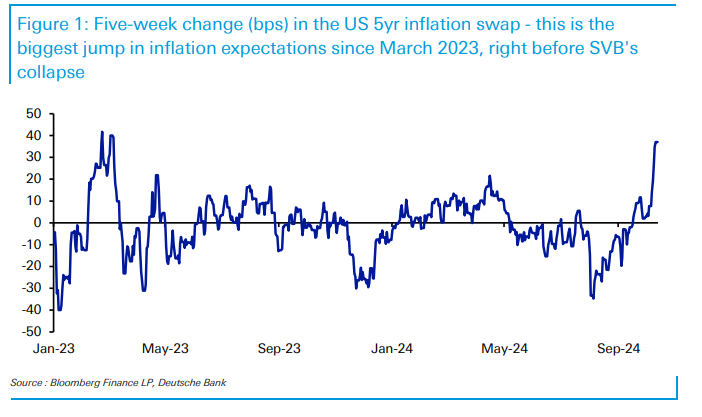
Then overnight, it was Deutsche Bank's chief credit strategist Jim Reid who observed that US 5yr inflation swaps have seen their "largest 5-week climb since just before SVB's collapse in March 2023, an event that shifted the narrative away from around 4 more hikes to imminent cuts for a period of time."

To be fair, it's not just the 50bps Fed easing in itself that has changed the inflation and rates outlook over the last few weeks. We’ve also seen 1) expectations that the ECB will move more aggressively; 2) renewed geopolitical risk and a potentially large China stimulus turn the Oil price (and other commodities) higher after a late summer slump; 3) a bumper payrolls report; and 4) still generally firm US data, including an upside surprise in the CPI last week.

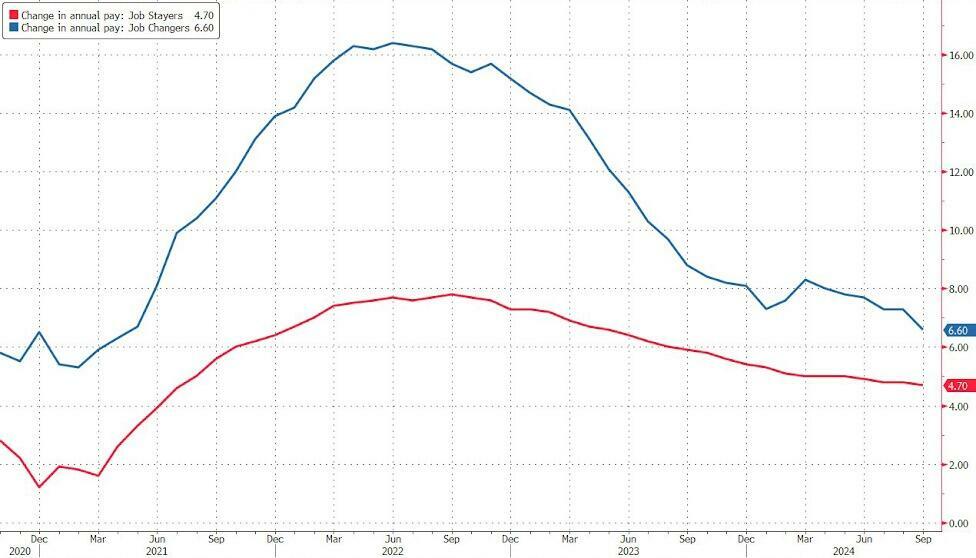
Then again, these are all dynamics that the Fed should have considered before it launched an aggressive easing cycle at a time when stock prices are at all time highs, when wage inflation ~5%...

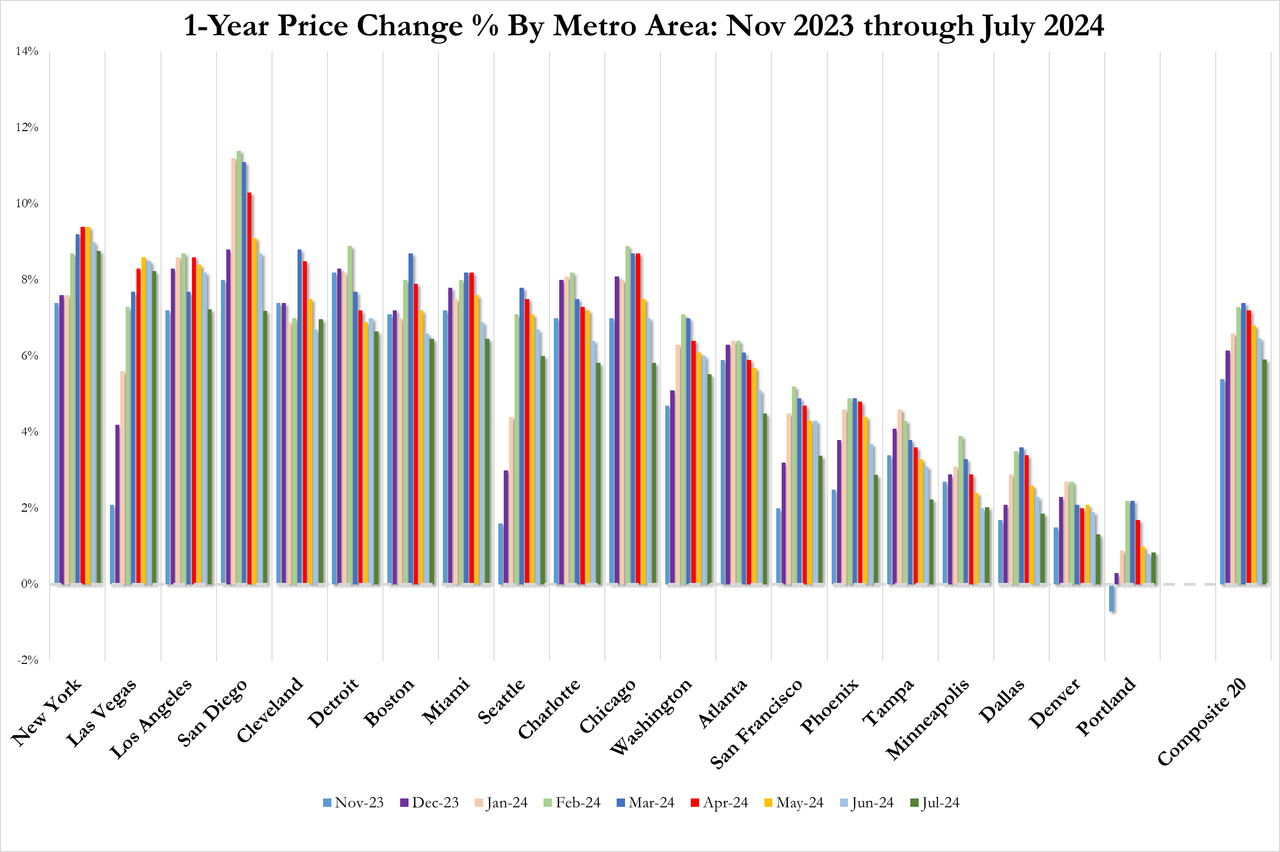
... and when home prices are still rising at a mindblowing 6%!

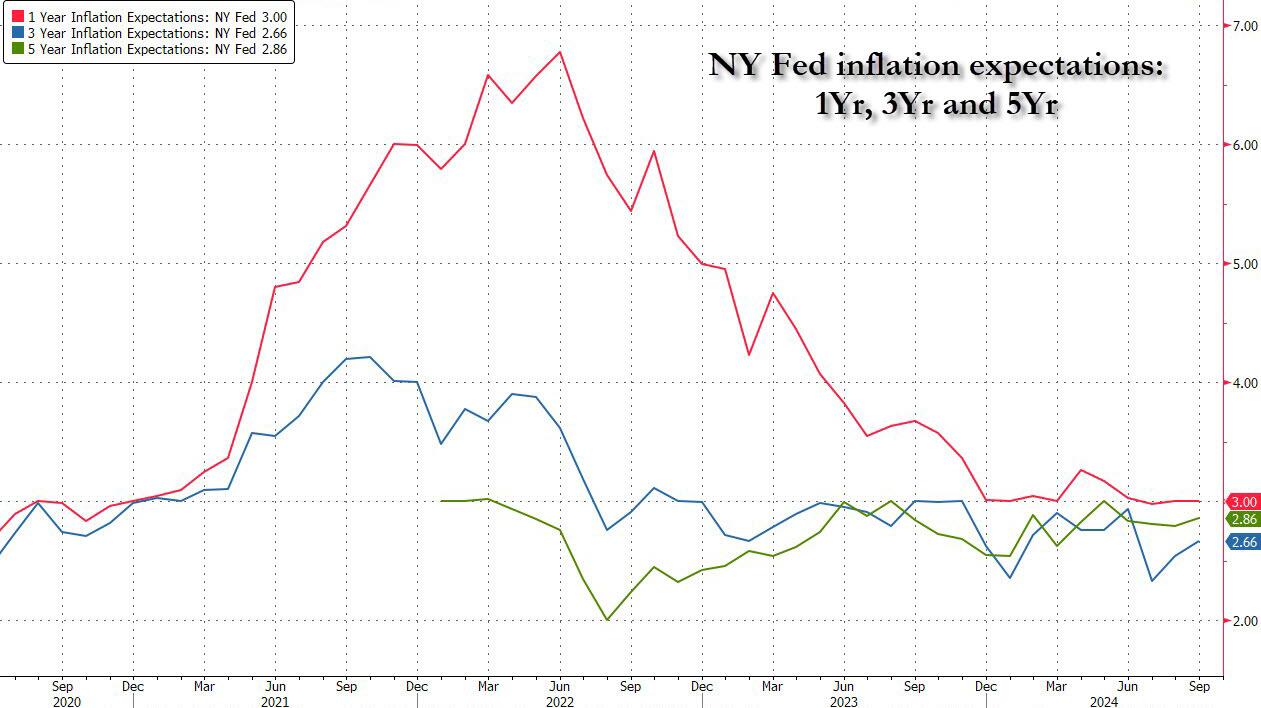
It is therefore not surprising that the latest monthly survey of consumer expectations from the NY Fed found that inflation expectations rose at both the three-year horizon (from 2.5% to 2.7%) and the five-year horizon (from 2.8% to 2.9%), and remained unchanged at the one-year horizon (where they are driven primarily by recent moves in gas prices).

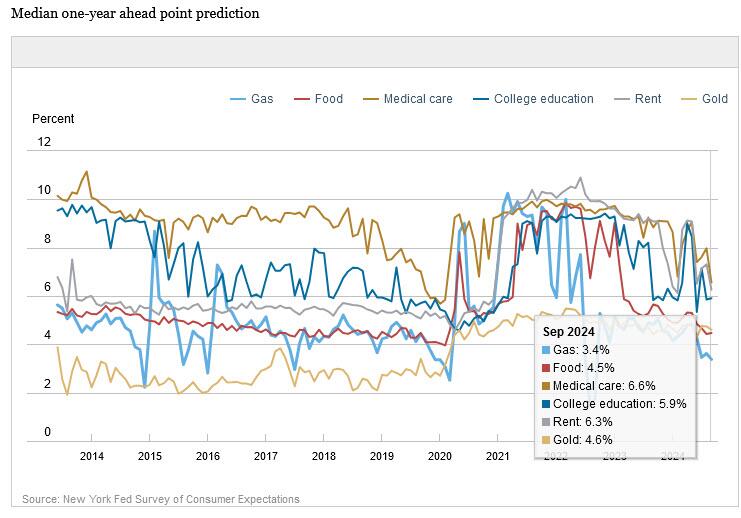
And the reason why the short-term inflation expectations were unchanged - if at the Fed's raised inflation target of 3% - is because the median respondent saw gasoline up "only" 3.4% over the next 12 months, the least in two years. Expected food inflation ticked higher after falling in August to the lowest level since pre-pandemic, while expectations for rental inflation moderated to 6.3%. Median home price growth expectations decreased by 0.1 percentage point to 3.0%. Some other year-ahead commodity price expectations: an increase of 0.1% for food to 4.5%, college prices remained unchanged at 5.9%; medical care cost expectations dropped by 1.4% to 6.6% (the lowest reading since February 2020).

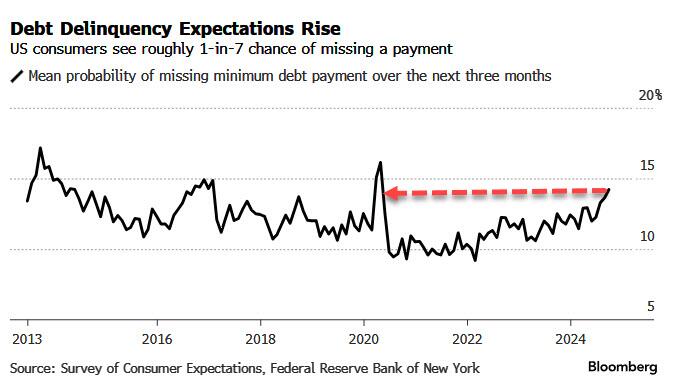
And while inflation expectations rose, sentiment about the broader economy deteriorated as perceptions among households that they might become delinquent on debts increased last month to the highest levels since April 2020.  The anticipated probability of missing a minimum debt payment over the next three months rose to 14.2% in September, marking the fourth straight month of increases; the increase was most pronounced for respondents between ages 40 and 60 and those with annual household incomes above $100k.

The latest data confirms the view that the US economy is becoming increasingly split as some households do well while others are getting crushed by rising prices, slower growth and higher unemployment. In other words, stagflation. 

While the orchestrated surge in the stock market - and one has the Fed's recent rate cut to thank for that - has helped propel overall household net worth to a record over the past few months, tens of millions of Americans do not own any equities and have instead been accumulating debt in recent years amid elevated interest rates.

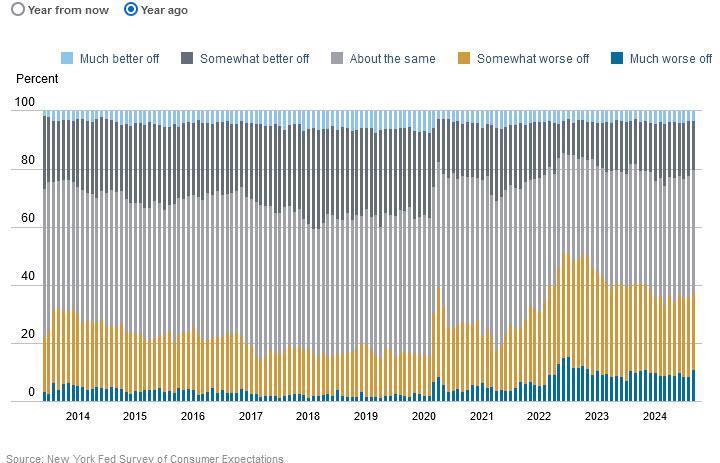
The increased odds of delinquency were mirrored in a broader deterioration of perceptions about households’ current financial situations, with fewer consumers reporting being better off and more reporting being worse off than a year ago, according to the survey.

Sticking with the stagflation theme, year-ahead household income and spending growth expectations declined by 0.1 percentage point to 3.0 percent and 4.9 percent, respectively.

There was slightly more cheer in consumers' labor market expectations, where the probability of leaving one’s job voluntarily in the next twelve months increased to 20.4% from 19.1%, and the mean perceived probability of finding a job in the event of job loss increased to 52.7% from 52.3% in August.

Hilariously, median year-ahead expected growth in government debt declined by 1.1 percentage points to 8.0%, reaching the measure’s lowest level since February 2020. Spoiler alert: it will be much, much higher.

And confirming that many of the respondents are absolutely clueless, the mean perceived probability that the average interest rate on saving accounts will be higher 12 months from now decreased by 1.5 percentage points to 25.1%. Yes, about 25% of households have no idea that the Fed is now cutting rates and rates on savings accounts will be much lower in 12 months... unless of course we get hyperinflation in the next 3-9 months and the Fed panics into a hiking frenzy

Last but not least, the mean perceived probability that U.S. stock prices will be higher 12 months from now increased by 1.0 percentage point to 40.3%. It was unclear how many bulls also expected lower rates in the coming year.

Overall, an ugly, stagflationary survey, and hardly what the Fed may have expected to see several weeks into the first easing cycle since the global economy was shut down by a genetically engineered flu virus in 2020.

Tyler Durden Tue, 10/15/2024 - 15:00
https://ift.tt/Pb8dK4V
from ZeroHedge News https://ift.tt/Pb8dK4V
via IFTTT

Stagflation Odds Jump In Latest NY Fed Survey As Inflation Expectations Rise, Delinquency Fears Hit 4 Year High SocialTwist Tell-a-Friend