| 0 comments ]

Daily Briefing: What Does Commodity Price Action Tell Us About the Economy?

The S&P 500 is down nearly 18% year to date, its worst first-half performance since 1970. U.S. consumer confidence dropped to its lowest level in 16 months in June, as inflation continues to extract its due. And Google searches for "recession" have reached a new high, according to Andreas Steno Larsen. “Typically,” he adds, “that only happens during actual recessions. Are we already in one, or is the risk overstated by now?” The fear of slowing growth now supplanting the fear of inflation, markets have fresh fuel to reprice assets across the risk spectrum. Andreas Steno Larsen joins Ash Bennington to talk about inflation, recession, and recent price action, including the particular pressure on convertible bonds. We also hear from Michael Gayed about an emerging counter-trend trade based on a correction for crude oil and commodities. Want to submit questions? Drop them right here on the Exchange: https://rvtv.io/3u7AgGV. Watch the full conversation featuring Michael Gayed here: https://rvtv.io/3nnJefp.

Tyler Durden Tue, 06/28/2022 - 14:54
https://ift.tt/p6hHNlI
from ZeroHedge News https://ift.tt/p6hHNlI
via IFTTT

Daily Briefing: What Does Commodity Price Action Tell Us About the Economy? SocialTwist Tell-a-Friend
| 0 comments ]

WTI Extends Gains After Unexpected Crude Draw

Oil prices are higher today following relatively positive news from China (easing some of its COVID quarantine restrictions), Macron-inspired doubts over the ability of Saudi Arabia and the United Arab Emirates to significantly boost output, and unrest in Ecuador and Libya helped lift prices.

“We’re in the crunch period, it’s hard to see any meaningful price relief for crude,” said John Kilduff.

There’s a lot of strength with China relaxing its Covid restrictions and starting its independent refiners, “we’re going to have another chunk of demand for crude oil,” as China relaxes its Covid-19 restrictions.

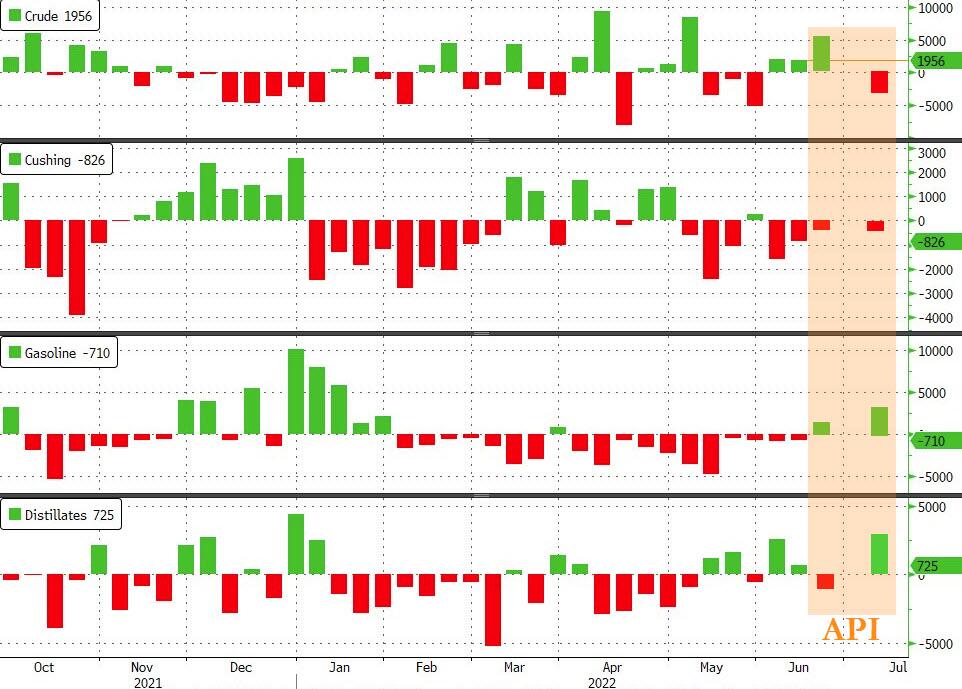
With no EIA data released last week due to a "systems issue" (they have issued a statement confirming that the data - and the newest data - will both be released tomorrow), the only guidance we have for now on the past week's inventory changes is from API...

API (last week)

  • Crude +5.607mm

  • Cushing -390k

  • Gasoline +1.216mm - first build since March

  • Distillates -1.656mm

API (this week)

  • Crude -3.799mm

  • Cushing -650k

  • Gasoline +2.852mm

  • Distillates +2.613mm

Crude stocks unexpectedly fell last week, almost erasing the major build from the week before (according to API). Gasoline stocks rose for the second straight week

Source: Bloomberg

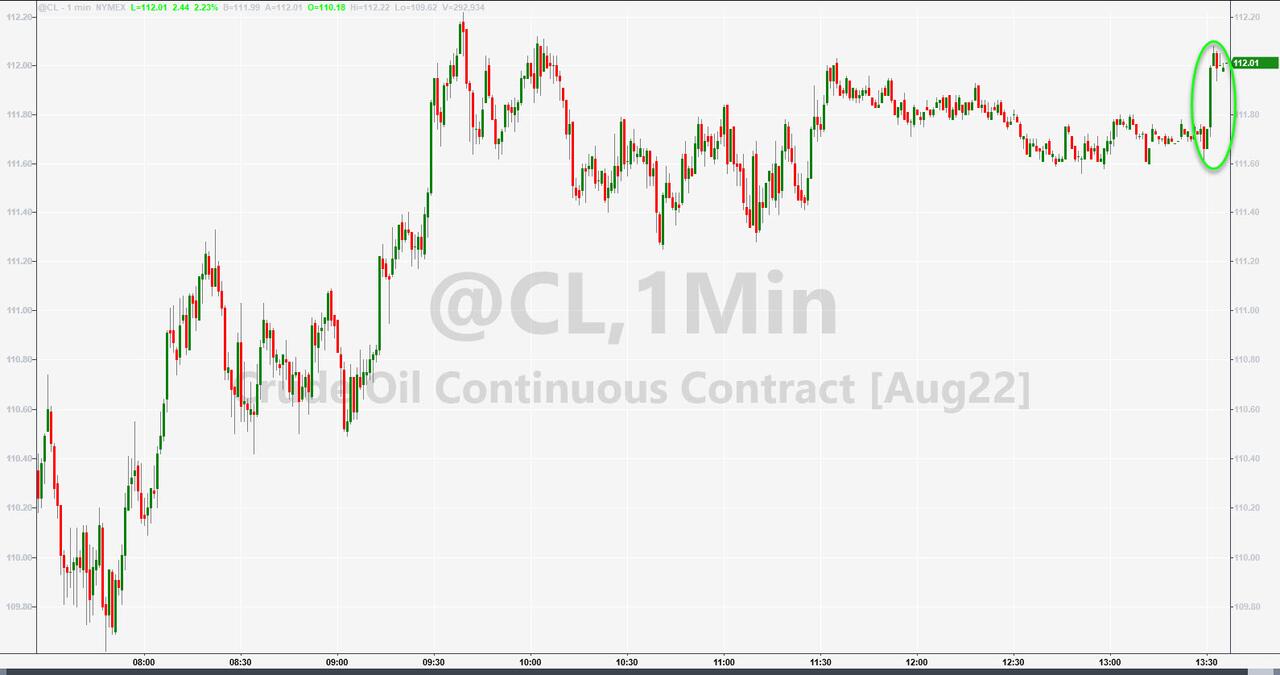
WTI was hovering around $111.75 and pushed up to $112 after the unexpected crude draw...

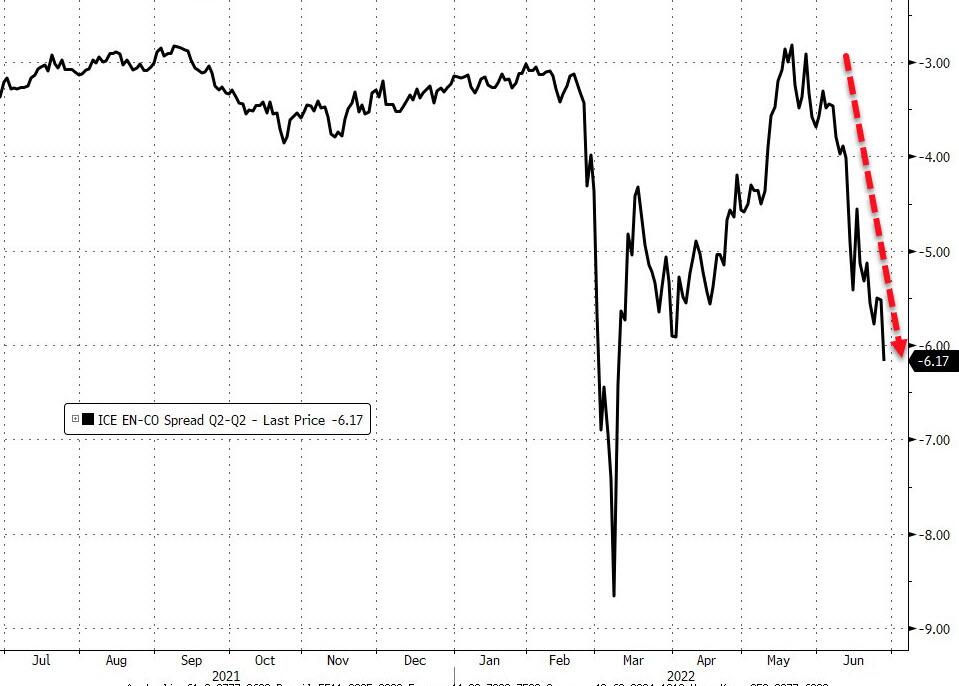
Finally, we note that the tight supply situation in oil (especially European) is revealing itself in the WTI-Brent spread, grew to $6.19, the widest in almost three months.

“European demand will remain robust, especially as natural gas supplies run out, while the North American demand for crude is weakening,” said Ed Moya, senior market analyst at Oanda.

This is not good news for President Biden as prices are rising...

And his ratings are hitting record lows.

Tyler Durden Tue, 06/28/2022 - 16:37
https://ift.tt/OS2Ea8c
from ZeroHedge News https://ift.tt/OS2Ea8c
via IFTTT

WTI Extends Gains After Unexpected Crude Draw SocialTwist Tell-a-Friend
| 0 comments ]

History's Biggest "Butterfly Effect"-Event Occurred On This Day

Via Global Macro Monitor,

The butterfly effect is the concept that small causes can have large effects. Initially, it was used with weather prediction but later the term became a metaphor used in and out of science.

In chaos theory, the butterfly effect is the sensitive dependence on initial conditions in which a small change in one state of a deterministic nonlinear system can result in large differences in a later state. The name, coined by Edward Lorenz for the effect which had been known long before, is derived from the metaphorical example of the details of a tornado (exact time of formation, exact path taken) being influenced by minor perturbations such as the flapping of the wings of a distant butterfly several weeks earlier. Lorenz discovered the effect when he observed that runs of his weather model with initial condition data that was rounded in a seemingly inconsequential manner would fail to reproduce the results of runs with the unrounded initial condition data. A very small change in initial conditions had created a significantly different outcome. 

-  Wikipedia

On this day in history, June 28, 1914, the driver for Archduke Franz Ferdinand,  nephew of Emperor Franz Josef and heir to the Austro-Hungarian Empire,  made a wrong turn onto Franzjosefstrasse in Sarajevo.

Just hours earlier, Franz Ferdinand narrowly escaped assassination as a bomb bounced off  his car as he and his wife,  Sophie,  traveled from the local train station to the city’s civic city.   Rather than making the wrong turn onto Franz Josef  Street, the car was supposed to travel on the river expressway allowing for a higher speed ensuring the Archduke’s safety.

Yet, somehow, the driver made a fatal mistake and tuned onto Franz Josef Street.

The 19-year-old anarchist and Serbian nationalist, Gavrilo Princip, who was part of a small group who had traveled to Sarajevo to kill the Archduke,  and a cohort of the earlier bomb thrower, was on his way home thinking the plot had failed.   He stopped for a sandwich on Franz Josef Street.

Seeing the driver of the Archduke’s car trying to back up onto the river expressway, Princi seized the opportunity and fired into the car, shooting Franz Ferdinand and Sophie at point-blank range,  killing both.

That small wrong turn,  a minor perturbation to the initial conditions, or deviation from the original plan,  set off the chain events that led to World War I.

Stumbling Into The Great War

Fearing Russian support of Serbia, Franz Josef would not retaliate by invading Serbia unless he was assured he had the backing of Germany.   It is uncertain as to whether the Kaiser gave Franz Josef Germany’s unequivocal support.   Russia, fearing Germany would intervene, mobilized its troops forcing Germany’s hand.

The great European powers thus stumbled into a war they didn’t want through complicated entanglements and alliances, and miscalculation.  Russia backing Serbia;  France aligned with Russia,  Germany backing the Austro-Hungarian Empire;  and Britian, who really didn’t have a dog in the fight except her economic interests, aligned with France and Russia.

Later the U.S. would enter the war due to Germany’s unrestricted submarine warfare threatening American merchant ships and the Kaiser floating the idea of an alliance with Mexico in the famous Zimmerman Telegram, which was intercepted by the British.

Of course, some will argue that Great War in Europe was inevitable

The great Prussian statesman Otto von Bismarck, the man most responsible for the unification of Germany in 1871, was quoted as saying at the end of his life that “One day the great European War will come out of some damned foolish thing in the Balkans.” It went as he predicted.  – History.com

Nevertheless,  maybe the course of history would have been different if not for that wrong turn on June 28, 1914, which created the humongous butterfly effect, which we still experience the consequences this very day.

The botched Treaty of Versailles  sowed the seeds the for World II.  The War contributed to the Russian revolution and Cold War.  The redrawing of borders in the Middle East after the War created the conditions for the instability and breakdown to tribalism the region experiences today.

A map marked with crude chinagraph-pencil in the second decade of the 20th Century shows the ambition – and folly – of the 100-year old British-French plan that helped create the modern-day Middle East.

Straight lines make uncomplicated borders. Most probably that was the reason why most of the lines that Mark Sykes, representing the British government, and Francois Georges-Picot, from the French government, agreed upon in 1916 were straight ones.  — BBC News

If Franz Ferdinand had not been murdered on this day in history,  that conflict between the Serbs and the Austro-Hungarian Empire may have been contained to just the Balkans.   Maybe.

The butterfly effect.  Think how many small events, decisions, mistakes, one small turn, or “minor perturbations” in plans have had enormous consequences in your own personal life.

Tyler Durden Tue, 06/28/2022 - 16:20
https://ift.tt/vQtkhsJ
from ZeroHedge News https://ift.tt/vQtkhsJ
via IFTTT

History's Biggest "Butterfly Effect"-Event Occurred On This Day SocialTwist Tell-a-Friend
| 0 comments ]

Biden-Erdogan Meeting On The Table As Turkey Vows 'Won't Back Down' At NATO Summit

The 2022 NATO summit in Madrid, Spain is set to kick off Tuesday and run through Thursday of this week; however, US officials say they don't expected Turkey's concerns over Sweden and Finland's membership bids to be allayed.

One European diplomatic official told CNN that there's hope of "last moment" Turkish concessions: "My best projection based on what I've seen is that they will run this to the wire at Madrid. They also always prefer if they're going to make concessions to do it at the leader level, they believe that enhances that status," the unnamed official said. "It is Turkey's standard operating procedure not to give concessions till the last possible moment. And that last possible moment is usually defined as a bilateral with the US president, followed by a leaders meeting."

Ankara has emphasized that despite pressure from Western allies, it doesn't at all see the Madrid summit as a "deadline". This as Turkish media has confirmed Erdogan will attend talks with the leaders of Sweden and Finland just ahead of the NATO meeting this week.

Then VP Biden met with Erdogan on 23 January 2016, via EPA/EFE

"There will be a four-way summit at the leader level with the attendance of our president in Madrid upon the request of the NATO secretary general," a Turkish foreign ministry statement said. And according to Turkish presidential spokesperson Ibrahim Kalin:

Kalin said Erdogan attending the talks with Sweden, Finland and NATO on Tuesday "does not mean we will take a step back from our position."

Kalin said Türkiye and the Nordic countries had largely agreed on issues and would be in a better position in Madrid if they could agree on them during talks on Monday.

"We have brought negotiations to a certain point. It is not possible for us to take a step back here," he also said of the talks on Monday.

Erdogan's government has been consistent in denouncing Swedish and Finish "support" for Kurdish "terrorist" groups, namely the outlawed PKK and its affiliates, for example in northern Syria. Erdogan has gone so far as to demand the Nordic countries extradite wanted members of the organization.

While Ankara is pledging that it will not back down, there's growing anticipation that it will take nothing less than a meeting between Erdogan and Biden - where it'd be the US expected to make big concessions visa-a-vis Turkey - for Turkey to budge on the NATO membership questions.

National security adviser Jake Sullivan addressed this possibility on the sidelines of the ongoing G7 summit:

Speaking to reporters at the G7 summit in Germany, US national security adviser Jake Sullivan said the goal ahead of the Madrid summit was to "create as much positive momentum as we can behind the candidacies of Finland and Sweden," though he cautioned, "I am not sitting here today suggesting that all issues will be resolved by Madrid."

He said no formal bilateral meeting was scheduled between Biden and Erdogan, but that they "may very well have the opportunity to see one another."

"Let's see how the next 24 hours unfold. There is a flurry of diplomatic activity occurring today," he said.

Sullivan's vague comment certainly seems like an opening to a face-to-face Biden-Erdogan meeting. Akin to Biden's reversal on isolating "pariah" Saudi Arabia and crown prince MbS, we could soon see a re-embrace of "autocrat" Erdogan.

Tyler Durden Mon, 06/27/2022 - 18:15
https://ift.tt/VJHDY52
from ZeroHedge News https://ift.tt/VJHDY52
via IFTTT

Biden-Erdogan Meeting On The Table As Turkey Vows 'Won't Back Down' At NATO Summit SocialTwist Tell-a-Friend
| 0 comments ]

"The Rubicon Has Been Crossed": The BOJ Now Owns More Than 50% Of All Japanese Bonds

A little over three years ago, the Bank of Japan crossed a historic milestone when we reported that the central bank had become a top-10 shareholder in 50% of all Japanese companies. Since then, the central bank's equity stake across Japanese corporations has only grown.

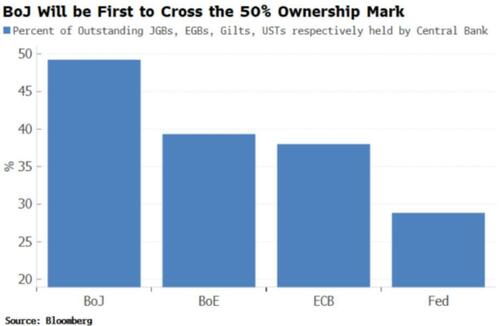
One week ago, we also reported that the BOJ was on the verge of crossing the final "50%" Rubicon, when as consequence of the latest surge in bond buying by Kuroda's central bank meant to prevent the bank's Yield Curve Control from collapsing, the BoJ was brought to a place it almost certainly never envisaged when it started QE as a “temporary” measure back in 2001 -- owning virtually half of the JGB market.

As Bloomberg's Simon White said last week, "we are in uncharted territory as no other major central bank has crossed this threshold before."
He continued:

The BoJ could pass the 50% threshold as early as this week. That would be crossing the Rubicon. However you slice it or dice it, the BoJ will be the JGB market. What this means over the long term we’ll eventually find out. But it’s not a big leap to guess that private JGB holders -- both domestic and foreign -- will become less comfortable in a market with such lopsided ownership.

Well, as of today, this final threshold has also been crossed, thanks to the recent burst of YCC-defending debt monetization which reached a mindbogglging 11 trillion in the last week...

... and as Japan's Nikkei reports, the share of Japanese government bonds held by the Bank of Japan just topped 50%, hitting a record Ponzi high.

According to Nikkei calculations, the BOJ purchased JGBs worth 14.8 trillion yen ($110 billion) in June, surpassing the 11.1 trillion yen purchased in November 2002, its largest monthly total. According to the QUICK database, the outstanding value of long-term JGBs as of June 20 totaled 1,021.1 trillion yen, of which the BOJ held 514.9 trillion yen on a face-value basis. That translates to 50.4% of the total amount outstanding, up from 50.0% in February to March 2021.

As we explained a few weeks ago, the BOJ has been buying up the majority of the JGBs on the market, an unusual situation that has caused distortions in the bond market including a deeply inverted yield curve.
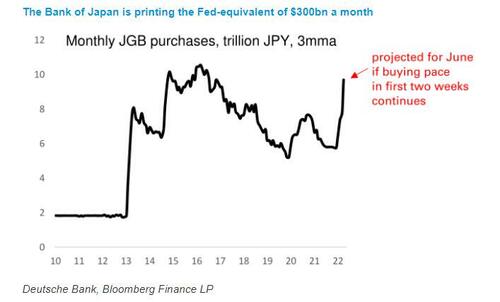
Putting the BOJ's unprecedented bond buying spree in context, the central bank's JGB holdings were "only" in the 10% range when Gov. Kuroda started the massive monetary easing program in 2013. Its holdings have continued to grow as the ultraloose policy has continued. At this rate, all else equal, the BOJ will own the entire bond market in another decade or so.

Several years ago, the IMF calculated that the BOJ holding around 40% of the bond market would lead to a broken market. Well, it is now 50%+ and there are days when not a single trade crosses - the definition of a broken market.

The problem for the BOJ is that it can't stop buying now... or ever: According to estimates by the Japan Center for Economic Research, the BOJ will need to increase its JGB holdings by 120 trillion yen from the current level of over 500 trillion yen to keep long-term interest rates at 0.25%. The central bank's JGB holdings are quickly approaching and are expected to exceed 60% of total.

Until now, the BOJ has concentrated on specific JGBs, holding 87.6% of newly issued 10-year JGBs, a measure of long-term interest rates. However, at this rate it will soon run out of 10Y paper to buy and will be forced to move left and right on the ccurve.

Meanwhile, even though bonds with longer maturities have higher interest rates, as the BOJ has focused on the yield on 10-year JGBs to suppress interest rates, yields on JGBs with seven to nine years to maturity are now higher than those on 10-year JGBs.

As discussed on several prior occasions, this month some trades occurred at yields above the BOJ's upper limit of 0.25% -- a situation where JGBs were trading at a lower price than the level at which the BOJ promised to buy them -- effectively breaching the bank's yield curve control. This means that market participants believe the BOJ will soon no longer be able to maintain the current interest rate control measures, known as yield curve control. A failure to defend YCC could lead to a catastrophic move lower in the JGB market, and spark a hyperinflation collapse of the Japanese yen, and the entire economy.

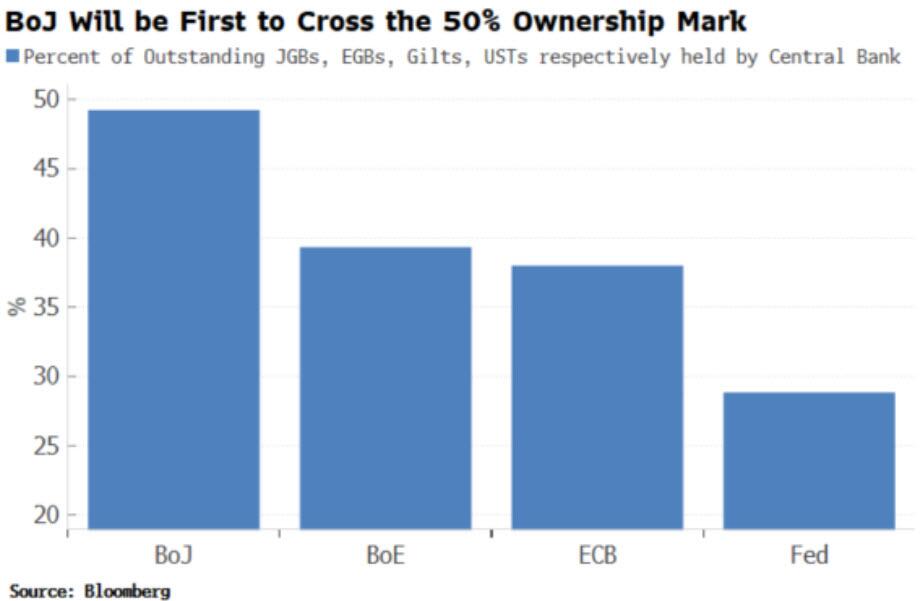
The BOJ's bond-buying stands out compared with other central banks' moves. The U.S. Federal Reserve's holdings of government bonds were in the 20% range at the end of March, and it began quantitative tightening in June to reduce its holdings of government bonds and other assets. The European Central Bank's ratio is currently in the 30% range. The ECB will end its quantitative easing program of purchasing government bonds and other assets in July.

At the same time, and as also discussed extensively, the widening interest rate gap between Japan and the U.S. and Japan and Europe has prompted a fall in the value of the yen. The Japanese currency fell to a 24-year low of 136 against the dollar earlier this month. It will fall much lower if the BOJ defends the 0.25% YCC barrier "whatever it takes", as the resultant liquidity needed to prevent yields from spiking will continue crashing the yen.

Naturally, with the BOJ buying up every piece of paper it can find, JGBs held by private financial institutions have been rapidly declining: as of the end of March, banks and other deposit-taking institutions held 11.4% of the total, while insurance and pension funds held 23.2%. This means that the BOJ is now taking on even more risk of incurring losses if long-term interest rates rise and JGB prices drop.

Japan's three megabanks hold a total of over 70 trillion yen in JGBs. The average maturity is 2.8 years for Mitsubishi UFJ Financial Group, 2.8 years for Sumitomo Mitsui Financial Group, and 1.2 years for Mizuho Financial Group. In recent years, these banks have been investing mainly in bonds with shorter maturities to prepare for rising interest rates.

As the Nikkei concludes, the BOJ's strategy of holding half of the JGBs could be perceived as its way of filling the budget deficit. "There is also a risk that the government's fiscal discipline could be loosened by the central bank keeping interest rates low" the Nikkei notes, adding that "the government needs to work on reforms to stimulate economic growth, to break away from its dependence on the BOJ."

To which all we can say is "it's far too late for that" and instead we recommend the BOJ - and Japanese savers - panic.

Tyler Durden Mon, 06/27/2022 - 17:47
https://ift.tt/SW62HCk
from ZeroHedge News https://ift.tt/SW62HCk
via IFTTT

"The Rubicon Has Been Crossed": The BOJ Now Owns More Than 50% Of All Japanese Bonds SocialTwist Tell-a-Friend